

EN 12697-1:2012
(Main)Bituminous mixtures - Test methods for hot mix asphalt - Part 1: Soluble binder content
- Abstract
This document describes test methods for the determination of the soluble binder content of samples of bituminous mixtures.
The test methods described are suitable for quality control purposes during the production of plant mix and for checking compliance with a product specification.
For the analysis of mixtures containing modified binders, the guidance of Annex D should be followed.
- Status
- Withdrawn
- Publication Date
- 05-Jun-2012
- Withdrawal Date
- 06-Oct-2026
- Technical Committee
- CEN/TC 227 - Road materials
- Drafting Committee
- CEN/TC 227/WG 1 - Bituminous mixtures
- Current Stage
- 9960 - Withdrawal effective - Withdrawal
- Start Date
- 11-Mar-2020
- Completion Date
- 07-Oct-2026



Relations
- Effective Date
- 13-Jun-2012
- Effective Date
- 24-Mar-2020
- Effective Date
- 25-Aug-2026
- Effective Date
- 25-Aug-2026
- Effective Date
- 28-Jan-2026
- Effective Date
- 28-Jan-2026
- Effective Date
- 28-Jan-2026
- Effective Date
- 28-Jan-2026
- Effective Date
- 28-Jan-2026
- Effective Date
- 28-Jan-2026
- Effective Date
- 28-Jan-2026
- Effective Date
- 28-Jan-2026
- Effective Date
- 28-Jan-2026
- Effective Date
- 28-Jan-2026
Get Certified
Connect with accredited certification bodies for this standard

Zavod za gradbeništvo Slovenije (ZAG) - Inšpekcija
ZAG inspection body for construction products, structures, and materials.
Sponsored listings
Frequently Asked Questions
EN 12697-1:2012 is a standard published by the European Committee for Standardization (CEN). Its full title is "Bituminous mixtures - Test methods for hot mix asphalt - Part 1: Soluble binder content". This standard covers: This document describes test methods for the determination of the soluble binder content of samples of bituminous mixtures. The test methods described are suitable for quality control purposes during the production of plant mix and for checking compliance with a product specification. For the analysis of mixtures containing modified binders, the guidance of Annex D should be followed.
This document describes test methods for the determination of the soluble binder content of samples of bituminous mixtures. The test methods described are suitable for quality control purposes during the production of plant mix and for checking compliance with a product specification. For the analysis of mixtures containing modified binders, the guidance of Annex D should be followed.
EN 12697-1:2012 is classified under the following ICS (International Classification for Standards) categories: 93.080.20 - Road construction materials. The ICS classification helps identify the subject area and facilitates finding related standards.
EN 12697-1:2012 has the following relationships with other standards: It is inter standard links to EN 12697-1:2005, EN 12697-1:2020, ISO 3310-2:1999, ISO 3310-1:2000, EN 12697-28:2000, EN 12697-4:2023, EN 12697-3:2013+A1:2018, EN 12697-14:2020, EN 15316-4-6:2007, EN 933-1:2012, EN 15316-4-5:2007, EN 12274-2:2018, EN 12697-4:2015, EN 12697-3:2013. Understanding these relationships helps ensure you are using the most current and applicable version of the standard.
EN 12697-1:2012 is available in PDF format for immediate download after purchase. The document can be added to your cart and obtained through the secure checkout process. Digital delivery ensures instant access to the complete standard document.
Standards Content (Sample)
2003-01.Slovenski inštitut za standardizacijo. Razmnoževanje celote ali delov tega standarda ni dovoljeno.Asphalt - Prüfverfahren für Heißasphalt - Teil 1: Löslicher BindemittelgehaltMélanges bitumineux - Méthode d'essai pour mélange hydrocarboné à chaud - Partie 1: Teneur en liant solubleBituminous mixtures - Test methods for hot mix asphalt - Part 1: Soluble binder content93.080.20Materiali za gradnjo cestRoad construction materialsICS:Ta slovenski standard je istoveten z:EN 12697-1:2012SIST EN 12697-1:2012en,fr,de01-september-2012SIST EN 12697-1:2012SLOVENSKI
STANDARDSIST EN 12697-1:20061DGRPHãþD
EUROPEAN STANDARD NORME EUROPÉENNE EUROPÄISCHE NORM
EN 12697-1
June 2012 ICS 93.080.20 Supersedes EN 12697-1:2005English Version
Bituminous mixtures - Test methods for hot mix asphalt - Part 1: Soluble binder content
Mélanges bitumineux - Méthode d'essai pour mélange hydrocarboné à chaud - Partie 1: Teneur en liant soluble
Asphalt - Prüfverfahren für Heißasphalt - Teil 1: Löslicher Bindemittelgehalt This European Standard was approved by CEN on 28 April 2012.
CEN members are bound to comply with the CEN/CENELEC Internal Regulations which stipulate the conditions for giving this European Standard the status of a national standard without any alteration. Up-to-date lists and bibliographical references concerning such national standards may be obtained on application to the CEN-CENELEC Management Centre or to any CEN member.
This European Standard exists in three official versions (English, French, German). A version in any other language made by translation under the responsibility of a CEN member into its own language and notified to the CEN-CENELEC Management Centre has the same status as the official versions.
CEN members are the national standards bodies of Austria, Belgium, Bulgaria, Croatia, Cyprus, Czech Republic, Denmark, Estonia, Finland, France, Germany, Greece, Hungary, Iceland, Ireland, Italy, Latvia, Lithuania, Luxembourg, Malta, Netherlands, Norway, Poland, Portugal, Romania, Slovakia, Slovenia, Spain, Sweden, Switzerland, Turkey and United Kingdom.
EUROPEAN COMMITTEE FOR STANDARDIZATION
COMITÉ EUROPÉEN DE NORMALISATION EUROPÄISCHES KOMITEE FÜR NORMUNG
Management Centre:
Avenue Marnix 17,
B-1000 Brussels © 2012 CEN All rights of exploitation in any form and by any means reserved worldwide for CEN national Members. Ref. No. EN 12697-1:2012: ESIST EN 12697-1:2012
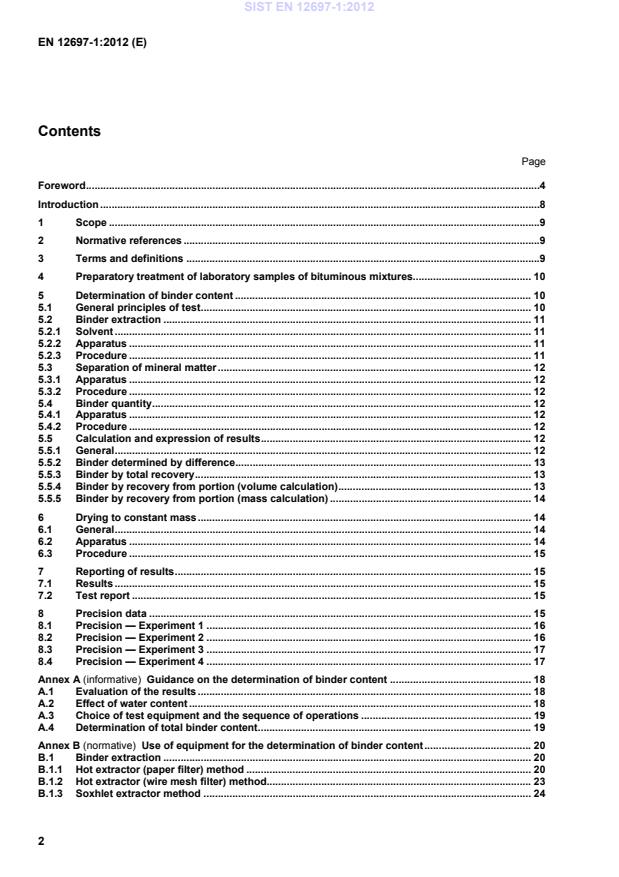
Guidance on the determination of binder content . 18A.1 Evaluation of the results . 18A.2 Effect of water content . 18A.3 Choice of test equipment and the sequence of operations . 19A.4 Determination of total binder content. 19Annex B (normative)
Use of equipment for the determination of binder content . 20B.1 Binder extraction . 20B.1.1 Hot extractor (paper filter) method . 20B.1.2 Hot extractor (wire mesh filter) method. 23B.1.3 Soxhlet extractor method . 24SIST EN 12697-1:2012
Determination of residual mineral matter in the binder extract by incineration . 40C.1 General . 40C.2 Method 1 . 40C.2.1 Apparatus . 40C.2.2 Reagent. 40C.2.3 Procedure . 40C.3 Method 2 . 41C.3.1 Apparatus . 41C.3.2 Procedure . 41Annex D (informative)
Guidance on determination of soluble binder content of mixtures with polymer-modified binders . 43D.1 General . 43D.2 Preparatory treatment of laboratory samples of bituminous mixtures . 43D.3 Determination of binder content . 43D.3.1 General principles of test . 43D.3.2 Binder extraction . 43D.3.3 Separation of mineral matter . 45D.3.4 Binder quantity . 46D.3.5 Calculation and expression of results . 46D.4 Drying to constant mass . 46D.5 Reporting of results . 46D.6 Precision data . 46Bibliography . 47
b) For the separation of mineral, a note is added that the residue depends on the solvent and the equipment used; c) The desiccator is made optional with the method of achieving a moisture-free atmosphere not fixed; d) The definition of constant mass is changed; e) Alternative procedures for determination of binder are extended; f) Volume units are corrected from mm³ to 10³ mm³ as appropriate; g) In Annex B, note is added to ensure the binder is well dissolved; h) In Annex B, density of perchloroethylene is changed from (1,6 ± 0,05) g/cm³ at 24 °C to (1,6 ± 0,05) Mg/m³ at 20 ºC; i) In Annex B, weighing of multiple sieves that are fitted to the feed funnel is allowed; j) In Annex B, repeating the procedure with a second cup in the centrifuge is undertaken with half the flow rate; k) In Annex B, note is added that the second run is unnecessary for some centrifuges with larger capacities; l) In Annex C, M2 is clarified as being the mass of fine mineral matter; m) In Annex C, the procedures for collecting the recovered binder are clarified; n) In Annex D, a note is added that a good solubility of the polymer-modified binder does not always guarantee a good extraction of the PmB in the bituminous mixture; o) In Annex D, the discussion on different solvents is refined; p) In Annex D, the flow rate is adjusted rather than just checked to avoid overflowing; SIST EN 12697-1:2012
The applicability of this European Standard is described in the product standards for bituminous mixtures. WARNING — The method described in this European Standard may require the use of dichloromethane (methylene chloride), 1,1,1-trichloroethane, benzene, trichloroethylene, xylene, toluene, perchloroethylene (tetracloroethylene) or other solvents capable of dissolving bitumen. These solvents are hazardous to health and are subject to occupational exposure limits as detailed in relevant legislation and regulations. Exposure levels are related to both handling procedures and ventilation provision and it is emphasised that adequate training should be given to staff employed in the usage of these substances. According to the CEN/CENELEC Internal Regulations, the national standards organizations of the following countries are bound to implement this European Standard: Austria, Belgium, Bulgaria, Croatia, Cyprus, Czech Republic, Denmark, Estonia, Finland, France, Germany, Greece, Hungary, Iceland, Ireland, Italy, Latvia, Lithuania, Luxembourg, Malta, Netherlands, Norway, Poland, Portugal, Romania, Slovakia, Slovenia, Spain, Sweden, Switzerland, Turkey and the United Kingdom.
1) In preparation. SIST EN 12697-1:2012
with a probability of 95 % Note 1 to entry: The symbol used for repeatability limit is r. 3.7 reproducibility precision under reproducibility conditions 3.8 reproducibility conditions conditions in which test results are obtained with the same method on identical test items in different laboratories with different operators using different equipment 3.9 reproducibility limit maximum absolute difference between two test results obtained under re…bility conditions that may be expected
with a probability of 95 % Note 1 to entry: The symbol used for reproducibility limit is R. 3.10 single test result value obtained by applying the standard test method once, fully, on a single specimen
Note 1 to entry: The single test result may also be the mean of two or more observations or the result of a calculation from a set of observations as specified by the standard test method. 4 Preparatory treatment of laboratory samples of bituminous mixtures Prepare laboratory samples in accordance with EN 12697-28 to obtain suitable test portions. 5 Determination of binder content 5.1 General principles of test The test method for determining the binder content of a test portion of bituminous mixture, prepared in accordance with Clause 4, normally comprises the following basic operations: a) binder extraction by dissolving in a hot or cold solvent; SIST EN 12697-1:2012
NOTE The apparatus should be calibrated and traceable. 5.2.2.1 Balance, capable of weighing a test portion to an accuracy of 0,05 % of its mass. 5.2.2.2 Binder extraction apparatus, conforming to the requirements of the method selected from B.1, as appropriate. 5.2.3 Procedure 5.2.3.1 Prepare laboratory samples in accordance with EN 12697-28 to obtain suitable test portions. NOTE If determining binder content by difference, see Annex A. 5.2.3.2 Weigh the test portion to the nearest 0,05 % of the mass taken, and place it in the binder extraction apparatus in accordance with the requirements of the method selected from B.1, as appropriate. 5.2.3.3 The binder extraction procedure shall ensure that no soluble binder is left adhering to the aggregate particles after extraction. NOTE In limited cases, it may be difficult to dissolve every trace of binder adhering to the aggregate (see A.4). SIST EN 12697-1:2012
NOTE 1 In case of an oven, a temperature of (110 ± 5)°C is usually suitable. Where it is necessary to dry a test portion before analysis a temperature of (80 ± 5) °C may be more suitable to avoid binder drainage, but a longer time will be necessary. NOTE 2 In case of a drying cabinet lower temperatures are used. The lower the temperature, the longer it will take to dry to constant mass. NOTE 3 Constant mass is defined as successive weighings after drying at least 1 h apart not differing by more than 0,1 %. NOTE 4 For convenience, it is recommended that the successive weighings to determine constant mass should be carried out whilst the material is hot. It may be advisable to protect the balance from heat. 6.3.2 When constant mass has been achieved, cool in a moisture-free atmosphere and weigh. NOTE
A moisture-free atmosphere can be obtained by cooling in a desiccator. 7 Reporting of results 7.1 Results Report the soluble binder content, and, where appropriate: a) the water content to the nearest 0,1 % by mass in accordance with EN 12697-14; b) and/or the insoluble binder content in accordance with A.4. 7.2 Test report The report shall contain at least the following information in addition to that in 7.1: a) name and address of the testing laboratory;
b) unique serial number for the test report; c) name of the client; d) description and an identification of the sample, and the date of receipt; e) identification of the test method by reference to the Annex B apparatus used; f) any deviations, additions to or exclusions from the test method; g) whether or not the sample was accompanied by a sampling certificate; h) signature of officer accepting the technical responsibility for the test report; i) date of issue. 8 Precision data NOTE 1 Criteria for judging the acceptability of the binder content of bituminous mixtures determined by this European Standard are limited. The data that are tabulated herein were obtained from four separate precision experiments on SIST EN 12697-1:2012
...