

EN 12272-3:2025
(Main)Surface dressing - Test methods - Part 3: Determination of binder aggregate adhesivity by the Vialit plate shock test method
- Abstract
This document specifies, for anhydrous bituminous binder (cut-back and fluxed bituminous binders), the measurement of the binder aggregate adhesivity and the influence of adhesion agents or interfacial dopes on adhesion characteristics. This is to help designing binder aggregate systems for surface dressing.
This document specifies methods of measurement of:
— the mechanical adhesion of the binder to the surface of the aggregate;
— the active adhesivity of the binder to the chippings;
— the improvement of the mechanical adhesion and active adhesivity by adding an adhesion agent either into the mass of the binder or by spraying the interface between binder and chippings;
— the wetting temperature of the binder to the aggregate;
— the variation of adhesivity below the fragility temperature.
The wetting capacity of the binder affects the adhesivity properties. With the presence of water, the wetting capacity of bitumen emulsion is naturally high. Even if mechanical adhesion and active adhesivity test methods are mainly dedicated to anhydrous bituminous binders (cut-back and fluxed bituminous binders), these measurements can also be practiced with bitumen emulsion with a personalized interpretation of the results that depends on the design of the binder aggregate system. For bitumen emulsion, the adhesivity is conventionally measured through the water immersion test (EN 13614).
This test method is applicable to:
— bituminous binders used for surface dressings (e.g. conventional or polymer modified binders; mainly anhydrous bituminous binders such as cut-back and fluxed bituminous binders and bitumen emulsions);
— all the following aggregates sizes that can be used for surface dressings:
— set 1: 2/5 mm, 5/8 mm, 8/11 mm and 11/16 mm; and
— set 2: 2/4 mm, 2/6 mm, 4/6 mm, 4/8 mm, 6/10 mm, 6/12 mm and 10/14 mm.
This test method does not apply to quality control on site.
NOTE Further information concerning the purpose of the test can be found in Annex D.
WARNING – The use of this document can involve hazardous operations. This document does not purport to address all of the safety problems associated with its use. It is the responsibility of the user of this document to establish appropriate safety practices and determine the applicability of regulatory limitations prior to use.
- Status
- Published
- Publication Date
- 04-Nov-2025
- Technical Committee
- CEN/TC 227 - Road materials
- Drafting Committee
- CEN/TC 227/WG 2 - Surface dressing and slurry surfacing
- Current Stage
- 6060 - Definitive text made available (DAV) - Publishing
- Start Date
- 05-Nov-2025
- Due Date
- 11-Nov-2025
- Completion Date
- 05-Nov-2025

Overview
EN 12272-3:2025 - Surface dressing - Test methods - Part 3 defines laboratory methods to determine binder–aggregate adhesivity using the Vialit plate shock test. Published by CEN, the standard covers measurement of mechanical adhesion, active adhesivity and the influence of adhesion agents or interfacial dopes for mainly anhydrous bituminous binders (cut-back and fluxed) and, where applicable, bitumen emulsions. Results support the design of binder–aggregate systems for durable surface dressings.
Key topics and technical requirements
- Scope of measurement
- Mechanical adhesion (dry chippings with natural fines)
- Active adhesivity (damp chippings in natural state)
- Effect of adhesion agents added to binder or sprayed at the interface
- Wetting temperature (lowest binder temperature at which ≥90% chippings show staining/bonding)
- Fragility temperature (lowest test temperature at which 90% aggregates remain bonded)
- Test conditions
- Vialit plate shock test procedure; anhydrous binders tested at (5 ± 1) °C, emulsions at room temperature
- Not intended for on-site quality control - laboratory method for design and comparison
- Applicability
- Bituminous binders used in surface dressing (conventional and polymer‑modified; cut-back, fluxed; emulsions with adapted interpretation)
- Aggregate sizes accepted (two sets): Set 1 - 2/5, 5/8, 8/11, 11/16 mm; Set 2 - 2/4, 2/6, 4/6, 4/8, 6/10, 6/12, 10/14 mm
- Apparatus & procedure elements (summarized)
- Flat steel plates, 3‑point supports, steel ball, rubber roller, sprayer, balance, climatic chambers, oven
- Plate preparation, binder dosing, chippings spreading, conditioning to test temperature, shock test implementation
- Reporting
- Expression of results, fragility/wetting temperature reporting and example test reports (informative annexes)
Practical applications and users
EN 12272-3:2025 is used by:
- Pavement materials laboratories validating binder–aggregate combinations
- Highway authorities and specifiers designing surface dressing mixes and program timing (early/late season risks)
- Binder manufacturers and adhesion agent suppliers assessing product performance
- Research organizations comparing adhesion performance between binders, aggregates and additives
Benefits:
- Informs selection of binder type and additive dosage
- Helps predict performance at low temperatures and with damp aggregates
- Supports specification of binder and aggregate pairings for durable surface dressings
Related standards
- EN 12272-1: Surface dressing - Rate and accuracy of spread (companion standard)
- EN 12272-2: Surface dressing - Visual assessment of defects
- EN 13614: Water immersion test for bitumen emulsion adhesivity (conventional emulsion test)
Note: The standard includes safety warnings - laboratory users must follow appropriate safety and regulatory procedures. Keywords: EN 12272-3:2025, Vialit plate shock test, surface dressing, binder aggregate adhesivity, wetting temperature, fragility temperature.
Relations
- Effective Date
- 02-Aug-2023
- Effective Date
- 09-Feb-2026
- Effective Date
- 28-Jan-2026
Get Certified
Connect with accredited certification bodies for this standard

Zavod za gradbeništvo Slovenije (ZAG) - Inšpekcija
ZAG inspection body for construction products, structures, and materials.
Sponsored listings
Frequently Asked Questions
EN 12272-3:2025 is a standard published by the European Committee for Standardization (CEN). Its full title is "Surface dressing - Test methods - Part 3: Determination of binder aggregate adhesivity by the Vialit plate shock test method". This standard covers: This document specifies, for anhydrous bituminous binder (cut-back and fluxed bituminous binders), the measurement of the binder aggregate adhesivity and the influence of adhesion agents or interfacial dopes on adhesion characteristics. This is to help designing binder aggregate systems for surface dressing. This document specifies methods of measurement of: — the mechanical adhesion of the binder to the surface of the aggregate; — the active adhesivity of the binder to the chippings; — the improvement of the mechanical adhesion and active adhesivity by adding an adhesion agent either into the mass of the binder or by spraying the interface between binder and chippings; — the wetting temperature of the binder to the aggregate; — the variation of adhesivity below the fragility temperature. The wetting capacity of the binder affects the adhesivity properties. With the presence of water, the wetting capacity of bitumen emulsion is naturally high. Even if mechanical adhesion and active adhesivity test methods are mainly dedicated to anhydrous bituminous binders (cut-back and fluxed bituminous binders), these measurements can also be practiced with bitumen emulsion with a personalized interpretation of the results that depends on the design of the binder aggregate system. For bitumen emulsion, the adhesivity is conventionally measured through the water immersion test (EN 13614). This test method is applicable to: — bituminous binders used for surface dressings (e.g. conventional or polymer modified binders; mainly anhydrous bituminous binders such as cut-back and fluxed bituminous binders and bitumen emulsions); — all the following aggregates sizes that can be used for surface dressings: — set 1: 2/5 mm, 5/8 mm, 8/11 mm and 11/16 mm; and — set 2: 2/4 mm, 2/6 mm, 4/6 mm, 4/8 mm, 6/10 mm, 6/12 mm and 10/14 mm. This test method does not apply to quality control on site. NOTE Further information concerning the purpose of the test can be found in Annex D. WARNING – The use of this document can involve hazardous operations. This document does not purport to address all of the safety problems associated with its use. It is the responsibility of the user of this document to establish appropriate safety practices and determine the applicability of regulatory limitations prior to use.
This document specifies, for anhydrous bituminous binder (cut-back and fluxed bituminous binders), the measurement of the binder aggregate adhesivity and the influence of adhesion agents or interfacial dopes on adhesion characteristics. This is to help designing binder aggregate systems for surface dressing. This document specifies methods of measurement of: — the mechanical adhesion of the binder to the surface of the aggregate; — the active adhesivity of the binder to the chippings; — the improvement of the mechanical adhesion and active adhesivity by adding an adhesion agent either into the mass of the binder or by spraying the interface between binder and chippings; — the wetting temperature of the binder to the aggregate; — the variation of adhesivity below the fragility temperature. The wetting capacity of the binder affects the adhesivity properties. With the presence of water, the wetting capacity of bitumen emulsion is naturally high. Even if mechanical adhesion and active adhesivity test methods are mainly dedicated to anhydrous bituminous binders (cut-back and fluxed bituminous binders), these measurements can also be practiced with bitumen emulsion with a personalized interpretation of the results that depends on the design of the binder aggregate system. For bitumen emulsion, the adhesivity is conventionally measured through the water immersion test (EN 13614). This test method is applicable to: — bituminous binders used for surface dressings (e.g. conventional or polymer modified binders; mainly anhydrous bituminous binders such as cut-back and fluxed bituminous binders and bitumen emulsions); — all the following aggregates sizes that can be used for surface dressings: — set 1: 2/5 mm, 5/8 mm, 8/11 mm and 11/16 mm; and — set 2: 2/4 mm, 2/6 mm, 4/6 mm, 4/8 mm, 6/10 mm, 6/12 mm and 10/14 mm. This test method does not apply to quality control on site. NOTE Further information concerning the purpose of the test can be found in Annex D. WARNING – The use of this document can involve hazardous operations. This document does not purport to address all of the safety problems associated with its use. It is the responsibility of the user of this document to establish appropriate safety practices and determine the applicability of regulatory limitations prior to use.
EN 12272-3:2025 is classified under the following ICS (International Classification for Standards) categories: 93.080.20 - Road construction materials. The ICS classification helps identify the subject area and facilitates finding related standards.
EN 12272-3:2025 has the following relationships with other standards: It is inter standard links to EN 12272-3:2003, ISO 48-2:2018, EN 12271:2006. Understanding these relationships helps ensure you are using the most current and applicable version of the standard.
EN 12272-3:2025 is associated with the following European legislation: EU Directives/Regulations: 305/2011. When a standard is cited in the Official Journal of the European Union, products manufactured in conformity with it benefit from a presumption of conformity with the essential requirements of the corresponding EU directive or regulation.
EN 12272-3:2025 is available in PDF format for immediate download after purchase. The document can be added to your cart and obtained through the secure checkout process. Digital delivery ensures instant access to the complete standard document.
Standards Content (Sample)
SLOVENSKI STANDARD
01-februar-2026
Nadomešča:
SIST EN 12272-3:2004
Površinske prevleke - Preskusne metode - 3. del: Ugotavljanje adhezivnosti
veznega agregata s preskusno metodo udarjanja (preskusna metoda z Vialitovo
ploščo)
Surface dressing - Test methods - Part 3: Determination of binder aggregate adhesivity
by the Vialit plate shock test method
Oberflächenbehandlung - Prüfverfahren - Teil 3: Bestimmung des Adhäsionsvermögens
von Bindemittel und Gesteinskörnuung mit dem Schlagprüfverfahren
Enduits superficiels - Méthode d'essai - Partie 3: Détermination de l'adhésivité liants-
granulats par mesure de la cohésion Vialit
Ta slovenski standard je istoveten z: EN 12272-3:2025
ICS:
93.080.20 Materiali za gradnjo cest Road construction materials
2003-01.Slovenski inštitut za standardizacijo. Razmnoževanje celote ali delov tega standarda ni dovoljeno.
EN 12272-3
EUROPEAN STANDARD
NORME EUROPÉENNE
November 2025
EUROPÄISCHE NORM
ICS 93.080.20 Supersedes EN 12272-3:2003
English Version
Surface dressing - Test methods - Part 3: Determination of
binder aggregate adhesivity by the Vialit plate shock test
method
Enduits superficiels - Méthode d'essai - Partie 3: Oberflächenbehandlung - Prüfverfahren - Teil 3:
Détermination de l'adhésivité liants-granulats par Bestimmung des Adhäsionsvermögens von Bindemittel
mesure de la cohésion Vialit und Gesteinskörnung mit dem Schlagprüfverfahren
This European Standard was approved by CEN on 4 August 2025.
CEN members are bound to comply with the CEN/CENELEC Internal Regulations which stipulate the conditions for giving this
European Standard the status of a national standard without any alteration. Up-to-date lists and bibliographical references
concerning such national standards may be obtained on application to the CEN-CENELEC Management Centre or to any CEN
member.
This European Standard exists in three official versions (English, French, German). A version in any other language made by
translation under the responsibility of a CEN member into its own language and notified to the CEN-CENELEC Management
Centre has the same status as the official versions.
CEN members are the national standards bodies of Austria, Belgium, Bulgaria, Croatia, Cyprus, Czech Republic, Denmark, Estonia,
Finland, France, Germany, Greece, Hungary, Iceland, Ireland, Italy, Latvia, Lithuania, Luxembourg, Malta, Netherlands, Norway,
Poland, Portugal, Republic of North Macedonia, Romania, Serbia, Slovakia, Slovenia, Spain, Sweden, Switzerland, Türkiye and
United Kingdom.
EUROPEAN COMMITTEE FOR STANDARDIZATION
COMITÉ EUROPÉEN DE NORMALISATION
EUROPÄISCHES KOMITEE FÜR NORMUNG
CEN-CENELEC Management Centre: Rue de la Science 23, B-1040 Brussels
© 2025 CEN All rights of exploitation in any form and by any means reserved Ref. No. EN 12272-3:2025 E
worldwide for CEN national Members.
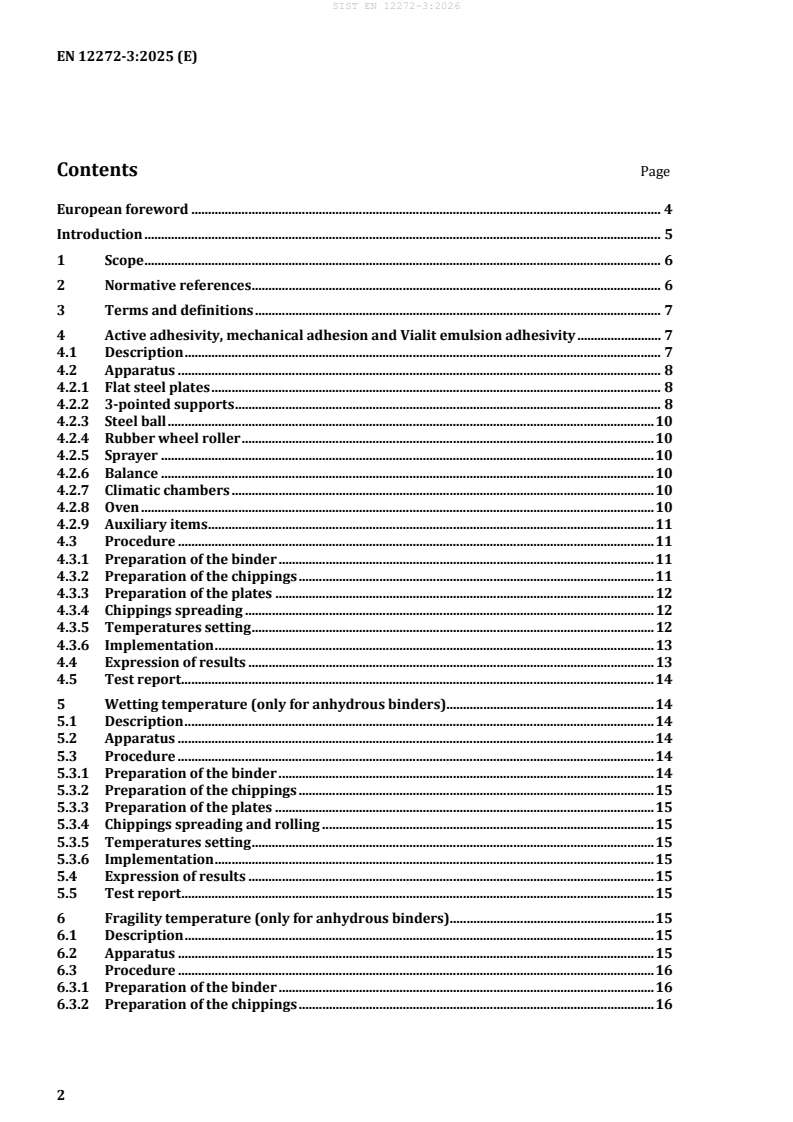
Contents Page
European foreword . 4
Introduction . 5
1 Scope . 6
2 Normative references . 6
3 Terms and definitions . 7
4 Active adhesivity, mechanical adhesion and Vialit emulsion adhesivity . 7
4.1 Description . 7
4.2 Apparatus . 8
4.2.1 Flat steel plates . 8
4.2.2 3-pointed supports . 8
4.2.3 Steel ball . 10
4.2.4 Rubber wheel roller . 10
4.2.5 Sprayer . 10
4.2.6 Balance . 10
4.2.7 Climatic chambers . 10
4.2.8 Oven . 10
4.2.9 Auxiliary items . 11
4.3 Procedure . 11
4.3.1 Preparation of the binder . 11
4.3.2 Preparation of the chippings . 11
4.3.3 Preparation of the plates . 12
4.3.4 Chippings spreading . 12
4.3.5 Temperatures setting . 12
4.3.6 Implementation . 13
4.4 Expression of results . 13
4.5 Test report . 14
5 Wetting temperature (only for anhydrous binders). 14
5.1 Description . 14
5.2 Apparatus . 14
5.3 Procedure . 14
5.3.1 Preparation of the binder . 14
5.3.2 Preparation of the chippings . 15
5.3.3 Preparation of the plates . 15
5.3.4 Chippings spreading and rolling . 15
5.3.5 Temperatures setting . 15
5.3.6 Implementation . 15
5.4 Expression of results . 15
5.5 Test report . 15
6 Fragility temperature (only for anhydrous binders). 15
6.1 Description . 15
6.2 Apparatus . 15
6.3 Procedure . 16
6.3.1 Preparation of the binder . 16
6.3.2 Preparation of the chippings . 16
6.3.3 Preparation of the plates . 16
6.3.4 Spreading and rolling (hot bituminous binders) . 16
6.3.5 Temperature setting. 16
6.3.6 Implementation . 16
6.4 Expression of results . 16
6.5 Test report . 16
7 Test report . 16
Annex A (informative) Summary of the preparation of the plates before testing . 18
Annex B (informative) Tables of results . 21
Annex C (informative) Measures of the fragility temperature . 23
Annex D (informative) Purpose of the Vialit plate shock test . 24
Bibliography . 25
European foreword
This document (EN 12272-3:2025) has been prepared by Technical Committee CEN/TC 227 “Road
materials”, the secretariat of which is held by BSI.
This European Standard shall be given the status of a national standard, either by publication of an
identical text or by endorsement, at the latest by May 2026, and conflicting national standards shall be
withdrawn at the latest by May 2026.
Attention is drawn to the possibility that some of the elements of this document may be the subject of
patent rights. CEN shall not be held responsible for identifying any or all such patent rights.
This document supersedes EN 12272-3:2003.
— the possible use of 2/4 mm aggregates;
— the new notion of Vialit emulsion adhesivity and the procedure related to its measurement;
— precision of different operating procedures:
— dosages when using 2/6 mm aggregates;
— time to temperature settings;
— curing time during the implementation of the test when using emulsion.
This document is one of a series of standards as listed below:
— EN 12272-1, Surface dressing — Test methods — Part 1: Rate of spread and accuracy of spread of
binder and chippings
— EN 12272-2, Surface dressing — Test methods — Part 2: Visual assessment of defects
— EN 12272-3, Surface dressing — Test methods — Part 3: Determination of binder aggregate adhesivity
by the Vialit plate shock test method
Annexes A, B, C and D are informative.
Any feedback and questions on this document should be directed to the users’ national standards body.
A complete listing of these bodies can be found on the CEN website.
According to the CEN-CENELEC Internal Regulations, the national standards organisations of the
following countries are bound to implement this European Standard: Austria, Belgium, Bulgaria, Croatia,
Cyprus, Czech Republic, Denmark, Estonia, Finland, France, Germany, Greece, Hungary, Iceland, Ireland,
Italy, Latvia, Lithuania, Luxembourg, Malta, Netherlands, Norway, Poland, Portugal, Republic of North
Macedonia, Romania, Serbia, Slovakia, Slovenia, Spain, Sweden, Switzerland, Türkiye and the United
Kingdom.
Introduction
The adhesion between binder and chippings is the basis of successful surface dressing. It is important
that this bond can be obtained, initially, at the moment of construction and be ensured in cool conditions
when the adhesivity problems become dominant for binder with damp or dry and dusty chippings. A
knowledge of adhesivity enables the choice of a binder and aggregate type for minimum risk, especially
for early and late season work. The purpose of the test is also developed on Annex D.
1 Scope
This document specifies, for anhydrous bituminous binder (cut-back and fluxed bituminous binders), the
measurement of the binder aggregate adhesivity and the influence of adhesion agents or interfacial dopes
on adhesion characteristics. This is to help designing binder aggregate systems for surface dressing.
This document specifies methods of measurement of:
— the mechanical adhesion of the binder to the surface of the aggregate;
— the active adhesivity of the binder to the chippings;
— the improvement of the mechanical adhesion and active adhesivity by adding an adhesion agent
either into the mass of the binder or by spraying the interface between binder and chippings;
— the wetting temperature of the binder to the aggregate;
— the variation of adhesivity below the fragility temperature.
The wetting capacity of the binder affects the adhesivity properties. With the presence of water, the
wetting capacity of bitumen emulsion is naturally high. Even if mechanical adhesion and active adhesivity
test methods are mainly dedicated to anhydrous bituminous binders (cut-back and fluxed bituminous
binders), these measurements can also be practiced with bitumen emulsion with a personalized
interpretation of the results that depends on the design of the binder aggregate system. For bitumen
emulsion, the adhesivity is conventionally measured through the water immersion test (EN 13614).
This test method is applicable to:
— bituminous binders used for surface dressings (e.g. conventional or polymer modified binders;
mainly anhydrous bituminous binders such as cut-back and fluxed bituminous binders and bitumen
emulsions);
— all the following aggregates sizes that can be used for surface dressings:
— set 1: 2/5 mm, 5/8 mm, 8/11 mm and 11/16 mm; and
— set 2: 2/4 mm, 2/6 mm, 4/6 mm, 4/8 mm, 6/10 mm, 6/12 mm and 10/14 mm.
This test method does not apply to quality control on site.
NOTE Further information concerning the purpose of the test can be found in Annex D.
WARNING – The use of this document can involve hazardous operations. This document does not purport
to address all of the safety problems associated with its use. It is the responsibility of the user of this
document to establish appropriate safety practices and determine the applicability of regulatory
limitations prior to use.
2 Normative references
The following documents are referred to in the text in such a way that some or all of their content
constitutes requirements of this document. For dated references, only the edition cited applies. For
undated references, the latest edition of the referenced document (including any amendments) applies.
ISO 48-2, Rubber, vulcanized or thermoplastic — Determination of hardness — Part 2: Hardness between
10 IRHD and 100 IRHD
3 Terms and definitions
For the purposes of this document, the following terms and definitions apply.
ISO and IEC maintain terminology databases for use in standardization at the following addresses:
— ISO Online browsing platform: available at https://www.iso.org/obp
— IEC Electropedia: available at https://www.electropedia.org/
3.1
active adhesivity
adhesivity necessary to bond damp chippings in their natural state
3.2
mechanical adhesion
adhesivity necessary to bond the dry chippings with their natural dust or fines making an inhibiting
screen
3.3
wetting temperature
lowest temperature of the binder on the plate, just prior to applying the chippings, at which the number
of all the stained chippings either bonded to the plate or fallen, after the shock test, is at least 90 % of the
chippings
3.4
fragility temperature
lowest test temperature at which 90 % aggregates remain bonded to the plate
Note 1 to entry: For more information see Annex C.
3.5
test temperature
temperature at which the plates with the binder and the chippings are conditioned before the shock test
3.6
Vialit emulsion adhesivity
adhesivity necessary to bond chippings with bitumen emulsion
Note 1 to entry: The results can be expressed with different treatments of chippings (washed or in their natural
state).
4 Active adhesivity, mechanical adhesion and Vialit emulsion adhesivity
4.1 Description
The required quantity of binder is heated to spraying temperature and spread evenly on a steel plate. The
test is performed at (5 ± 1) °C for anhydrous binders and at room temperature for emulsions.
Graded chippings are laid down on the binder and rolled only if anhydrous bituminous binder is used.
The prepared plate is turned over and put on 3-pointed supports.
A steel ball is made to fall 500 mm three times onto the plate within a 10 s period.
The adhesivity value is determined as the sum of the number of chippings remaining bonded to the plate
and the number of fallen chippings which are stained by the binder.
If the chippings are treated chemically or washed on site, or an interfacial adhesion agent (dope) is used
in construction, then this should be simulated in the test method. If polymer-modified binders are used
which need special site conditions, e.g. road temperatures > 10 °C or heated chippings, the test shall
reflect these constraints and the report modified accordingly, e.g. increase temperature of chippings to
10 °C.
4.2 Apparatus
4.2.1 Flat steel plates
Flat steel plates (see Figure 1) with a rim of 2 mm to 3 mm height and with following dimensions:
— side (200 ± 1) mm × (200 ± 1) mm;
— thickness (2,0 ± 0,2) mm.
The plates should be flat manufactured with a tolerance of 0,2 mm across the total length in any direction.
The maximum tolerance after usage shall be 0,5 mm.
Dimensions in millimetres
Figure 1 — Flat steel plate
4.2.2 3-pointed supports
A device composed of a rigid base with 3-pointed supports, a vertical support ending in a lightly angled
slide (3,0 ± 0,5) ° to launch the steel ball, see Figure 2.
Dimensions in millimetres
Key
1 level
2 steel ball
NOTE Tolerances ± 1 mm, except for:
— the supports: ± 0,2 mm;
— the steel ball: ± 0,5 mm.
Figure 2 — 3-pointed supports
4.2.3 Steel ball
Mass (510 ± 10) g, diameter (50,0 ± 0,5) mm.
4.2.4 Rubber wheel roller
— Thickness of the rubber: (15 ± 2) mm (see Figure 3).
— mass: (25 ± 1) kg;
— useful width: (260 ± 10) mm (see Figure 3);
— hardness of the rubber shall be Shore 40/150 in accordance with ISO 48-2.
Dimensions in millimetres
Key
1 rubber thickness (15 ± 2) mm
2 roller mass (25 ± 1) kg
Figure 3 — Rubber wheel roller
4.2.5 Sprayer
For applying adhesion agent (dope) as an interfacial layer between binder and chippings, if required.
4.2.6 Balance
Accurate to 0,1 g, range at least 1 000 g.
4.2.7 Climatic chambers
Capable of maintaining temperatures of the samples to cover the range (30 ± 1) °C to (−25 ± 1) °C and a
humidity greater than (90 ± 5) %.
4.2.
...