

EN 13534:2006
(Main)Food processing machinery - Curing injection machines - Safety and hygiene requirements
- Abstract
1.1 This standard applies for
curing injection machines with infeed and outfeed devices
curing injection machines with infeed and outfeed devices and loading devices
This standard does not apply to portable/hand guided curing injection devices.
This standard deals with all significant hazards, hazardous situations and events relevant to machines, appliances and machinery, when they are used as intended and under the conditions foreseen by the manufacturer (see Clause 4).
This document deals with all significant hazards, hazardous situations and events relevant to curing injection machinery, when they are used as intended and under conditions of misuse which are reasonably foreseeable by the manufacturer (see Clause 4).
This document is not applicable to curing injection machines which are manufactured before the date of publication of this document by CEN.
1.2 This standard covers the following types of curing injection machines:
Curing injection machines consist mainly of a single or multilane curing needle station, holding down clamp, infeed and outfeed devices, machine frame and related drive system, and electrical, electronic, or pneumatic components, depending on machine type.
Curing injection machines in the scope of this standard can be equipped with:
infeed chute;
splash guard flaps;
single or multi-lane curing needle bars (needle station);
holding down clamp;
infeed and outfeed conveyor belt;
infeed and outfeed rake;
interlocked transport car at the outfeed side;
loading device with delivery chute.
The product being processed (raw meat, game or raw fish) is fed by hand to the infeed device of the curing injection machine. The infeed device transports the product to the needle station; the product is then pressed against the infeed device by a holding down clamp. The needles of the needle station inject the curing liquid or other fluids into the product. (continued)
- Status
- Withdrawn
- Publication Date
- 10-Jan-2006
- Withdrawal Date
- 08-Jun-2010
- Technical Committee
- CEN/TC 153 - Food processing machinery - Safety and hygiene specifications
- Drafting Committee
- CEN/TC 153/WG 2 - Meat processing machinery
- Current Stage
- 9960 - Withdrawal effective - Withdrawal
- Start Date
- 09-Jun-2010
- Completion Date
- 09-Jun-2010
- Directive
- 98/37/EC - Machinery

Relations
- Effective Date
- 12-Apr-2010
- Effective Date
- 09-Feb-2026
- Effective Date
- 28-Jan-2026
Get Certified
Connect with accredited certification bodies for this standard

BSI Group
BSI (British Standards Institution) is the business standards company that helps organizations make excellence a habit.

Bureau Veritas
Bureau Veritas is a world leader in laboratory testing, inspection and certification services.

DNV
DNV is an independent assurance and risk management provider.
Sponsored listings
Frequently Asked Questions
EN 13534:2006 is a standard published by the European Committee for Standardization (CEN). Its full title is "Food processing machinery - Curing injection machines - Safety and hygiene requirements". This standard covers: 1.1 This standard applies for curing injection machines with infeed and outfeed devices curing injection machines with infeed and outfeed devices and loading devices This standard does not apply to portable/hand guided curing injection devices. This standard deals with all significant hazards, hazardous situations and events relevant to machines, appliances and machinery, when they are used as intended and under the conditions foreseen by the manufacturer (see Clause 4). This document deals with all significant hazards, hazardous situations and events relevant to curing injection machinery, when they are used as intended and under conditions of misuse which are reasonably foreseeable by the manufacturer (see Clause 4). This document is not applicable to curing injection machines which are manufactured before the date of publication of this document by CEN. 1.2 This standard covers the following types of curing injection machines: Curing injection machines consist mainly of a single or multilane curing needle station, holding down clamp, infeed and outfeed devices, machine frame and related drive system, and electrical, electronic, or pneumatic components, depending on machine type. Curing injection machines in the scope of this standard can be equipped with: infeed chute; splash guard flaps; single or multi-lane curing needle bars (needle station); holding down clamp; infeed and outfeed conveyor belt; infeed and outfeed rake; interlocked transport car at the outfeed side; loading device with delivery chute. The product being processed (raw meat, game or raw fish) is fed by hand to the infeed device of the curing injection machine. The infeed device transports the product to the needle station; the product is then pressed against the infeed device by a holding down clamp. The needles of the needle station inject the curing liquid or other fluids into the product. (continued)
1.1 This standard applies for curing injection machines with infeed and outfeed devices curing injection machines with infeed and outfeed devices and loading devices This standard does not apply to portable/hand guided curing injection devices. This standard deals with all significant hazards, hazardous situations and events relevant to machines, appliances and machinery, when they are used as intended and under the conditions foreseen by the manufacturer (see Clause 4). This document deals with all significant hazards, hazardous situations and events relevant to curing injection machinery, when they are used as intended and under conditions of misuse which are reasonably foreseeable by the manufacturer (see Clause 4). This document is not applicable to curing injection machines which are manufactured before the date of publication of this document by CEN. 1.2 This standard covers the following types of curing injection machines: Curing injection machines consist mainly of a single or multilane curing needle station, holding down clamp, infeed and outfeed devices, machine frame and related drive system, and electrical, electronic, or pneumatic components, depending on machine type. Curing injection machines in the scope of this standard can be equipped with: infeed chute; splash guard flaps; single or multi-lane curing needle bars (needle station); holding down clamp; infeed and outfeed conveyor belt; infeed and outfeed rake; interlocked transport car at the outfeed side; loading device with delivery chute. The product being processed (raw meat, game or raw fish) is fed by hand to the infeed device of the curing injection machine. The infeed device transports the product to the needle station; the product is then pressed against the infeed device by a holding down clamp. The needles of the needle station inject the curing liquid or other fluids into the product. (continued)
EN 13534:2006 is classified under the following ICS (International Classification for Standards) categories: 67.260 - Plants and equipment for the food industry. The ICS classification helps identify the subject area and facilitates finding related standards.
EN 13534:2006 has the following relationships with other standards: It is inter standard links to EN 13534:2006+A1:2010, EN 60464-2:2001, EN 16315:2014. Understanding these relationships helps ensure you are using the most current and applicable version of the standard.
EN 13534:2006 is associated with the following European legislation: EU Directives/Regulations: 98/37/EC; Standardization Mandates: M/079. When a standard is cited in the Official Journal of the European Union, products manufactured in conformity with it benefit from a presumption of conformity with the essential requirements of the corresponding EU directive or regulation.
EN 13534:2006 is available in PDF format for immediate download after purchase. The document can be added to your cart and obtained through the secure checkout process. Digital delivery ensures instant access to the complete standard document.
Standards Content (Sample)
SLOVENSKI STANDARD
01-maj-2006
Stroji za predelavo hrane – Stroji za konzerviranje z vbrizgavanjem – Varnostne in
higienske zahteve
Food processing machinery - Curing injection machines - Safety and hygiene
requirements
Nahrungsmittelmaschinen - Pökelspritzmaschinen - Sicherheits- und
Hygieneanforderungen
Machines pour les produits alimentaires - Machines a injecter de la saumure -
Prescriptions relatives a la sécurité et a l'hygiene
Ta slovenski standard je istoveten z: EN 13534:2006
ICS:
67.260 Tovarne in oprema za Plants and equipment for the
živilsko industrijo food industry
2003-01.Slovenski inštitut za standardizacijo. Razmnoževanje celote ali delov tega standarda ni dovoljeno.
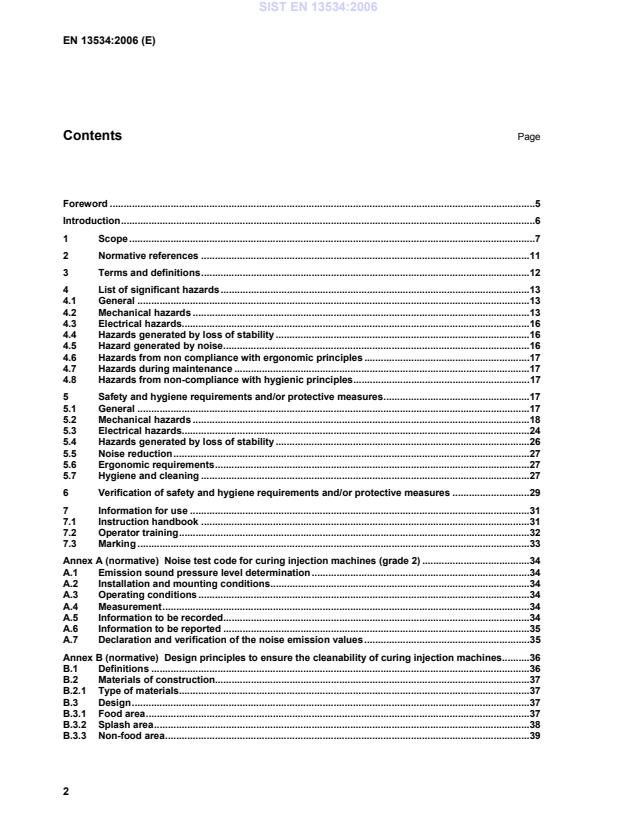
EUROPEAN STANDARD
EN 13534
NORME EUROPÉENNE
EUROPÄISCHE NORM
January 2006
ICS 67.260
English Version
Food processing machinery - Curing injection machines - Safety
and hygiene requirements
Machines pour les produits alimentaires - Machines à Nahrungsmittelmaschinen - Pökelspritzmaschinen -
injecter de la saumure - Prescriptions relatives à la sécurité Sicherheits- und Hygieneanforderungen
et à l'hygiène
This European Standard was approved by CEN on 21 November 2005.
CEN members are bound to comply with the CEN/CENELEC Internal Regulations which stipulate the conditions for giving this European
Standard the status of a national standard without any alteration. Up-to-date lists and bibliographical references concerning such national
standards may be obtained on application to the Central Secretariat or to any CEN member.
This European Standard exists in three official versions (English, French, German). A version in any other language made by translation
under the responsibility of a CEN member into its own language and notified to the Central Secretariat has the same status as the official
versions.
CEN members are the national standards bodies of Austria, Belgium, Cyprus, Czech Republic, Denmark, Estonia, Finland, France,
Germany, Greece, Hungary, Iceland, Ireland, Italy, Latvia, Lithuania, Luxembourg, Malta, Netherlands, Norway, Poland, Portugal, Romania,
Slovakia, Slovenia, Spain, Sweden, Switzerland and United Kingdom.
EUROPEAN COMMITTEE FOR STANDARDIZATION
COMITÉ EUROPÉEN DE NORMALISATION
EUROPÄISCHES KOMITEE FÜR NORMUNG
Management Centre: rue de Stassart, 36 B-1050 Brussels
© 2006 CEN All rights of exploitation in any form and by any means reserved Ref. No. EN 13534:2006: E
worldwide for CEN national Members.
Contents Page
Foreword .5
Introduction.6
1 Scope .7
2 Normative references .11
3 Terms and definitions.12
4 List of significant hazards.13
4.1 General .13
4.2 Mechanical hazards .13
4.3 Electrical hazards.16
4.4 Hazards generated by loss of stability .16
4.5 Hazard generated by noise.16
4.6 Hazards from non compliance with ergonomic principles .17
4.7 Hazards during maintenance .17
4.8 Hazards from non-compliance with hygienic principles.17
5 Safety and hygiene requirements and/or protective measures.17
5.1 General .17
5.2 Mechanical hazards .18
5.3 Electrical hazards.24
5.4 Hazards generated by loss of stability .26
5.5 Noise reduction.27
5.6 Ergonomic requirements.27
5.7 Hygiene and cleaning .27
6 Verification of safety and hygiene requirements and/or protective measures .29
7 Information for use .31
7.1 Instruction handbook .31
7.2 Operator training.32
7.3 Marking .33
Annex A (normative) Noise test code for curing injection machines (grade 2) .34
A.1 Emission sound pressure level determination .34
A.2 Installation and mounting conditions.34
A.3 Operating conditions .34
A.4 Measurement.34
A.5 Information to be recorded.34
A.6 Information to be reported .35
A.7 Declaration and verification of the noise emission values.35
Annex B (normative) Design principles to ensure the cleanability of curing injection machines.36
B.1 Definitions .36
B.2 Materials of construction.37
B.2.1 Type of materials.37
B.3 Design.37
B.3.1 Food area.37
B.3.2 Splash area.38
B.3.3 Non-food area.39
Annex C (normative) Common hazards for food processing machines and reduction
requirements applicable to curing injection machines.41
C.1 Cutting and stabbing hazards.41
C.2 Risks from cleaning.41
C.3 External influences on electrical equipment .41
C.4 Hazards from neglecting use of PPE.42
C.5 Hazard from noise.42
Annex ZA (informative) Relationship between this European Standard and the Essential
Requirements of EU Directive 98/37/EC.43
Bibliography.44
Figures
Figure 1 — Construction of a curing injection machine with needle bar, holding down clamp, infeed and
outfeed device . 8
Figure 2 —Construction of a curing injection machine with needle bar, holding down clamp, infeed and
outfeed device and transport car. 9
Figure 3 —Construction of a curing injection machine with needle bar, holding down clamp, infeed and
outfeed device, transport car and loading device. 10
Figure 4 — Curing injection machine – danger zones. 15
Figure 5 —Curing injection machine with loading device – danger zones. 15
Figure 6 — Curing injection machine infeed and outfeed side – safety distances. 19
Figure 7 — Curing injection machine infeed and outfeed side – safety distances outfeed side for a transport
car . 19
Figure 8 — Moveable guard with splash guard flap . 20
Figure 9 — Fixed guard with trip bar, light barrier . 20
Figure 10 — Bottom reservoir, infeed and outfeed device, transport rake – safety distances . 22
Figure 11 — ON-/OFF-switch with cover . 26
Figure 12 — Curing injection machines – Hygiene zones. 27
Figure B.B1 — Smooth surfaces - Food area . 36
Figure B.B2 — Angles and radii in Food area. 37
Figure B.B3 — Angles in food area. 38
Figure B.B4 — Intersecting surfaces in food area. 38
Figure B.B5 — Permissive fastening methods – head profiles. 39
Figure B.B6 — Examples of dimensions. 40
Foreword
This European Standard (EN 13534:2005) has been prepared by Technical Committee CEN/TC 153 “Food
processing machinery - Safety and hygiene specifications”, the secretariat of which is held by DIN.
This European Standard shall be given the status of a national standard, either by publication of an identical
text or by endorsement, at the latest by June 2006, and conflicting national standards shall be withdrawn at
the latest by June 2006.
This European Standard has been prepared under a mandate given to CEN by the European Commission
and the European Free Trade Association, and supports essential requirements of EU Directive(s).
For relationship with EU Directive(s), see informative Annex ZA, which is an integral part of this European
Standard.
According to the CEN/CENELEC Internal Regulations, the national standards organizations of the following
countries are bound to implement this European Standard: Austria, Belgium, Cyprus, Czech Republic,
Denmark, Estonia, Finland, France, Germany, Greece, Hungary, Iceland, Ireland, Italy, Latvia, Lithuania,
Luxembourg, Malta, Netherlands, Norway, Poland, Portugal, Romania, Slovakia, Slovenia, Spain, Sweden,
Switzerland and United Kingdom.
Introduction
This document is a type C standard as stated in EN ISO 12100-1.
The machinery concerned and the extent to which hazards, hazardous situations and events are covered are
indicated in the scope of this document.
When provisions of this type C standard are different from those which are stated in type A or B standards, the
provisions of this type C standard take precedence over the provisions of the other standards, for machines
that have been designed and built according to the provisions of this type C standard.
1 Scope
1.1 This standard applies for
curing injection machines with infeed and outfeed devices;
curing injection machines with infeed and outfeed devices and loading devices.
This standard does not apply to portable/hand guided curing injection devices.
This standard deals with all significant hazards, hazardous situations and events relevant to machines,
appliances and machinery when they are used as intended and under the conditions foreseen by the
manufacturer (see Clause 4).
This document deals with all significant hazards, hazardous situations and events relevant to curing injection
machinery when they are used as intended and under conditions of misuse which are reasonably foreseeable
by the manufacturer (see Clause 4).
This document is not applicable to curing injection machines which are manufactured before the date of
publication of this document by CEN.
1.2 This standard covers the following types of curing injection machines:
Curing injection machines consist mainly of a single or multilane curing needle station, holding down clamp,
infeed and outfeed devices, machine frame and related drive system, and electrical, electronic, or pneumatic
components, depending on machine type.
Curing injection machines in the scope of this standard can be equipped with:
infeed chute;
splash guard flaps;
single or multi-lane curing needle bars (needle station);
holding down clamp;
infeed and outfeed conveyor belt;
infeed and outfeed rake;
interlocked transport car at the outfeed side;
loading device with delivery chute.
The product being processed (raw meat, game or raw fish) is fed by hand to the infeed device of the curing
injection machine. The infeed device transports the product to the needle station; the product is then pressed
against the infeed device by a holding down clamp. The needles of the needle station inject the curing liquid or
other fluids into the product. The outfeed device then transports the product away from the needle station.
This standard also covers the loading devices, which can be necessary in the case of machines with high
capacity and/or great height.
Curing injection machines in the scope of this standard can be stationary or mobile.
1.2.1 Curing injection machines with single or multi-lane curing needle bars, infeed and outfeed device at
the infeed and outfeed side (see Figure 1).
The distance A between the floor/ standing position and the infeed surface of the infeed and outfeed device is
> 750 mm.
KEY
A > 750 mm
1 On/Off switch, hood 8 Needle bar
2 Infeed side 9 Housing
3 Infeed device 10 Guard cover
4 Splash guard flaps 11 Outfeed side/ outfeed device
5 Safety switch 12 Delivery chute
6 Guard cover, movable, interlocked 13 Curing liquid overflow
7 Holding down clamp 14 Bottom reservoir
Figure 1 — Construction of a curing injection machine with needle bar, holding down clamp, infeed
and outfeed device
1.2.2 Curing injection machines with single or multi-lane curing needle bars, infeed and outfeed device at the
infeed and outfeed side and an interlocked transport car at the outfeed side (see Figure 2).
The distance A between the floor/ standing position and the infeed surface of the infeed and outfeed device
is > 750 mm.
KEY
A > 750 m
1 On/Off switch, hood 8 Housing
2 Infeed side 9 Guard cover
3 Infeed and outfeed device 10 Outfeed side
4 Safety switch 11 Safety switch
5 Guard cover, moveable, 12 Transport car, interlocked
interlocked
13 Curing liquid overflow
6 Holding down clamp
14 Bottom reservoir
7 Needle bar
Figure 2 —Construction of a curing injection machine with needle bar, holding down clamp, infeed
and outfeed device and transport car
1.2.3 Curing injection machines with single or multi-lane curing needle bars, infeed and outfeed device at
infeed and outfeed side and with a loading device (see Figure 3).
The distance A between the floor/ standing position and the upper side of the infeed and outfeed device
is > 750 mm.
KEY
A > 750 mm
1 Locking device 8 Holding down clamp
2 Transport car 9 Needle bars
3 Loading device 10 Housing
4 Delivery chute 11 Guard cover
5 Infeed and outfeed device 12 Outfeed side/deloading conveyor
6 Safety switch 13 Safety switch
7 Guard cover, 14 Transport car, interlocked
moveable, interlocked 15 Curing liquid overflow
16 Bottom reservoir
Figure 3 —Construction of a curing injection machine with needle bar, holding down clamp, infeed
and outfeed device, transport car and loading device
1.3 Intended use
During the production of this standard the following assumptions were made:
Curing injection machines are installed at a sufficient lighted place.
They are used only by designated and skilled operators.
Although it should be advised against, this standard, taking into account practice, deals with the hazards
due to cleaning with pressurised water.
2 Normative references
The following referenced documents are indispensable for the application of this European Standard. For
dated references, only the edition cited applies. For undated references, the latest edition of the referenced
document (including any amendments) applies.
EN 614-1, Safety of machinery — Ergonomic design principles — Part 1: Terminology and general principles
EN 953:1997, Safety of machinery — Guards — General requirements for the design and construction of fixed
and moveable guards
EN 954-1:1996, Safety of machinery — Safety-related parts of control systems — Part 1: General principles
for design
EN 1005-1, Safety of machinery — Human physical performance — Part 1: Terms and definitions
EN 1005-2, Safety of machinery - Human physical performance - Part 2: Manual handling of machinery and
component parts of machinery
EN 1005-3, Safety of machinery - Human physical performance - Part 3: Recommended force limits for
machinery operation
EN 1050, Safety of machinery — Principles for risk assessment
EN 1088:1995, Safety of machinery - Interlocking devices associated with guards - Principles for design and
selection
EN 1672-2:2005, Food processing machinery — Basic concepts — Part 2: Hygiene requirements
EN 13288, Food processing machinery - Bowl lifting and tilting machines - Safety and hygiene requirements
EN 60204-1:1997,Safety of machinery - Electrical equipment of machines - Part 1: General requirements (IEC
60204-1:1997)
EN 60529, Degrees of protection provided by enclosures (IP code)(IEC 60529:1989)
EN 61496-1, Safety of machinery - Electro-sensitive protective equipment - Part 1: General requirements and
tests (IEC 61496-1:2004, modified)
EN ISO 4287, Geometrical product specifications (GPS) — Surface texture: Profile method — Terms,
definitions and surface texture parameters (ISO 4287:1997)
EN ISO 4871 Acoustics — Declaration and verification of noise emission values of machinery and equipment
(ISO 4871: 1996)
EN ISO 11204:1995, Acoustics — Noise emitted by machinery and equipment — Measurement of emission
sound pressure levels at a work station and at other specified positions — Method requiring environmental
corrections (ISO 11204:1995)
EN ISO 11688-1, Acoustics — Recommended practice for the design of low-noise machinery and
equipment — Part 1: Planning (ISO/TR 11688-1:1995)
EN ISO 12100-1:2003, Safety of machinery - Basic concepts, general principles for design - Part 1: Basic
terminology, methodology (ISO 12100-1:2003)
EN ISO 12100-2:2003, Safety of machinery - Basic concepts, general principles for design - Part 2: Technical
principles (ISO 12100-2:2003)
3 Terms and definitions
For the purposes of this European Standard, the terms and definitions given in EN ISO 12100-1:2003 and the
following apply.
3.1
container
device for holding products which are to be processed or are processed
3.2
loading device
lift-tilt device for the lifting and tilting of transport cars and containers
3.3
bottom reservoir
device for receiving excess curing liquid and other fluids
3.4
locking device
device for locking the transport car or container in the loading device
3.5
protecting device against tilting
device to prevent lifting or toppling over the machine
3.6
stroke height
distance between the infeed/ outfeed device and the holding down clamp in its highest position
3.7
curing liquid overflow
opening in the bottom reservoir through which the curing liquid or other fluids can flow out
3.8
light barrier
optical-electrical safety component
3.9
needle bar
assembly of needles, positioned in a row on a bar
3.10
needle station
mounting device with holding down clamp for curing needle bars, single or multi-lane
3.11
holding down clamp
spring mounted rail or frame going ahead of the curing needle bar for holding or stripping the product
3.12
curing needle
hollow needle for the injecting of the curing liquid or other fluids into the product
3.13
cleaning block
auxiliary device for rinsing the curing needles whilst mounted
3.14
trip bar
mechanically actuated trip device
3.15
guard cover
fixed or moveable guard
3.16
splash guard flaps
device to prevent the spraying of curing liquid or other fluids and deterring device for the hands
3.17
transport car
mobile device for holding the processed or to be processed product
3.18
overtravelling limiting device
device for automatic movement stopping
3.19
chute
device for receiving the product in front of the infeed device and for transferring the product to the infeed
device
3.20
infeed and outfeed device
device for cyclic infeeding and outfeeding of the product to and from the needle station by a conveyor (rubber-
or sectional band) or a transport rake at the infeed and outfeed side
4 List of significant hazards
4.1 General
This clause and Annex C contain all the significant hazards, hazardous situations and events, as far as they
are dealt with in this standard, identified by risk assessment as significant for this type of machinery and which
require action identified to eliminate or reduce risk.
Before using this standard it is important to carry out a risk assessment according to EN 1050 of the curing
injection machine to check that it has identified all significant hazards, hazardous situations and events in this
clause.
4.2 Mechanical hazards
4.2.1 Holding down clamp and curing needle station
4.2.1.1 Zone 1
Upward and downward moving needle station (holding down clamp/needle bar) at the infeed side (see
Figures 4 and 5).
Hazard of finger or hand being crushed or stabbed or punctured.
4.2.1.2 Zone 2
Upward and downward moving needle station (holding down clamp/needle bar at the outfeed side (see
Figures 4 and 5).
Hazard of finger or hand being crushed or stabbed or punctured.
4.2.1.3 Zone 3
Moving needle station (holding down clamp/needle bar) (see Figures 4 and 5).
Hazard of finger or hand being crushed.
KEY KEY
1 Zone 1 1 Zone 1 7 Zone 7
2 Zone 2 2 Zone 2 8 Zone 8
3 Zone 3 3 Zone 3 9 Zone 9
4 Zone 4 4 Zone 4 10 Zone 10
5 Zone 5 5 Zone 5 11 Zone 11
6 Zone 6 6 Zone 6
Figure 4 — Curing injection machine – danger Figure 5 —Curing injection machine with loading
zones device – danger zones
4.2.2 Infeed/outfeed device
4.2.2.1 Zone 4
Infeed/outfeed device above the curing liquid outlet port or other fluids in the bottom reservoir (see Figures 4
and 5).
Hazard of finger being crushed.
4.2.2.2 Zone 5
In-running nips or crushing points between the moving parts of the infeed/outfeed device and other elements
(infeed chute, outfeed chute) (see Figures 4 and 5).
Hazard of finger drawing in or being crushed.
4.2.3 Drive system
4.2.3.1 Zone 6
Drive systems of rotating machine components (see Figures 4 and 5).
Hazard of finger or hand being drawn in.
4.2.4 Machine parts e.g. covers
4.2.4.1 Zone 7
Unintended closure and intended shutting of machine components (see Figure 5).
Hazards of finger or hand being crushed.
4.2.5 Loading device on curing injection machines
4.2.5.1 Zone 8
Space under the transport car or container (see Figure 5).
Hazard to the body by trapping or crushing on the floor during the descent.
Hazard to the body by impact from uncontrolled descent, e.g. in the case of mechanical malfunction.
4.2.5.2 Zone 9
Motion profile of the transport car or container (see Figure 5).
Hazard to the body by impact with moving parts.
Hazard to fingers or hand by crushing or shearing between moving and fixed components.
4.2.5.3 Zone 10
Drive elements and (when used) pulleys, chains or cables (see Figure 5).
Hazard to fingers or hands by shearing, crushing, trapping or entanglement.
4.2.5.4 Zone 11
Outfeed area (see Figure 5).
Hazard to the body by impact or crushing by the loading device.
4.3 Electrical hazards
4.3.1 Direct or indirect electrical contact with live parts.
Hazard from electric shock to the body.
4.3.2 Electrical components with insufficient safety level.
Hazard of mechanical injury to the body due to malfunction.
4.4 Hazards generated by loss of stability
Mobile curing injection machine or curing injection machine with a loading device (see Figures 4 and 5).
Hazard to the body of impact or crushing if machine or loading device topples over.
4.5 Hazard generated by noise
Curing injection machines may generate noise which can result in hearing damage, and in accidents due to
interference with speech communication and in interference with the perception of acoustic signals.
4.6 Hazards from non compliance with ergonomic principles
Unhealthy body postures or excessive efforts;
Insufficient consideration of human hand/arm or foot/leg anatomy during machine design.
Hazard of harm to the body.
4.7 Hazards during maintenance
Hazard of insufficient safety measurements by stopping the machine.
4.8 Hazards from non-compliance with hygienic principles
4.8.1 Microbiological causes
Hazard (spoilage) of the foodstuffs.
Hazard of damage to health of the user through food poisoning.
Infection of the operator.
4.8.2 Chemical causes
Contamination of foodstuffs through traces of cleaning- and disinfecting materials.
Hazard of damage to health of the user through harm.
4.8.3 Physical causes
Foreign objects originating from raw materials, machines or other sources.
Hazard of damage to the health of the user through harm.
5 Safety and hygiene requirements and/or protective measures
5.1 General
Machinery shall comply with the safety and hygiene requirements and/or protective measures of this clause
and of Annex C. In addition, the machine shall be designed according to the principles of EN ISO 12100 for
hazards relevant but not significant, which are not dealt with by this document (e.g. sharp edges).
NOTE For hazards which are to be reduced by the application of the B-level standards EN 294, EN 614-1, EN 953,
EN 954-1, EN 1050, EN 1088, EN 1672-2, EN 60204-1 and EN ISO 4287, the manufacturer should carry out a risk
assessment to establish the requirements of the B-standard which are to be applied. This specific risk assessment should
be part of the general risk assessment of the machine.
Where reduction of the risk is by a physical arrangement or positioning of the installed machine, the
manufacturer shall include in the Information for use a reference to the reduction means to be provided, and to
any limiting value of the requirement, and, if appropriate, to the means of verification.
Where the reduction of the risk is by a safe system of working the machinery, the manufacturer shall include in
the Information for use, details of the system and of the elements of training required by the operating
personnel.
5.2 Mechanical hazards
Curing injection machines shall be designed and constructed in accordance with Annex C and with the
requirements mentioned below.
5.2.1 The interlocking systems of guards shall comply with 4.2.1 of EN 1088:1995 (interlocking devices
without guard locking) and the safety related parts of the control system shall comply with at least category 1
of EN 954-1:1996.
5.2.1.1 The interlocking devices shall be incorporated in the machine housing and correspond to 5.7 of
EN 1088:1995.
NOTE This is required for the following reasons:
- fulfillment of the hygiene requirements;
- protection against mechanical damages;
- protection against influence of cleaning and disinfection detergents;
- protection against influence of cleaning liquids (water);
- protection against bypassing in a simple way.
5.2.1.2 In the "Information for use" the manufacturer shall describe the procedure of the daily verification
of the interlocking device before using the machine.
5.2.2 Infeed side
5.2.2.1 Infeed side – zone 1
Holding down clamp and needle bar at the infeed side (see Figures 1 and 2).
The access to the danger points on the holding down clamp and needle bar shall be restricted. This shall be
achieved by observance of the following conditions:
5.2.2.1.1 At the infeed side:
product shall be carried to the needle station by a cyclic infeed device;
tunnel shaped guard shall be installed moveable and interlocked with the functioning of the machine;
tunnel shaped guard shall pass into a housing over the needle station (see Figures 6 and 7).
5.2.2.1.2 The tunnel shaped guard in combination with the housing at the curing station has to comply with
the following dimensions (see Figures 6 and 7):
Distance L > 230 mm between the outside edge of the guard and the needle station
Opening height H < 180 mm inclusive the opening distance before activation of the interlocking device
Opening height ≤ stroke height of the needle station
Splash guard flaps shall be a hand rejector at the infeed side of the guard (see Figure 8)
Width B ≤ 350 mm at the infeed device
or
Distance L ≥ 550 mm between outside edge of the guard and the needle station
Opening height H ≤ 350 mm inclusive the opening distance before activation of the interlocking device
Opening height ≤ stroke height of the needle station
Width B ≤ 350 mm at the infeed device
or
Distance L ≥ 850 mm between outside edge of the guard and the needle station
Opening height H ≥ 350 mm inclusive the opening distance before activation of the interlocking device
Opening height ≤ stroke height of the needle station
With a safety distance L ≥ 850 mm and an opening height ≤ 350 mm the guard differing from 5.2.2.1.1.
can be fixed.
5.2.2.1.3 The lowering motion of the needle bar shall be finished within 2 s, after activating the interlocking
device of the tunnel shaped guard.
Requirements of the interlocking of the tunnel shaped guard see 5.2.1.
KEY KEY
L > 230 mm L > 550 mm
H < 180 mm H < 350 mm
H < Stroke height of the needle station H < Stroke height of the needle station
L > 550 mm L > 850 mm
H < Stroke of holding down < 350 mm H > 350 mm
H = Stroke of holding down needle station H > Stroke of holding down needle station
U < 50 mm
Figure 6 — Curing injection machine infeed and Figure 7 — Curing injection machine infeed and
outfeed side – safety distances outfeed side – safety distances outfeed side for a
transport car
5.2.2.2 When using a tunnel shaped fixed guard with a distance L ≥ 230 mm or L ≥ 550 mm, up to
L ≤ 850 mm, the upper edge of the infeed opening shall be provided with a protective device (e.g. trip bar or
light barrier) with proximity reaction (see Figure 9).
For requirements for the interlocking of the trip bar see 5.2.1. The construction of the light barrier shall be
ESPE type 2, see EN 61496-1.
KEY
L < 230 mm A < 180 mm
H < 180 mm
1 Housing 3 Splash guard flaps 1 Guard cover, fixed
2 Guard cover, moveable, 4 Holding down clamp 2 Switch bar
interlocked
5 Needle bars 3 Light barrier
Figure 8 — Moveable guard with splash guard flap Figure 9 — Fixed guard with trip bar, light barrier
The lowering motion of the needle station shall come to a standstill within 2 s after activating the interlocking
device of the tunnel shaped guard, the trip bar or the light barrier.
5.2.2.3 The tunnel shaped movable guard shall be such designed and pivoted, that an operating effort of
< 50 N is required.
5.2.3 Outfeed side
5.2.3.1 Zone 2
Holding down clamp and needle bar at the outfeed side (see Figures 6 and 7).
Access to the danger points at the holding down clamp and at the needle bar shall be prevented. This can be
achieved by observing all the following measures:
5.2.3.1.1 At the outfeed side:
product of the needle station shall be unloaded by a cyclic out-feed device;
there shall be a fixed tunnel shaped guard, or if movable interlocked with the functioning of the machine,
or a guard in combination with an interlocked transport car/container;
tunnel shaped guard shall pass into a housing at the needle station (see Figures 6 and 7).
5.2.3.1.2 The tunnel shaped guard shall fulfil in combination with the housing at the needle station the
following conditions (see Figures 6 and 7):
Distance L ≥ 550 mm between the edge of the guard and the needle station
Opening height H ≤ 350 mm inclusive the opening distance before activation of the interlocking device
Opening height ≤ stroke height of the needle station
or
Distance L ≥ 850 mm between the edge of the guard and the needle station
Opening height H ≥ 350 mm inclusive the opening distance before activation of the interlocking device
Opening height ≤ stroke height of the needle station
Dimensions of the guard are not required, if the access to the needle station is prevented by the design of
the guard in combination with a transport car/container (see Figure 7). At the disconnection point between
guard and transport car/container there shall be a device with interlocking.
Distance U ≤ 50 mm between transport car/container and the guard (see Figure 7).
5.2.3.1.3 The lowering motion of the needle station shall come to a standstill within 2 s, after activating the
interlocking device of the tunnel shaped guard or the transport car/container.
For requirements for the interlocking of the guard or the transport car/container see 5.2.1.
5.2.4 Zone 3
Needle station above the infeed/out-feed device (see Figures 6 and 7).
The access to the danger points at the movable parts of the holding down clamp and needle bar above the
infeed/outfeed device shall be prevented. This can be achieved e.g. by observance of all of the following
measures:
5.2.4.1 At the zone of the needle station which is moving up and down, above the infeed/out-feed device,
an enclosed housing shall be available. The guard shall be either fixed or movable. A movable housing and
doors or hatches shall be interlocked with the functioning of the machine.
5.2.4.2 The lowering motion of the needle station shall come to a standstill within 2 s, after activating the
interlocking device of the movable housing or of the doors/hatches.
For requirements for the interlocking of the movable housing or the doors/hatches see 5.2.1.
5.2.5 Zone 4
Infeed/ outfeed device (see Figure 10).
The access to the danger points between the infeed/outfeed device and the bottom reservoir and also the
outlet ports in the bottom reservoir shall be prevented. This shall be achieved by fulfilling all of the following
conditions:
5.2.5.1 The distance A between the infeed and outfeed device and the bottom reservoir shall be > 25 mm
(see Figure 10).
5.2.5.2 The curing liquid out-feed openings D in the bottom reservoir shall have a diameter of D < 25 mm
or a slot width S < 15 mm (see Figure 10).
5.2.5.3 The distance A between the bottom reservoir and the transport rake shall be > 25 mm (see
Figure 10).
KEY
A > 25 mm
A > 25 mm
D < 25 mm
S < 15 mm
1 Infeed and outfeed device (lower part)
2 Bottom reservoir
3 Diameter
4 Slot width
5 Transport rake
Figure 10 — Bottom reservoir, infeed and outfeed device, transport rake – safety distances
5.2.6 Zone 5
Infeed/out-feed chutes (see Figures 4 and 5).
Access to the danger points at the nip points of the infeed/outfeed chutes shall be prevented. This can be
achieved by fulfilling the following condition:
The transition chute (fixed) shall directly pass over in the infeed/outfeed device (movable) and shall have an
angle of pitch > 90°.
5.2.7 Zone 6
Drive system (see Figures 4 and 5).
The access to the danger points on the drive system shall be prevented. This shall be achieved by fulfilling all
of the following conditions:
5.2.7.1 At the drive system safety guards (e.g. doors) shall be provided according to 3.2 and 3.3 of
EN 953:1997. The guards (e.g. doors) can be fixed guards or interlocking movable guards.
5.2.7.2 If guards have to be opened for changing the machine operation or cleaning these guards shall
be interlocked.
Requirements for interlocking of the guards shall be in accordance with 5.2.1.
5.2.8 Zone 7
Machine parts, e.g. guard covers (see Figure 5).
Movable machine components (e.g. guards) shall be prevented from falling into a closed position. This can be
achieved by observance of one of the following measures:
5.2.8.1 A non-driven guard shall be provided with e.g. a counter balance weight, or a spring, when the
guard in its open position is not far enough behind its centre of gravity to prevent it falling. The guard shall be
provided with a handle.
5.2.8.2 For power-operated guards the closing time of the last 250 mm (measured at the outer closing
edge) of the closing distance shall be > 4 s. The measuring point is located at the greatest opening width of
the guard. If a drive system malfunctions (e.g. piping or hose rupture) the motion of the cover shall be
interrupted.
5.2.9 Zone 8 to 11
5.2.9.1 Loading devices on curing injection machines (see Figure 5)
Loading devices shall comply with the requirements of EN 13288 as far as applicable. For additional
requirements for lift-tilt devices see 5.2.9.2.
NOTE Lift-tilt devices of various designs exist, e.g. with
- Fixed lifting arms for holding transport cars;
- Lifting arms which allow the transport car to swivel in a gondola and thus remain horizontal;
- Vertical pillar mast and forks for holding the transport car or container.
Lift-tilt devices can be free standing or connected to the curing injection machine.
5.2.9.2 Additional requirements for lift-tilt devices on curing injection machines
5.2.9.2.1 Installation
5.2.9.2.1.1 Lift-tilt devices shall be designed in such a way, that they are stable.
5.2.9.2.1.2 A special device shall be provided to prevent the lift-tilt device or the curing injection machine
from falling over if the loading device is lowering and meets an obstacle. This can be achieved by fulfilling one
of the following conditions:
use of a hold to-run control for the lowering of the loading parts;
use of gravity only for lowering of the loading device;
special device on the machine or lift-tilt device so that powered descent of the loading device onto an
obstacle cannot cause instability. This can be a level switch, to automatically stop the descent, if the lift-tilt
device is in a slope position.
5.2.9.2.1.3 Where the curing injection machine or the lift-tilt device is fixed to the floor, overload conditions
to the loading components of the lift-tilt device shall be prevented in the event of the power operated loading
device meeting an obstacle. This can be achieved by fulfilling of one of the following conditions:
slipping clutch;
overload cut out (e.g. control limit switches with snap action and slow action contacts, and positive
contact opening) to stop automatically the lowering motion.
...