

prEN 12983-1
(Main)Cookware - Domestic cookware for use on top of a stove, cooker or hob - Part 1: General requirements
- Abstract
This document specifies safety and performance requirements for items of cookware for domestic use on top of a stove, cooker or hob. It is applicable to all cookware regardless of material or method of manufacture. It is also applicable to cookware intended for use both “on top” and “in oven”.
Hob types covered by this document are gas, electric solid plate, electric radiant ring, radiant plate in glass ceramic and induction plate in glass ceramic.
This document is not applicable to pressure cookers, stove top water kettles and coffee makers.
NOTE 1 Requirements for suitability for use in automatic dishwashers are under study by a specialist group and will be added by amendment when completed.
NOTE 2 The requirements for ceramic and glass ceramic are specified in Part 2.
NOTE 3 The additional requirements for cookware for use on induction heating sources are specified in Part 3.
- Status
- Not Published
- Publication Date
- 20-Dec-2027
- Technical Committee
- CEN/TC 194 - Utensils in contact with food
- Drafting Committee
- CEN/TC 194/WG 1 - Cookware
- Current Stage
- 4020 - Submission to enquiry - Enquiry
- Start Date
- 05-Nov-2026
- Due Date
- 08-Sep-2026
- Completion Date
- 08-Sep-2026

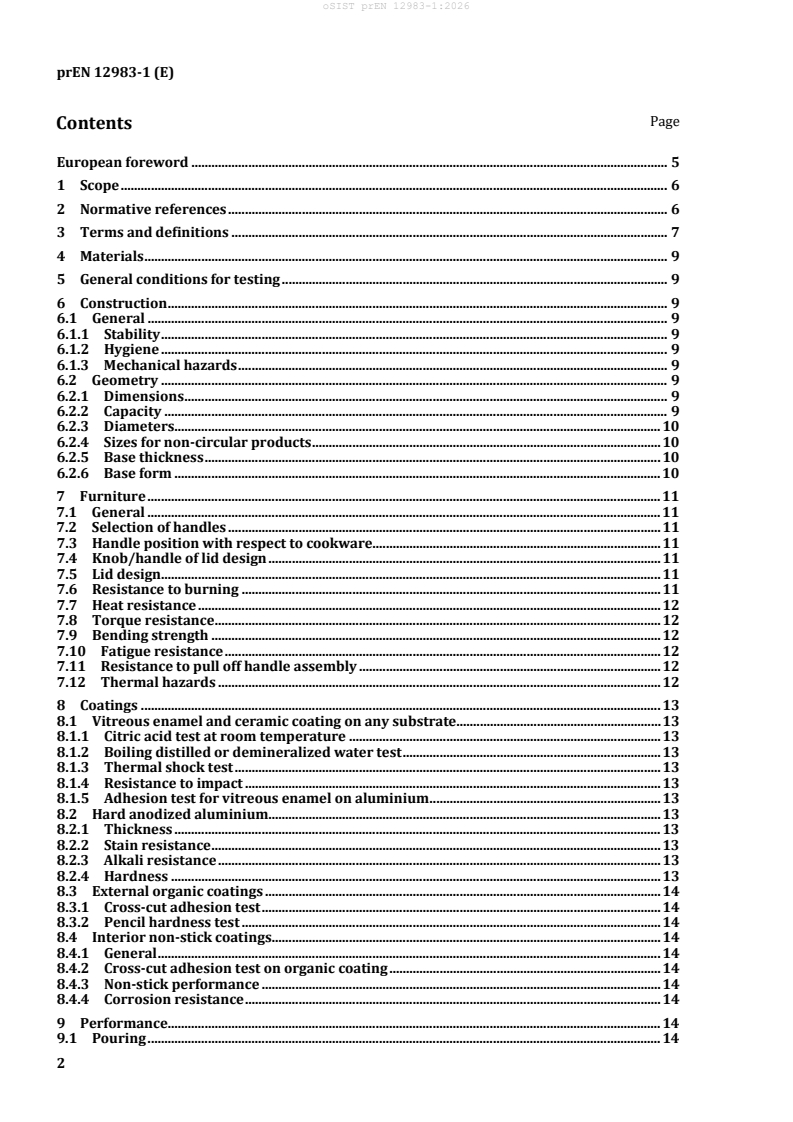
prEN 12983-1 is a CEN draft European Standard for domestic cookware used on top of a stove, cooker or hob, including cookware intended for use both on top and in an oven. It specifies safety and performance requirements for cookware of any material or manufacturing method, and it gives manufacturers, test laboratories, quality teams and buyers a common basis for checking design, coatings, handles, hob suitability and product information.
What does prEN 12983-1 specify?
prEN 12983-1 covers domestic cookware for use on gas, electric solid plate, electric radiant ring, radiant plate in glass ceramic and induction plate in glass ceramic. It applies to cookware regardless of material or method of manufacture, but it excludes pressure cookers, stove top water kettles and coffee makers.
The document is organized into 10 clauses and a set of normative annexes. Clause 1 gives the scope, Clause 2 lists the referenced standards, Clause 3 defines the key terms, and Clauses 4 to 10 cover materials, testing conditions, construction, furniture, coatings, performance and product information.
| Annex | What it covers |
|---|---|
| A | Resistance to burning |
| B | Heat resistance of furniture |
| C | Resistance to torque |
| D | Bending strength |
| E | Handle fatigue |
| F | Insulating properties of furniture |
| G | Adhesion of vitreous enamel on aluminium |
| H | Resistance to staining of anodised coatings |
| I | Resistance to alkali of anodized aluminium |
| J | Pencil hardness for external organic coatings |
| K | Pouring test |
| L | Base stability - resistance to thermal shocks |
| M | Resistance to pull |
| N | Suitability of non-stick coatings |
| O | Corrosion resistance of non-stick surfaces |
| P | Heat distribution |
| Q | Suitability for gas burner and electric radiant ring and solid plate |
| R | Suitability for glass ceramic hob with radiant or halogen heaters |
| S | Suitability for solid plate |
The scope also says the document does not cover energy efficiency requirements. Its notes point readers to Part 2 for ceramic and glass ceramic cookware and to Part 3 for cookware intended for induction heating sources.
What are the key requirements of prEN 12983-1?
prEN 12983-1 combines general safety rules with specific testable performance requirements. The practical effect is that product design, claims on packaging and the test report all have to match the same defined methods.
Materials and general construction
Clause 4 requires cookware materials and purity to be suitable for normal use without toxic hazards or unwanted effects on food taste or smell. In practice, this means food-contact materials must be controlled, not just mechanically workable.
Clause 5 sets the general test atmosphere at (23 ± 5) °C unless another temperature is specified. It also says that if a test failure could have been caused by an earlier test, the failed test is repeated on a new product. That matters because many checks can stress the same sample.
Clause 6 requires stable cookware that does not tilt when placed empty, without lid, on a (5 ± 0,5)° incline in the least favourable position. It also requires food-contact surfaces to be easily cleanable and all components to be free from burrs, splinters and sharp edges. Claimed dimensions must be clear to the consumer, and claimed capacity, diameter and base thickness must meet the stated tolerances.
Furniture, handles and lids
Clause 7 is the main functional section for handles, knobs and lids. Cookware over 3,75 l capacity or over 5 kg when filled to capacity with water shall have two handles. Handle position is checked against the centre of gravity, which matters for safe carrying and for shallow items.
The clause also sets mechanical and thermal checks for furniture. Handles and knobs are tested for burning, heat resistance, torque, bending strength, fatigue, pull-off resistance and thermal hazards. In practical terms, the manufacturer has to prove that the handle stays secure, does not deform excessively, and does not become too hot to touch under the conditions defined in the annexes.
Coatings and surface claims
Clause 8 separates requirements by coating type. Vitreous enamel and ceramic coatings are checked for chemical resistance, thermal shock and impact resistance, and enamel on aluminium has a specific adhesion test. Hard anodized aluminium has thickness, stain resistance, alkali resistance and hardness requirements.
External organic coatings and interior non-stick coatings are both checked with cross-cut adhesion methods. If a product is claimed to be non-stick, it must also pass a pancake release test after wear and a corrosion resistance test. That means the non-stick claim is not only about first use; it must survive the specified abrasion and cooking cycles.
Performance, heat sources and product information
Clause 9 covers pouring, base stability after thermal shocks, heat distribution and suitability for different heat sources. It also requires the manufacturer or supplier to declare the heat source or sources for which the product is suitable. Where suitability is claimed, Annexes Q, R and S define the matching test procedures for gas burners, electric radiant ring, solid plate, and glass ceramic hobs with radiant or halogen heaters.
Clause 10 requires point-of-sale information and care instructions. The label or packaging must show the product type, material and size, the suitable heating source types, and the manufacturer, importer or retailer plus the product reference. The instructions must cover first use, cleaning, care of furniture, energy-efficient use, safety advice, non-stick care, deep-frying warnings where relevant, and contact details.
What terms does prEN 12983-1 define?
- Cookware - a hollow utensil intended to transfer heat from the heat source to food, mainly for cooking on a stove, cooker or hob and/or in an oven.
- Cooking range - an appliance with a hob and at least one oven, and it may also include a grill.
- Hob - an appliance or part of an appliance that has one or more cooking zones or areas, together with a control unit.
- Fixing system - the attachment method or methods used to fasten a handle to the body of cookware or a knob to a lid.
- Usable capacity - two thirds of the capacity, used as a test reference rather than as consumer information.
- Furniture - the handles and knobs of the cookware.
- Non-stick coating - an interior coating applied to reduce sticking during cooking and make cleaning easier.
- Concavity - the difference in height between the external base diameter and the external base centre of the product.
Who uses prEN 12983-1?
prEN 12983-1 is used by cookware manufacturers, furniture and coating suppliers, test laboratories and conformity assessment teams. It is also relevant to quality managers, product engineers and buyers who need to compare domestic cookware on the basis of measurable safety and performance criteria.
In practice, it is used when designing handles and lids, selecting coatings, defining product claims, writing use and care instructions, and verifying compatibility with gas, electric and glass ceramic heat sources. It is also useful for retailers and importers who need the label and packaging information to match the tested product.
What changed in prEN 12983-1 from the previous edition?
prEN 12983-1:2026 supersedes EN 12983-1:2023.
The European foreword states these technical revisions:
- requirements and associated tests for handles were revised;
- requirements and associated tests for coating were revised;
- requirements and associated tests for heat suitability were revised;
- requirements and associated tests for heat distribution were revised.
The foreword also says the heat distribution requirement was updated to take account of existing cookware designs that allow fast heating, for example Enamelled Steel, and that complementary criteria are under study.
Which standards are used with prEN 12983-1?
- ISO 10093:2020 - provides the ignition source used in Annex A for the burning test.
- EN 30-1-1:2021+A1:2023 - provides the domestic gas hob setup used in Annex F for the insulating properties test.
- EN ISO 2064:2000 and EN ISO 2360:2017 - provide the thickness measurement basis for hard anodized aluminium in Clause 8.
- EN ISO 2409:2020 - provides the cross-cut test method used, with modifications, for external organic coatings and non-stick coatings.
- EN ISO 2747:2022 - provides the thermal shock test for vitreous and porcelain enamels.
- EN ISO 4532:2022 - provides the impact test for enamels.
- EN ISO 4628-2:2016 - provides the blistering rating used for non-stick corrosion resistance.
- EN 12875-1:2005 - provides the dishwasher resistance method referenced in Annex O.
- EN ISO 28706-1:2011 and EN ISO 28706-2:2017 - provide the chemical corrosion tests for enamel coatings.
- EN 60350-2:2018 and EN 60350-2:2018/A1:2021 - provide the reference cookware and hob methods used in the heat-source suitability tests.
The document also points to EN 13834:2020 for cookware intended for ovens, and its product-information clause refers to EN 14916:2005 and ISO 7000:2019 for graphical symbols.
What does the prEN 12983-1 document contain?
prEN 12983-1 contains clause-based requirements plus 19 normative annexes that give the test apparatus and procedures. The annexes cover burner setups, ovens, levers, loading bars, cyclic handle fatigue rigs, gas hob and electric plate test arrangements, reference pots, thermal imaging or pyrometer methods, and coating-specific chemical and mechanical tests.
It also includes tables for burner sizes, filling masses, test temperatures, coating ratings and reference-pot comparisons. Several clauses use figures to show measuring points, handle geometry, loading arrangements and concavity checks, so the reader can reproduce the tests in the same way.
For product development and compliance, the document functions as a complete test framework: it says what to claim, what to measure, what apparatus to use and how to judge pass or fail for cookware intended for domestic use on top of a stove, cooker or hob.
Relations
- Effective Date
- 26-Apr-2023
Frequently Asked Questions
prEN 12983-1 is a draft published by the European Committee for Standardization (CEN). Its full title is "Cookware - Domestic cookware for use on top of a stove, cooker or hob - Part 1: General requirements". This standard covers: This document specifies safety and performance requirements for items of cookware for domestic use on top of a stove, cooker or hob. It is applicable to all cookware regardless of material or method of manufacture. It is also applicable to cookware intended for use both “on top” and “in oven”. Hob types covered by this document are gas, electric solid plate, electric radiant ring, radiant plate in glass ceramic and induction plate in glass ceramic. This document is not applicable to pressure cookers, stove top water kettles and coffee makers. NOTE 1 Requirements for suitability for use in automatic dishwashers are under study by a specialist group and will be added by amendment when completed. NOTE 2 The requirements for ceramic and glass ceramic are specified in Part 2. NOTE 3 The additional requirements for cookware for use on induction heating sources are specified in Part 3.
This document specifies safety and performance requirements for items of cookware for domestic use on top of a stove, cooker or hob. It is applicable to all cookware regardless of material or method of manufacture. It is also applicable to cookware intended for use both “on top” and “in oven”. Hob types covered by this document are gas, electric solid plate, electric radiant ring, radiant plate in glass ceramic and induction plate in glass ceramic. This document is not applicable to pressure cookers, stove top water kettles and coffee makers. NOTE 1 Requirements for suitability for use in automatic dishwashers are under study by a specialist group and will be added by amendment when completed. NOTE 2 The requirements for ceramic and glass ceramic are specified in Part 2. NOTE 3 The additional requirements for cookware for use on induction heating sources are specified in Part 3.
prEN 12983-1 is classified under the following ICS (International Classification for Standards) categories: 97.040.60 - Cookware, cutlery and flatware. The ICS classification helps identify the subject area and facilitates finding related standards.
prEN 12983-1 has the following relationships with other standards: It is inter standard links to EN 12983-1:2023. Understanding these relationships helps ensure you are using the most current and applicable version of the standard.
prEN 12983-1 is available in PDF format for immediate download after purchase. The document can be added to your cart and obtained through the secure checkout process. Digital delivery ensures instant access to the complete standard document.
Standards Content (Sample)
Contents
- 1 Scope
- 2 Normative references
- 3 Terms and definitions
- 3.1 cookware
- 3.2 cooking range
- 3.3 hob
- 3.4 fixing system
- 3.5 capacity
- 3.6 usable capacity
- 3.7 handle
- 3.8 knob
- 3.9 shallow item
- 3.10 furniture
- 3.11 non-stick coating
- 3.12 external base diameter
- 3.13 interior base diameter
- 3.14 glass
- 3.15 ceramic
- 3.16 glass ceramic
- 3.17 organic coating
- 3.18 ceramic coating
- 3.19 hard substrate
- 3.20 concavity
- 4 Materials
- 5 General conditions for testing
- 6 Construction
- 6.1 General
- 6.2 Geometry
- 7 Furniture
- 7.1 General
- 7.2 Selection of handles
- 7.3 Handle position with respect to cookware
- 7.4 Knob/handle of lid design
- 7.5 Lid design
- 7.6 Resistance to burning
- 7.7 Heat resistance
- 7.8 Torque resistance
- 7.9 Bending strength
- 7.10 Fatigue resistance
- 7.11 Resistance to pull off handle assembly
- 7.12 Thermal hazards
- 8 Coatings
- 8.1 Vitreous enamel and ceramic coating on any substrate
- 8.2 Hard anodized aluminium
- 8.3 External organic coatings
- 8.4 Interior non-stick coatings
- 9 Performance
- 9.1 Pouring
- 9.2 Base stability – Resistance to thermal shocks
- 9.3 Heat distribution
- 9.4 Suitability for use with various heat sources
- 10 Product information
- 10.1 Point of sale information
- 10.2 Care and use instructions – General instructions
- Annex A
- Annex B
- Annex C
- Annex D
- Annex E
- Annex F
- Annex G
- Annex H
- Annex I
- Annex J
- Annex K
- Annex L
- Annex M
- Annex N
- Annex O
- Annex P
- Annex Q
- 2 Nominal power Gas burner diameter
- Annex R
- Annex S
- Bibliography
1 Scope
This document specifies safety and performance requirements for items of cookware for domestic use on top of a cooking range or hob. It is applicable to all cookware regardless of material or method of manufacture. It is also applicable to cookware intended for use both “on top” and “in oven”. Hob types covered by this document are gas, electric solid plate, electric radiant ring, radiant plate in glass ceramic and induction plate in glass ceramic.
This document is not applicable to pressure cookers, stove top water kettles and coffee makers. This document does not cover requirements or measurement methods on energy efficiency. NOTE 1 Requirements for suitability for use in automatic dishwashers are under study by a specialist group and will be added by amendment when completed.
NOTE 2 The requirements for ceramic and glass ceramic are specified in Part 2. NOTE 3 The additional requirements for cookware for use on induction heating sources are specified in Part 3.
2 Normative references
The following documents are referred to in the text in such a way that some or all of their content constitutes requirements of this document. For dated references, only the edition cited applies. For undated references, the latest edition of the referenced document (including any amendments) applies. ISO 10093:2020, Plastics — Fire tests — Standard ignition sources EN 30-1-1:2021+A1:2023, Domestic cooking appliances burning gas - Part 1-1: Safety - General EN ISO 2064:2000, Metallic and other inorganic coatings - Definitions and conventions concerning the measurement of thickness (ISO 2064:1996) EN ISO 2360:2017, Non-conductive coatings on non-magnetic electrically conductive base metals - Measurement of coating thickness - Amplitude-sensitive eddy-current method (ISO 2360:2017) EN ISO 2409:2020, Paints and varnishes - Cross-cut test (ISO 2409:2020) EN ISO 2747:2022, Vitreous and porcelain enamels - Enamelled cooking utensils - Determination of resistance to thermal shock (ISO 2747:1998) EN ISO 4532:2022, Vitreous and porcelain enamels - Determination of the resistance of enamelled articles to impact - Pistol test (ISO 4532:1991) EN ISO 4628-2:2016, Paints and varnishes - Evaluation of degradation of coatings - Designation of quantity and size of defects, and of intensity of uniform changes in appearance - Part 2: Assessment of degree of blistering (ISO 4628-2:2016) EN 12875-1:2005, Mechanical dishwashing resistance of utensils - Part 1: Reference test method for domestic articles EN ISO 28706-1:2011, Vitreous and porcelain enamels - Determination of resistance to chemical corrosion - Part 1: Determination of resistance to chemical corrosion by acids at room temperature (ISO 28706- 1:2008) EN ISO 28706-2:2017, Vitreous and porcelain enamels - Determination of resistance to chemical corrosion - Part 2: Determination of resistance to chemical corrosion by boiling acids, boiling neutral liquids, alkaline liquids and/or their vapours (ISO 28706-2:2017) EN 60350-2:2018, Household electric cooking appliances - Part 2: Hobs - Methods for measuring performance
oSIST prEN 12983-1:2026 prEN 12983-1 (E) EN 60350-2:2018/A1:2021, Household electric cooking appliances - Part 2: Hobs - Methods for measuring performance
3 Terms and definitions
For the purposes of this document, the following terms and definitions apply. ISO and IEC maintain terminology databases for use in standardization at the following addresses:
- ISO Online browsing platform: available athttp://www.iso.org/obp
- IEC Electropedia: available athttp://www.electropedia.org/
3.1 cookware
utensil, in the form of a hollow container, which transfers heat from the heat source to food, and is primarily intended for use in the cooking of food or liquids on the top of a stove, cooker or hob, and/or in an oven Note 1 to entry: Cookware intended to be used in an oven should also meet the requirements of EN 13834:2020 [1]
3.2 cooking range
appliance having a hob and at least one oven and which may incorporate a grill [SOURCE: EN 60350-2:2018, 3.1]
3.3 hob
appliance or part of an appliance which incorporates one or more cooking zones and/or cooking areas including a control unit [SOURCE: EN 60350-2:2018, 3.2]
3.4 fixing system
attachment method, or methods, utilized in fastening a handle to the body of an item of cookware or to fix a knob to a lid
3.5 capacity
maximum volume of water which can be held by the article on a level surface
3.6 usable capacity
two thirds of the capacity Note 1 to entry: The true usable capacity of the cookware varies with the food being cooked. The figure given here is an average value intended for use in test situations only and not as information to the consumer
3.7 handle
projection integral with or affixed to the body of the cookware and intended to facilitate the carrying and holding of the article in normal use
oSIST prEN 12983-1:2026 prEN 12983-1 (E)
3.8 knob
handle of lid projection integral with or affixed to the lid of the cookware to facilitate positioning or removal in normal use
3.9 shallow item
cookware of overall internal depth 1/3 or less of the interior diameter at the rim
3.10 furniture
handles and knobs
3.11 non-stick coating
coating applied to the interior of a cookware to achieve an anti-adherent effect during cooking and facilitate cleaning
3.12 external base diameter
dimension, measured on the external bottom of the cookware, across the maximum circumference of contact when placed on a flat surface
3.13 interior base diameter
diameter, measured on the inside of the cookware, excluding the radius of the body base to the body wall
3.14 glass
inorganic non-metallic material produced by the complete fusion of raw materials at a high temperature into a homogeneous liquid which is then cooled to a rigid condition essentially without crystallization
3.15 ceramic
inorganic non-metallic material made by firing a mixture of raw materials at high temperature Note 1 to entry: The firing temperature is high enough to give the necessary strength to the article, which is already shaped but is lower than the temperature which is necessary to achieve complete fusion of the mixture.
3.16 glass ceramic
inorganic, non-metallic material produced by complete fusion of a mixture of raw materials at high temperature into a homogeneous liquid which is then cooled to a rigid material and heat treated to achieve a certain degree of crystallization, mainly sub-microscopic crystallites Note 1 to entry: Vitro ceramic is also considered as glass ceramic.
3.17 organic coating
kind of polymer coating whose main or primary ingredients are based on compound from organic chemistry
3.18 ceramic coating
inorganic, non-metallic solid and inert film, mainly composed of silica and possibly containing some organic substances
oSIST prEN 12983-1:2026 prEN 12983-1 (E)
3.19 hard substrate
main material of the body shape EXAMPLE Aluminium, cast iron, steel.
3.20 concavity
difference of the height between the external base diameter and the external base centre of the product
4 Materials
Cookware shall be made of materials of a type and purity that, under normal conditions of use, present no toxic hazards nor in any way affect the organoleptic qualities of food prepared in it. NOTE There are European regulations in force regarding products intended to be used in contact with foodstuffs.
5 General conditions for testing
Unless otherwise specified, the tests shall be carried out at an ambient temperature of (23 ± 5) °C. When a failure in a test could be caused by the stresses set up by a previous test, the failed test shall be repeated on a new product.
6 Construction
6.1 General
6.1.1 Stability
The product shall be stable (i.e. shall not tilt), the base shall be in intended contact with the surface (a slide could be accepted), when placed empty without lid on a (5 ± 0,5)° inclined surface in the least favourable position.
6.1.2 Hygiene
All surfaces intended to come into contact with food shall be easily cleanable under normal circumstances.
6.1.3 Mechanical hazards
All components shall be free from burrs, splinters or sharp edges that could cause injury or discomfort to the user.
6.2 Geometry
6.2.1 Dimensions
The points of measurement of any claimed dimensions shall be made clear to the consumer, e.g. by means of a simple sketch.
6.2.2 Capacity
If a capacity is claimed, the actual capacity shall be equal or greater than the claimed capacity, when measured with an accuracy of 0,05 l.
0,1 % (mass fraction) of domestic washing up liquid detergent shall be added to the water in order to minimize the surface tension.
oSIST prEN 12983-1:2026 prEN 12983-1 (E)
6.2.3 Diameters
Any diameter claimed for the base shall be within ±10 mm of the average of two measurements of the actual diameter taken at right angles to one another.
Any other claimed diameter shall be within ±5 mm of the average of two measurements of the actual diameter taken at right angles to one another.
6.2.4 Sizes for non-circular products
Every claimed size shall be within tolerance of ±10 mm.
6.2.5 Base thickness
If a thickness is claimed for the base of a product, the average thickness of the base shall be greater than 85 % of the claimed thickness. The average thickness shall be calculated, by taking the average of the 8 points measured as described in Figure 1.
If more than 22 % of the base area is deliberately deformed for aesthetic or functional reasons, either internally or externally, no claim for base thickness shall be made. Dimensions in millimetres
Key 1 measuring points d base diameter Figure 1 — Measuring points
6.2.6 Base form
The base, when viewed from the beneath, shall not be convex except for products whose intrinsic design features preclude them complying with this requirement, e.g. certain woks.
oSIST prEN 12983-1:2026 prEN 12983-1 (E)
7 Furniture
7.1 General
It is not the intention that all these tests shall be passed in sequence. Except where otherwise stated, each test shall stand alone.
7.2 Selection of handles
All cookware with a capacity greater than 3,75 l or a total weight greater than 5 kg when filled to capacity with water shall be fitted with two handles.
7.3 Handle position with respect to cookware
Handles shall be positioned above the centre of gravity of an item of cookware when filled with water to its capacity. For shallow items, there shall be a minimum clearance of 30 mm between the handle and the horizontal projection of the base of the item of cookware at a point halfway along the handle assembly. In the case of side handles, the measurement is taken at the lowest point where they are held in normal use (see Figure 2).
Dimensions in millimetres
Figure 2 — Handle position
7.4 Knob/handle of lid design
It shall be possible to use the knob for its normal purposes without coming into contact with any surface whose temperature exceeds the values given in 7.12 for the relevant materials.
7.5 Lid design
The design of the lid shall be such that it shall be possible to remove it from the body using a force equal to the weight of the lid + 2 N in any position at a temperature of (23 ± 5) °C. This test shall be carried out both before and after bringing a quantity of water, equal to the usable capacity, to the boil and allowing it to cool to ambient temperature. The lid shall remain in place throughout the boiling and cooling stages. If the lid is fitted with a locking device, this test shall be carried out with the device disengaged. NOTE For glass lid thermal shock endurance, see EN 12983-2:2023+A1:2025 [2], Clause 5.
7.6 Resistance to burning
The underside of the handle or any insert or inlay there, consisting of organic material, shall not drip molten material or keep burning when tested according to Annex A. Any burning shall self-extinguish within 15 s of the removal of the flame. Once extinguished the handle material shall not spontaneously re-ignite. Each material shall be tested at its position.
oSIST prEN 12983-1:2026 prEN 12983-1 (E)
7.7 Heat resistance
All furniture designed to be attached to the main body of a product shall be free from cracks and blisters after completion of the test described in Annex B for a temperature of (150 ± 5) °C for 1 h. Purely decorative features, e.g. thermoplastic inlays or sleeves, are exempt from this requirement.
7.8 Torque resistance
When tested in accordance with Annex C, the movement of the handle shall be no more than 10° in either direction. There shall be no damage affecting the function caused to the handle, ferrule or fixing system by this test.
7.9 Bending strength
No part of the handle or handle fixing system shall detach or break with a bending force of 100 N when tested as described in Annex D during 30 s.
If the capacity of the product is less than 3 l, the test is performed with a bending force twice the capacity plus the weight of the item with a minimum of 40 N and a maximum of 100 N. No fracturing nor permanent deformation of 10° or greater of any part of the handle or handle fixing system shall be observed where 10° relates to the original position of the handle, see Figure D.1.
7.10 Fatigue resistance
A handle assembly shall withstand 15 000 cycles, without permanent deformation or permanent loosening of the handle or its fixing system, when tested as described in Annex E. If any loosening of the handle is noticed it is acceptable to retighten as mentioned in the use and care manual. Distortion of less than 5 % of the handle length measured at the end of the handle is ignored unless it affects safety or function.
7.11 Resistance to pull off handle assembly
When tested as described in Annex M, a handle assembly shall withstand a dynamic impact of 1,5 Nm without any breakage nor reduction in the security of the handle nor the fixing system.
7.12 Thermal hazards
For the following materials, the maximum temperature shall not exceed:
a) Metal: 55 °C; b) Plastics, silicone: 70 °C; c) Wood: 89 °C; d) Ceramic, glass, stone: 66 °C when tested as described in Annex F.
If the values exceed these limits or the cookware is claimed to be suitable for deep frying, the manufacturer shall indicate in the instructions (see 10.2) that the use of protection is required in order to ensure a safe handling of the cookware.
It shall not be possible to touch, with a spherical probe 14 mm in diameter, any metal part contained within the insulated portion of the furniture which exceeds 55 °C when tested as described in Annex F.
oSIST prEN 12983-1:2026 prEN 12983-1 (E)
8 Coatings
8.1 Vitreous enamel and ceramic coating on any substrate
8.1.1 Citric acid test at room temperature
The interior coating shall be tested in accordance with EN ISO 28706-1:2011. For matte and glossy surfaces, the result is considered as successful if the sample is in class AA, A+.
8.1.2 Boiling distilled or demineralized water test
When the interior enamel coat is tested in accordance with EN ISO 28706-2:2017, Clause 14, the maximum acceptable weight loss shall be 1,5 g/m2 for the liquid phase and 4,5 g/m2 for the vapour over a test period of 24 h.
NOTE This test does not apply to ceramic coating.
8.1.3 Thermal shock test
When the coating is tested in accordance with EN ISO 2747:2022, the minimum acceptable failure temperature shall be 280 °C.
8.1.4 Resistance to impact
When the coating is tested in accordance with EN ISO 4532:2022, the coating shall resist a minimum impact of 20 N, showing no damage greater than 2 mm after 24 h.
8.1.5 Adhesion test for vitreous enamel on aluminium
When tested as described in Annex G, exposure of the base metal shall not exceed 3 mm from the test edge.
8.2 Hard anodized aluminium
8.2.1 Thickness
The minimum average thickness of an anodized layer shall be 25 μm when measured as specified in EN ISO 2064:2000 and EN ISO 2360:2017.
This check shall be carried out only where the hard anodized coating is not covered by a separate coat of a different material.
8.2.2 Stain resistance
When tested as described in Annex H, there shall be no staining visible on any surface intended to come into contact with food.
8.2.3 Alkali resistance
When tested as described in Annex I, there shall be no loss of the insulating properties of the coating of any surface intended to come into contact with food.
8.2.4 Hardness
Coatings claimed to be hard anodized shall have a hardness greater than 350 HV 0,5 or equivalent.
oSIST prEN 12983-1:2026 prEN 12983-1 (E)
8.3 External organic coatings
8.3.1 Cross-cut adhesion test
There shall be no removal of the coating greater than classification 2 when tested as described in EN ISO 2409:2020for hard substrates, with the following modifications:
a) precondition the sample by immersing in continuously boiling water for 15 min, allowing it to cool at ambient temperature and wiping it dry; b) repeat the test method described in A.2 of EN ISO 2409:2020 a further 3 times applying the tape at 90° to the previous application each time. The tape used shall have an adhesion performance from 360 cN/Cm to 440 cN/Cm.
8.3.2 Pencil hardness test
When tested on the base as described in Annex J at ambient temperature, the minimum acceptable hardness shall be 2 H.
This requirement is applicable only in case of flat surface (i.e. outside base).
8.4 Interior non-stick coatings
8.4.1 General
The requirements given in this Clause apply to any surfaces which are claimed to be non-stick.
8.4.2 Cross-cut adhesion test on organic coating
There shall be no removal of the coating greater than classification 2 when tested as described in EN ISO 2409:2020 for hard substrates, with the following modifications:
a) precondition the test piece by immersing in continuously boiling water for 15 min, allowing it to cool at ambient temperature and wiping it dry; b) repeat the test method described in A.2 of EN ISO 2409:2020 a further 3 times applying the tape at 90° to the previous application each time. The tape used shall have an adhesion performance from 360 cN/Cm to 440 cN/Cm.
8.4.3 Non-stick performance
When tested as described in Annex N, any surface claimed to be non-stick shall still have acceptable pancake release over 5 cooking cycles and shall not show wear through of the coating. Acceptable pancake release means all food is released with a spatula with some effort (minimum requirement 50 points on all 5 tests).
8.4.4 Corrosion resistance
When tested as described in Annex O, any surface claimed to be non-stick shall show no blistering exceeding size 2 density 2 according to EN ISO 4628-2:2016.
9 Performance
9.1 Pouring
When tested as described in Annex K, the liquid shall flow cleanly from the rim. There shall be no continuous dribbling, but individual droplets may flow back on to the sidewall.
oSIST prEN 12983-1:2026 prEN 12983-1 (E) Items of cookware provided with a pouring lip shall be tested to satisfy this requirement only at the pouring lip.
Shallow products, e.g. frypans and omelette pans, shall only be tested if they are provided with a pouring lip.
9.2 Base stability – Resistance to thermal shocks
When tested as described in Annex L, the base shall not become convex.
9.3 Heat distribution
When tested as described in Annex P(procedure Clause P.3or Clause P.4), the maximum temperature reached shall not exceed 290 °C at the completion of the test. If the maximum temperature reached exceeds 290 °C, the test shall be carried out according to Annex P(P.4.6), and the maximum temperature reached shall not exceed 270 °C at the completion of the test.
...