

EN 14199:2005
(Main)Execution of special geotechnical works - Micropiles
- Abstract
1.1 This Standard establishes general principles for the execution of micropiles.
They are for:
- drilled micropiles a shaft diameter not greater than 300 mm;
- driven micropiles a shaft diameter or a maximum shaft cross sectional extension not greater than 150 mm.
1.2 Micropiles are structural members to transfer actions to the ground and may contain bearing elements to transfer directly or indirectly loads and or to limit deformations. Their shaft and base resistance may be improved (mostly by grouting) and they may be constructed with (see Figure 1):
- uniform cross section (straight shaft); or
- telescopically changing shaft dimensions;
- shaft enlargements; and/or
- base enlargement.
1.3 Other than practical considerations, there are no limitations regarding, length, rake (definition of rake, see Figure 2), slenderness ratio or shaft and base enlargements.
1.4 The provisions of the Standard apply to (see Figure 3):
- single micropiles;
- micropile groups;
- reticulated micropiles;
- micropile walls.
1.5 The micropiles which are the subject of this Standard can be installed into the ground using drilling, driving or a combination of these methods.
1.6 The material of micropiles covered by this Standard can be:
- steel or other reinforcement materials;
- grout, mortar or concrete;
- a combination of above.
1.7 Micropiles may be used for:
- working under restricted access and/or headroom conditions;
- foundations of new structures (particularly in very heterogeneous soil or rock formations);
- reinforcing or strengthening of existing structures to increase the capacity to transfer load to depth with acceptable load settlement characteristics, e.g. underpinning works;
- reducing settlements and/or displacements;
- forming a retaining wall;
- reinforcing of soil to form a bearing and/or retaining structure;
- improving slope stability;
- securing against uplift;
- other applications where micropile techniques are appropriate.
1.8 Mixed-
- Status
- Withdrawn
- Publication Date
- 08-Mar-2005
- Withdrawal Date
- 06-Oct-2026
- Technical Committee
- CEN/TC 288 - Execution of special geotechnical works
- Drafting Committee
- CEN/TC 288/WG 8 - Micropiles
- Current Stage
- 9960 - Withdrawal effective - Withdrawal
- Start Date
- 20-May-2015
- Completion Date
- 07-Oct-2026

Relations
- Effective Date
- 28-Jun-2010
- Effective Date
- 25-Mar-2026
- Effective Date
- 11-Mar-2026
- Effective Date
- 28-Jan-2026
- Refers
EN 10080:2005 - Steel for the reinforcement of concrete - Weldable reinforcing steel - General - Effective Date
- 28-Jan-2026
- Effective Date
- 28-Jan-2026
- Effective Date
- 28-Jan-2026
- Effective Date
- 28-Jan-2026
- Effective Date
- 28-Jan-2026
- Effective Date
- 28-Jan-2026
- Effective Date
- 28-Jan-2026
- Effective Date
- 28-Jan-2026
- Effective Date
- 28-Jan-2026
- Effective Date
- 28-Jan-2026
- Effective Date
- 28-Jan-2026
Get Certified
Connect with accredited certification bodies for this standard

Zavod za gradbeništvo Slovenije (ZAG) - Inšpekcija
ZAG inspection body for construction products, structures, and materials.
Sponsored listings
Frequently Asked Questions
EN 14199:2005 is a standard published by the European Committee for Standardization (CEN). Its full title is "Execution of special geotechnical works - Micropiles". This standard covers: 1.1 This Standard establishes general principles for the execution of micropiles. They are for: - drilled micropiles a shaft diameter not greater than 300 mm; - driven micropiles a shaft diameter or a maximum shaft cross sectional extension not greater than 150 mm. 1.2 Micropiles are structural members to transfer actions to the ground and may contain bearing elements to transfer directly or indirectly loads and or to limit deformations. Their shaft and base resistance may be improved (mostly by grouting) and they may be constructed with (see Figure 1): - uniform cross section (straight shaft); or - telescopically changing shaft dimensions; - shaft enlargements; and/or - base enlargement. 1.3 Other than practical considerations, there are no limitations regarding, length, rake (definition of rake, see Figure 2), slenderness ratio or shaft and base enlargements. 1.4 The provisions of the Standard apply to (see Figure 3): - single micropiles; - micropile groups; - reticulated micropiles; - micropile walls. 1.5 The micropiles which are the subject of this Standard can be installed into the ground using drilling, driving or a combination of these methods. 1.6 The material of micropiles covered by this Standard can be: - steel or other reinforcement materials; - grout, mortar or concrete; - a combination of above. 1.7 Micropiles may be used for: - working under restricted access and/or headroom conditions; - foundations of new structures (particularly in very heterogeneous soil or rock formations); - reinforcing or strengthening of existing structures to increase the capacity to transfer load to depth with acceptable load settlement characteristics, e.g. underpinning works; - reducing settlements and/or displacements; - forming a retaining wall; - reinforcing of soil to form a bearing and/or retaining structure; - improving slope stability; - securing against uplift; - other applications where micropile techniques are appropriate. 1.8 Mixed-
1.1 This Standard establishes general principles for the execution of micropiles. They are for: - drilled micropiles a shaft diameter not greater than 300 mm; - driven micropiles a shaft diameter or a maximum shaft cross sectional extension not greater than 150 mm. 1.2 Micropiles are structural members to transfer actions to the ground and may contain bearing elements to transfer directly or indirectly loads and or to limit deformations. Their shaft and base resistance may be improved (mostly by grouting) and they may be constructed with (see Figure 1): - uniform cross section (straight shaft); or - telescopically changing shaft dimensions; - shaft enlargements; and/or - base enlargement. 1.3 Other than practical considerations, there are no limitations regarding, length, rake (definition of rake, see Figure 2), slenderness ratio or shaft and base enlargements. 1.4 The provisions of the Standard apply to (see Figure 3): - single micropiles; - micropile groups; - reticulated micropiles; - micropile walls. 1.5 The micropiles which are the subject of this Standard can be installed into the ground using drilling, driving or a combination of these methods. 1.6 The material of micropiles covered by this Standard can be: - steel or other reinforcement materials; - grout, mortar or concrete; - a combination of above. 1.7 Micropiles may be used for: - working under restricted access and/or headroom conditions; - foundations of new structures (particularly in very heterogeneous soil or rock formations); - reinforcing or strengthening of existing structures to increase the capacity to transfer load to depth with acceptable load settlement characteristics, e.g. underpinning works; - reducing settlements and/or displacements; - forming a retaining wall; - reinforcing of soil to form a bearing and/or retaining structure; - improving slope stability; - securing against uplift; - other applications where micropile techniques are appropriate. 1.8 Mixed-
EN 14199:2005 is classified under the following ICS (International Classification for Standards) categories: 93.020 - Earthworks. Excavations. Foundation construction. Underground works. The ICS classification helps identify the subject area and facilitates finding related standards.
EN 14199:2005 has the following relationships with other standards: It is inter standard links to EN 14199:2015, EN 1994-1-1:2026, EN 206-2:2026, EN 10210-2:2019, EN 10080:2005, EN ISO 11960:2021, EN 1008:2002, EN 1993-5:2025, EN 1994-1-1:2004, EN 206:2013+A2:2021, EN 10210-1:2006, EN 16228-7:2014+A1:2021, EN 1993-1-1:2022, EN 1537:1999, EN 12794:2005+A1:2007. Understanding these relationships helps ensure you are using the most current and applicable version of the standard.
EN 14199:2005 is available in PDF format for immediate download after purchase. The document can be added to your cart and obtained through the secure checkout process. Digital delivery ensures instant access to the complete standard document.
Standards Content (Sample)
2003-01.Slovenski inštitut za standardizacijo. Razmnoževanje celote ali delov tega standarda ni dovoljeno.Execution of special geotechnical works - MicropilesExécution de travaux géotechniques spéciaux - MicropieuxAusführung von besonderen geotechnischen Arbeiten (Spezialtiefbau) - Pfähle mit kleinen Durchmessern (Mikropfähle)93.020Zemeljska dela. Izkopavanja. Gradnja temeljev. Dela pod zemljoEarthworks. Excavations. Foundation construction. Underground worksICS:SIST EN 14199:2005enTa slovenski standard je istoveten z:EN 14199:200501-maj-2005SIST EN 14199:2005SLOVENSKI
STANDARD
EUROPEAN STANDARDNORME EUROPÉENNEEUROPÄISCHE NORMEN 14199March 2005ICS 93.020English versionExecution of special geotechnical works - MicropilesExécution de travaux géotechniques spéciaux - MicropieuxAusführung von besonderen geotechnischen Arbeiten(Spezialtiefbau) - Pfähle mit kleinen Durchmessern(Mikropfähle)This European Standard was approved by CEN on 27 October 2004.CEN members are bound to comply with the CEN/CENELEC Internal Regulations which stipulate the conditions for giving this EuropeanStandard the status of a national standard without any alteration. Up-to-date lists and bibliographical references concerning such nationalstandards may be obtained on application to the Central Secretariat or to any CEN member.This European Standard exists in three official versions (English, French, German). A version in any other language made by translationunder the responsibility of a CEN member into its own language and notified to the Central Secretariat has the same status as the officialversions.CEN members are the national standards bodies of Austria, Belgium, Cyprus, Czech Republic, Denmark, Estonia, Finland, France,Germany, Greece, Hungary, Iceland, Ireland, Italy, Latvia, Lithuania, Luxembourg, Malta, Netherlands, Norway, Poland, Portugal, Slovakia,Slovenia, Spain, Sweden, Switzerland and United Kingdom.EUROPEAN COMMITTEE FOR STANDARDIZATIONCOMITÉ EUROPÉEN DE NORMALISATIONEUROPÄISCHES KOMITEE FÜR NORMUNGManagement Centre: rue de Stassart, 36
B-1050 Brussels© 2005 CENAll rights of exploitation in any form and by any means reservedworldwide for CEN national Members.Ref. No. EN 14199:2005: E
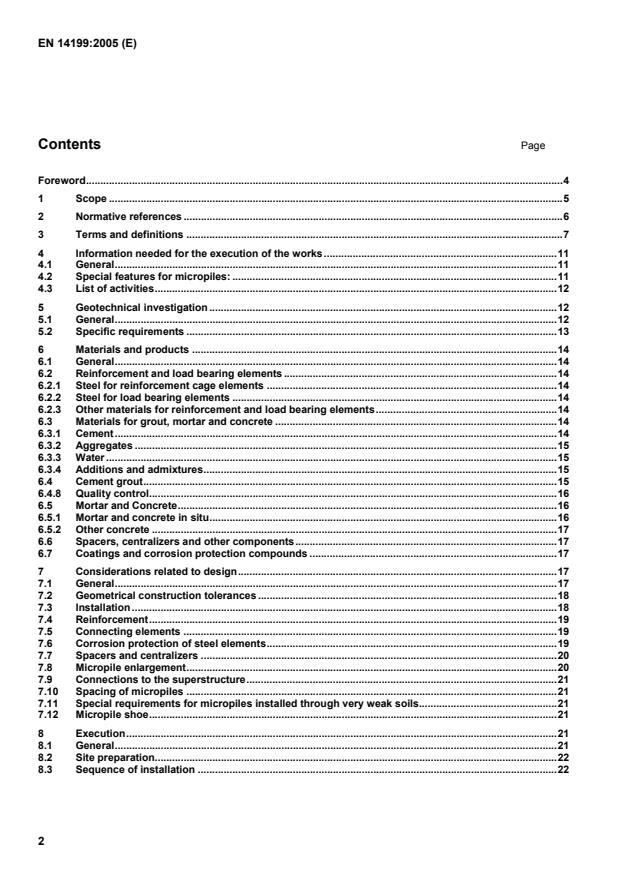
Execution methods of micropiles.40 A.1 Drilled micropiles.40 A.2 Displacement micropiles.41 Annex B (informative)
Guidance on geometrical construction tolerances.42 Annex C (informative)
Minimum cover (in mm) for reinforcement and bearing element of low strength steel for cast in place micropiles taking into account exposure classes related to environmental actions as defined in EN 206-1.43 Annex D (informative)
Guidance on corrosion rates.44 Annex E (informative)
Borehole testing and pregrouting.45 Annex F (informative)
Guideline for the preparation of a record for several drilled micropiles.46 Annex G (informative)
Guideline for the preparation of a record for several driven micropiles.47 Bibliography.48
2 Normative references The following referenced documents are indispensable for the application of this document. For dated references, only the edition cited applies. For undated references, the latest edition of the referenced document (including any amendments) applies. EN 197-1, Cement - Part 1: Composition, specifications and conformity criteria for common cements. EN 206-1:
Concrete - Part 1: Specification, performance, production and conformity. EN 791, Drill rigs – Safety. EN 934-2, Admixtures for concrete, mortar and grout - Part 2: Concrete admixtures - Definitions, requirements, conformity, marking and labelling. EN 996, Piling equipment – Safety requirements. EN 1008, Mixing water for concrete - Specification for sampling, testing and assessing the suitability of water, including water recovered from processes in the concrete industry, as mixing water for concrete EN 1536:1999, Execution of special geotechnical work - Bored piles. EN 1537:1999, Execution of special geotechnical work - Ground anchors. EN 1991-1, Eurocode 1: Basis of design and actions on structures – Part 1: Basis of design. EN 1992-1-1, Eurocode 2: Design of concrete structures - Part 1: General rules and rules for buildings EN 1993-1-1, Eurocode 3: Design of steel structures - Part 1-1: General rules and rules for buildings EN 1993-5, Eurocode 3: Design of steel structures – Part 5: Piling. EN 1994-1-1, Eurocode 4: Design of composite steel and concrete structures - Part 1-1: General rules for buildings. EN 1997-1:2004, Eurocode 7: Geotechnical design – Part 1: General rules. EN 10025, Hot-rolled products of non-alloy structural steels. EN 10080, Steel for the reinforcement of concrete weldable ribbed reinforcing steel B 500 - Technical delivery conditions for bars, coils and welded fabric prEN 10138-4, Prestressing steels - Part 4: Bars.
vision, monitoring and testing. 4.1.3 The information regarding the site conditions shall cover where relevant: a) the geometry of the site (boundary conditions, topography, access, slopes, headroom restrictions .); b) the existing underground structures, underground and arial services, obstructions, known contaminations and archeological constraints; c) the environmental restrictions, including noise, vibration, pollution; d) the future or ongoing construction activities such as dewatering, tunnelling, deep excavations. 4.2 Special features for micropiles: 4.2.1 The following additional site informations shall be made available in the project documentation and be on site before commencement of the micropile works, where applicable: working platform levels; location of site datum; chemical aggressiveness of ground and/or groundwater (= exposure class according to EN 206-1); climatic conditions; possibility of stray electric current; potential instability of the ground; presence of existing piles, anchors, and/or other artificial obstructions in the ground (as for example wood, steel, etc. …). 4.2.2 The following items shall be investigated during design and shall be made available for execution where relevant: all necessary or relevant information for the production of the working drawings and method statements, where required;
...