EN 1537:1999
(Main)Execution of special geotechnical work - Ground anchors
Execution of special geotechnical work - Ground anchors
This Standard is applicable to the installation, testing and monitoring of permanent and temporary ground anchors where the load capacity is tested. An anchor consists of an anchor head, a free anchor length and a fixed anchor length which is bonded to the ground by grout. The term "ground" is taken to encompass both soil and rock.
Ausführung von besonderen geotechnischen Arbeiten (Spezialtiefbau) - Verpreßanker
Diese Norm gilt für den Einbau, die Prüfung und die Überwachung von Dauer- und Kurzzeitankern, deren Bruchkraft geprüft wird. Ein Anker besteht aus einem Ankerkopf, einer freien Ankerlänge und einer Krafteintragungslänge, die mit dem Baugrund durch Verpreßmörtel verbunden ist. Die Bezeichnung "Baugrund" beinhaltet sowohl Boden als auch Fels.
Exécution des travaux géotechniques spéciaux - Tirant d'ancrage
La présente norme s'applique à la mise en place, aux essais et au contrôle des tirants d'ancrage permanents et provisoires lorsque la capacité d'ancrage est testée. Un tirant d'ancrage comporte trois parties, la tête d'ancrage, la partie libre et la partie scellée au terrain par injection. Le terme "terrain" englobe à la fois les sols et les roches.
Izvedba posebnih geotehničnih del - Geotehnična sidra
General Information
- Status
- Withdrawn
- Publication Date
- 07-Dec-1999
- Withdrawal Date
- 09-Jul-2013
- Technical Committee
- CEN/TC 288 - Execution of special geotechnical works
- Drafting Committee
- CEN/TC 288 - Execution of special geotechnical works
- Current Stage
- 9960 - Withdrawal effective - Withdrawal
- Start Date
- 10-Jul-2013
- Completion Date
- 10-Jul-2013
Relations
- Effective Date
- 22-Dec-2008
- Effective Date
- 08-Jun-2022
Frequently Asked Questions
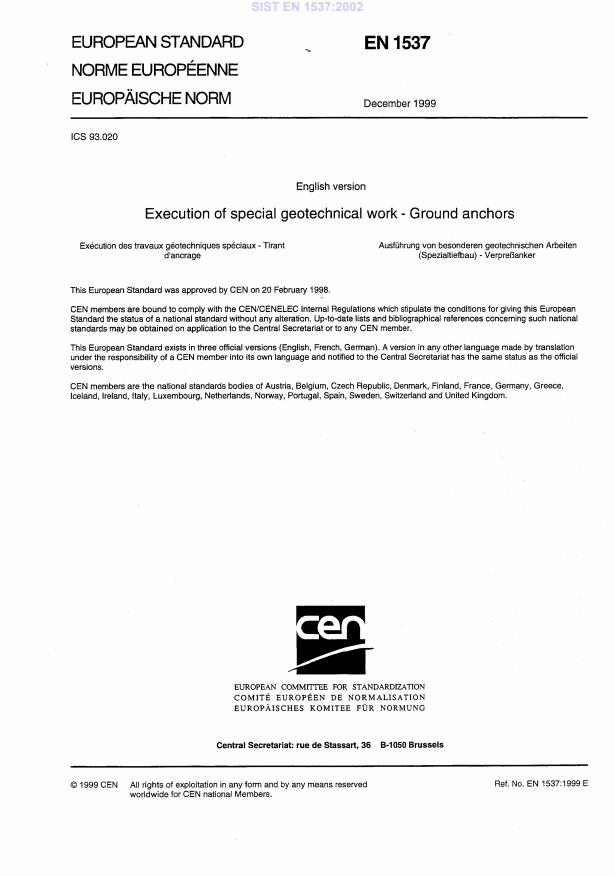
EN 1537:1999 is a standard published by the European Committee for Standardization (CEN). Its full title is "Execution of special geotechnical work - Ground anchors". This standard covers: This Standard is applicable to the installation, testing and monitoring of permanent and temporary ground anchors where the load capacity is tested. An anchor consists of an anchor head, a free anchor length and a fixed anchor length which is bonded to the ground by grout. The term "ground" is taken to encompass both soil and rock.
This Standard is applicable to the installation, testing and monitoring of permanent and temporary ground anchors where the load capacity is tested. An anchor consists of an anchor head, a free anchor length and a fixed anchor length which is bonded to the ground by grout. The term "ground" is taken to encompass both soil and rock.
EN 1537:1999 is classified under the following ICS (International Classification for Standards) categories: 93.020 - Earthworks. Excavations. Foundation construction. Underground works. The ICS classification helps identify the subject area and facilitates finding related standards.
EN 1537:1999 has the following relationships with other standards: It is inter standard links to EN 1537:2013, EN 1537:1999/AC:2000. Understanding these relationships helps ensure you are using the most current and applicable version of the standard.
You can purchase EN 1537:1999 directly from iTeh Standards. The document is available in PDF format and is delivered instantly after payment. Add the standard to your cart and complete the secure checkout process. iTeh Standards is an authorized distributor of CEN standards.
Standards Content (Sample)
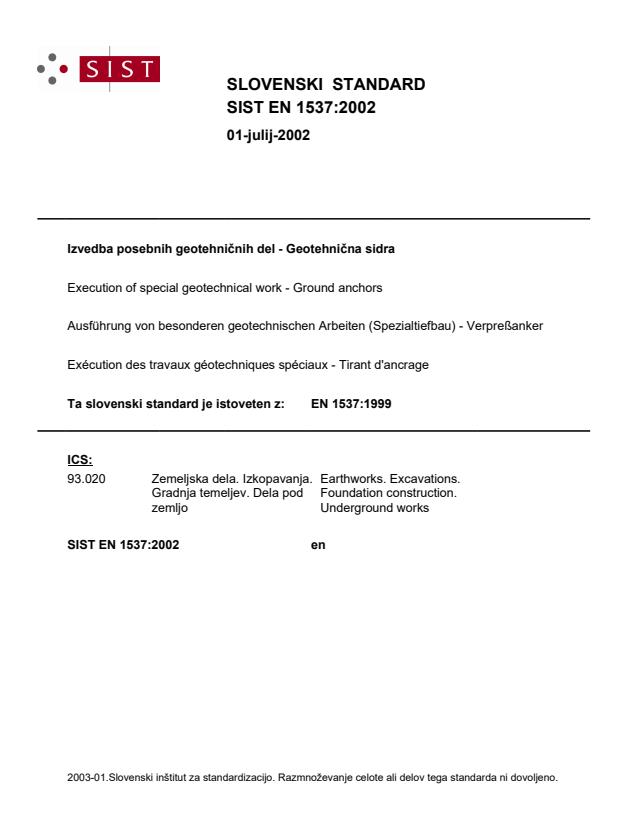
2003-01.Slovenski inštitut za standardizacijo. Razmnoževanje celote ali delov tega standarda ni dovoljeno.Ausführung von besonderen geotechnischen Arbeiten (Spezialtiefbau) - VerpreßankerExécution des travaux géotechniques spéciaux - Tirant d'ancrageExecution of special geotechnical work - Ground anchors93.020Zemeljska dela. Izkopavanja. Gradnja temeljev. Dela pod zemljoEarthworks. Excavations. Foundation construction. Underground worksICS:Ta slovenski standard je istoveten z:EN 1537:1999SIST EN 1537:2002en01-julij-2002SIST EN 1537:2002SLOVENSKI
STANDARD
SIST EN 1
...
La norme SIST EN 1537:2002, intitulée "Exécution de travaux géotechniques spéciaux - Ancrages au sol", établit des directives claires et précises concernant l'installation, l'essai et la surveillance des ancrages au sol, qu'ils soient permanents ou temporaires. Cette norme est essentielle pour garantir la sécurité et la fiabilité des structures reposant sur ces ancrages. L'un des principaux atouts de cette norme est sa portée exhaustive. En définissant des critères spécifiques pour les éléments constitutifs d'un ancrage - y compris la tête d'ancrage, la longueur libre et la longueur fixe - elle assure une compréhension uniforme parmi les professionnels du domaine. De plus, le fait de considérer le "sol" comme englobant tant le sol que la roche élargit son application, rendant cette norme pertinente dans divers contextes géotechniques. Un autre point fort de la norme est son approche rigoureuse en matière de tests et de surveillance. En stipulant des méthodes d'essai pour vérifier la capacité de charge des ancrages, la norme garantit que les ancrages répondent à des critères de performance clairs avant d'être utilisés dans des applications réelles. Cela contribue à la prévention des défaillances structurelles, renforçant ainsi la confiance des ingénieurs et des entrepreneurs dans l'utilisation de ces systèmes. En résumé, la norme SIST EN 1537:2002 se révèle être un document fondamental pour les professionnels du secteur géotechnique. Sa vigueur dans l'établissement de procédures d'installation et de vérification de la performance des ancrages au sol en fait une référence incontournable pour assurer la sécurité et la durabilité des projets de construction.
The standard EN 1537:1999, titled "Execution of special geotechnical work - Ground anchors," is a comprehensive guide that pertains to the installation, testing, and monitoring protocols for both permanent and temporary ground anchors. This standard emphasizes the critical aspect of load capacity testing, ensuring that all ground anchors are capable of sustaining the forces they are designed to withstand, thereby enhancing safety and reliability in geotechnical applications. One of the notable strengths of this standard is its thorough definition of an anchor, which includes the anchor head, free anchor length, and fixed anchor length. This clarity ensures that practitioners in the field of geotechnical engineering have a precise understanding of anchor components. Additionally, the inclusion of both soil and rock under the term "ground" broadens the standard's applicability, making it relevant for a wide range of geotechnical conditions and projects. Another key aspect of EN 1537:1999 is its focus on the systematic monitoring of ground anchors. This is particularly significant in assessing the long-term performance and integrity of anchors installed in various geological environments. The provisions for testing and monitoring not only enhance the reliability of ground anchors but also contribute to informed decision-making during construction and maintenance phases. Furthermore, the standard's alignment with other European standards reflects its relevance in global geotechnical practices. By adhering to these guidelines, professionals can ensure compliance with international safety and quality benchmarks, which is paramount for the successful execution of geotechnical works. Overall, the EN 1537:1999 standard serves as a vital reference for engineers and contractors involved in the execution of special geotechnical work. Its detailed guidelines on ground anchors facilitate improved construction practices and contribute significantly to the advancement of the field.
SIST EN 1537:2002 표준은 특수 지반 작업의 실행에 관한 유럽 규격으로, 특히 지반 앵커의 설치, 시험 및 모니터링에 초점을 맞추고 있습니다. 이 표준은 영구적이며 일시적인 지반 앵커의 부하 용량을 시험하는 과정에 적용됩니다. 지반 앵커는 앵커 헤드, 자유 앵커 길이, 그리고 모르타르로 지면에 결합된 고정 앵커 길이로 구성됩니다. 이 문서에서는 "지반"이라는 용어가 토양과 암석을 모두 포함하는 것으로 정의되고 있습니다. 이 표준의 강점 중 하나는 지반 앵커에 대한 명확한 설치 및 시험 절차를 규정함으로써, 시공 품질을 높이고 안전성을 보장한다는 점입니다. 재료의 적합성, 제작 공정 및 현장 조건에 대한 지침을 제공하여 설계자와 시공자 모두에게 유용한 정보를 제공합니다. 이 표준은 또한 지반 앵커의 성능을 지속적으로 모니터링할 수 있는 방법을 제시하고 있어, 장기적 안정성을 확보하는 데 기여합니다. 표준의 적용 범위는 건설 산업에서 중요한 역할을 하는 지반 앵커의 설치 및 관리에 있어, 다양한 환경에서의 적합성을 보장합니다. 이는 지하 구조물, 교량, 그리고 댐 등에서 필수적인 요소로, 지반 앵커의 성공적인 운용을 위해 필수적으로 적용해야 할 기준입니다. 결과적으로 SIST EN 1537:2002 표준은 지반 공학 분야에서 각종 프로젝트의 안전성과 효율성을 극대화하는 데 중요한 역할을 수행하고 있습니다.
SIST EN 1537:2002は、「特殊地盤工事の施工 - 地盤アンカー」に関する標準規格であり、永続的および一時的なアンカーの取り付け、試験、監視に適用されます。この規格は、負荷能力が確認される地盤アンカーにおいて、特に重要な役割を果たします。地盤アンカーは、アンカーヘッド、自由なアンカー長、そして地面にグラウトで接着された固定アンカー長から構成されます。この際の「地面」は、土壌だけでなく岩石も含むことが明確に定義されています。 この標準の強みは、地盤アンカーに関連する技術的な要求と手法を詳細に規定している点にあります。特に、施工に際しての安全性や品質の確保を重視しており、試験方法や監視手法が明確に示されているため、施工業者やエンジニアが信頼性の高い作業を行えるといえます。また、標準に基づく実施は、プロジェクトの一貫性や効率性を向上させる効果があります。 さらに、SIST EN 1537:2002は、国際的な基準に準拠し、異なる国や地域においても適用可能であるため、グローバルなプロジェクトにも柔軟に対応できる点が評価されます。このように、地盤アンカーに関する技術的な基準が確立されていることは、土木工事や建設プロジェクトにおける地盤の安定性と安全性を確保するために極めて重要です。 この標準規格は、技術者や施工担当者にとって必見の資料であり、専門的な知識を持つ方々にとっても、地盤アンカーの設計と施工における基準の重要性を再認識させる内容となっています。
Die Norm EN 1537:1999 befasst sich mit der Ausführung von speziellen geotechnischen Arbeiten, insbesondere im Hinblick auf Grundanker. Der Anwendungsbereich dieser Norm ist klar umrissen und erstreckt sich auf die Installation, Prüfung und Überwachung von permanenten sowie temporären Grundankern, bei denen die Tragfähigkeit überprüft wird. Dies ist besonders wichtig für Bauprojekte, bei denen die Sicherheit und Stabilität von Konstruktionen auf einem stabilen Fundament basieren. Ein wesentlicher Stärke dieser Norm ist ihre detaillierte Beschreibung der Komponenten eines Ankers, der aus einem Ankerkopf, einer freien Ankerlänge und einer fixen Ankerlänge besteht. Letztere wird durch Mörtel mit dem Boden verbunden. Diese präzise Definition ermöglicht es Fachleuten, ein genaues Verständnis der Struktur und Funktion von Grundankern zu haben, was für die Planung und Durchführung von Bauprojekten von entscheidender Bedeutung ist. Die Norm behandelt sowohl die Installation als auch die Testmethoden von Grundankern umfassend, stellt damit sicher, dass die Anforderungen an die Tragfähigkeit in unterschiedlichen Bodenarten, einschließlich Boden und Fels, erfüllt werden. Dies ist von großer Relevanz, da unterschiedliche geotechnische Bedingungen spezifische Ansätze erfordern. Die Norm legt zudem die Methoden zur Überwachung von Grundankern fest, um die langfristige Leistungsfähigkeit und Sicherheit sicherzustellen. Insgesamt ist die EN 1537:1999 eine unverzichtbare Referenz für Fachleute im Bereich der Geotechnik, da sie nicht nur die Standards für die Ausführung von Grundankern setzt, sondern auch die Sicherheit und Qualität im Bauwesen fördert. Die Norm bietet damit eine wertvolle Grundlage für die Planung und Durchführung geotechnischer Projekte und trägt entscheidend zur Risikominderung und Effektivität in der Bauindustrie bei.


Questions, Comments and Discussion
Ask us and Technical Secretary will try to provide an answer. You can facilitate discussion about the standard in here.
Loading comments...