

EN 15237:2007
(Main)Execution of special geotechnical works - Vertical drainage
- Abstract
This European Standard establishes general principles for the execution, testing, supervision and monitoring of vertical drain projects.
This European Standard includes the application of prefabricated vertical drains and sand drains and deals with requirements to be placed on design, drain material and installation methods. This European Standard applies to the improvement of low-permeability, highly compressible soils by vertical drainage and preloading. Information regarding loading (embankment, vacuum or ground water lowering) and preloading is given in informative Annexes A and B.
Vertical drainage is used both in on land and in marine constructions for the following purposes:
(pre-)consolidation and reduction of post-construction settlements;
speeding up the consolidation process by decreasing the path lengths for pore water dissipation;
increase of stability (by increasing effective stresses in the soil);
groundwater lowering;
mitigation of liquefaction effects.
In each case there is an overall treatment of the soil (the volume of the drains is small in relation to the soil volume treated).
This European Standard does not include soil improvement by means of wells, gravel and stone columns, large-diameter geotextile enclosed columns or reinforcing elements.
Vertical drainage can also be combined with other foundation or ground improvement methods, e.g. electro osmosis, piles and compacted sand piles, dynamic compaction and deep mixing.
Guidance on practical aspects of vertical drainage, such as investigation of drain properties, execution procedures and equipment, is given in Annex A. Investigation of soil characteristics and assessment of design parameters, which are affected by drain properties and execution, are presented in Annex B.
- Status
- Published
- Publication Date
- 27-Feb-2007
- Withdrawal Date
- 30-Aug-2007
- Technical Committee
- CEN/TC 288 - Execution of special geotechnical works
- Drafting Committee
- CEN/TC 288/WG 11 - Vertical drains
- Current Stage
- 9093 - Decision to confirm - Review Enquiry
- Start Date
- 11-Mar-2024
- Completion Date
- 07-Oct-2026

Overview
EN 15237:2007 - Execution of Special Geotechnical Works: Vertical Drainage is a European Standard developed by CEN that establishes the principles for the execution, testing, supervision, and monitoring of vertical drain projects. This standard specifies general requirements for the design, material selection, and installation methods of prefabricated vertical drains and sand drains, focusing on ground improvement in low-permeability, highly compressible soils. Its applications include embankments, marine construction, and foundations where accelerated consolidation and stability are required.
Key Topics
- Vertical Drain Types: Covers both prefabricated vertical drains (PVDs, also known as wick drains) and traditional sand drains, including requirements for material properties and installation.
- Design Requirements: Outlines the necessary design documentation, including geotechnical investigations, site conditions, and methods for assessing drain effectiveness.
- Installation Procedures: Details preparation of the site, working platform requirements, drainage blanket construction, and the correct execution of drain installation.
- Testing, Supervision & Monitoring: Defines supervision procedures, monitoring of settlement and pore water pressure, construction records, and quality control measures.
- Performance Objectives:
- (Pre-)consolidation of soils to reduce post-construction settlement
- Accelerating the consolidation process by shortening water dissipation paths
- Increase of effective soil stresses for greater stability
- Groundwater lowering
- Mitigation of liquefaction effects in susceptible soils
- Exclusions: The standard does not apply to soil improvement using wells, stone columns, large-diameter geotextile columns, or structural reinforcement elements.
Applications
EN 15237:2007 provides essential guidance for civil engineers, contractors, project managers, and geotechnical specialists involved in projects requiring soil improvement by vertical drainage. Key application areas include:
- Infrastructure Development: Roads, railways, and airport runways constructed over soft, compressible soils benefit from reduced settlement and risks of instability.
- Marine and Waterfront Structures: Used for land reclamation, port construction, and embankments subject to high water tables and challenging soil conditions.
- Industrial and Commercial Foundations: Ensures building stability and long-term performance where rapid soil consolidation is needed.
- Earthworks & Embankments: Supports large-scale fills by enabling controlled soil settlement and better management of groundwater conditions.
The standard supports not only stand-alone vertical drainage methods but also combinations with other ground improvement techniques such as electro-osmosis, piling, dynamic compaction, and deep soil mixing, allowing for a tailored approach to complex soil conditions.
Related Standards
EN 15237:2007 is often used in conjunction with other European and international standards relating to geotechnical engineering and ground improvement:
- EN 1997-1 (Eurocode 7 Part 1): General rules for geotechnical design
- EN 1997-2 (Eurocode 7 Part 2): Ground investigation and testing
- EN 13252: Geotextiles and geotextile-related products for drainage systems
- EN ISO 9862, EN ISO 10319, EN ISO 10320, EN ISO 10321, EN ISO 11058, EN ISO 12956, EN ISO 12958: Various geotextile test methods and criteria
Adhering to EN 15237:2007 ensures compatibility with modern, best-practice approaches in geotechnical works across Europe. This results in improved project safety, durability, and environmental compliance, supporting efficient soil improvement in diverse civil engineering contexts.
Keywords: vertical drainage, geotechnical works, soil consolidation, prefabricated vertical drain, sand drain, ground improvement, EN 15237, CEN standards, embankment stability, settlement control, geosynthetics, foundation construction.
Relations
- Effective Date
- 28-Jan-2026
- Effective Date
- 28-Jan-2026
- Effective Date
- 28-Jan-2026
- Effective Date
- 28-Jan-2026
- Effective Date
- 28-Jan-2026
- Effective Date
- 28-Jan-2026
- Effective Date
- 28-Jan-2026
- Effective Date
- 28-Jan-2026
- Effective Date
- 28-Jan-2026
- Effective Date
- 28-Jan-2026
- Effective Date
- 28-Jan-2026
Get Certified
Connect with accredited certification bodies for this standard

Zavod za gradbeništvo Slovenije (ZAG) - Inšpekcija
ZAG inspection body for construction products, structures, and materials.
Sponsored listings
Frequently Asked Questions
EN 15237:2007 is a standard published by the European Committee for Standardization (CEN). Its full title is "Execution of special geotechnical works - Vertical drainage". This standard covers: This European Standard establishes general principles for the execution, testing, supervision and monitoring of vertical drain projects. This European Standard includes the application of prefabricated vertical drains and sand drains and deals with requirements to be placed on design, drain material and installation methods. This European Standard applies to the improvement of low-permeability, highly compressible soils by vertical drainage and preloading. Information regarding loading (embankment, vacuum or ground water lowering) and preloading is given in informative Annexes A and B. Vertical drainage is used both in on land and in marine constructions for the following purposes: (pre-)consolidation and reduction of post-construction settlements; speeding up the consolidation process by decreasing the path lengths for pore water dissipation; increase of stability (by increasing effective stresses in the soil); groundwater lowering; mitigation of liquefaction effects. In each case there is an overall treatment of the soil (the volume of the drains is small in relation to the soil volume treated). This European Standard does not include soil improvement by means of wells, gravel and stone columns, large-diameter geotextile enclosed columns or reinforcing elements. Vertical drainage can also be combined with other foundation or ground improvement methods, e.g. electro osmosis, piles and compacted sand piles, dynamic compaction and deep mixing. Guidance on practical aspects of vertical drainage, such as investigation of drain properties, execution procedures and equipment, is given in Annex A. Investigation of soil characteristics and assessment of design parameters, which are affected by drain properties and execution, are presented in Annex B.
This European Standard establishes general principles for the execution, testing, supervision and monitoring of vertical drain projects. This European Standard includes the application of prefabricated vertical drains and sand drains and deals with requirements to be placed on design, drain material and installation methods. This European Standard applies to the improvement of low-permeability, highly compressible soils by vertical drainage and preloading. Information regarding loading (embankment, vacuum or ground water lowering) and preloading is given in informative Annexes A and B. Vertical drainage is used both in on land and in marine constructions for the following purposes: (pre-)consolidation and reduction of post-construction settlements; speeding up the consolidation process by decreasing the path lengths for pore water dissipation; increase of stability (by increasing effective stresses in the soil); groundwater lowering; mitigation of liquefaction effects. In each case there is an overall treatment of the soil (the volume of the drains is small in relation to the soil volume treated). This European Standard does not include soil improvement by means of wells, gravel and stone columns, large-diameter geotextile enclosed columns or reinforcing elements. Vertical drainage can also be combined with other foundation or ground improvement methods, e.g. electro osmosis, piles and compacted sand piles, dynamic compaction and deep mixing. Guidance on practical aspects of vertical drainage, such as investigation of drain properties, execution procedures and equipment, is given in Annex A. Investigation of soil characteristics and assessment of design parameters, which are affected by drain properties and execution, are presented in Annex B.
EN 15237:2007 is classified under the following ICS (International Classification for Standards) categories: 93.020 - Earthworks. Excavations. Foundation construction. Underground works. The ICS classification helps identify the subject area and facilitates finding related standards.
EN 15237:2007 has the following relationships with other standards: It is inter standard links to EN ISO 14688-2:2018, EN 13252:2000, EN 1997-1:2024, EN ISO 12956:2020, EN ISO 14688-1:2018, EN ISO 9862:2023, EN ISO 10320:2019, EN ISO 10319:2024, EN ISO 12958:1999, EN ISO 11058:2019, EN ISO 10321:2008. Understanding these relationships helps ensure you are using the most current and applicable version of the standard.
EN 15237:2007 is available in PDF format for immediate download after purchase. The document can be added to your cart and obtained through the secure checkout process. Digital delivery ensures instant access to the complete standard document.
Standards Content (Sample)
2003-01.Slovenski inštitut za standardizacijo. Razmnoževanje celote ali delov tega standarda ni dovoljeno.Execution of special geotechnical works - Vertical drainageExécution des travaux géotechniques spéciaux - Drains verticauxAusführung von besonderen geotechnischen Arbeiten (Spezialtiefbau) - VertikaldränsTa slovenski standard je istoveten z:EN 15237:2007SIST EN 15237:2007en;fr;de93.020Zemeljska dela. Izkopavanja. Gradnja temeljev. Dela pod zemljoEarthworks. Excavations. Foundation construction. Underground worksICS:SLOVENSKI
STANDARDSIST EN 15237:200701-julij-2007
EUROPEAN STANDARDNORME EUROPÉENNEEUROPÄISCHE NORMEN 15237February 2007ICS 93.020 English VersionExecution of special geotechnical works - Vertical drainageExécution des travaux géotechniques spéciaux - DrainsverticauxAusführung von besonderen geotechnischen Arbeiten(Spezialtiefbau) - VertikaldränsThis European Standard was approved by CEN on 7 January 2007.CEN members are bound to comply with the CEN/CENELEC Internal Regulations which stipulate the conditions for giving this EuropeanStandard the status of a national standard without any alteration. Up-to-date lists and bibliographical references concerning such nationalstandards may be obtained on application to the CEN Management Centre or to any CEN member.This European Standard exists in three official versions (English, French, German). A version in any other language made by translationunder the responsibility of a CEN member into its own language and notified to the CEN Management Centre has the same status as theofficial versions.CEN members are the national standards bodies of Austria, Belgium, Bulgaria, Cyprus, Czech Republic, Denmark, Estonia, Finland,France, Germany, Greece, Hungary, Iceland, Ireland, Italy, Latvia, Lithuania, Luxembourg, Malta, Netherlands, Norway, Poland, Portugal,Romania, Slovakia, Slovenia, Spain, Sweden, Switzerland and United Kingdom.EUROPEAN COMMITTEE FOR STANDARDIZATIONCOMITÉ EUROPÉEN DE NORMALISATIONEUROPÄISCHES KOMITEE FÜR NORMUNGManagement Centre: rue de Stassart, 36
B-1050 Brussels© 2007 CENAll rights of exploitation in any form and by any means reservedworldwide for CEN national Members.Ref. No. EN 15237:2007: E
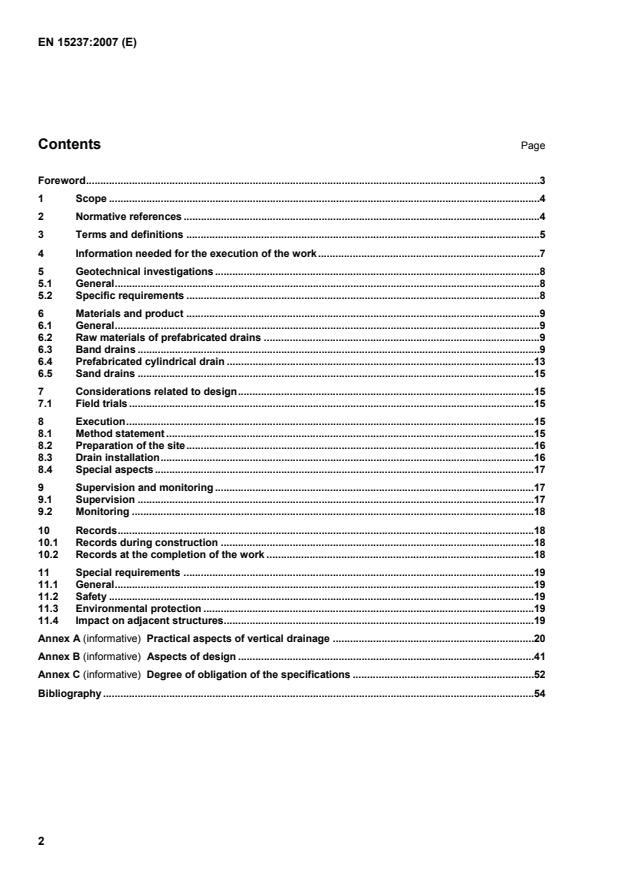
Practical aspects of vertical drainage.20 Annex B (informative)
Aspects of design.41 Annex C (informative)
Degree of obligation of the specifications.52 Bibliography.54
1) The terms “wick drains” and “prefabricated vertical drains” (PVD) are also used.
(20 % if exposed to frost); c) minimum tensile force > 1,5 kN at failure of the weakest element. The seam should not fail during the test. NOTE These values depend on the installation equipment and procedure and may need to be adjusted accordingly. 6.3.4.4 The strength of the seam, measured according to EN ISO 10321 in a range of temperatures, which apply to the project site, shall be at least 1 kN/m. 6.3.5 Discharge capacity 6.3.5.1 The discharge capacity and the filtration characteristics are the most important properties. The following factors influence the discharge capacity: a) due to increasing lateral effective pressure during the consolidation process the filter is squeezed into the channel system of the core, which reduces the channel area; b) the vertical compression of the soil taking place during the consolidation process may lead to buckling of the relatively incompressible band drains, which may reduce the channel area;
6.3.6.2 The filter sleeve should have a regular structure. 6.3.6.3 The occurrence of creases, tears, holes and/or other defects shall not be allowed. The seams of the filter sleeve shall be constructed in such a way that fines cannot intrude into the core of the band drain. 6.3.6.4 Visual inspections for damage shall be made regularly during production in accordance with the factory production control plan. 6.3.7 Tensile strength per unit width of filter 6.3.7.1 The tensile strength of the filter shall be sufficient to prevent breakage during and after installation. 6.3.7.2 Testing should be carried out in accordance with EN ISO 10319. The average of the individually measured values for the tensile strength should not be lower than 3 kN/m in the longitudinal direction. For installations deeper than 25 m or in difficult soil conditions, a minimum tensile strength of 6 kN/m in the longitudinal direction is recommended. 6.3.8 Velocity index of filter Testing should be carried out in accordance with EN ISO 11058. The average of the individually measured values of the velocity index (vh50) should be higher than 1 mm/s. In case of drain installation for liquefaction problems, the filter pore size should be adapted to ensure adequate permeability of the filter for this application, see 6.4.
Quality control 6.3.10.1 The band drain shall comply with all European requirements and conformity assessment procedures that apply to it. The properties shall be within the limits announced in the accompanying document accredited by a Notifying Body. 6.3.10.2 The filter and drain characteristics and corresponding testing methods, as well as the proposed testing frequency, are given in Table 1, adapted from EN 13252. The sampling procedure for the different testing methods shall comply with EN ISO 9862. NOTE The on-site testing frequency should be decided between the parties involved.
Thickness 25 000 m2 EN 9863-1 Mass per unit area 25 000 m2 EN 9864 Pore size 200 000 m2 EN 12956 Velocity index 200 000 m2 EN 11058 Tensile strength in the longitudinal direction 200 000 m2 EN 10319 Tensile strength in the cross direction 200 000 m2 EN 10319 Drain composite: Width and thickness 25 000 m EN 9863-1 Mass per unit length 25 000 m EN 9864 Tensile strength in the longitudinal direction 100 000 m EN 10319 Elongation at maximum tensile force 100 000 m EN 10319 Discharge capacity straight 500 000 m Annex A Discharge capacity buckled 500 000 m Annex A Tensile strength of filter seam 100 000 m EN 10321 Durability 500 000 m EN 13252 6.4 Prefabricated cylindrical drain 6.4.1 Shape and structure of cylindrical drains 6.4.1.1 A cylindrical drain consists of an annular-corrugated and perforated open core, surrounded by a filter sock. The drain diameter is typically 50 mm in outer diameter and 45 mm in inner diameter. 6.4.1.2 Tears and/or other defects shall not be allowed to occur. Visual inspections for damage shall be made regularly as part of the production quality control. 6.4.2 Measurements The diameter and thickness of the core should comply with the dimensions given by the manufacturer (within allowable deviations given by the manufacturer).
6.4.3 Durability 6.4.3.1 The durability of the drain shall comply with the durability aspects given in EN 13252 (Annex B, B.1 weathering, and B.2, required service lives up to five years or more when the drains are installed to mitigate soil liquefaction). 6.4.3.2 The drains should be protected against weathering during storage on the site. 6.4.3.3 The product shall not be exposed longer than the time announced by the producer for CE Marking (EN 13252) unless the product is protected by a wrapping material or stored in-house. The recommendations of the supplier shall be followed.
Quality control The prefabricated drain product shall comply with all European requirements and conformity assessment procedures that apply to it. The properties shall be within the limits announced in the accompanying document accredited by a Notifying Body. 6.5 Sand drains 6.5.1 The sand drain has a circular cross-section, built up of granular material with high permeability. The diameter of the sand drain can vary typically from 150 mm to 500 mm. 6.5.2 The grain size distribution of the material used for sand drains should preferably fall within the limits given in Annex A. 6.5.3 The permeability of the sand should be high enough to avoid significant well resistance. The permeability requirements depend on the permeability of the surrounding soil and the depth of drain installation (see Annex B) and should primarily be defined by the designer. 6.5.4 Material used for sand drains shall not cause pollution of soil or groundwater when installed. 7 Considerations related to design 7.1 Field trials 7.1.1 Test areas with various drain spacing and/or various drain types may be required as a basis for the final design of the drain installation work. 7.1.2 The process of consolidation in the test areas should be monitored by settlement measurement in combination with pore pressure measurement, preferably by means of settlement gauges and piezometers placed at various depths. The strength increase due to consolidation may be assessed by laboratory tests and/or in-situ tests. 7.1.3 When relevant, the horizontal displacements along the periphery of the test area may be measured by means of inclinometer. 7.1.4 In case of test areas with partially penetrating drains the influence on the consolidation process of underlying untreated soil layers should be taken into account. 8 Execution 8.1 Method statement 8.1.1 A method statement shall be prepared, which details the vertical drainage works. The method statement shall detail the location, drain grid/pattern, equipment and method of installation, possible restrictions during the construction phase and any hazards associated with the execution of the work. 8.1.2 The equipment and installation method chosen by the contractor shall be assessed and approved. 8.1.3 The following method statement shall be delivered as a minimum (see Clause 4): a) objective and scope of drain installation; b) site installation and working areas; c) plant and equipment;
...