


EN 12952-1:2015
(Main)Water-tube boilers and auxiliary installations - Part 1: General
Water-tube boilers and auxiliary installations - Part 1: General
1.1 General
This European Standard applies to water-tube boilers with volumes in excess of two litres for the generation of steam and/or hot water at a maximum allowable pressure PS greater than 0,5 bar and with a temperature in excess of 110 °C as well as auxiliary installations (other plant equipment).
The purpose of this European Standard is to ensure that the necessary essential safety requirements according to Annex I of the Pressure Equipment Directive are fulfilled in order to guarantee the safety of water tube boilers.
This aim will be achieved by:
- the proper application of the design, manufacturing, testing and inspection methods and techniques,
- the provision of protective measures against hazards, which cannot be eliminated, and
- the provision of information on residual hazards and other measures to reduce risk,
which are incorporated in the various parts of this European Standard.
The requirements of this European Standard take account of pressure-related hazards, which apply to water tube boilers, including failure of pressure-retaining components due to overheating.
This standard recognizes that it is not possible to cover all the combinations of situations that might arise.
1.2 Boiler assembly
For the purpose of this European Standard, the boiler assembly includes:
- the water-tube boiler including all the pressure parts from the feedwater inlet (including the inlet valve) up to and including the steam and/or hot water outlet (including the outlet valve or, if there is no valve, the first circumferential weld or flange downsteam of the outlet header);
- all superheaters, reheaters, economizers, that are not capable of isolation from the main system by interposing shut-off valves, associated safety accessories and interconnecting piping;
- additionally, the piping that is connected to the boiler involved in services such as draining, venting, desuperheating, etc., up to and including the first isolating valve in the tubing line downstream of the boiler;
- reheaters which are independently fired, and are separately provided with their safety accessories including all control and safety systems.
The following equipment and components can be integrated in the assembly at the discretion of the manufacturer:
- isolatable superheaters, reheaters, economizers and related interconnecting piping;
- the heat supply or firing system;
- the means of preparing and feeding the fuel to the boiler including the control systems;
- the means of providing the boiler with feedwater including the control system;
- the pressure expansion vessels and tanks of hot water generating plant.
1.3 Other plant equipment
a) The boiler supporting structural steelwork, the thermal insulation and/or brickwork and the casing;
b) the means of providing the boiler with air including the forced draught fans and air pre-heaters which are heated by the gases of combustion;
c) the facilities for moving flue gases through the boiler up to the stack inlet, including the induced draught fans and the air pollution reducing equipment located in the flue gas removal path;
d) all other equipment necessary for the operation of the boiler plant.
1.4 Exclusions
This European Standard does not apply to the following types of boiler plant:
a) boilers other than stationary boilers;
b) shell type boilers;
c) electrical boilers;
d) nuclear primary circuits, the failure of which can cause an emission of radioactivity.
Wasserrohrkessel und Anlagenkomponenten - Teil 1: Allgemeines
1.1 Allgemeines
Diese Europäische Norm gilt für Wasserrohrkessel mit einem Volumen von mehr als zwei Liter zur Erzeugung von Dampf und/oder Heißwasser mit einem zulässigen Druck von mehr als 0,5 bar und einer Temperatur über 110 °C sowie andere Anlagenkomponenten.
Zweck dieser Europäischen Norm ist die Sicherstellung der Sicherheit von Wasserrohrkesseln durch Erfüllung der erforderlichen grundlegenden Sicherheitsanforderungen nach Anhang I der Druckgeräterichtlinie.
Dieses Ziel wird erreicht durch:
die sachgemäße Anwendung der Konstruktions , Fertigungs , Prüf und Kontrollverfahren und techniken;
die Festlegung von Schutzmaßnahmen gegen Gefahren, die nicht beseitigt werden können und
die Festlegung von Hinweisen auf Restgefahren und andere Maßnahmen zur Risikoverringerung,
die in den verschiedenen Teilen dieser Europäischen Normen Reihe festgelegt sind.
Die Anforderungen dieser Europäischen Norm berücksichtigen die für Wasserrohrkessel zutreffenden druckbedingten Gefahren sowie das überhitzungsbedingte Versagen drucktragender Bauteile.
Zu beachten ist, dass es nicht möglich ist, in dieser Norm alle Kombinationen von Situationen abzudecken, die auftreten können.
1.2 Dampfkesselbaugruppe
Für die Anwendung dieser Norm umfasst die Dampfkesselbaugruppe:
den Wasserrohrkessel einschließlich aller drucktragenden Teile vom Speisewassereintritt (einschließlich Eintrittsarmatur) bis einschließlich des Dampf und/oder Heißwasseraustritts (einschließlich Austritts-armatur oder, falls dort keine Armatur vorhanden ist, der ersten Rundnaht oder dem ersten Flansch nach dem Sammler);
alle Überhitzer, Zwischenüberhitzer, Speisewasservorwärmer, das dazugehörige Sicherheitszubehör und angeschlossene Verbindungsleitungen, die vom Hauptsystem nicht durch zwischengeschaltete Absperrarmaturen abgetrennt werden können;
weiterhin die mit dem Dampfkessel verbundenen Rohrleitungen für die Entwässerung, Entlüftung, Dampfkühlung usw., bis einschließlich des ersten Absperrventils in der Rohrleitung nach dem Dampfkessel;
Zwischenüberhitzer, die unabhängig beheizt werden und mit einem eigenen Sicherheitszubehör einschließlich aller Überwachungs und Sicherheitssysteme ausgerüstet sind.
Folgende Bauteile können nach Wahl des Herstellers in die Dampfkesselbaugruppe integriert werden:
absperrbare Überhitzer, Zwischenüberhitzer, Speisewasservorwärmer und dazugehörige Verbindungs-leitungen;
Einrichtungen zur Wärmeversorgung oder Beheizung;
Einrichtungen zur Aufbereitung und Zuleitung des Brennstoffs zum Dampfkessel einschließlich der Überwachungssysteme;
Einrichtungen zur Versorgung des Dampfkessels mit Speisewasser einschließlich der Überwachungs-systeme;
Druckausdehnungsgefäße und Ausdehnungsbehälter für Anlagen zur Heißwassererzeugung.
1.3 Andere Anlagenausrüstungen
a) Das Kesselgerüst aus Stahl, die Wärmedämmung und/oder die Ausmauerung und die Ummantelung;
b) die Einrichtungen zur Luftversorgung des Dampfkessels einschließlich der Gebläse und der mit Rauchgas beheizten Luftvorwärmer;
c) die Einrichtungen zur Rauchgasführung bis zum Schornsteineintritt einschließlich der Saugzuganlagen und der in die Rauchgasführung eingebauten Anlagen zur Verminderung der Luftverunreinigungen;
d) alle anderen Einrichtungen, die für den Betrieb der Dampfkesselanlage notwendig sind.
1.4 Ausschlüsse
Diese Europäische Norm gilt nicht für folgende Arten von Dampfkesselanlagen:
a) nicht-stationäre Dampfkessel;
b) Großwasserraumkessel einschließlich der Dampfkessel mit elektrischer Beheizung;
c) nukleare Primärkreisläufe, bei denen ein Versagen zur Emission von Radioaktivität führen kann.
Chaudières à tubes d'eau et installations auxiliaires - Partie 1: Généralités
1.1 Généralités
La présente Norme européenne s'applique aux installations équipées de chaudières à tubes d'eau ayant un volume supérieur à 2 litres pour la production de vapeur et/ou d'eau surchauffée à une pression admissible supérieure à 0,5 bar et à une température supérieure à 110 C° ainsi qu'aux installations auxiliaires (autres que des équipements d'installation).
La présente Norme européenne vise à s'assurer que les exigences essentielles nécessaires de sécurité selon l'Annexe I de la Directive Équipements sous pression sont satisfaites, afin de garantir la sécurité des chaudières à tubes d'eau.
Cet objectif doit être atteint grâce à :
- l'application elle-même des méthodes et techniques de conception, fabrication, essai et contrôle ;
- l'application de mesures de protection contre les phénomènes dangereux, qui ne peuvent être écartés, et
- la transmission d'informations sur les risques résiduels et autres mesures visant à réduire les risques,
qui sont incluses dans plusieurs parties de la présente Norme européenne.
Les prescriptions de la présente Norme européenne tiennent compte des phénomènes dangereux liés à la pression concernant les chaudières à tubes d'eau, y compris la défaillance des composants sous pression en raison d'une surchauffe.
La présente norme admet qu'il n'est pas possible de couvrir toutes les combinaisons de situations susceptibles de se produire.
1.2 Ensemble chaudière
Pour les besoins de la présente norme, l'ensemble chaudière comporte :
- La chaudière à tubes d'eau, y compris l'ensemble des parties sous pression, depuis la tubulure d'entrée d'eau d'alimentation (incluant la robinetterie d'entrée) jusqu'à et y compris le collecteur de sortie de la vapeur ou de l'eau surchauffée (incluant la robinetterie de sortie ; ou si elle n'existe pas, la première soudure bout à bout ou bride en aval du collecteur de sortie).
- Tous les surchauffeurs, resurchauffeurs et économiseurs qui ne sont pas aptes à être isolés de l'installation principale par interposition de robinets de sectionnement, d'accessoires de sécurité associés et de tuyauteries de liaison.
- En complément, les tuyauteries reliées à la chaudière qui sont impliquées dans les fonctions de service telles que la purge, l'évent, la désurchauffe, etc., jusqu’à et y compris le premier robinet d’isolement rencontré sur la ligne de tuyauterie en aval de la chaudière.
- Les resurchauffeurs, qui sont soumis indépendamment à la flamme et fournis séparément avec leurs accessoires de sécurité, y compris tous les systèmes de commande et de sécurité.
Les composants suivants peuvent être intégrés dans l'assemblage au choix du fabricant :
- les surchauffeurs isolables, les resurchauffeurs, les économiseurs et les tuyauteries de liaison associées ;
- la source de chaleur ou l'équipement de chauffe ;
- les moyens de préparation et d'alimentation en carburant de la chaudière y compris les systèmes de commande ;
- les moyens d'alimentation en eau de la chaudière, y compris les systèmes de commande ;
- les vases et réservoirs d’expansion de l'installation de production d'eau surchauffée ;
Vodocevni kotli in pomožne napeljave - 1. del: Splošno
Ta evropski standard velja za vodocevne kotle s prostornino, večjo od 2 l, za izdelavo pare in/ali vroče vode pri dovoljenem tlaku, večjem od 0,5 bara, in s temperaturo, večjo od 110 °C, ter drugo opremo v obratu. Namen tega standarda je čim bolj zmanjšati nevarnosti, povezane z delovanjem vodocevnih kotlov, in zagotoviti ustrezno zaščito za omejitev nevarnosti, ki so še prisotne pri delovanju kotla.
General Information
- Status
- Published
- Publication Date
- 27-Oct-2015
- Withdrawal Date
- 29-Apr-2016
- Technical Committee
- CEN/TC 269 - Shell and water tube boilers
- Drafting Committee
- CEN/TC 269/WG 1 - Water-tube boilers
- Current Stage
- 6060 - Definitive text made available (DAV) - Publishing
- Start Date
- 28-Oct-2015
- Due Date
- 13-Mar-2016
- Completion Date
- 28-Oct-2015
- Directive
- 97/23/EC - Pressure equipment
Relations
- Effective Date
- 08-Jun-2022
- Effective Date
- 28-Jan-2026
- Effective Date
- 28-Jan-2026
- Effective Date
- 28-Jan-2026
- Effective Date
- 28-Jan-2026
- Effective Date
- 28-Jan-2026
- Effective Date
- 28-Jan-2026
- Effective Date
- 28-Jan-2026
- Effective Date
- 28-Jan-2026
- Effective Date
- 28-Jan-2026
- Effective Date
- 28-Jan-2026
- Effective Date
- 28-Jan-2026
- Effective Date
- 28-Jan-2026
- Effective Date
- 19-Jan-2023
Overview
EN 12952-1:2015 - published by CEN - defines the general requirements for water‑tube boilers and auxiliary installations. It applies to water‑tube boilers with internal volumes > 2 litres used to generate steam and/or hot water at a maximum allowable pressure (PS) > 0.5 bar and temperatures above 110 °C. The standard’s primary purpose is to ensure compliance with the essential safety requirements of the Pressure Equipment Directive (Annex I) and to harmonize design, manufacturing, testing and inspection practices for safe boiler operation.
Key topics and requirements
- Scope and applicability
- Covers the boiler assembly from the feedwater inlet up to the steam/hot‑water outlet (including valves or first downstream flange/weld).
- Includes non‑isolatable superheaters, reheaters, economizers, associated safety accessories and interconnecting piping.
- Specifies piping up to the first isolating valve downstream for services such as draining, venting and desuperheating.
- Identifies optional components that manufacturers may integrate (firing systems, feedwater systems, pressure expansion vessels, isolatable heat exchangers).
- Safety objective
- Ensures essential safety requirements are met by applying proper design, manufacturing, testing and inspection methods.
- Requires protective measures where hazards cannot be eliminated and information on residual hazards and risk‑reduction measures.
- Addresses pressure‑related hazards including failure of pressure‑retaining components due to overheating.
- Boiler assembly and other plant equipment
- Defines included and associated equipment: structural supports, thermal insulation, air supply devices (fans, air pre‑heaters), flue gas handling (induced draught fans, flue‑gas cleaning) and all necessary operational equipment.
- Exclusions
- Excludes non‑stationary boilers, shell‑type boilers, electrical boilers and nuclear primary circuits subject to radioactive release concerns.
- Series interdependency
- Part 1 is the general part of the EN 12952 series and is intended to be used in conjunction with Parts 2–18 (materials, design, construction, inspection, firing systems, safeguards, feedwater quality, flue‑gas cleaning, acceptance tests, operating instructions, etc.).
Applications - who uses it
- Boiler manufacturers and fabricators for compliant design and construction
- Designers and engineers specifying pressure parts and assemblies
- Purchasers and project managers for procurement and acceptance criteria
- Notified bodies / inspection authorities / user inspectorates for conformity assessment
- Plant operators and maintenance teams to understand assembly boundaries, safety accessories and documentation requirements
Related standards and regulatory context
- Part of the EN 12952 series (Parts 2–18 cover materials, design, workmanship, testing and specific firing and safety systems).
- Harmonized to support the essential requirements of EU Directive 2014/68/EU (Pressure Equipment Directive).
- Normative references include EN 764 and other EN 12952 parts relevant for materials, construction and inspection.
Keywords: EN 12952-1:2015, water-tube boilers, boiler safety, CEN standard, Pressure Equipment Directive, boiler design, boiler testing, boiler inspection, steam generation.

Get Certified
Connect with accredited certification bodies for this standard

DNV
DNV is an independent assurance and risk management provider.

Lloyd's Register
Lloyd's Register is a global professional services organisation specialising in engineering and technology.
DNV Energy Systems
Energy and renewable energy certification.
Sponsored listings
Frequently Asked Questions
EN 12952-1:2015 is a standard published by the European Committee for Standardization (CEN). Its full title is "Water-tube boilers and auxiliary installations - Part 1: General". This standard covers: 1.1 General This European Standard applies to water-tube boilers with volumes in excess of two litres for the generation of steam and/or hot water at a maximum allowable pressure PS greater than 0,5 bar and with a temperature in excess of 110 °C as well as auxiliary installations (other plant equipment). The purpose of this European Standard is to ensure that the necessary essential safety requirements according to Annex I of the Pressure Equipment Directive are fulfilled in order to guarantee the safety of water tube boilers. This aim will be achieved by: - the proper application of the design, manufacturing, testing and inspection methods and techniques, - the provision of protective measures against hazards, which cannot be eliminated, and - the provision of information on residual hazards and other measures to reduce risk, which are incorporated in the various parts of this European Standard. The requirements of this European Standard take account of pressure-related hazards, which apply to water tube boilers, including failure of pressure-retaining components due to overheating. This standard recognizes that it is not possible to cover all the combinations of situations that might arise. 1.2 Boiler assembly For the purpose of this European Standard, the boiler assembly includes: - the water-tube boiler including all the pressure parts from the feedwater inlet (including the inlet valve) up to and including the steam and/or hot water outlet (including the outlet valve or, if there is no valve, the first circumferential weld or flange downsteam of the outlet header); - all superheaters, reheaters, economizers, that are not capable of isolation from the main system by interposing shut-off valves, associated safety accessories and interconnecting piping; - additionally, the piping that is connected to the boiler involved in services such as draining, venting, desuperheating, etc., up to and including the first isolating valve in the tubing line downstream of the boiler; - reheaters which are independently fired, and are separately provided with their safety accessories including all control and safety systems. The following equipment and components can be integrated in the assembly at the discretion of the manufacturer: - isolatable superheaters, reheaters, economizers and related interconnecting piping; - the heat supply or firing system; - the means of preparing and feeding the fuel to the boiler including the control systems; - the means of providing the boiler with feedwater including the control system; - the pressure expansion vessels and tanks of hot water generating plant. 1.3 Other plant equipment a) The boiler supporting structural steelwork, the thermal insulation and/or brickwork and the casing; b) the means of providing the boiler with air including the forced draught fans and air pre-heaters which are heated by the gases of combustion; c) the facilities for moving flue gases through the boiler up to the stack inlet, including the induced draught fans and the air pollution reducing equipment located in the flue gas removal path; d) all other equipment necessary for the operation of the boiler plant. 1.4 Exclusions This European Standard does not apply to the following types of boiler plant: a) boilers other than stationary boilers; b) shell type boilers; c) electrical boilers; d) nuclear primary circuits, the failure of which can cause an emission of radioactivity.
1.1 General This European Standard applies to water-tube boilers with volumes in excess of two litres for the generation of steam and/or hot water at a maximum allowable pressure PS greater than 0,5 bar and with a temperature in excess of 110 °C as well as auxiliary installations (other plant equipment). The purpose of this European Standard is to ensure that the necessary essential safety requirements according to Annex I of the Pressure Equipment Directive are fulfilled in order to guarantee the safety of water tube boilers. This aim will be achieved by: - the proper application of the design, manufacturing, testing and inspection methods and techniques, - the provision of protective measures against hazards, which cannot be eliminated, and - the provision of information on residual hazards and other measures to reduce risk, which are incorporated in the various parts of this European Standard. The requirements of this European Standard take account of pressure-related hazards, which apply to water tube boilers, including failure of pressure-retaining components due to overheating. This standard recognizes that it is not possible to cover all the combinations of situations that might arise. 1.2 Boiler assembly For the purpose of this European Standard, the boiler assembly includes: - the water-tube boiler including all the pressure parts from the feedwater inlet (including the inlet valve) up to and including the steam and/or hot water outlet (including the outlet valve or, if there is no valve, the first circumferential weld or flange downsteam of the outlet header); - all superheaters, reheaters, economizers, that are not capable of isolation from the main system by interposing shut-off valves, associated safety accessories and interconnecting piping; - additionally, the piping that is connected to the boiler involved in services such as draining, venting, desuperheating, etc., up to and including the first isolating valve in the tubing line downstream of the boiler; - reheaters which are independently fired, and are separately provided with their safety accessories including all control and safety systems. The following equipment and components can be integrated in the assembly at the discretion of the manufacturer: - isolatable superheaters, reheaters, economizers and related interconnecting piping; - the heat supply or firing system; - the means of preparing and feeding the fuel to the boiler including the control systems; - the means of providing the boiler with feedwater including the control system; - the pressure expansion vessels and tanks of hot water generating plant. 1.3 Other plant equipment a) The boiler supporting structural steelwork, the thermal insulation and/or brickwork and the casing; b) the means of providing the boiler with air including the forced draught fans and air pre-heaters which are heated by the gases of combustion; c) the facilities for moving flue gases through the boiler up to the stack inlet, including the induced draught fans and the air pollution reducing equipment located in the flue gas removal path; d) all other equipment necessary for the operation of the boiler plant. 1.4 Exclusions This European Standard does not apply to the following types of boiler plant: a) boilers other than stationary boilers; b) shell type boilers; c) electrical boilers; d) nuclear primary circuits, the failure of which can cause an emission of radioactivity.
EN 12952-1:2015 is classified under the following ICS (International Classification for Standards) categories: 27.040 - Gas and steam turbines. Steam engines. The ICS classification helps identify the subject area and facilitates finding related standards.
EN 12952-1:2015 has the following relationships with other standards: It is inter standard links to EN 12952-1:2001, EN 12952-6:2011, EN 764-5:2014, EN 764-1:2015+A1:2016, EN 764-4:2014, EN 12952-5:2011, EN 764-7:2002, EN 764-2:2012, EN 12952-10:2021, CR 12952-17:2002, EN 12952-6:2021, EN 12952-5:2021, EN 12952-3:2022, prEN 12952-1. Understanding these relationships helps ensure you are using the most current and applicable version of the standard.
EN 12952-1:2015 is associated with the following European legislation: EU Directives/Regulations: 2014/68/EU, 97/23/EC; Standardization Mandates: M/071. When a standard is cited in the Official Journal of the European Union, products manufactured in conformity with it benefit from a presumption of conformity with the essential requirements of the corresponding EU directive or regulation.
EN 12952-1:2015 is available in PDF format for immediate download after purchase. The document can be added to your cart and obtained through the secure checkout process. Digital delivery ensures instant access to the complete standard document.
Standards Content (Sample)
2003-01.Slovenski inštitut za standardizacijo. Razmnoževanje celote ali delov tega standarda ni dovoljeno.Vodocevni kotli in pomožne napeljave - 1. del: SplošnoWasserrohrkessel und Anlagenkomponenten - Teil 1: AllgemeinesChaudières à tubes d'eau et installations auxiliaires - Partie 1 : GénéralitésWater-tube boilers and auxiliary installations - Part 1: General27.060.30Grelniki vode in prenosniki toploteBoilers and heat exchangersICS:Ta slovenski standard je istoveten z:EN 12952-1:2015SIST EN 12952-1:2016en,fr,de01-februar-2016SIST EN 12952-1:2016SLOVENSKI
STANDARDSIST EN 12952-1:20021DGRPHãþD
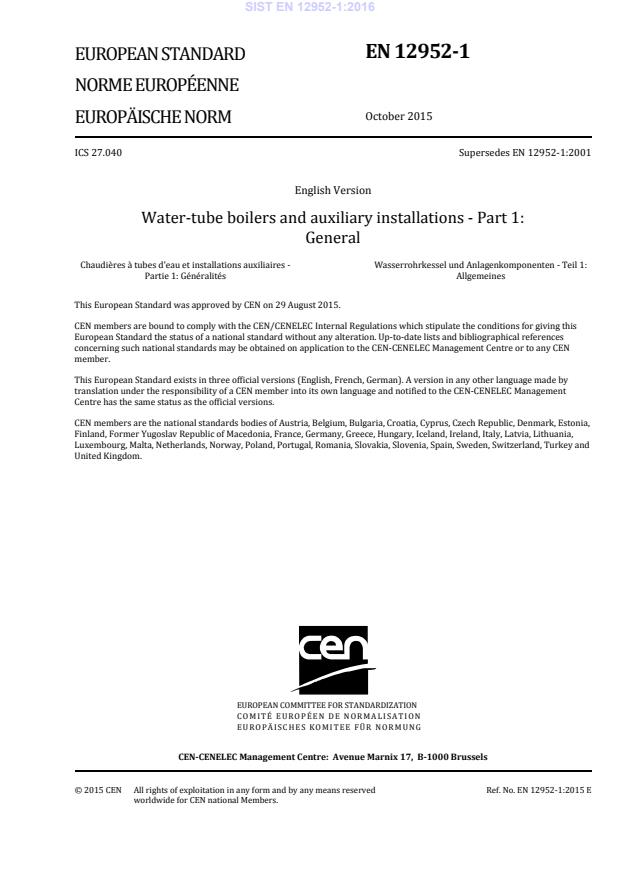
EUROPEAN STANDARD NORME EUROPÉENNE EUROPÄISCHE NORM
EN 12952-1
October
t r s w ICS
t yä r v r Supersedes EN
s t { w tæ sã t r r sEnglish Version
Waterætube boilers and auxiliary installations æ Part
sã General Chaudières à tubes d 5eau et installations auxiliaires æ Partie
sã Généralités
Wasserrohrkessel und Anlagenkomponenten æ Teil
sã Allgemeines This European Standard was approved by CEN on
t { August
t r s wä
egulations which stipulate the conditions for giving this European Standard the status of a national standard without any alterationä Upætoædate lists and bibliographical references concerning such national standards may be obtained on application to the CENæCENELEC Management Centre or to any CEN memberä
translation under the responsibility of a CEN member into its own language and notified to the CENæCENELEC Management Centre has the same status as the official versionsä
CEN members are the national standards bodies of Austriaá Belgiumá Bulgariaá Croatiaá Cyprusá Czech Republicá Denmarká Estoniaá Finlandá Former Yugoslav Republic of Macedoniaá Franceá Germanyá Greeceá Hungaryá Icelandá Irelandá Italyá Latviaá Lithuaniaá Luxembourgá Maltaá Netherlandsá Norwayá Polandá Portugalá Romaniaá Slovakiaá Sloveniaá Spainá Swedená Switzerlandá Turkey and United Kingdomä
EUROPEAN COMMITTEE FOR STANDARDIZATION COMITÉ EUROPÉEN DE NORMALISATION EUROPÄISCHES KOMITEE FÜR NORMUNG
CEN-CENELEC Management Centre:
Avenue Marnix 17,
B-1000 Brussels
t r s w CEN All rights of exploitation in any form and by any means reserved worldwide for CEN national Membersä Refä Noä EN
s t { w tæ sã t r s w ESIST EN 12952-1:2016
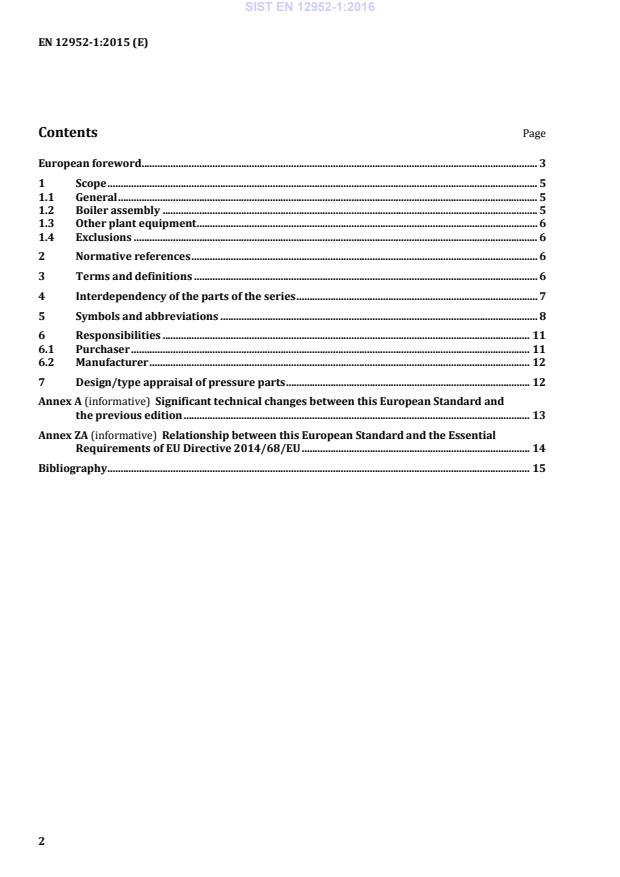
Significant technical changes between this European Standard and the previous edition . 13 Annex ZA (informative)
Relationship between this European Standard and the Essential Requirements of EU Directive 2014/68/EU . 14 Bibliography . 15
...
Questions, Comments and Discussion
Ask us and Technical Secretary will try to provide an answer. You can facilitate discussion about the standard in here.
Loading comments...