

EN 1877-2:2000
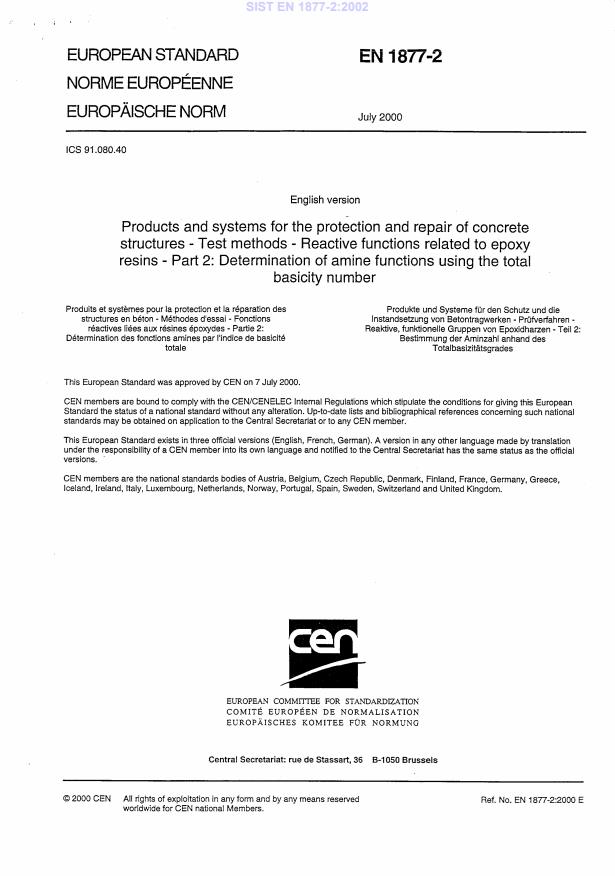
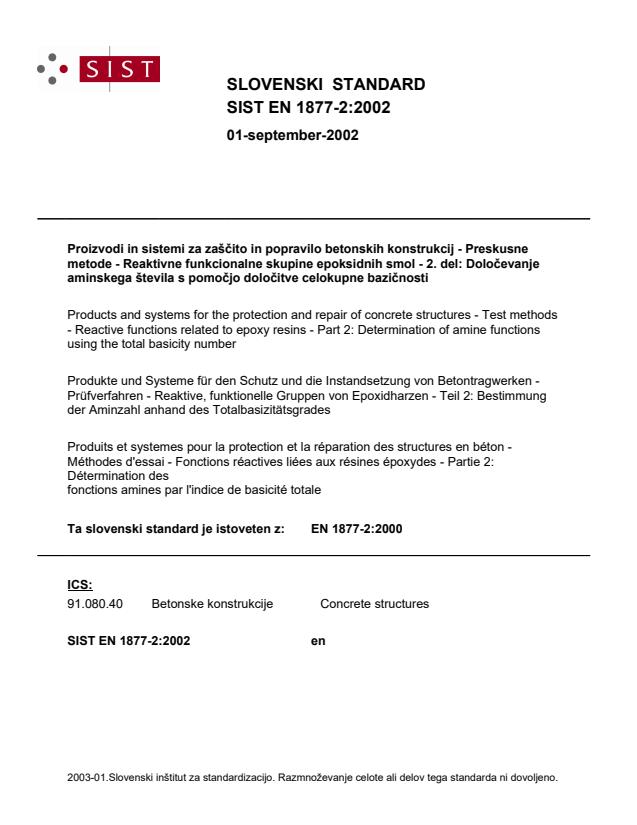
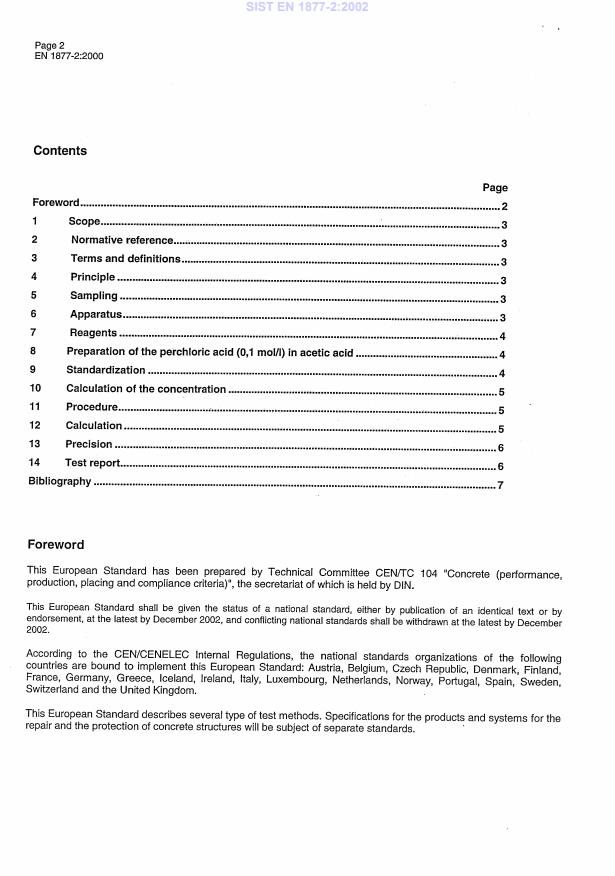
(Main)Products and systems for the protection and repair of concrete structures - Test methods - Reactive functions related to epoxy resins - Part 2: Determination of amine functions using the total basicity number
- Abstract
This European Standard describes a method for determining total basicity number of amines and is applicable to amine-based hardeners used in the epoxy resins.
- Status
- Published
- Publication Date
- 18-Jul-2000
- Technical Committee
- CEN/TC 104 - Concrete ( performance, production, placing and compliance criteria )
- Drafting Committee
- CEN/TC 104/SC 8/WG 1 - Surface protection systems
- Current Stage
- 9020 - Submission to 2 Year Review Enquiry - Review Enquiry
- Start Date
- 15-Jul-2026
- Completion Date
- 15-Jul-2026

Overview
EN 1877-2:2000 is a European Standard issued by CEN focusing on test methods related to epoxy resins used in the protection and repair of concrete structures. Specifically, this part of the standard establishes a method for determining the total basicity number of amines. The total basicity number quantifies the amine functions present in amine-based hardeners commonly used with epoxy resin systems. Accurate measurement of these reactive amine functions is essential for assessing the quality and performance of epoxy-based products designed for concrete repair applications.
This standard provides a reliable and reproducible test procedure, ensuring consistency in evaluating amine hardeners that influence the curing and mechanical properties of epoxy coatings and adhesives. By adhering to EN 1877-2:2000, manufacturers and testing laboratories can optimize product performance and ensure compliance with quality requirements in structural concrete protection.
Key Topics
- Scope: Determination of the total basicity number for amine-based hardeners used in epoxy resins.
- Test Methodology: A chemical analysis procedure designed to measure the total amine content through quantitative titration or equivalent analytical techniques.
- Reactive Functions: Focus on the amine groups that react with epoxy components during resin curing.
- Application to Concrete Repair: Ensures the effectiveness of epoxy systems in concrete protection and restoration projects.
- Quality Assurance: Provides a standardized approach to verifying amine hardener characteristics, reducing variability in product performance.
- Relevance to Epoxy Systems: Critical for products and systems used in the protection and repair of reinforced concrete structures.
Applications
EN 1877-2:2000 is widely applicable in industries and sectors involved in the maintenance, repair, and strengthening of concrete infrastructure. Typical applications include:
- Concrete Repair Products: Quality control of epoxy-based adhesives, coatings, and mortars used for repairing cracks, spalls, and damaged concrete elements.
- Protective Coatings: Evaluation of amine hardeners in epoxy coatings applied to concrete surfaces for durability and chemical resistance.
- Structural Strengthening Systems: Verification of epoxy resin systems used in composite structural reinforcement.
- Research and Development: Analysis of new epoxy formulations requiring precise determination of reactive amine functions.
- Construction and Civil Engineering: Ensuring high performance of epoxy materials used in bridges, tunnels, buildings, and other concrete structures.
Using the test method defined in EN 1877-2 contributes to improved reliability and longevity of epoxy-based repair systems, ultimately enhancing the safety and durability of concrete infrastructure.
Related Standards
For comprehensive quality and performance evaluation of epoxy resins and systems used in concrete protection and repair, EN 1877-2:2000 should be considered alongside other relevant standards, such as:
- EN 1504 Series – Standards covering products and systems for the protection and repair of concrete structures, including performance requirements.
- EN 1877-1 – Part 1 of this standard series, addressing general reactive functions related to epoxy resins.
- EN ISO 1465 – Methods for determining amine content in resin systems.
- EN 13892 – Test methods for resin-based mortars and coatings.
- ISO 9001 – Quality management systems applicable to manufacturers of construction products.
By integrating the EN 1877-2:2000 testing method into the broader framework of construction material standards, manufacturers and engineers can ensure compliance with European regulations and achieve optimal durability in concrete protection and repair projects.
Keywords: EN 1877-2:2000, epoxy resin test methods, amine functions, total basicity number, concrete repair, concrete protection, epoxy hardeners, reactive groups, construction standards, European Standard, CEN, epoxy resin curing, quality control epoxy systems, concrete infrastructure maintenance.
Relations
- Effective Date
- 28-Jan-2026
- Effective Date
- 28-Jan-2026
- Effective Date
- 28-Jan-2026
- Effective Date
- 28-Jan-2026
- Effective Date
- 28-Jan-2026
- Referred By
EN 15274:2015 - General purpose adhesives for structural assembly - Requirements and test methods - Effective Date
- 28-Jan-2026
- Referred By
EN 15274:2007 - General purpose adhesives for structural assembly - Requirements and test methods - Effective Date
- 28-Jan-2026
- Effective Date
- 28-Jan-2026
- Effective Date
- 28-Jan-2026
- Effective Date
- 22-Dec-2008
Get Certified
Connect with accredited certification bodies for this standard

DIBt (Deutsches Institut für Bautechnik)
German Institute for Building Technology.
DIN CERTCO
DIN Group product certification.

Aboma Certification B.V.
Specialized in construction, metal, and transport sectors.
Sponsored listings
Frequently Asked Questions
EN 1877-2:2000 is a standard published by the European Committee for Standardization (CEN). Its full title is "Products and systems for the protection and repair of concrete structures - Test methods - Reactive functions related to epoxy resins - Part 2: Determination of amine functions using the total basicity number". This standard covers: This European Standard describes a method for determining total basicity number of amines and is applicable to amine-based hardeners used in the epoxy resins.
This European Standard describes a method for determining total basicity number of amines and is applicable to amine-based hardeners used in the epoxy resins.
EN 1877-2:2000 is classified under the following ICS (International Classification for Standards) categories: 91.080.40 - Concrete structures. The ICS classification helps identify the subject area and facilitates finding related standards.
EN 1877-2:2000 has the following relationships with other standards: It is inter standard links to EN ISO 15528:2020, EN 1504-6:2006, EN 1504-3:2005, EN 1504-5:2004, EN 1504-7:2006, EN 15274:2015, EN 15274:2007, EN 1504-5:2013, EN 1504-2:2004; is excused to EN 1877-1:2000. Understanding these relationships helps ensure you are using the most current and applicable version of the standard.
EN 1877-2:2000 is associated with the following European legislation: EU Directives/Regulations: 305/2011, 89/106/EEC. When a standard is cited in the Official Journal of the European Union, products manufactured in conformity with it benefit from a presumption of conformity with the essential requirements of the corresponding EU directive or regulation.
EN 1877-2:2000 is available in PDF format for immediate download after purchase. The document can be added to your cart and obtained through the secure checkout process. Digital delivery ensures instant access to the complete standard document.
Standards Content (Sample)
2003-01.Slovenski inštitut za standardizacijo. Razmnoževanje celote ali delov tega standarda ni dovoljeno.Produkte und Systeme für den Schutz und die Instandsetzung von Betontragwerken - Prüfverfahren - Reaktive, funktionelle Gruppen von Epoxidharzen - Teil 2: Bestimmung der Aminzahl anhand des TotalbasizitätsgradesProduits et systemes pour la protection et la réparation des structures en béton - Méthodes d'essai - Fonctions réactives liées aux résines époxydes - Partie 2: Détermination desfonctions amines par l'indice de basicité totaleProducts and
...