

EN 1504-5:2013
(Main)Products and systems for the protection and repair of concrete structures - Definitions, requirements, quality control and evaluation of conformity - Part 5: Concrete injection
- Abstract
This European Standard specifies requirements and conformity criteria for the identification, performance (including durability aspects) and safety of injection products for the repair and protection of concrete structures, used for:
- force transmitting filling of cracks, voids and interstices in concrete (category F, see 3.1);
- ductile filling of cracks, voids and interstices in concrete (category D, see 3.1);
- swelling fitted filling of cracks, voids and interstices in concrete (category S, see 3.1).
The performance requirements in this part of this document may not be applicable to highly specialised applications in extreme environmental conditions, e.g. cryogenic use, nor do they cover specialised circumstances such as accidental impact, e.g. due to traffic or ice, or earthquake loading, where specific performance requirements will apply.
This European Standard does not cover:
- the treatment of cracks by widening them and sealing them with an elastomeric sealing compound;
- external filling of cavities, that is, the placement of product outside the structure (generally within the surrounding foundation soils, or at the interface between the structure and the soil); this is covered by EN 12715 [2], under contact grouting;
- preliminary injection works, if necessary, to temporarily stop water passage during waterproofing injection.
- Status
- Published
- Publication Date
- 09-Apr-2013
- Withdrawal Date
- 30-Oct-2013
- Technical Committee
- CEN/TC 104 - Concrete ( performance, production, placing and compliance criteria )
- Drafting Committee
- CEN/TC 104/SC 8/WG 4 - Injection products
- Current Stage
- 9092 - Decision on results of review/2YR ENQ - revise - Review Enquiry
- Start Date
- 13-May-2020
- Completion Date
- 07-Oct-2026



Overview
EN 1504-5:2013 is the CEN European Standard that sets requirements for concrete injection products and systems used in the repair and protection of concrete structures. It defines identification, performance (including durability), safety and conformity criteria for injection materials used to fill cracks, voids and interstices. The standard covers three main product categories - force-transmitting (F), ductile (D) and swelling (S) injection products - and applies to both polymer- and hydraulic-based injection systems. It also addresses factory production control, sampling, initial type testing and CE marking requirements under the Construction Products Directive.
Key topics and requirements
- Scope and exclusions
- Specifies injection use for waterproofing, corrosion protection and structural strengthening.
- Excludes elastomeric crack sealing by widening, external cavity filling (contact grouting covered by EN 12715) and temporary pre-injection for waterproofing.
- Not intended for highly specialised extreme-environment or accidental-impact/earthquake loading conditions.
- Product classification
- Category F: force-transmitting injections that bond and transmit stresses across cracks.
- Category D: ductile injections that allow subsequent movement.
- Category S: swelling (gel) injections for repeated water adsorption and waterproofing.
- Binder types: reactive polymer (P) and hydraulic (H).
- Performance and durability
- Requirements for injectability, adhesion to concrete, watertightness, dimensional stability, and mechanical behaviour (including limited ductility tests).
- Definitions of pot life and workable time for mixed products (test sample guidance included).
- Quality control & conformity
- Initial type-testing, factory production control (FPC) and assessment/surveillance procedures.
- Marking, labelling and Annex ZA guidance for CE marking and declaration of conformity.
Applications
- Waterproofing cracked concrete elements (basements, tunnels, retaining walls)
- Preventing reinforcement corrosion by sealing ingress paths
- Restoring structural integrity and load transfer across cracked concrete (injections for bonding and strengthening)
- Filling voids and service ducts where internal consolidation is required
Who uses this standard
- Structural and repair engineers specifying injection systems
- Product manufacturers and suppliers preparing technical data and CE declarations
- Contractors and applicators executing concrete injection works
- Testing laboratories performing conformity and performance tests
- Asset owners and facility managers seeking durable concrete repair solutions
Related standards
- EN 1504 series (Parts 1, 8, 9) - general definitions, quality control and principles for use
- Specific test methods referenced in EN 1504-5 such as EN 1771 (injectability), EN 14068 (watertightness of injected cracks), EN 14497 (filtration stability) and others listed in the normative references.
By following EN 1504-5:2013, stakeholders ensure consistent specification, testing and use of injection products for reliable concrete repair, durability and safety.
Relations
- Effective Date
- 17-Apr-2013
- Effective Date
- 09-Feb-2026
- Effective Date
- 28-Jan-2026
- Effective Date
- 28-Jan-2026
- Effective Date
- 28-Jan-2026
- Effective Date
- 28-Jan-2026
- Effective Date
- 28-Jan-2026
- Effective Date
- 28-Jan-2026
- Refers
EN 196-3:2016 - Methods of testing cement - Part 3: Determination of setting times and soundness - Effective Date
- 28-Jan-2026
- Effective Date
- 28-Jan-2026
- Effective Date
- 28-Jan-2026
- Effective Date
- 28-Jan-2026
- Effective Date
- 28-Jan-2026
- Effective Date
- 28-Jan-2026
- Effective Date
- 28-Jan-2026
Get Certified
Connect with accredited certification bodies for this standard

DIBt (Deutsches Institut für Bautechnik)
German Institute for Building Technology.
DIN CERTCO
DIN Group product certification.

Aboma Certification B.V.
Specialized in construction, metal, and transport sectors.
Sponsored listings
Frequently Asked Questions
EN 1504-5:2013 is a standard published by the European Committee for Standardization (CEN). Its full title is "Products and systems for the protection and repair of concrete structures - Definitions, requirements, quality control and evaluation of conformity - Part 5: Concrete injection". This standard covers: This European Standard specifies requirements and conformity criteria for the identification, performance (including durability aspects) and safety of injection products for the repair and protection of concrete structures, used for: - force transmitting filling of cracks, voids and interstices in concrete (category F, see 3.1); - ductile filling of cracks, voids and interstices in concrete (category D, see 3.1); - swelling fitted filling of cracks, voids and interstices in concrete (category S, see 3.1). The performance requirements in this part of this document may not be applicable to highly specialised applications in extreme environmental conditions, e.g. cryogenic use, nor do they cover specialised circumstances such as accidental impact, e.g. due to traffic or ice, or earthquake loading, where specific performance requirements will apply. This European Standard does not cover: - the treatment of cracks by widening them and sealing them with an elastomeric sealing compound; - external filling of cavities, that is, the placement of product outside the structure (generally within the surrounding foundation soils, or at the interface between the structure and the soil); this is covered by EN 12715 [2], under contact grouting; - preliminary injection works, if necessary, to temporarily stop water passage during waterproofing injection.
This European Standard specifies requirements and conformity criteria for the identification, performance (including durability aspects) and safety of injection products for the repair and protection of concrete structures, used for: - force transmitting filling of cracks, voids and interstices in concrete (category F, see 3.1); - ductile filling of cracks, voids and interstices in concrete (category D, see 3.1); - swelling fitted filling of cracks, voids and interstices in concrete (category S, see 3.1). The performance requirements in this part of this document may not be applicable to highly specialised applications in extreme environmental conditions, e.g. cryogenic use, nor do they cover specialised circumstances such as accidental impact, e.g. due to traffic or ice, or earthquake loading, where specific performance requirements will apply. This European Standard does not cover: - the treatment of cracks by widening them and sealing them with an elastomeric sealing compound; - external filling of cavities, that is, the placement of product outside the structure (generally within the surrounding foundation soils, or at the interface between the structure and the soil); this is covered by EN 12715 [2], under contact grouting; - preliminary injection works, if necessary, to temporarily stop water passage during waterproofing injection.
EN 1504-5:2013 is classified under the following ICS (International Classification for Standards) categories: 91.080.40 - Concrete structures. The ICS classification helps identify the subject area and facilitates finding related standards.
EN 1504-5:2013 has the following relationships with other standards: It is inter standard links to EN 1504-5:2004, ISO 13320:2009, EN ISO 527-1:2019, EN 445:2007, EN ISO 3251:2019, EN 12618-1:2003, EN 1242:2013, EN 14498:2004, EN 196-3:2016, EN 12618-2:2004, EN ISO 3219-1:2021, EN 14068:2003, EN ISO 9514:2019, EN 1543:1998, EN 12614:2004. Understanding these relationships helps ensure you are using the most current and applicable version of the standard.
EN 1504-5:2013 is associated with the following European legislation: EU Directives/Regulations: 305/2011, 89/106/EEC; Standardization Mandates: M/128. When a standard is cited in the Official Journal of the European Union, products manufactured in conformity with it benefit from a presumption of conformity with the essential requirements of the corresponding EU directive or regulation.
EN 1504-5:2013 is available in PDF format for immediate download after purchase. The document can be added to your cart and obtained through the secure checkout process. Digital delivery ensures instant access to the complete standard document.
Standards Content (Sample)
2003-01.Slovenski inštitut za standardizacijo. Razmnoževanje celote ali delov tega standarda ni dovoljeno.Produkte und Systeme für den Schutz und die Instandsetzung von Betontragwerken - Definitionen, Anforderungen, Qualitätsüberwachung und Beurteilung der Konformität - Teil 5: Injektion von BetonbauteilenProduits et systèmes pour la protection et la réparation des structures en béton - Définitions, exigences, maîtrise de la
qualité et évaluation de la conformité - Partie 5 : Produits et systèmes d'injection du bétonProducts and systems for the protection and repair of concrete structures - Definitions, requirements, quality control and evaluation of conformity - Part 5: Concrete injection91.080.40Betonske konstrukcijeConcrete structuresICS:Ta slovenski standard je istoveten z:EN 1504-5:2013SIST EN 1504-5:2013en,fr,de01-september-2013SIST EN 1504-5:2013SLOVENSKI
STANDARDSIST EN 1504-5:20051DGRPHãþD
EUROPEAN STANDARD NORME EUROPÉENNE EUROPÄISCHE NORM
EN 1504-5
April 2013 ICS 91.080.40 Supersedes EN 1504-5:2004English Version
Products and systems for the protection and repair of concrete structures - Definitions, requirements, quality control and evaluation of conformity - Part 5: Concrete injection
Produits et systèmes pour la protection et la réparation des structures en béton - Définitions, exigences, maîtrise de la
qualité et évaluation de la conformité - Partie 5 : Produits et systèmes d'injection du béton
Produkte und Systeme für den Schutz und die Instandsetzung von Betontragwerken - Definitionen, Anforderungen, Qualitätsüberwachung und Beurteilung der Konformität - Teil 5: Injektion von Betonbauteilen This European Standard was approved by CEN on 20 January 2013.
CEN members are bound to comply with the CEN/CENELEC Internal Regulations which stipulate the conditions for giving this European Standard the status of a national standard without any alteration. Up-to-date lists and bibliographical references concerning such national standards may be obtained on application to the CEN-CENELEC Management Centre or to any CEN member.
This European Standard exists in three official versions (English, French, German). A version in any other language made by translation under the responsibility of a CEN member into its own language and notified to the CEN-CENELEC Management Centre has the same status as the official versions.
CEN members are the national standards bodies of Austria, Belgium, Bulgaria, Croatia, Cyprus, Czech Republic, Denmark, Estonia, Finland, Former Yugoslav Republic of Macedonia, France, Germany, Greece, Hungary, Iceland, Ireland, Italy, Latvia, Lithuania, Luxembourg, Malta, Netherlands, Norway, Poland, Portugal, Romania, Slovakia, Slovenia, Spain, Sweden, Switzerland, Turkey and United Kingdom.
EUROPEAN COMMITTEE FOR STANDARDIZATION
COMITÉ EUROPÉEN DE NORMALISATION EUROPÄISCHES KOMITEE FÜR NORMUNG
Management Centre:
Avenue Marnix 17,
B-1000 Brussels © 2013 CEN All rights of exploitation in any form and by any means reserved worldwide for CEN national Members. Ref. No. EN 1504-5:2013: ESIST EN 1504-5:2013
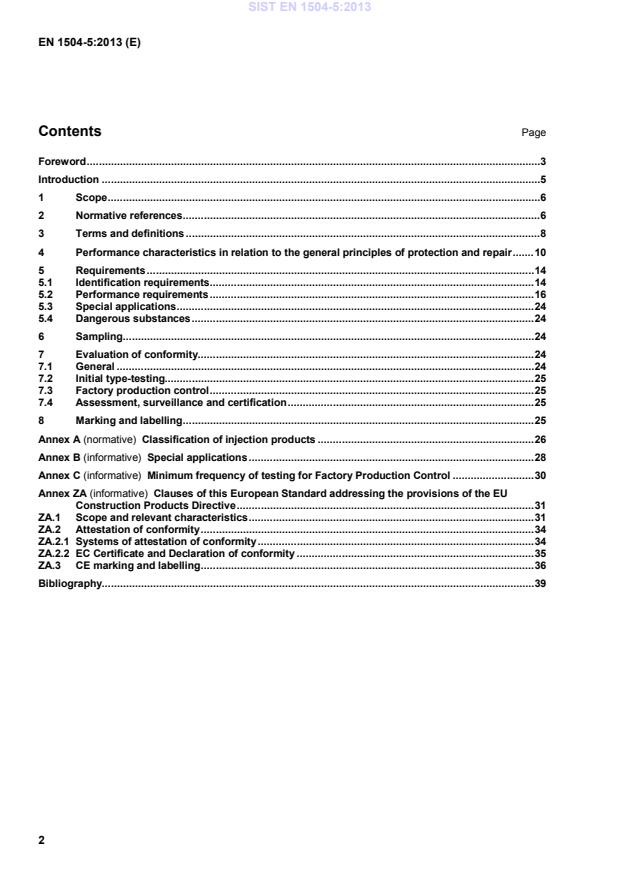
Classification of injection products . 26 Annex B (informative)
Special applications . 28 Annex C (informative)
Minimum frequency of testing for Factory Production Control . 30 Annex ZA (informative)
Clauses of this European Standard addressing the provisions of the EU Construction Products Directive . 31 ZA.1 Scope and relevant characteristics . 31 ZA.2 Attestation of conformity . 34 ZA.2.1 Systems of attestation of conformity . 34 ZA.2.2 EC Certificate and Declaration of conformity . 35 ZA.3 CE marking and labelling . 36 Bibliography. 39
c) revision of normative references; d) renumbering of the tables. EN 1504 consists of the following parts, under the general title Products and systems for the protection and repair of concrete structures — Definitions, requirements, quality control and evaluation of conformity: Part 1: Definitions; Part 2: Surface protection systems for concrete; Part 3: Structural and non-structural repair; Part 4: Structural bonding; Part 5: Concrete injection; Part 6: Anchoring of reinforcing steel bar; Part 7: Reinforcement corrosion protection; Part 8: Quality control and evaluation of conformity; Part 9: General principles for the use of products and systems; Part 10: Site application of products and systems and quality control of the works. Part 5 of EN 1504 includes a normative Annex A dealing with classification, an informative Annex B dealing with special applications and an informative Annex C dealing with Factory Production Control on products. SIST EN 1504-5:2013
Injection products can be classified in three categories, according to the intended use. 3.1.1 injection product for force transmitting filling of cracks, voids and interstices in concrete
(F) product able to bond to the concrete surface and transmit forces across it Note 1 to entry:
Products for injection for force transmitting filling of cracks, voids and interstices can also be used for saturation without receiving a force transmitting bond. Note 2 to entry:
Unless otherwise stated, injection products are intended for filling of cracks, voids and interstices, so that in the following only the wording injection products for filling of cracks is used. 3.1.2 injection product for ductile filling of cracks, voids and interstices in concrete (D) flexible product which is able to accommodate subsequent movement 3.1.3 injection product for swelling fitted filling of cracks, voids and interstices in concrete (S) product which is able, in the reacted state, to swell repeatedly by water adsorption, where the water molecules are bonded to the molecules of the injection product Note 1 to entry:
This category of products, referred to as gels, are only used for waterproofing purposes for cracks and voids in damp, wet and water - flow conditions.
3.2 injection product formulated with reactive polymer binder
(P) product where the hardening is related to the curing of a reactive polymer binder; the reactive part of a polymer binder involved in the hardening of the binder is the functional group 3.3 injection product formulated with hydraulic binder
(H) product where the hardening is related to the hydration reaction of an hydraulic binder 3.4 pot life for injection products
period of time taken by the freshly mixed product to:
to reach a viscosity of 1 000 mPa·s to reach a recorded lowering of the filtration stability for injection products formulated with hydraulic binder Note 1 to entry:
Pot life is an identification test carried out under standard laboratory conditions. Note 2 to entry:
Test sample: 1 000 ml. 3.5 workable time for injection products period of time the mixed injection product remains workable in the batch quantities used and at the limit of conditions that the product is fit for the purpose of use
Note 1 to entry:
The workable time is given by the manufacturer. Note 2 to entry:
The workable time depends on temperature, humidity, volume of mixed product (A+B), reactivity of the product, technology of injection. Reactivity of the product and volume of mixed product are best chosen according to those various parameters and to the anticipated time necessary to inject the concrete structure. 3.6 crack width width of the crack measured on the not mechanical treated surface of the concrete 3.7 injectability ability of an injection product to penetrate in a crack, which is given by the minimum crack width into which the product is injectable Note 1 to entry:
Following crack widths are considered: 0,1mm | 0,2 mm | 0,3 mm | 0,5 mm | 0,8 mm. Note 2 to entry:
Crack width is expressed in millimetres. Note 3 to entry:
The injectability is declared by the manufacturer, and tested with the injectability test(s) (see Clause 4). 3.8 moisture state of the crack, voids or interstices water content in the crack or flowing from the crack Note 1 to entry:
The following conditions are considered: dry, damp, wet, flowing water. 3.8.1
dry no water in the crack or on the crack flanks; migration of water in the crack is excluded during injection and hardening of injection product Note 1 to entry:
A dry crack is indicated if the colour of the crack and dry surface concrete is the same. 3.8.2
damp no water in the crack, water on the crack flanks, however without a water layer on the surface of the flanks Note 1 to entry:
A difference of colour between the crack surface and the dry surface concrete gives evidence of a damp crack. SIST EN 1504-5:2013
The presence of water drops on the crack surface is characteristic of a wet crack. 3.8.4
flowing water water that flows through the crack, voids or interstices Note 1 to entry:
The manufacturer will indicate the moisture state or states with which the product is compatible, based on the results of the injectability and other relevant performance tests specified in Clause 4. 3.9 crack movement change of crack width as a function of time and actions on structures Note 1 to entry: Actions on structures are induced by: mechanical influences (e.g. by traffic); physical influences, which can be daily (for example due to exposure to the sun, change of temperature) or seasonally. Note 2 to entry:
Traffic induced crack movements of 10 µm to 15 µm during cure do not influence the adhesion of injection products formulated with reactive polymer binder. Note 3 to entry:
Gels will not be used for cracks submitted to daily movements unless also injected in excess outside the structure. Note 4 to entry:
Injection products formulated with hydraulic binder will not be used for the injection of cracks submitted to high frequency changes during hardening. These products are normally not used for injection of cracks submitted to daily changes during hardening, unless it can be proved that the adhesion on concrete will be higher than 2 N/mm2 within 10 h at the minimum use temperature. 4 Performance characteristics in relation to the general principles of protection and repair Tables 1, 2 and 3 list the performance characteristics of concrete injection products which are required for “all intended uses” or “for certain intended uses” according to the “principles” and “methods” defined in
EN 1504-9. Performance characteristics which are required for “all intended uses” are marked with 9. All other performance characteristics which are marked with : may be required for “certain intended uses”. See Annex B for special applications. The performance characteristics of products are classified as follows: basic characteristics, compressive strength, strength related to adhesion, volume change (shrinkage), compatibility with steel and concrete, glass transition temperature, watertightness essential for the intended use; workability characteristics, related to the work conditions which the product can be used for (width, moisture state of the crack); these characteristics are declared by the manufacturer, and tested accordingly; reactivity characteristics, related to the workable time and the development of strength; durability, related to the long term behaviour of the hardened product under climatic conditions. NOTE Workability and reactivity characteristics are product characteristics for the designer and contractor. SIST EN 1504-5:2013
Compressive strength (H) 9 Adhesion by slant shear strength (H, P) : Non-volatile matter (P) 9 Bleeding (H) 9 Volume change (H) 9 Glass transition temperature (P) : Chloride content (H) : WORKABILITY CHARACTERISTICS Injectability into dry medium
crack widths: 0,1 mm – 0,2 mm – 0,3 mm: determination of injectability and splitting test (H, P) crack widths: 0,5 mm – 0,8 mm or where EN 1771 is not suitable : covered by: adhesion by tensile bond strength (H, P) 9
Injectability into non-dry medium crack widths: 0,1 mm – 0,2 mm – 0,3 mm: determination of injectability and splitting test (H, P) crack widths: 0,5 mm – 0,8 mm or where EN 1771 is not suitable: covered by: adhesion by tensile bond strength (H, P) 9 Viscosity (P) 9 Time of efflux (H) 9 REACTIVITY CHARACTERISTICS Workable time (H, P) 9 Tensile strength development for polymers (P) 9 Setting time (H) 9 DURABILITY Adhesion by tensile bond strength after thermal and wet-drying cycles (H, P) 9 Compatibility with concrete (H, P) 9 9 For all intended uses. : For certain intended uses. (H) Injection product formulated with hydraulic binder. (P) Injection product formulated with reactive polymer binder.
crack widths: 0,1 mm – 0,2 mm – 0,3 mm: determination of injectability and splitting test (P) crack widths: 0,5 mm – 0,8 mm or where EN 1771 is not suitable : covered by: adhesion by tensile bond strength (P) 9 Injectability into non-dry medium crack widths: 0,1 mm – 0,2 mm – 0,3 mm: determination of injectability and splitting test (P) crack widths: 0,5 mm – 0,8 mm or where EN 1771 is not suitable: covered by: adhesion by tensile bond strength (P) 9 Viscosity (P) 9 REACTIVITY CHARACTERISTICS Workable time (P)
DURABILITY Compatibility with concrete (P) 9 9 For all intended uses. : For certain intended uses. (P) Injection product formulated with reactive polymer binder. SIST EN 1504-5:2013
5 Requirements 5.1 Identification requirements The manufacturer shall undertake selected representative initial identification tests for the product or system as specified in Tables 4 and 5. These tests may be used to confirm the composition of the product at any time. Acceptable tolerances are given in Tables 4 and 5. Test records shall be held by the manufacturer. SIST EN 1504-5:2013
* Related to the functional group
Epoxy equivalent EN 1877-1 ± 5
Amine functions EN 1877-2 ± 6
Hydroxyl value EN 1240 ± 10
Isocyanate content EN 1242 ± 10
Other functional group To be determined, according to the nature of the functional group
* Specific weight EN ISO 2811 (Part 1 or Part 2) ± 3 * Infrared analysis EN 1767 The positions and relative intensities of the main absorption bands shall match those of the reference spectrum. Freshly mixed product
* Viscosity EN ISO 3219 ± 20
Viscosity shall be measured 5 min after mixing of the product has been completed.
The separate components of the product shall be maintained at a constant temperature of (21 ± 2) °C before mixing. The temperature of the freshly mixed product shall be measured and recorded before the viscosity is measured.
For products that harden in less than 5 min, viscosity shall be measured on unmixed components.
* Pot life EN ISO 9514 ± 20
The test shall be performed at three conditioning and test temperatures: 21 °C and the minimum and maximum use temperatures recommended by the manufacturer, with a tolerance of ± 2 °C.
NOTE Definition 3.4 applies. Test sample: 1 000 ml
* Determination of non-volatile matter EN ISO 3251 ± 5 Identification on the hardened mixture
* Tensile strength, elongation and elastic
modulus (F, D) EN ISO 527-1 ± 20
EN ISO 527-2
The test shall be performed after 7 days conditioning under the standard conditions for injection products formulated with reactive polymer binder, which are poured on to a non-adherent substrate to a thickness of 3 mm.
* Strength properties (S) A compressive load is applied with a speed
of 100 mm/min on the product specimen, obtained from the pot life test, with a stamp ∅ 20 mm provided by a conical head (angle: 60 °); the load/deformation curve is reported. The test is performed after 24 h conditioning under the standard conditions. ± 20
* Particle size analysis by laser diffraction ISO 13320 Confirmed by comparison Freshly mixed product
* Time of efflux (Marsh Funnel) EN 14117 ± 20
Viscosity shall be measured 5 min after the end of the mixing of the product has been completed.
* Setting time EN 196-3 ± 20 * Pot life EN ISO 9514
± 20
The test shall be performed at three conditioning and test temperatures: 21 °C; minimum and maximum temperatures recommended by the manufacturer, with a tolerance of ± 2 °C. Test sample: 1 000 ml, instead of 300 ml.
NOTE Definition 3.4 applies.
* Filtration stability EN 14497 ≤ provided value (µ) Mixed and hardened product
* Compression strength and density EN 12190 ± 15
5.2 Performance requirements The manufacturer shall undertake initial performance tests of the product in accordance with Table 6 (injection products for force transmitting filling of cracks,), Table 7 (injection products for ductile filling of cracks), or Table 8 (injection products for swelling fitted filling of cracks) and the product shall comply with the requirements. The classification of injection products given in Annex A is based on the performance of products in the performance tests specified in Tables 6, 7 and 8. SIST EN 1504-5:2013
Performance characteristics Test method Requirements BASIC CHARACTERISTICS 1 Adhesion by tensile bond strength fct (H, P) EN 12618-2 Concrete type MC(040) Following principle 4 (H, P) F1: fct ≥ 3,0 N/mm2 (2,5 N/mm2) a
F2: fct ≥ 2,0 N/mm2 (1,5 N/mm2) a
if fct ≤ 3,5 N/mm2 then cohesive failure in the concrete (P) if fct > 3,5 N/mm2 then cohesive or adhesive failure (P)
For injection products only intended for filling voids and interstices and following principle 1 for cracks (H)
F3: Declared value (H)
2 Compressive strength (H) EN 12190
after 7 days without sand F3: > 20 N/mm2 after 7 days
For injection products only intended for filling voids and interstices (H) 3 Adhesion by slant shear strength (H, P) EN 12618-3 Monolithic failure (similar pattern of cracking to the control prisms) 4 Non-volatile matter (P) EN ISO 3251 Weighted sample of fresh mixture is 10 g (initial mass, m1). After 7-day storage at (21 ± 2) °C and 1 % relative humidity, 3 h drying (exsiccator) at 105 °C (final mass, m2) > 95 %
5 Bleeding (H) EN 445/3.3 Bleeding < 1 % of the initial volume after 3 h 6 Volume change (H) EN 445/3.4 – 1 % < volume change < + 5 % of the initial volume 7 Glass transition temperature (P) EN 12614 > 40 °C 8 Chloride content (H) EN 196-2 < 0,2 %
Performance characteristics Test method Requirements WORKABILITY CHARACTERISTICS 9 Injectability into dry medium.
- crack widths
0,1 mm – 0,2 mm – 0,3 mm:
determination of injectability and splitting test (H, P) EN 1771
Injectability class (P) 1: < 4 min (column only) for crack widths 0, 1 mm
2: < 8 min (column only) for crack widths 0, 2 mm
3: < 12 min (column only) for crack widths 0,3 mm
Injectability class (H) 3: <12 min + 20 ml surplus
for crack widths 0,3 mm
Splitting test
> 7 N/mm2 (P)
> 3 N/mm2 (H) - crack widths 0,5 mm – 0,8 mm or where EN 1771 is not suitable: covered by adhesion by tensile bond strength (H, P) EN 12618-2 Concrete type MC(040)
For crack widths 0,5 mm and 0,8 mm, inert flexible plastic spacers of respectively 0,5 mm and 0,8 mm width shall be used. When adhesion requirements item (1) fulfilled
5: Percentage of the crack filled > 90 in crack width 0,5 mm
8: Percentage of the crack filled > 90 in crack width 0,8 mm
10 Injectability into non-dry medium - Crack widths
0,1 mm – 0,2 mm – 0,3 mm:
determination of injectability and splitting test (H, P)
EN 1771
Injectability class Injectability class (P) 1: < 4 min (column only) for crack widths 0,1 mm
2: < 8 min (column only) for crack widths 0,2 mm
3: < 12 min (column only) for crack widths 0,3 mm Injectability class (H) 3: < 4 min + 20 ml surplus for crack widths 0,3 mm Splitting test > 7 N/mm2 (P)
> 3 N/mm2 (H) SIST EN 1504-5:2013
Performance characteristics Test method Requirements 10 - Crack widths 0,5 mm – 0,8 mm or where EN 1771 is not suitable (H, P) Covered by tensile bond strength EN 12618-2 Concrete type MC(040)
For injectability classes 0,5 mm and 0,8 mm, inert flexible plastic spacers of respectively 0,5 mm and 0,8 mm width shall be used. Injectability class (H, P) When adhesion requirements (item 1) fulfilled 5: Percentage of the crack filled > 90 in crack width 0,5 mm 8: Percentage of the crack filled > 90 in crack width 0,8 mm 11 Viscosity (P) EN ISO 3219 Declared value 12 Time of efflux (H) EN 14117 Declared value REACTIVITY CHARACTERISTICS 13 Workable time (H, P) EN ISO 9514 Pot life: see Tables 4 (P) and 5 (H) NOTE: Definitions 3.4 and 3.5 apply. Declared value 14 Tensile strength development for polymers (P) EN 1543 The test shall be performed at three conditioning and test temperatures: 21 °C and the minimum and maximum use temperatures recommended by the manufacturer, with a tolerance of ± 2 °C. Tensile strength > 3 N/mm2 within 72 h at the minimum use temperature, or within 10 h at the minimum use temperature by daily crack movements higher than 10 % or 0,03 mm (the lowest value has to be taken in account). 15 Setting time (H) EN 196-3 The test shall be performed at three conditioning and test temperatures: 21 °C and the minimum and maximum use temperatures recommended by the manufacturer, with a tolerance of ± 2 °C. Declared value DURABILITY 16 Adhesion by tensile bond strength fct after thermal and wet-drying cycles (H, P) EN 12618-2 Concrete type MC(040) Before the artificial aging a slab (300 mm x 300 mm) shall be sawed from the midst of upper half composite specimen. The four sides (flanks) of the slab shall be watertight sealed with epoxy. The maximum test-temperature of the artificial aging is 40 °C. A higher temperature (for example: 60 °C) can be defined by the manufacturer. At the end of each changing period, the temperature has to reach the target temperature ±2 °C. After cycle storing, five cores with a diameter of 50 mm are to be drilled out for tensile testing. They are to be arranged in such a way, that the distance of the drilling core edges amounts to at least 50 mm of each other and from the record edge. F1: fct ≥ 3,0 N/mm2 (2,5 N/mm2) (P) a F2: fct ≥ 2,0 N/mm2 (1,5 N/mm2) (P) a Reduction in tensile bond strength less than 30 % of the initial values (H)
F3: Declared value (H) SIST EN 1504-5:2013
Performance characteristics Test method Requirements 17 Compatibility with concrete Covered by: Adhesion by tensile bond strength (H, P) EN 12618-2 Concrete type MC(040) Before the artificial aging a slab (300 mm x 300 mm) shall be sawed from the midst of upper half composite specimen. The four sides (flanks) of the slab shall be watertight sealed with epoxy. The maximum test-temperature of the artificial aging is 40 °C. A higher temperature (for example: 60 °C) can be defined by the manufacturer. At the end of each changing period, the temperature has to reach the target temperature ±2 °C. After cycle storing, five cores with a diameter of 50 mm are to be drilled out for tensile testing. They are to be arranged in such a way, that the distance of the drilling core edges amounts to at least 50 mm of each other and from the record edge. F1: fct ≥ 3,0 N/mm2 (2,5 N/mm2 (P) a
F2: fct ≥ 2,0 N/mm2 (1,5 N/mm2) (P) a Reduction in tensile bond strength less than 30 % of the initial values (H)
F3: Declared value (H) (P) Injection product formulated with reactive polymer binder. (H) Injection product formulated with hydraulic binder. a The value in brackets is the lowest accepted value of any reading. SIST EN 1504-5:2013
Performance characteristics Test method Requirements BASIC CHARACTERISTICS 1 Adhesion and elongation capacity of ductile injection products (P) EN 12618-1 Adhesion: declared value
Elongation: > 10 % 2 Watertightness (P) EN 14068 Watertight at 2 x 10⁵ Pa 3 Glass transition temperature (P) EN 12614 Declared value WORKABILITY CHARACTERISTICS 4 Injectability into dry medium – crack widths 0,1 mm – 0,2 mm – 0,3 mm : determination of injectability (P)
EN 1771
Injectability class
1: < 4 min (column only) for crack widths 0,1 mm 2: < 8 min (column only) for crack widths 0,2 mm 3: < 12 min (column only) for crack widths 0,3 mm – crack widths 0,5 mm – 0,8 mm or where EN 1771 is not suitable
Covered by injection between concrete tiles EN 12618-2:2004 (4.3 to 4.6) Concrete type MC(040) Injectability class
For crack widths 0,5 mm and 0,8 mm, inert flexible plastic spacers of respectively 0,5 mm and 0,8 mm width shall be used. 5: Percentage of the crack filled > 90 in crack width 0,5 mm
8: Percentage of the crack filled > 90 in crack width 0,8 mm SIST EN 1504-5:2013
Performance characteristics Test method Requirements 5 Injectability into non-dry medium
– crack widths 0,1 mm – 0,2 mm – 0,3 mm:
determination of injectability (P) EN 1771
Injectability class 1: < 4 min (column only) for crack widths 0,1 mm
2: < 8 min (column only) for crack widths 0,2 mm
3: <12 min (column only) 0,3 mm - crack widths 0,5 mm – 0,8 mm or where EN 1771 is not suitable Covered by injection between concrete tiles EN 12618-2:2004 (4.3 to 4.6)
Concrete type MC(040)
For crack widths 0,5 mm and 0,8 mm, inert flexible plastic spacers of respectively 0,5 mm and 0,8 mm width shall be used. 5: Percentage of the crack filled > 90 in crack width 0,5 mm
8: Percentage of the crack filled > 90 in crack width 0,5 mm 6 Viscosity (P) EN ISO 3219 Declared value REACTIVITY CHARACTERISTICS 7 Workable time (P) EN ISO 9514
NOTE Definitions 3.4 and 3.5 apply
Pot life: see Table 4. Declared value DURABILITY 8 Compatibility with concrete (P) EN 12637-1 No failure by compressive testing Loss of the deformation work < 20 % related to the loss of the deformation work of the with water prepared, air stored specimen (P) Injection product formulated with reactive polymer binder.
Performance characteristics Test method Requirements BASIC CHARACTERISTICS 1 Watertightness (P) EN 14068 Watertight at 2 x 10⁵ Pa
The test method described in EN 14068 shall be completed by 500 cycles of pressure modifications, each cycle being constituted as follows: 15 min at 75 % of the maximum pressure – 15 min at 25 % of the maximum pressure. After application of the maximum declared pressure for 7 days, as provided in EN 14068, the pressure shall be lowered to 50 % of the maximum declared pressure, main-tained 2 h at this pressure, before beginning the cycles.
2 Corrosion behaviour (P) Until there is an accepted European Standard, the national regulations in the place of use shall apply where required. No promotion of corrosion of steel reinforcement in concrete. WORKABILITY CHARACTERISTICS 3 Workability – Viscosity (P) EN ISO 3219 ≤ 60 mPa·s Where EN ISO 3219 is not suitable, EN 12618-2 shall be applicable. For crack widths 0,3 mm – 0,5 mm and 0,8 mm, inert plastic spacers of respectively 0,3 mm – 0,5 mm and 0,8 mm width shall be used. Percentage of the crack filled
> 95 4 Expansion ratio and evolution by water storage EN 14498 Declared value Weight changes by air drying and water storage (P)
REACTIVITY CHARACTERISTICS 5 Workable time (P) EN ISO 9514 Declared value Pot life: see Table 4
NOTE Definitions 3.4 and 3.5 apply.
DURABILITY CHARACTERISTICS 6 Sensitivity to water: expansion ratio caused by water
...