


EN 12493:2001
(Main)Welded steel tanks for liquefied petroleum gas (LPG) - Road tankers - Design and manufacture
Welded steel tanks for liquefied petroleum gas (LPG) - Road tankers - Design and manufacture
This European Standard specifies minimum requirements for materials, design, construction and workmanship procedures, and tests for welded LPG road tanker tanks and their welded attachments manufactured from carbon, carbon/manganese and micro alloy steels.
There is no upper size limit as this is determined by the gross vehicle weight limitation.
This standard does not cover tanks for ISO type containers.
Geschweißte Druckbehälter aus Stahl für Flüssiggas (LPG) - Straßentankfahrzeuge - Konstruktion und Herstellung
Anwendungsbereich
Die vorliegende Europäische Norm legt Mindestanforderungen für Werkstoffe, Konstruktion, Ausführung und
Herstellungsverfahren sowie Prüfungen für geschweißte Druckbehälter für Flüssiggas für Straßentankfahrzeuge
und deren angeschweißte Zusatzeinrichtungen fest, die aus Kohlenstoffstahl, Kohlenstoff-/Manganstahl und
mikrolegiertem Stahl hergestellt sind.
Es besteht keine obere Begrenzung für die Größe, da diese durch Begrenzung der Bruttomasse des
Fahrzeugs festgesetzt wird.
Diese Norm gilt nicht für Druckbehälter für ISO-Container.
Citernes en acier soudées pour gaz de pétrole liquéfiés (GPL) - Véhicules citernes routiers - Conception et construction
La présente Norme européenne spécifie les exigences minimales relatives aux matériaux, au calcul, à la construction, aux procédures d'exécution ainsi qu'aux essais en usine des réservoirs en acier soudés des véhicules citernes routiers utilisés pour le transport du gaz de pétrole liquéfié et de leurs accessoires soudés fabriqués en acier au carbone, en acier au carbone / manganèse et en acier à grain fin.
La présente norme ne définit pas de taille limite supérieure au réservoir étant donné que celle-ci sera déterminée par la limite du poids total en charge du véhicule.
La présente norme ne couvre pas les réservoirs destinés à des conteneurs de type ISO.
Varjenje jeklenih rezervoarjev za utekočinjeni naftni plin (UNP) - Rezervoarji za cestni prevoz - Konstrukcija in izdelava
General Information
- Status
- Withdrawn
- Publication Date
- 19-Jun-2001
- Withdrawal Date
- 18-Mar-2008
- Technical Committee
- CEN/TC 286 - Liquefied petroleum gas equipment and accessories
- Drafting Committee
- CEN/TC 286/WG 1 - Design and manufacture of LPG pressure vessels
- Current Stage
- 9960 - Withdrawal effective - Withdrawal
- Start Date
- 19-Mar-2008
- Completion Date
- 19-Mar-2008
Relations
- Effective Date
- 22-Dec-2008



Get Certified
Connect with accredited certification bodies for this standard

Institut za varilstvo d.o.o. (Welding Institute)
Slovenia's leading welding institute since 1952. ISO 3834, EN 1090, pressure equipment certification, NDT personnel, welder qualification. Only IIW Au
Sponsored listings
Frequently Asked Questions
EN 12493:2001 is a standard published by the European Committee for Standardization (CEN). Its full title is "Welded steel tanks for liquefied petroleum gas (LPG) - Road tankers - Design and manufacture". This standard covers: This European Standard specifies minimum requirements for materials, design, construction and workmanship procedures, and tests for welded LPG road tanker tanks and their welded attachments manufactured from carbon, carbon/manganese and micro alloy steels. There is no upper size limit as this is determined by the gross vehicle weight limitation. This standard does not cover tanks for ISO type containers.
This European Standard specifies minimum requirements for materials, design, construction and workmanship procedures, and tests for welded LPG road tanker tanks and their welded attachments manufactured from carbon, carbon/manganese and micro alloy steels. There is no upper size limit as this is determined by the gross vehicle weight limitation. This standard does not cover tanks for ISO type containers.
EN 12493:2001 is classified under the following ICS (International Classification for Standards) categories: 23.020.30 - Pressure vessels, gas cylinders; 23.020.35 - Gas cylinders. The ICS classification helps identify the subject area and facilitates finding related standards.
EN 12493:2001 has the following relationships with other standards: It is inter standard links to EN 12493:2008. Understanding these relationships helps ensure you are using the most current and applicable version of the standard.
EN 12493:2001 is associated with the following European legislation: EU Directives/Regulations: 94/55/EC, 96/86/EC, TRRTP121; Standardization Mandates: M/086. When a standard is cited in the Official Journal of the European Union, products manufactured in conformity with it benefit from a presumption of conformity with the essential requirements of the corresponding EU directive or regulation.
EN 12493:2001 is available in PDF format for immediate download after purchase. The document can be added to your cart and obtained through the secure checkout process. Digital delivery ensures instant access to the complete standard document.
Standards Content (Sample)
2003-01.Slovenski inštitut za standardizacijo. Razmnoževanje celote ali delov tega standarda ni dovoljeno.Geschweißte Druckbehälter aus Stahl für Flüssiggas (LPG) - Straßentankfahrzeuge - Konstruktion und HerstellungCiternes en acier soudées pour gaz de pétrole liquéfiés (GPL) - Véhicules citernes routiers - Conception et constructionWelded steel tanks for liquefied petroleum gas (LPG) - Road tankers - Design and manufacture43.080.10Tovornjaki in priklopnikiTrucks and trailers23.020.20Posode in vsebniki, montirani na vozilaVessels and containers mounted on vehiclesICS:Ta slovenski standard je istoveten z:EN 12493:2001SIST EN 12493:2002en01-maj-2002SIST EN 12493:2002SLOVENSKI
STANDARD
EUROPEAN STANDARDNORME EUROPÉENNEEUROPÄISCHE NORMEN 12493June 2001ICS 23.020.30English versionWelded steel tanks for liquefied petroleum gas (LPG) - Roadtankers - Design and manufactureCiternes en acier soudées pour gaz de pétrole liquéfiés(GPL) - Véhicules citernes routiers - Conception etconstructionGeschweißte Druckbehälter aus Stahl für Flüssiggas (LPG)- Straßentankfahrzeuge - Konstruktion und HerstellungThis European Standard was approved by CEN on 9 May 2001.CEN members are bound to comply with the CEN/CENELEC Internal Regulations which stipulate the conditions for giving this EuropeanStandard the status of a national standard without any alteration. Up-to-date lists and bibliographical references concerning such nationalstandards may be obtained on application to the Management Centre or to any CEN member.This European Standard exists in three official versions (English, French, German). A version in any other language made by translationunder the responsibility of a CEN member into its own language and notified to the Management Centre has the same status as the officialversions.CEN members are the national standards bodies of Austria, Belgium, Czech Republic, Denmark, Finland, France, Germany, Greece,Iceland, Ireland, Italy, Luxembourg, Netherlands, Norway, Portugal, Spain, Sweden, Switzerland and United Kingdom.EUROPEAN COMMITTEE FOR STANDARDIZATIONCOMITÉ EUROPÉEN DE NORMALISATIONEUROPÄISCHES KOMITEE FÜR NORMUNGManagement Centre: rue de Stassart, 36
B-1050 Brussels© 2001 CENAll rights of exploitation in any form and by any means reservedworldwide for CEN national Members.Ref. No. EN 12493:2001 ESIST EN 12493:2002
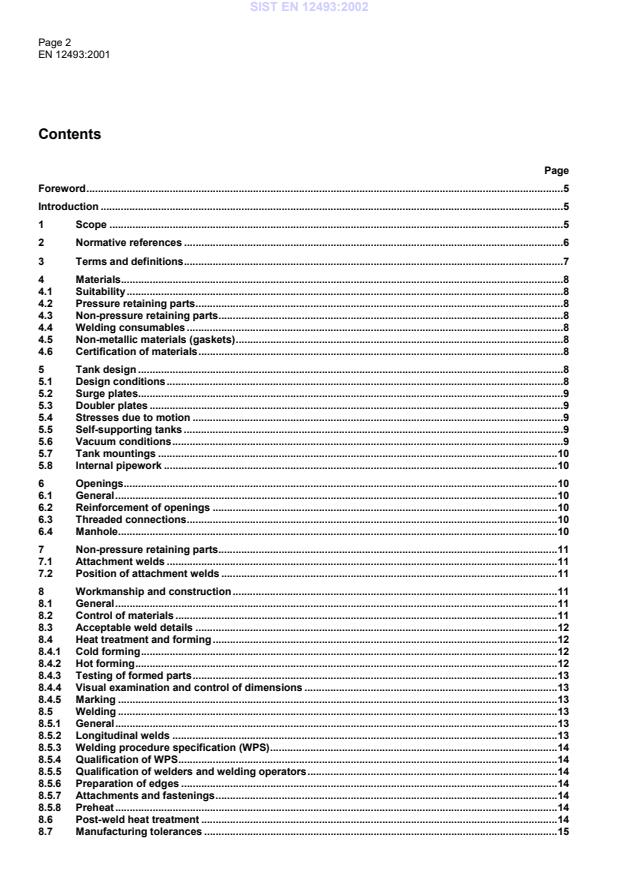
Page 2EN 12493:2001ContentsPageForeword.5Introduction.51Scope.52Normative references.63Terms and definitions.74Materials.84.1Suitability.84.2Pressure retaining parts.84.3Non-pressure retaining parts.84.4Welding consumables.84.5Non-metallic materials (gaskets).84.6Certification of materials.85Tank design.85.1Design conditions.85.2Surge plates.95.3Doubler plates.95.4Stresses due to motion.95.5Self-supporting tanks.95.6Vacuum conditions.95.7Tank mountings.105.8Internal pipework.106Openings.106.1General.106.2Reinforcement of openings.106.3Threaded connections.106.4Manhole.107Non-pressure retaining parts.117.1Attachment welds.117.2Position of attachment welds.118Workmanship and construction.118.1General.118.2Control of materials.118.3Acceptable weld details.128.4Heat treatment and forming.128.4.1Cold forming.128.4.2Hot forming.128.4.3Testing of formed parts.138.4.4Visual examination and control of dimensions.138.4.5Marking.138.5Welding.138.5.1General.138.5.2Longitudinal welds.138.5.3Welding procedure specification (WPS).148.5.4Qualification of WPS.148.5.5Qualification of welders and welding operators.148.5.6Preparation of edges.148.5.7Attachments and fastenings.148.5.8Preheat.148.6Post-weld heat treatment.148.7Manufacturing tolerances.15SIST EN 12493:2002
Page 3EN 12493:20018.8Repairs to pressure envelope and direct attachment welds.158.8.1General requirements.158.8.2Repair of surface imperfections in the parent metal.158.8.3Repair of weld imperfections.159Construction and workmanship of internal pipework.1510Inspection and testing.1610.1General.1610.2Mechanical testing.1610.2.1Production test plates.1610.2.2Longitudinal welds.1610.2.3Circumferential welds.1610.2.4Mechanical tests.1610.2.5Test requirements.1610.3Non-destructive testing.1710.3.1Internal imperfections.1710.3.2Surface imperfections.1710.4Non-destructive testing techniques for welds.1710.4.1Radiographic techniques.1710.4.2Marking and identification of radiographs.1810.4.3Ultrasonic techniques.1810.4.4Magnetic particle techniques.1810.4.5Penetrant techniques.1810.5Qualification of non-destructive testing personnel.1810.6Visual examination of welds.1810.7Acceptance test criteria.1910.8Pressure test.1910.9Capacity.1911External corrosion protection and finishing.1911.1External protection.1911.2Finishing operations.1912Marking.1913Records and documentation.1913.1Documentation obtained by the manufacturer.1913.2Records prepared by the manufacturer.1913.3Retention and supply of documents.20Annex A (normative)
Guidance on selection of material grades.21Annex B (normative)
Reference temperatures for design.22B.1Introduction.22B.2General.22B.3Developed pressure.22B.4Filling.22Annex C (informative)
Alternative reference temperatures for design.23C.1Introduction.23C.2General.23C.3Developed pressure.23C.4Filling.23Annex D (normative)
Design.24D.1Design stresses.24D.2Design Pressure.24D.2.1Rigid single tankers and semi-trailers.24D.2.2Tanker plus full trailer combinations.24D.3Design Formulae.24D.3.1Cylindrical shell calculation.24D.3.2Dished ends.25D.3.3Conical shell calculations.28D.4Nozzle reinforcement.32D.5Nozzle reinforcement by pads or flanges.34D.6Nozzle reinforcement by branches.34Annex E (informative)
Example of joints.39SIST EN 12493:2002
Page 4EN 12493:2001Annex F (normative)
Allowable tolerances.43F.1Tanks.43F.1.1External diameter.43F.1.2Out of roundness.43F.1.3Deviation of straightness.43F.1.4Irregularities in profile.43F.2Dished end tolerance.44F.2.1Thickness of material.44F.2.2Profile.44F.3Assembly tolerances.45F.3.1Middle line alignment.45F.3.2Surface alignment.45F.4Attachments, nozzles and fittings.46F.5Overall length.46Annex G (normative)
Heat treatment.47G.1Method of post-weld heat treatment.47G.2Temperature control.47G.3Temperature limit.47G.4Temperature measurement.47Annex H (informative)
Typical method for measurement of shell peaking.48H.1Profile gauge.48H.2Peaking survey.48Annex I (normative)
Welding imperfections and test specimens.51I.1Imperfections.51I.2Test specimens.54Annex J (informative)
Choice of non-destructive test methods for welds.55J.1Internal imperfections.55J.2Surface imperfections.55Annex K (normative)
Hydraulic pressure test.56K.1Temporary fittings.56K.2Pressure gauges.56K.3Pressurising agent.56K.4Avoidance of shock.56K.5Applied pressure.56Annex L (normative)
Name plate.57Bibliography.59SIST EN 12493:2002
Page 5EN 12493:2001ForewordThis European Standard has been prepared by Technical Committee CEN/TC 286 "Liquefied petroleum gasequipment and accessories", the secretariat of which is held by NSAI.This European Standard shall be given the status of a national standard, either by publication of an identical text orby endorsement, at the latest by December 2001, and conflicting national standards shall be withdrawn at the latestby December 2001.This European Standard has been prepared under a mandate given to CEN by the European Commission and theEuropean Free Trade Association and supports the framework Directives on the Transport of Dangerous Goods.This European Standard has been submitted for reference into the technical annexes of the European Agreementconcerning the international carriage of dangerous goods by road (ADR).The standards listed in the normative references and covering the basic requirements of the ADR not addressedwithin the present standard are normative only if the standards themselves are referred to in the technical annexesof ADR.The annexes A, B, D, F, G, I, K and L are normative.The annexes C, E, H and J are informative.According to the CEN/CENELEC Internal Regulations, the national standards organizations of the followingcountries are bound to implement this European Standard: Austria, Belgium, Czech Republic, Denmark, Finland,France, Germany, Greece, Iceland, Ireland, Italy, Luxembourg, Netherlands, Norway, Portugal, Spain, Sweden,Switzerland and the United Kingdom.IntroductionThis European Standard calls for the use of substances and procedures that may be injurious to health if adequateprecautions are not taken. It refers only to technical suitability and does not absolve the user from legal obligationsrelating to health and safety at any stage.It has been assumed in the drafting of this European Standard that execution of its provisions is entrusted toappropriately qualified and experienced people.1 ScopeThis European Standard specifies minimum requirements for materials, design, construction and workmanshipprocedures, and tests for welded LPG road tanker tanks and their welded attachments manufactured from carbon,carbon/manganese and micro alloy steels.There is no upper size limit as this is determined by the gross vehicle weight limitation.This standard does not cover tanks for ISO type containers.SIST EN 12493:2002
Page 6EN 12493:20012 Normative referencesThis European Standard incorporates by dated or undated reference, provisions from other publications. Thesenormative references are cited at the appropriate places in the text and the publications are listed hereafter. Fordated references, subsequent amendments to or revisions of any of these publications apply to this EuropeanStandard only when incorporated in it by amendment or revision. For undated references the latest edition of thepublication referred to applies (including amendments).EN 287-1, Approval and testing of welders — Fusion welding — Part 1: Steels.EN 288-2, Specification and approval of welding procedures for metallic materials — Part 2: Welding procedurespecification for arc welding.EN 288-3, Specification and approval of welding procedures for metallic materials — Part 3: Welding proceduretests for the arc welding of steels.EN 444, Non-destructive testing — General principles for radiographic examination of metallic materials by X- andgamma rays.EN 462-1, Non-destructive testing — Image quality of radiographs — Part 1: Image quality indicators (wire type) —Determination of image quality value.EN 462-2, Non-destructive testing — Image quality of radiographs — Part 2: Image quality indicators (step/holetype) — Determination of image quality value.EN 473, Qualification and certification of NDT personnel — General principles.EN 571-1, Non-destructive testing — Penetrant testing — Part 1: General principles.EN 729-2, Quality requirements for welding — Fusion welding of metallic materials — Part 2: Comprehensivequality requirements.EN 837-2, Pressure gauges — Part 2: Selection and installation recommendations for pressure gauges.EN 875, Destructive tests on welds in metallic materials — Impact tests — Test specimen location notch orientationand examination.EN 876, Destructive tests on welds in metallic materials — Longitudinal tensile test on weld metal in fusion weldedjoints.EN 895, Destructive tests on welds in metallic materials — Transverse tensile test.EN 910, Destructive tests on welds in metallic materials — Bend tests.EN 970, Non-destructive examination of fusion welds — Visual examination.EN 1290, Non-destructive examination of welds — Magnetic particle examination of welds.EN 1321, Destructive tests on welds in metallic materials — Macroscopic and microscopic examination of welds.EN 1418, Welding personnel — Approval testing of operators for fusion welding and resistance weld setters for fullymechanized and automatic welding of metallic materials.EN 1435, Non-destructive examination of welds — Radiographic examination of welded joints.EN 1714, Non-destructive examination of welds — Ultrasonic examination of welded joints.EN 10002-1, Metallic materials- Tensile testing Part 1: Method of test.EN 10025, Hot-rolled products of non-alloyed structural steels — Technical delivery conditions.SIST EN 12493:2002
Page 7EN 12493:2001EN 10028, Flat products made of steels for pressure purposes : (all parts).EN 10045-1, Metallic materials — Charpy impact test — Part 1: Test method.EN 10204, Metallic products — Types of inspection documents.EN 12252, Equipping of Liquified Petroleum Gas (LPG) road tankers.prEN 13445-2, Unfired pressure vessels — Part 2: Materials.prEN 13445-3, Unfired pressure vessels — Part 3: Design.EN 25817:1997, Arc-welded joints in steel — Guidance on quality levels for inspections (ISO 5817:1992).EN ISO 6520-1:1998, Welding and allied processes - Classification of geometric imperfections in metallic materials– Part 1: Fusion welding (ISO 6520-1:1998).prEN ISO 6520-2:1999, Welding and allied processes - Classification of geometric imperfections in metallicmaterials – Part 2: Welding with pressure (ISO/FDIS 6520-2:1999).3 Terms and definitionsFor the purposes of this European Standard, the following terms and definitions apply:3.1yield strengthupper yield stress ReH or, for steels that do not exhibit a definite yield (non-proportional elongation), the 0,2 % proofstress3.2cold formingforming at temperatures not less than 25 °C below the maximum permissible temperature for stress relieving, inaccordance with the applicable material specifications3.3hot formingforming at temperatures above the temperature for stress relieving as stated in the material specifications3.4sun shieldshield covering not less than the upper third but not more than the upper half of the shell surface, separated fromthe shell by an air gap of at least 40 mm3.5tankassembly of the shell (the pressure-retaining enclosure including the openings and their closures) and non-pressure-retaining parts welded directly to the shell3.6competent authorityauthority designated as such in each country its government3.7notified/designated bodytesting and certifying body approved by a competent authority3.8competent personperson who, by qualifications, training, experience and resources, is able to make objective judgementsSIST EN 12493:2002
Page 8EN 12493:20014 Materials4.1 SuitabilityUnless otherwise specified by the design documents, the design temperature range shall be – 20 °C to + 50 °C.The materials of construction shall be suitable for operating within the envisaged temperature range. If the tankcould be subjected to more severe ambient or product temperatures, the design temperature range shall be – 40 °C to + 50 °C.Guidance on selection of material grades is given in annex A.If additional impact testing is required, it shall be carried out in accordance with EN 10045-1 to achieve the impactvalues specified in 10.2.5.4.4.2 Pressure retaining partsPressure-retaining materials shall be of appropriate steels conforming to EN 10028 or shall conform tospecifications agreed with the competent authority. All materials shall conform to 10.2.5.4 and the ratio of thespecified yield strength (ReH) to minimum tensile strength (Rm) shall not exceed 0,85 (i.e. ReH/Rm
0,85). Thepercentage elongation at fracture shall be not less than 10 000 divided by the actual tensile strength in N/mm2, andin any case shall be not less than 16 % for fine grained steels and not less than 20 % for other steels.4.3 Non-pressure retaining partsNon-pressure retaining parts that are directly welded to pressure retaining parts shall be of suitable materialsconforming to EN 10025 or materials with characteristics approved by a competent authority. All materials used fornon-pressure retaining parts shall be compatible with the material of pressure retaining parts, and shall conform tothe impact requirements of 10.2.5.4, tested in accordance with the method specified in EN 10045-1.4.4 Welding consumablesWelding consumables shall be able to provide consistent welds with properties at least equal to those specified forthe parent materials in the finished tank.4.5 Non-metallic materials (gaskets)Non-metallic materials (gaskets) shall be compatible with both phases of LPG over the range of pressures andtemperatures for which the tanker is designed (see 4.1 and annexes B and C).4.6 Certification of materialsPressure retaining parts and non-pressure retaining parts directly welded to the tank shall be provided with thematerial manufacturers’ certificates conforming to EN 10204 certificate type 3.1B. Other parts shall have certificatesconforming to EN 10204 certificate type 2.2.5 Tank design5.1 Design conditionsReference temperatures shall conform to annex B.Design calculations shall be carried out in accordance with annex D.Account shall be taken of the fatigue loading on all component parts of the tank and its attachments by conductingan assessment or through proven operating experience.SIST EN 12493:2002
Page 9EN 12493:20015.2 Surge platesTo reduce the dynamic loadings of the liquid content due to accelerations of the vehicle, tanks longer than 4 mshall be fitted with transverse surge plates at a maximum spacing of 4 m, and shall be designed to permit fullinternal inspection of the tank. The area of each plate shall be at least 70 % of the cross-sectional area of the tankin which the plates are fitted.Surge plates shall be able to withstand the load imposed by a full capacity liquid content of the section between theplates in either direction. Surge plates shall be at least 2 mm thick.Provision shall be made for communication and drainage between sections.For tanks over 1,8 m diameter, having a wall thickness less than 6 mm and for tanks up to 1,8 m diameter, having awall thickness less than 5 mm, the surge plates shall have the same thickness as the shell and the volume betweenany two plates shall not exceed 7 500 litres.5.3 Doubler platesTo reduce stress concentration on the tank, load-carrying attachments shall incorporate a doubler plate betweenthe attachment and the tank.Non-circular doubler plates shall be designed with as generous as practicable corner radii, with a minimum of25 mm to reduce stress concentrations.If doubler plates are provided with test sockets they shall be closed with threaded plugs after testing.5.4 Stresses due to motionTanks and their permanent attachments shall be able to absorb, under maximum permissible load, forces exertedby the design pressure, and the following dynamic forces: in the direction of travel: twice the total mass times gravity; at right-angles to the direction of travel: the total mass times gravity; vertically upwards: the total mass times gravity; vertically downwards: twice the total mass times gravity.Under the forces defined above, the stresses in the tank and its fastenings shall not exceed the following:a) general membrane stress in the shell, remote from the supports: the normal design stress as defined in D.1;b) stresses local to the supports, determined either by experimental analysis or calculation/special analysis: the limits specified in prEN 13445-3.5.5 Self-supporting tanksSelf-supporting tanks shall be designed to carry bending stresses that would otherwise be carried by the chassis orframe.5.6 Vacuum conditionsTanks shall be designed to withstand vacuum conditions generated by the product during operation or otheroperational conditions, but as a minimum, this shall be equivalent to an external pressure of at least 40 kPa(0,4 bar) gauge pressure.SIST EN 12493:2002
Page 10EN 12493:2001NOTE 1Some liquefied petroleum gases have vapour pressures below atmospheric pressure at temperatures that couldoccur during normal operations in winter, and this could create partial vacuum conditions within the carrying tank.NOTE 2Suitable design methods may be applied from prEN 13445-3.5.7 Tank mountings5.7.1Mounting structures shall be fabricated in steel and designed to limit movement of the tank in relation to thechassis.5.7.2Tank mountings and their method of attachment to the shell shall be of sufficient strength to support thetank when full of water.5.7.3The design of the tank mountings shall be co-ordinated with the design of the vehicle chassis. Thedesigner shall assess the effect of the tank and its mountings, including the additional loadings given in 5.4.NOTEThe chassis manufacturer should be notified at the tank design stage that the tank, while on the chassis, could besubjected to a hydraulic test, during which the tank can contain twice the normal weight of carrying capacity.5.7.4 Tank mountings designed as an integral attachment to the shell shall be fitted with doubler plates asspecified in 5.3. Stitch welding shall not be used.5.8 Internal pipeworkThe mechanical strength of internal pipework and supports shall be sufficient to withstand the service conditions,including dynamic load.NOTEInternal pipework may be attached directly to a tank boss.Pipework shall be located so as to avoid inadvertent entry of liquid LPG from the liquid inlet line into other pipeworkterminating in the vapour space.6 Openings6.1 GeneralFor the equipping of LPG road tankers, see EN 12252.Valves and other accessories shall be protected against damage by external impact either by their positioning onthe tank, when mounted on the vehicle, or by specific tank design. Provision in tank design shall be either bymounting and fitting valves and other accessories in a recess within the contour of the tank shell or end, or by useof a guard able to withstand a collision with another vehicle and the forces experienced in a tank roll-over.6.2 Reinforcement of openingsOpenings shall be reinforced and designed in accordance with D.4.6.3 Threaded connectionsThe maximum nominal diameter of threaded connections shall be 80 mm.6.4 ManholeTanks over 1,5 m diameter shall be fitted with a manhole either: at least 500 mm in diameter; or at least 420 mm in diameter, if acceptable to the notified/designated body.NOTESmaller tanks may be fitted with inspection openings instead of a manhole, with dimensions conforming to EN 286-1.SIST EN 12493:2002
Page 11EN 12493:2001Manholes shall be of forged construction, machined from plate, or fabricated from pipe and standard flanges of theappropriate temperature and pressure rating. If plate is used for pad type manholes, it shall be ultrasonically testedfor lamellar defects.The manhole shall be positioned for ease of access.7 Non-pressure retaining parts7.1 Attachment welds Attachment welds shall be continuous.7.2 Position of attachment weldsAttachments shall be designed not to trap water and to permit inspection of the weld. Wherever possible,attachment welds shall be clear of vessel welds (longitudinal, circumferential and opening welds), by a minimumdistance of 40 mm. Where this is not possible, attachment welds shall fully cross the main welds.8 Workmanship and construction8.1 GeneralRoad tanker tanks shall be manufactured in accordance with drawings and specifications approved by anotified/designated body.The manufacturer shall be responsible for the competence, training and supervision of their staff.The manufacturer shall ensure, taking into account any instructions from the material supplier, that the materials ofthe finished tank conform to this European Standard.The manufacturer shall have defined procedures for manufacturing operations, including processes such asforming, welding and heat treatment.8.2 Control of materialsThe manufacturer of the tank shall maintain a system of identification for the material used in the fabrication so thatall material for pressure-retaining parts and non-pressure-retaining parts directly welded to pressure-retaining partsin the completed work can be traced to origin. The system shall incorporate appropriate procedures for verifying theidentity of material received from the supplier.Verifying procedures shall be based on the material manufacturers’ certificates and/or acceptance tests. Thesystem shall ensure that before cutting and forming parts of the tank, the original identification mark of the materialis transferred to any parts of the tank that could be without markings after the process. The manufacturer shallensure that the material conforms to the design and/or drawings specification.In laying out and cutting the material: the material identification mark shall be clearly visible when the pressure part is complete; or the manufacturer shall operate a documented system that ensures material traceability for all materials in thecompleted tanks.If the material identification mark is unavoidably cut out during manufacture of a pressure part, it shall betransferred by the pressure part manufacturer to another part of the component. Transfer of the mark shall becarried out by a person designated by the manufacturer.When identification on materials is transferred, the method of marking shall not have any detrimental effect on thespecified material properties.SIST EN 12493:2002
Page 12EN 12493:2001Details of welding consumables shall be retained.8.3 Acceptable weld details8.3.1The manufacturer, in selecting an appropriate weld detail, shall consider: the method of manufacture; the service conditions; the ability to carry out necessary non-destructive testing.NOTE 1Recommended weld details are given in EN 1708-1.The root faces of welding preparations shall be aligned within the tolerances given in the welding procedurespecification.NOTE 2Examples of typical welded joints used on the tank are given in annex E.8.3.2If a tank is made from more than one shell strake, the longitudinal weld of adjacent strakes shall bestaggered by at least 100 mm between weld edges.8.3.3Where the tank diameter is less than 1,5 m and no internal access is provided, joggle joints are permittedfor end to shell joints. Only dished ends shall be joggled.Joggles shall be sufficiently clear of the knuckle radius to ensure that the edge of the circumferential weld is at least12 mm clear of the knuckle.NOTEA typical joggle joint detail is shown in Figure E.2.8.4 Heat treatment and forming8.4.1 Cold formingHeat treatment of cold formed cylindrical shells is not required.Cold formed dished ends shall be heat treated unless the manufacturer can demonstrate that the properties of thefinished products conform to the original design.Cold formed dished ends that have not been heat treated shall not be welded or heated locally in the knuckle areato temperatures above 550 °C without subsequent heat treatment.8.4.2 Hot formingFor normalised steels, because of the danger of excessive grain growth, the workpiece temperature during hotforming shall not exceed 1 050 °C. Before the final stage of hot forming, or if hot forming is performed only once,the workpiece shall not be heated above 980 °C.NOTEThe duration of hot forming should be kept to a minimum to avoid
...
Questions, Comments and Discussion
Ask us and Technical Secretary will try to provide an answer. You can facilitate discussion about the standard in here.
Loading comments...