

EN 1440:2005
(Main)LPG equipment and accessories - Transportable refillable welded and brazed steel Liquefied Petroleum Gas (LPG) cylinders - Periodic inspection
- Abstract
This European Standard specifies inspection intervals, procedures for periodic inspection and testing, for transportable refillable welded and brazed steel LPG cylinders of water capacity from 0,5 l up to and including 150 l with a minimum wall thickness of 1,5 mm (see EN 1442 and EN 12807).
This standard does not apply to cylinders permanently installed in vehicles, or to plant and filling equipment.
- Status
- Withdrawn
- Publication Date
- 22-Nov-2005
- Withdrawal Date
- 26-Feb-2008
- Technical Committee
- CEN/TC 286 - Liquefied petroleum gas equipment and accessories
- Drafting Committee
- CEN/TC 286 - Liquefied petroleum gas equipment and accessories
- Current Stage
- 9960 - Withdrawal effective - Withdrawal
- Start Date
- 27-Feb-2008
- Completion Date
- 27-Feb-2008

Relations
- Effective Date
- 22-Dec-2008
- Effective Date
- 22-Dec-2008
- Effective Date
- 22-Dec-2008
Get Certified
Connect with accredited certification bodies for this standard

Institut za varilstvo d.o.o. (Welding Institute)
Slovenia's leading welding institute since 1952. ISO 3834, EN 1090, pressure equipment certification, NDT personnel, welder qualification. Only IIW Au
Sponsored listings
Frequently Asked Questions
EN 1440:2005 is a standard published by the European Committee for Standardization (CEN). Its full title is "LPG equipment and accessories - Transportable refillable welded and brazed steel Liquefied Petroleum Gas (LPG) cylinders - Periodic inspection". This standard covers: This European Standard specifies inspection intervals, procedures for periodic inspection and testing, for transportable refillable welded and brazed steel LPG cylinders of water capacity from 0,5 l up to and including 150 l with a minimum wall thickness of 1,5 mm (see EN 1442 and EN 12807). This standard does not apply to cylinders permanently installed in vehicles, or to plant and filling equipment.
This European Standard specifies inspection intervals, procedures for periodic inspection and testing, for transportable refillable welded and brazed steel LPG cylinders of water capacity from 0,5 l up to and including 150 l with a minimum wall thickness of 1,5 mm (see EN 1442 and EN 12807). This standard does not apply to cylinders permanently installed in vehicles, or to plant and filling equipment.
EN 1440:2005 is classified under the following ICS (International Classification for Standards) categories: 23.020.30 - Pressure vessels, gas cylinders; 23.020.35 - Gas cylinders. The ICS classification helps identify the subject area and facilitates finding related standards.
EN 1440:2005 has the following relationships with other standards: It is inter standard links to EN 1440:1996/AC:1999, EN 1440:1996, EN 1440:2008. Understanding these relationships helps ensure you are using the most current and applicable version of the standard.
EN 1440:2005 is associated with the following European legislation: EU Directives/Regulations: 94/55/EC, 96/49/EC, 96/86/EC, 96/87/EC; Standardization Mandates: M/086. When a standard is cited in the Official Journal of the European Union, products manufactured in conformity with it benefit from a presumption of conformity with the essential requirements of the corresponding EU directive or regulation.
EN 1440:2005 is available in PDF format for immediate download after purchase. The document can be added to your cart and obtained through the secure checkout process. Digital delivery ensures instant access to the complete standard document.
Standards Content (Sample)
2003-01.Slovenski inštitut za standardizacijo. Razmnoževanje celote ali delov tega standarda ni dovoljeno.LPG equipment and accessories - Transportable refillable welded and brazed steel Liquefied Petroleum Gas (LPG) cylinders - Periodic inspectionJOHGLEquipements pour GPL et leurs accessoires - Bouteilles en acier soudé et brasé transportables et rechargeables pour gaz de pétrole liquéfié (GPL) - Contrôle périodiqueFlüssiggas-Geräte und Ausrüstungsteile - Ortsbewegliche wiederbefüllbare geschweißte Flaschen aus Stahl für Flüssiggas (LPG) - Wiederkehrende PrüfungTa slovenski standard je istoveten z:EN 1440:2005SIST EN 1440:2006en23.020.30ICS:SIST EN 1440:1998/AC:2000SIST EN 1440:19981DGRPHãþDSLOVENSKI
STANDARDSIST EN 1440:200601-marec-2006
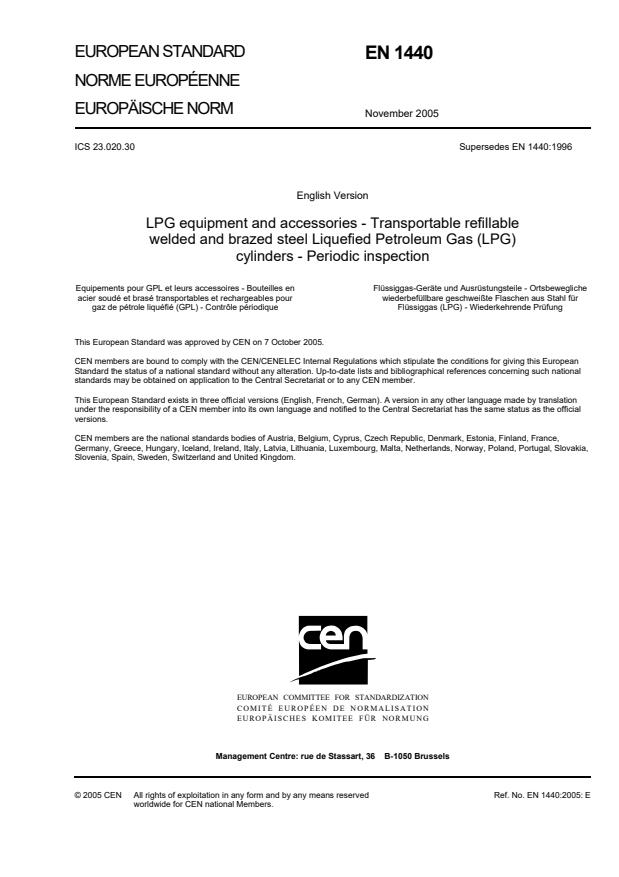
EUROPEAN STANDARDNORME EUROPÉENNEEUROPÄISCHE NORMEN 1440November 2005ICS 23.020.30Supersedes EN 1440:1996
English VersionLPG equipment and accessories - Transportable refillablewelded and brazed steel Liquefied Petroleum Gas (LPG)cylinders - Periodic inspectionEquipements pour GPL et leurs accessoires - Bouteilles enacier soudé et brasé transportables et rechargeables pourgaz de pétrole liquéfié (GPL) - Contrôle périodiqueFlüssiggas-Geräte und Ausrüstungsteile - Ortsbeweglichewiederbefüllbare geschweißte Flaschen aus Stahl fürFlüssiggas (LPG) - Wiederkehrende PrüfungThis European Standard was approved by CEN on 7 October 2005.CEN members are bound to comply with the CEN/CENELEC Internal Regulations which stipulate the conditions for giving this EuropeanStandard the status of a national standard without any alteration. Up-to-date lists and bibliographical references concerning such nationalstandards may be obtained on application to the Central Secretariat or to any CEN member.This European Standard exists in three official versions (English, French, German). A version in any other language made by translationunder the responsibility of a CEN member into its own language and notified to the Central Secretariat has the same status as the officialversions.CEN members are the national standards bodies of Austria, Belgium, Cyprus, Czech Republic, Denmark, Estonia, Finland, France,Germany, Greece, Hungary, Iceland, Ireland, Italy, Latvia, Lithuania, Luxembourg, Malta, Netherlands, Norway, Poland, Portugal, Slovakia,Slovenia, Spain, Sweden, Switzerland and United Kingdom.EUROPEAN COMMITTEE FOR STANDARDIZATIONCOMITÉ EUROPÉEN DE NORMALISATIONEUROPÄISCHES KOMITEE FÜR NORMUNGManagement Centre: rue de Stassart, 36
B-1050 Brussels© 2005 CENAll rights of exploitation in any form and by any means reservedworldwide for CEN national Members.Ref. No. EN 1440:2005: E
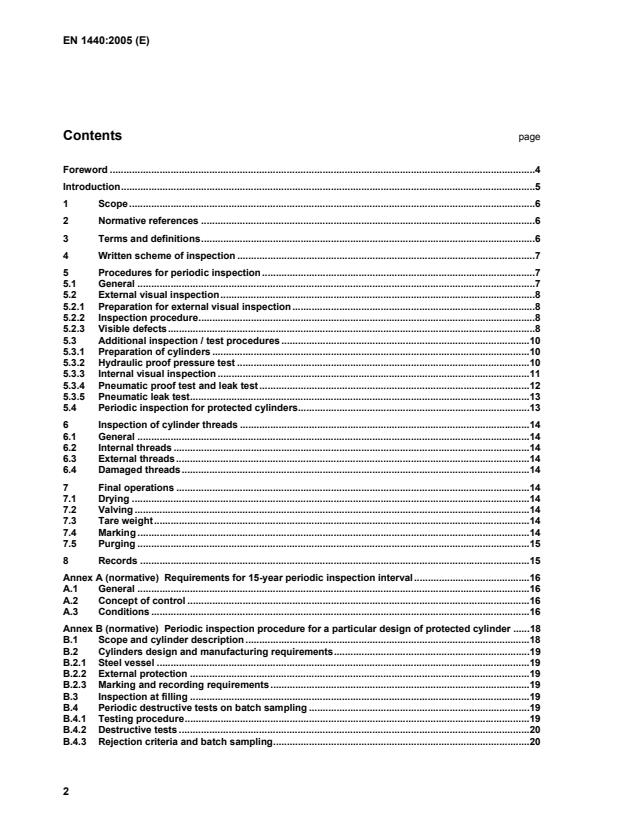
Requirements for 15-year periodic inspection interval.16 A.1 General.16 A.2 Concept of control.16 A.3 Conditions.16 Annex B (normative)
Periodic inspection procedure for a particular design of protected cylinder.18 B.1 Scope and cylinder description.18 B.2 Cylinders design and manufacturing requirements.19 B.2.1 Steel vessel.19 B.2.2 External protection.19 B.2.3 Marking and recording requirements.19 B.3 Inspection at filling.19 B.4 Periodic destructive tests on batch sampling.19 B.4.1 Testing procedure.19 B.4.2 Destructive tests.20 B.4.3 Rejection criteria and batch sampling.20
Therefore the standards listed in the normative references and covering basic requirements of the RID/ADR not addressed within the present standard are normative only when the standards themselves are referred to in the RID and/or in the technical annexes of the ADR. This European Standard
supersedes EN 1440:1996. According to the CEN/CENELEC Internal Regulations, the national standards organizations of the following countries are bound to implement this European Standard: Austria, Belgium, Cyprus, Czech Republic, Denmark, Estonia, Finland, France, Germany, Greece, Hungary, Iceland, Ireland, Italy, Latvia, Lithuania, Luxembourg, Malta, Netherlands, Norway, Poland, Portugal, Slovakia, Slovenia, Spain, Sweden, Switzerland and United Kingdom.
Periodic inspection is normally carried out at a test station operated under the responsibility of a competent gas organisation, or of a third party.
This European Standard has now been prepared to reflect the current state of the art for periodically inspecting LPG cylinders, and is based upon the operating experience of many hundreds of millions of cylinder years of service. This European Standard calls for the use of substances and procedures that can be injurious to health if adequate precautions are not taken. It refers only to technical suitability and does not absolve the user from legal obligations relating to health and safety at any stage. It has been assumed in the drafting of this European Standard that the execution of its provisions is entrusted to appropriately qualified and experienced people. Where judgements are called for, it has been assumed that they are made by competent persons who have been trained specifically for the tasks.
An interval of 10 years shall apply if any of the conditions specified in Annex A are not met.
For protected cylinders the interval is determined in accordance with 5.4. The inspection procedures to be applied shall be selected from the alternatives given in Clause 5. 5 Procedures for periodic inspection 5.1 General Procedures for periodic inspection shall consist of an external visual inspection as described in 5.2 and, additionally, at least one of the procedures described in 5.3.
An alternative procedure for periodic inspection of protected cylinders is described in 5.4. Periodic inspections/tests shall be carried out under the responsibility of a body approved by a competent authority.
The decision to render a cylinder unserviceable may be taken at any stage during the periodic inspection procedure.
With the agreement of the owner, a cylinder shall be rendered unserviceable in accordance with EN 12816, so that it cannot be re-issued into service as a pressure vessel. NOTE In some countries, render unserviceable means scrapping. 5.2 External visual inspection 5.2.1 Preparation for external visual inspection a) If required, the cylinder shall be cleaned and have all loose coatings or labels, corrosion products, tar, oil or other foreign matter removed from its external surface. b) Care shall be taken to avoid damaging the cylinder. c) When cylinders are treated by a process that might remove cylinder material, the competent body shall decide whether a thickness test is required, e.g. ultrasonic thickness check. NOTE Cleaning methods may be wire brushing, shot blasting (in accordance with EN ISO 8504 and EN ISO 8501-1), water jet cleaning, chemical cleaning or other suitable methods. 5.2.2 Inspection procedure The entire surface of the cylinder shall be inspected for: a) dents, cuts, gouges, bulges, cracks, laminations or punctures, applying the criteria for rejection in Table 1; b) corrosion, giving special attention to areas where water can be trapped, at the base of the cylinder, the junction between the cylindrical shell and the foot-ring, the cylindrical shell and the valve guard or shroud, and in particular hidden corrosion (e.g. data plate) applying the criteria for rejection given in Table 2; c) other defects (e.g. depressed bung or fire damage) applying the criteria for rejection given in Table 3; d) the integrity of all permanent attachments; e) the integrity of all mandatory permanent markings. 5.2.3 Visible defects Rejection criteria for physical and material defects or heat damage on the cylinder shell are contained in Table 1, Table 2 and Table 3.
Dent A depression in the cylinder that has neither penetrated nor removed metal, when its width at any point is greater than 2 % of the external cylinder diameter When the depth of the dent exceeds 25 % of its width at any point a Cut or gouge A sharp impression where metal has been removed or redistributed Where the original calculated wall thickness is known:
the depth of cut or gouge is such that the
undamaged (remaining) wall is less than the
minimum calculated wall thickness Where the original calculated wall thickness is not known:
all Dent containing cut or gouge A depression in the cylinder within which there is a cut or gouge When the size of the dent or cut or gouge exceeds the dimensions for rejection as an individual defect Crack A split or rift in the cylinder shell All Lamination Layering of the material within the cylinder wall appearing as a discontinuity, crack, lap or bulge at the surface. All a Appearance (e.g. sharp dent) and location (e.g. on shoulder of the cylinder) also play a part in the evaluation of dent severity.
Table 2 — Corrosion on the cylinder wall Type of corrosion Description Rejection limit Isolated c
...