


EN 14398-2:2003
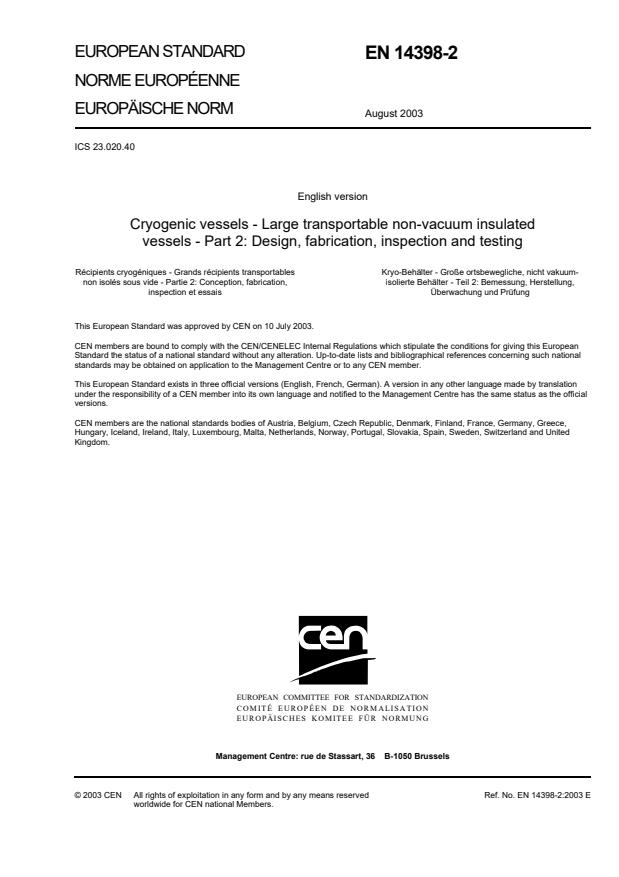
(Main)Cryogenic vessels - Large transportable non-vacuum insulated vessels - Part 2: Design, fabrication, inspection and testing
Cryogenic vessels - Large transportable non-vacuum insulated vessels - Part 2: Design, fabrication, inspection and testing
This European Standard specifies requirements for the design, fabrication, inspection and testing of large transportable non vacuum insulated cryogenic vessels of more than 1000 l volume, which are permanently (fixed tanks) or not permanently (demountable tanks) attached to a vehicle, for carriage by road. However, it can be used for other mode of transport providing the specific regulations/requirements are complied with.
This European Standard applies to large transportable non vacuum insulated cryogenic vessels for fluids specified in prEN 14398-1 and does not apply to vessels designed for toxic fluids.
This European Standard does not include the general vehicle requirements e.g. running gear, brakes, lighting etc. that shall be in accordance with the relevant standards/regulations.
Kryo-Behälter - Große ortsbewegliche, nicht vakuum-isolierte Behälter - Teil 2: Bemessung, Herstellung, Überwachung und Prüfung
Diese Europäische Norm gilt für die Bemessung, Herstellung und Prüfung von großen ortsbeweglichen, nicht vakuum-isolierten Kryo-Behältern mit einem Fassungsraum von mehr als 1 000 Litern für festverbundene Tanks (von Tank- oder Schienenfahrzeugen), Aufsetztanks, Tanks von Batterie-Fahrzeugen und Tankcontainern (TC) für tiefgekühlte verflüssigte Gase im Sinne der Regelungen für die Beförderung gefährlicher Güter.
Diese Norm gilt für große ortsbewegliche, nicht vakuum-isolierte Kryo-Behälter für Fluide, die in EN 14398-1 festgelegt sind, und sie gilt nicht für giftige Fluide.
Diese Europäische Norm enthält keine allgemeinen Anforderungen an Fahrzeuge wie z. B. an Fahrgestell, Bremsen, Beleuchtung usw., diese müssen mit den relevanten Normen/Gesetzen übereinstimmen.
Récipients cryogéniques - Grands récipients transportables non isolés sous vide - Partie 2: Conception, fabrication, inspection et essais
La présente Norme européenne spécifie des exigences en matière de conception, fabrication, contrôle et essais de grands récipients cryogéniques transportables non isolés sous vide d'un volume supérieur à 1 000 l, fixés sur un véhicule de manière permanente (réservoirs fixes) ou non (réservoirs démontables) pour le transport routier. Elle peut cependant être utilisée pour d'autres modes de transport à condition que soient respectées les lois et exigences correspondantes.
La présente Norme européenne s'applique aux grands récipients cryogéniques transportables non isolés sous vide pour les fluides spécifiés dans l'EN 14398-1 et ne s'applique pas à des récipients prévus pour contenir des fluides toxiques.
La présente Norme européenne ne couvre pas les exigences générales relatives aux véhicules, par exemple, les organes de roulement, les freins, les feux, etc., qui doivent être conformes aux normes/règlements correspondants.
Kriogene posode – Velike premične, vakuumsko neizolirane posode - 2. del: Konstruiranje, izdelava, kontrola in preskus
General Information
- Status
- Withdrawn
- Publication Date
- 26-Aug-2003
- Withdrawal Date
- 18-Mar-2008
- Technical Committee
- CEN/TC 268 - Cryogenic vessels
- Drafting Committee
- CEN/TC 268/WG 1 - Design
- Current Stage
- 9960 - Withdrawal effective - Withdrawal
- Start Date
- 19-Mar-2008
- Completion Date
- 19-Mar-2008
Relations
- Effective Date
- 18-Jan-2023
- Effective Date
- 22-Dec-2008
- Effective Date
- 22-Dec-2008
- Effective Date
- 22-Dec-2008

Get Certified
Connect with accredited certification bodies for this standard

Institut za varilstvo d.o.o. (Welding Institute)
Slovenia's leading welding institute since 1952. ISO 3834, EN 1090, pressure equipment certification, NDT personnel, welder qualification. Only IIW Au
Sponsored listings
Frequently Asked Questions
EN 14398-2:2003 is a standard published by the European Committee for Standardization (CEN). Its full title is "Cryogenic vessels - Large transportable non-vacuum insulated vessels - Part 2: Design, fabrication, inspection and testing". This standard covers: This European Standard specifies requirements for the design, fabrication, inspection and testing of large transportable non vacuum insulated cryogenic vessels of more than 1000 l volume, which are permanently (fixed tanks) or not permanently (demountable tanks) attached to a vehicle, for carriage by road. However, it can be used for other mode of transport providing the specific regulations/requirements are complied with. This European Standard applies to large transportable non vacuum insulated cryogenic vessels for fluids specified in prEN 14398-1 and does not apply to vessels designed for toxic fluids. This European Standard does not include the general vehicle requirements e.g. running gear, brakes, lighting etc. that shall be in accordance with the relevant standards/regulations.
This European Standard specifies requirements for the design, fabrication, inspection and testing of large transportable non vacuum insulated cryogenic vessels of more than 1000 l volume, which are permanently (fixed tanks) or not permanently (demountable tanks) attached to a vehicle, for carriage by road. However, it can be used for other mode of transport providing the specific regulations/requirements are complied with. This European Standard applies to large transportable non vacuum insulated cryogenic vessels for fluids specified in prEN 14398-1 and does not apply to vessels designed for toxic fluids. This European Standard does not include the general vehicle requirements e.g. running gear, brakes, lighting etc. that shall be in accordance with the relevant standards/regulations.
EN 14398-2:2003 is classified under the following ICS (International Classification for Standards) categories: 23.020.40 - Cryogenic vessels. The ICS classification helps identify the subject area and facilitates finding related standards.
EN 14398-2:2003 has the following relationships with other standards: It is inter standard links to EN 14398-2:2003+A2:2008, EN 14398-2:2003/A1:2006, EN 14398-2:2003/AC:2006; is excused to EN 14398-1:2003. Understanding these relationships helps ensure you are using the most current and applicable version of the standard.
EN 14398-2:2003 is associated with the following European legislation: EU Directives/Regulations: 94/55/EC, 96/49/EC, 96/86/EC, 96/87/EC, TRRTP121; Standardization Mandates: M/086. When a standard is cited in the Official Journal of the European Union, products manufactured in conformity with it benefit from a presumption of conformity with the essential requirements of the corresponding EU directive or regulation.
EN 14398-2:2003 is available in PDF format for immediate download after purchase. The document can be added to your cart and obtained through the secure checkout process. Digital delivery ensures instant access to the complete standard document.
Standards Content (Sample)
2003-01.Slovenski inštitut za standardizacijo. Razmnoževanje celote ali delov tega standarda ni dovoljeno.Cryogenic vessels - Large transportable non-vacuum insulated vessels - Part 2: Design, fabrication, inspection and testingRécipients cryogéniques - Grands récipients transportables non isolés sous vide - Partie 2: Conception, fabrication, inspection et essaisKryo-Behälter - Große ortsbewegliche, nicht vakuum-isolierte Behälter - Teil 2: Bemessung, Herstellung, Überwachung und PrüfungTa slovenski standard je istoveten z:EN 14398-2:2003SIST EN 14398-2:2004en23.020.40ICS:SLOVENSKI
STANDARDSIST EN 14398-2:200401-junij-2004
EUROPEAN STANDARDNORME EUROPÉENNEEUROPÄISCHE NORMEN 14398-2August 2003ICS 23.020.40English versionCryogenic vessels - Large transportable non-vacuum insulatedvessels - Part 2: Design, fabrication, inspection and testingRécipients cryogéniques - Grands récipients transportablesnon isolés sous vide - Partie 2: Conception, fabrication,inspection et essaisKryo-Behälter - Große ortsbewegliche, nicht vakuum-isolierte Behälter - Teil 2: Bemessung, Herstellung,Überwachung und PrüfungThis European Standard was approved by CEN on 10 July 2003.CEN members are bound to comply with the CEN/CENELEC Internal Regulations which stipulate the conditions for giving this EuropeanStandard the status of a national standard without any alteration. Up-to-date lists and bibliographical references concerning such nationalstandards may be obtained on application to the Management Centre or to any CEN member.This European Standard exists in three official versions (English, French, German). A version in any other language made by translationunder the responsibility of a CEN member into its own language and notified to the Management Centre has the same status as the officialversions.CEN members are the national standards bodies of Austria, Belgium, Czech Republic, Denmark, Finland, France, Germany, Greece,Hungary, Iceland, Ireland, Italy, Luxembourg, Malta, Netherlands, Norway, Portugal, Slovakia, Spain, Sweden, Switzerland and UnitedKingdom.EUROPEAN COMMITTEE FOR STANDARDIZATIONCOMITÉ EUROPÉEN DE NORMALISATIONEUROPÄISCHES KOMITEE FÜR NORMUNGManagement Centre: rue de Stassart, 36
B-1050 Brussels© 2003 CENAll rights of exploitation in any form and by any means reservedworldwide for CEN national Members.Ref. No. EN 14398-2:2003 E
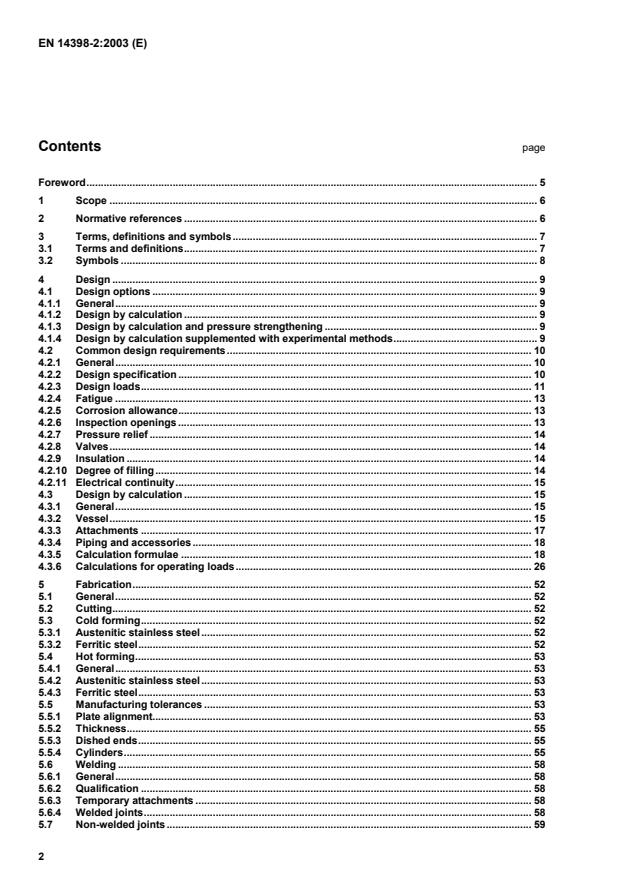
Elastic stress analysis.65A.1General.65A.2Terminology.65A.2.1Stress intensity.65A.2.2Gross structural discontinuity.66A.2.3Local structural discontinuity.66A.2.4Normal stress.66A.2.5Shear stress.66A.2.6Membrane stress.66A.2.7Primary stress.67A.2.8Primary local membrane stress.67A.2.9Secondary stress.67A.2.10Peak stress.67A.3Limit for longitudinal compressive general membrane stress.67A.4Stress categories and stress limits for general application.68A.4.1General.68A.4.2General primary membrane stress category.68A.4.3Local primary membrane stress category.68A.4.4General or local primary membrane plus primary bending stress category.68A.4.5Primary plus secondary stress category.68A.4.6Thermal stress.69A.5Specific criteria, stress categories and stress limits for limited application.69A.5.1General.69A.5.2Attachments and supports.69A.5.3Nozzles and openings.70A.5.4Additional stress limits.70Annex B (normative)
Additional requirements for 9 % Ni steel.74B.1Introduction.74B.2Specific requirements.74Annex C (normative)
Pressure strengthening of vessels from austenitic stainless steels.76C.1Introduction.76C.2Scope.76C.3Definitions and units of measurement.76C.4Materials.77C.5Design.78C.5.1General.78C.5.2Design for internal pressure.78C.6Manufacturing and inspection.81C.6.1Strengthening procedure.81C.6.2Procedure record.81C.6.3Welding.81C.6.4Pressure vessel drawing.82C.6.5Data plate.82C.7Comments.82C.7.1Strengthening theory.82C.7.2Work-hardened material.83C.7.3Derivation of formulae.84
Specific weld details.88D.1Field of application.88D.2Weld detail.88D.2.1Joggle joint.88D.2.2Intermediate ends.88D.2.3Backing strip.89D.2.4End plate closure.89D.2.5Non full penetration nozzle weld.89D.2.6Non continuous fillet weld on attachments.89D.3Oxygen service requirements.89Annex E (normative)
Increased material property for austenitic stainless steel.92Bibliography.93
14398-1 and does not apply to vessels designed for toxic fluids.This European Standard does not include the general vehicle requirements e.g. running gear, brakes, lighting etc.that shall be in accordance with the relevant standards/regulations.2 Normative referencesThis European Standard incorporates by dated or undated reference, provisions from other publications. Thesenormative references are cited at the appropriate places in the text, and the publications are listed hereafter. Fordated references, subsequent amendments to or revisions of any of these publications apply to this EuropeanStandard only when incorporated in it by amendment or revision. For undated references the latest edition of thepublication referred to applies (including amendments).EN 287-1, Approval testing of welders - Fusion welding - Part 1 : Steels.EN 287-2, Approval testing of welders - Fusion welding - Part 2 : Aluminium and aluminium alloys.EN 288-3:1992, Specification and approval of welding procedures for metallic materials - Part 3 : Weldingprocedure tests for the arc welding of steels.EN 288-4, Specification and approval of welding procedures for metallic materials - Part 4 : Welding proceduretests for the arc welding of aluminium and its alloys.EN 288-8, Specification and approval of welding procedures for metallic materials - Part 8 : Approval by a pre-production welding test.EN 473, Non destructive testing - Qualification and certification of NDT personnel - General principles.EN 875, Destructive tests on welds in metallic materials - Impact tests - Test specimen location, notch orientationand examination.EN 895, Destructive tests on welds in metallic materials - Transverse tensile test.EN 910, Destructive tests on welds in metallic materials – Bend tests.EN 1252-1:1998, Cryogenic vessels - Materials - Part 1 : Toughness requirements for temperatures below - 80 °C.EN 1252-2, Cryogenic vessels - Materials - Part 2 : Toughness requirements for temperatures between – 80 °Cand –20 °C.EN 1418, Welding personnel – Approval testing of welding operators for fusion welding and resistance weld settersfor fully mechanised and automatic welding of metallic materials.EN 1435, Non-destructive examination of welds – Radiographic examination of welded joints.EN 1626, Cryogenic vessels - Valves for cryogenic service.EN 1797, Cryogenic vessels - Gas/material compatibility.EN 10028-4, Flat products made of steels for pressure purposes – Part 4 : Nickel alloy steels with specified lowtemperature properties.
Large Transportable non-vacuum insulated vessels – Part 3 Operationalrequirements.EN ISO 6520-1, Welding and allied processes - Classification of geometric imperfections in metallic materials - Part1 : Fusion welding (ISO 6520-1:1998).ISO 1106-1, Recommended practice for radiographic examination of fusion welded joints - Part 1 : Fusion weldedbutt joints in steel plates up to 50 mm thick.3 Terms, definitions and symbolsFor the purposes of this European Standard, the following terms, definitions and symbols apply.3.1 Terms and definitionsFor the purposes of this European Standard, the terms and definitions given in EN 14398-1:2003 and the followingapply.3.1.1large transportable non vacuum insulated vesselvessel of more than 1000 l volume intended for one or more cryogenic fluids, consisting of an inner vessel, aninsulation, all of the valves and accessories and additional framework3.1.2fixed tank (tank vehicle)large transportable vessel permanently attached to a vehicle or to units of running gear used in its stead3.1.3demountable tanklarge transportable vessel non permanently attached to a vehicle. When attached to the carrier vehicle, thedemountable tank meets the requirements prescribed for a fixed tank. It is designed to be lifted only when empty3.1.4inner vesselpressure vessel proper intended to contain the cryogenic fluid3.1.5insulationto protect the vessel against heat transfer from the outside atmospheric temperature3.1.6automatic weldingwelding in which the parameters are automatically controlled. Some of these parameters can be adjusted to alimited extent, either manually or automatically, during welding to maintain the specified welding conditions
vessel itself or the protective frame,if any, are concerned ;the initial design programme shall be repeated to take account of these modifications.4.2.2 Design specificationTo enable the design to be prepared the following information which defines a vessel type shall be available : maximum allowable pressure ; fluids intended to be used ; liquid capacity ; dimensions and allowable weight, taking characteristics of the vehicle into account ; location of fastening points and loads allowable on these points ; filling and emptying rate ; range of ambient temperature, if differing from 7.2 of EN 14398-1:2003.A design document in the form of drawings with text if any shall be prepared, it shall contain the information givenabove plus the following where applicable : definition of which components are designed by calculation, by pressure strengthening, by experiment and bysatisfactory in service experience ; drawings with dimensions and thicknesses of load bearing components ; specification of all load bearing materials including grade, class, temper, testing etc. as relevant ; type of material test certificates ;
: the value used for validation purposes shall be :bar3,1sTpp(1)considered for each element of the vessel e.g. shell, courses, head, etc.ps is the maximum allowable pressure, in bar.The vessel shall be capable of holding the pressure test fluid without plastic deformation.b) pressure during operation, pC, where :LCppps(2)pL is the pressure, in bars, exerted by the mass of the liquid contents when the vessel is filled to capacityand subject to each load defined in 4.2.3.1, with either :1) boiling liquid at minimum allowable temperature2) cryogenic fluid at its equilibrium triple point or melting point temperature;
...
Questions, Comments and Discussion
Ask us and Technical Secretary will try to provide an answer. You can facilitate discussion about the standard in here.
Loading comments...