

EN 12812:2008
(Main)Falsework - Performance requirements and general design
- Abstract
This European Standard specifies performance requirements and limit state design methods for two design classes of falsework.
It sets out the rules that have to be taken into account to produce a safe falsework structure.
It also provides information where falsework is required to support a "permanent structure", or where the design or supply of falsework has to be commissioned.
This European Standard also gives information on foundations.
This European Standard does not specify requirements for formwork, although formwork may be a part of the falsework construction. Nor does it provide information on access and working scaffolds, which is given in EN 12811-1.
This European Standard does not provide information about site activities. It does not provide information about the use of some standardized products, including timber formwork beams conforming to EN 13377 and props conforming to EN 1065.
- Status
- Published
- Publication Date
- 15-Jul-2008
- Withdrawal Date
- 30-Jan-2009
- Technical Committee
- CEN/TC 53 - Temporary works equipment
- Drafting Committee
- CEN/TC 53/WG 6 - Performance requirements for falsework
- Current Stage
- 9093 - Decision to confirm - Review Enquiry
- Start Date
- 04-Mar-2024
- Completion Date
- 07-Oct-2026

Overview
EN 12812:2008 - "Falsework - Performance requirements and general design" - is a critical European Standard developed by CEN for professionals involved in the construction and engineering sectors. The standard outlines comprehensive performance requirements and design methodologies for two main classes of falsework. Falsework is essential as temporary supporting structures used during construction activities, especially to support permanent structures until they are self-supporting.
This standard sets the framework to ensure that falsework is safe, robust, and designed using defined limit state methods. EN 12812:2008 does not cover formwork requirements or details on scaffolds and site operations, focusing strictly on the temporary structures required to bear construction loads. Importantly, it also provides guidance on foundations supporting falsework, contributing to overall project safety and efficiency.
Key Topics
Design Classes:
EN 12812:2008 distinguishes two design classes for falsework:- Class A: For simple, repetitive applications with established good practice and limited structural demand.
- Class B: For more complex projects, requiring full structural calculations and further subdivided into B1 and B2, offering options for design complexity and safety.
Performance Requirements:
The standard specifies the required structural integrity under various loading and environmental conditions. It outlines:- Proper material selection and minimum thickness for steel and aluminum components.
- Secure and intentional connections to prevent accidental disassembly.
- Design considerations for differential settlement or movement due to thermal effects.
- Load combinations including self-weight, imposed loads, wind, temperature, seismic activity, and possible actions from water or debris.
Foundations:
EN 12812:2008 includes guidelines for the foundation design of falsework, ensuring safe transmission of loads into the ground or supporting structure. It covers:- Requirements for support on natural ground, permanent structures, or prepared sub-structures.
- Methods to address drainage, frost action, and stability against lateral forces.
Technical Documentation:
The standard details the necessary technical documentation for Class B falsework designs, including:- Calculations, construction sequence, structural models and assumptions.
- Comprehensive drawings for fabrication and site assembly.
- Method statements and clear instructions for erection, use, and dismantling.
Applications
EN 12812:2008 is widely used in:
- Building and Infrastructure Construction:
For supporting freshly poured concrete in bridges, buildings, and civil structures until they are self-supporting. - Structural Modifications and Repairs:
Supporting existing structures during renovation, maintenance, or structural changes. - Temporary Material Storage:
Providing safe temporary platforms for storing materials and equipment on site.
By adhering to EN 12812, professionals ensure that falsework:
- Meets European safety, reliability, and durability benchmarks.
- Is designed using consistent, proven methods, reducing risk of structural failures.
- Fulfills legal and contractual obligations in public and private sector projects.
Related Standards
Integration with EN 12812:2008 is essential for holistic temporary works design. Complementary standards include:
- EN 12810-1 / EN 12810-2: Facade scaffolds of prefabricated components.
- EN 12811-1: Performance requirements and general design for scaffolds.
- EN 13377: Requirements for prefabricated timber formwork beams.
- EN 1065: Specifications and testing for adjustable telescopic steel props.
- EN 1990 - EN 1999 (Eurocodes): Basis for all structural and geotechnical design.
- EN 1090-2 / EN 1090-3: Execution requirements for steel and aluminum structures.
These related documents provide broader regulatory and technical context for safe and effective temporary and permanent works in construction projects across Europe.
In summary, EN 12812:2008 is a cornerstone standard for the temporary works sector, setting clear rules for the safe design and construction of falsework. Its adoption promotes safety, reduces the risk of failure, and supports efficiency throughout the construction process.
Relations
- Effective Date
- 22-Dec-2008
- Effective Date
- 25-Mar-2026
- Effective Date
- 25-Mar-2026
- Refers
EN 1991-3:2026 - Eurocode 1 - Actions on structures - Part 3: Actions induced by cranes and machines - Effective Date
- 25-Mar-2026
- Effective Date
- 25-Mar-2026
- Refers
EN 1998-1-2:2026 - Eurocode 8 - Design of structures for earthquake resistance - Part 1-2: Buildings - Effective Date
- 25-Mar-2026
- Effective Date
- 25-Mar-2026
- Effective Date
- 28-Jan-2026
- Effective Date
- 28-Jan-2026
- Refers
EN 13377:2002 - Prefabricated timber formwork beams - Requirements, classification and assessment - Effective Date
- 28-Jan-2026
- Effective Date
- 28-Jan-2026
- Effective Date
- 28-Jan-2026
- Effective Date
- 28-Jan-2026
- Effective Date
- 28-Jan-2026
- Effective Date
- 28-Jan-2026
Get Certified
Connect with accredited certification bodies for this standard

DIBt (Deutsches Institut für Bautechnik)
German Institute for Building Technology.
DIN CERTCO
DIN Group product certification.

Aboma Certification B.V.
Specialized in construction, metal, and transport sectors.
Sponsored listings
Frequently Asked Questions
EN 12812:2008 is a standard published by the European Committee for Standardization (CEN). Its full title is "Falsework - Performance requirements and general design". This standard covers: This European Standard specifies performance requirements and limit state design methods for two design classes of falsework. It sets out the rules that have to be taken into account to produce a safe falsework structure. It also provides information where falsework is required to support a "permanent structure", or where the design or supply of falsework has to be commissioned. This European Standard also gives information on foundations. This European Standard does not specify requirements for formwork, although formwork may be a part of the falsework construction. Nor does it provide information on access and working scaffolds, which is given in EN 12811-1. This European Standard does not provide information about site activities. It does not provide information about the use of some standardized products, including timber formwork beams conforming to EN 13377 and props conforming to EN 1065.
This European Standard specifies performance requirements and limit state design methods for two design classes of falsework. It sets out the rules that have to be taken into account to produce a safe falsework structure. It also provides information where falsework is required to support a "permanent structure", or where the design or supply of falsework has to be commissioned. This European Standard also gives information on foundations. This European Standard does not specify requirements for formwork, although formwork may be a part of the falsework construction. Nor does it provide information on access and working scaffolds, which is given in EN 12811-1. This European Standard does not provide information about site activities. It does not provide information about the use of some standardized products, including timber formwork beams conforming to EN 13377 and props conforming to EN 1065.
EN 12812:2008 is classified under the following ICS (International Classification for Standards) categories: 91.220 - Construction equipment. The ICS classification helps identify the subject area and facilitates finding related standards.
EN 12812:2008 has the following relationships with other standards: It is inter standard links to EN 12812:2004, EN 1991-1-4:2026, EN 1991-1-6:2026, EN 1991-3:2026, EN 1991-1-8:2026, EN 1998-1-2:2026, EN 1991-4:2026, EN 1999-1-4:2023, EN 1998-1-1:2024, EN 13377:2002, EN 1991-3:2006, EN 1090-3:2019, EN 1999-1-3:2023, EN 74-3:2007, EN 1991-1-4:2005/A1:2010. Understanding these relationships helps ensure you are using the most current and applicable version of the standard.
EN 12812:2008 is available in PDF format for immediate download after purchase. The document can be added to your cart and obtained through the secure checkout process. Digital delivery ensures instant access to the complete standard document.
Standards Content (Sample)
2003-01.Slovenski inštitut za standardizacijo. Razmnoževanje celote ali delov tega standarda ni dovoljeno.Nosilni odri - Zahtevane lastnosti in projektiranjeTraggerüste - Anforderungen, Entwurf und BemessungEtaiements - Exigences de performance et méthodes de conception et calculsFalsework - Performance requirements and general design91.220Gradbena opremaConstruction equipmentICS:Ta slovenski standard je istoveten z:EN 12812:2008SIST EN 12812:2008en,fr01-oktober-2008SIST EN 12812:2008SLOVENSKI
STANDARDSIST EN 12812:20041DGRPHãþD
EUROPEAN STANDARDNORME EUROPÉENNEEUROPÄISCHE NORMEN 12812July 2008ICS 91.220Supersedes EN 12812:2004
English VersionFalsework - Performance requirements and general designEtaiements - Exigences de performance et méthodes deconception et calculsTraggerüste - Anforderungen, Bemessung und EntwurfThis European Standard was approved by CEN on 7 June 2008.CEN members are bound to comply with the CEN/CENELEC Internal Regulations which stipulate the conditions for giving this EuropeanStandard the status of a national standard without any alteration. Up-to-date lists and bibliographical references concerning such nationalstandards may be obtained on application to the CEN Management Centre or to any CEN member.This European Standard exists in three official versions (English, French, German). A version in any other language made by translationunder the responsibility of a CEN member into its own language and notified to the CEN Management Centre has the same status as theofficial versions.CEN members are the national standards bodies of Austria, Belgium, Bulgaria, Cyprus, Czech Republic, Denmark, Estonia, Finland,France, Germany, Greece, Hungary, Iceland, Ireland, Italy, Latvia, Lithuania, Luxembourg, Malta, Netherlands, Norway, Poland, Portugal,Romania, Slovakia, Slovenia, Spain, Sweden, Switzerland and United Kingdom.EUROPEAN COMMITTEE FOR STANDARDIZATIONCOMITÉ EUROPÉEN DE NORMALISATIONEUROPÄISCHES KOMITEE FÜR NORMUNGManagement Centre: rue de Stassart, 36
B-1050 Brussels© 2008 CENAll rights of exploitation in any form and by any means reservedworldwide for CEN national Members.Ref. No. EN 12812:2008: ESIST EN 12812:2008
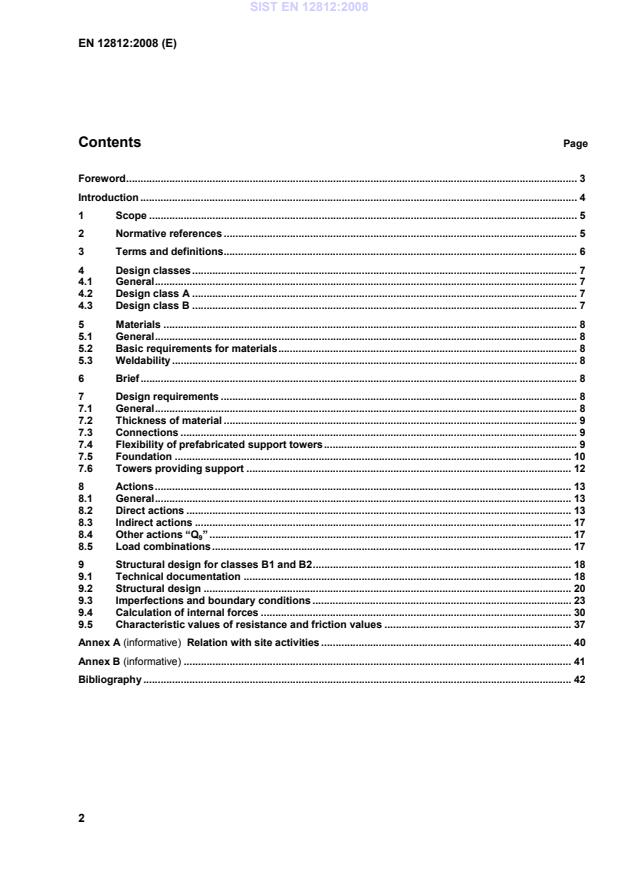
Relation with site activities.40 Annex B (informative).41 Bibliography.42
According to the CEN/CENELEC Internal Regulations, the national standards organizations of the following countries are bound to implement this European Standard: Austria, Belgium, Bulgaria, Cyprus, Czech Republic, Denmark, Estonia, Finland, France, Germany, Greece, Hungary, Iceland, Ireland, Italy, Latvia, Lithuania, Luxembourg, Malta, Netherlands, Norway, Poland, Portugal, Romania, Slovakia, Slovenia, Spain, Sweden, Switzerland and the United Kingdom. SIST EN 12812:2008
Introduction Most falsework is used: to carry the loads due to freshly poured concrete for permanent structures until these structures have reached a sufficient load bearing capacity; to absorb the loads from structural members, plant and equipment which arise during the erection, maintenance, alteration or removal of buildings or other structures; additionally, to provide support for the temporary storage of building materials, structural members and equipment. This European Standard gives performance requirements for specifying and using falsework and gives methods to design falsework to meet those requirements. Clause 9 provides design methods. It also gives simplified design methods for falsework made of tubes and fittings. The information on structural design is supplementary to the relevant Structural Eurocodes. The standard describes different design classes. This allows the designer to choose between more or less complex design methods, while achieving the same level of structural safety. Provision for specific safety matters is dealt with in EN 12811-1 and other documents. SIST EN 12812:2008
EN 74-1, Couplers, spigot pins and baseplates for use in falsework and scaffolds — Part 1: Couplers for tubes — Requirements and test procedures prEN 74-2, Couplers, spigot pins and baseplates for use in falsework and scaffolds — Part 2: Special couplers — Requirements and test procedures EN 74-3, Couplers, spigot pins and baseplates for use in falsework and scaffolds — Part 3: Plain base plates and spigot pins — Requirements and test procedures EN 1065:1998, Adjustable telescopic steel props — Product specifications, design and assessment by calculation and tests EN 1090-2, Execution of steel structures and aluminium structures - Part 2: Technical requirements for steel structures EN 1090-3, Execution of steel structures and aluminium structures - Part 3: Technical requirements for aluminium structures EN 1990, Eurocode — Basis of structural design EN 1991 (all parts), Eurocode 1 — Actions on structures EN 1993-1-1:2005, Eurocode 3: Design of steel structures - Part 1-1: General rules and rules for buildings EN 1997 (all parts), Eurocode 7 — Geotechnical design EN 1998 (all parts), Eurocode 8 — Design of structures for earthquake resistance EN 1999 (all parts), Eurocode 9 — Design of aluminium structures SIST EN 12812:2008
NOTE 1 A bow imperfection can occur both in an individual member and in the complete tower or modular beam assembly. It arises because the member is not straight, is manufactured not straight or members are assembled out of alignment. NOTE 2 These are the values for design purposes and may be more than the erection tolerance. 3.8 node theoretical intersection point of members SIST EN 12812:2008
4 Design classes 4.1 General The design shall be in accordance with one of the classes: A or B. Class B has two subclasses, B1 and B2, see 4.3 where the designer has to decide which subclass shall be applied. 4.2 Design class A NOTE A Class A falsework is one which follows established good practice which may be deemed to satisfy the design requirements. Class A covers falsework for simple constructions such as in situ slabs and beams. Class A shall only be adopted where: a) slabs have a cross-sectional area not exceeding 0,3 m2 per metre width of slab; b) beams have a cross-sectional area not exceeding 0,5 m2; c) the clear span of beams and slabs does not exceed 6,0 m; d) the height to the underside of the permanent structure does not exceed 3,5 m. The design for class A falsework shall be in accordance with the descriptive requirements in Clauses 5 and 7. 4.3 Design class B Class B falsework is one for which a complete structural design is undertaken. Class B falsework is required to be designed in accordance with the relevant Eurocodes. There are separate additional provisions in this code for Classes B1 and B2 that are detailed below. Class B2 uses a simpler design method than Class B1 to achieve the same level of safety. 4.3.1 Class B1 The design shall be in accordance with the relevant Eurocodes (EN 1990, EN 1991 to EN 1999) and additionally with 9.1.1, 9.1.2.1, 9.1.3, 9.3.3 and 9.4.1 of the present standard. NOTE
It is assumed that the erection will be carried out to the level of workmanship appropriate for permanent construction, see EN 1090-2 and EN 1090-3 for metal structures. 4.3.2 Class B2 The design shall be in accordance with Clauses 5, 6, 7, 8 and 9, with the exception of 9.1.2.1, 9.3.3, 9.4.1, and with the relevant Eurocodes (EN 1991, EN 1990 to EN 1999). Where there is a conflict, the provisions of the present standard shall take precedence. NOTE Attention is drawn to the simplified methods given in 9.3 and 9.4 and to the requirements for drawings and other documentation given in 9.1.2. SIST EN 12812:2008
Where the relevant properties of materials and equipment cannot be obtained from the standards referred to in 5.2.1, their properties shall be established by testing (see 9.5.2).
5.2.3 Steel of deoxidation type FU (Rimming steel) shall not be used. 5.3 Weldability The steel used shall be weldable, unless structural members and components are not intended to be welded. Welding shall be carried out in accordance with the requirements of EN 1090-2 and EN 1090-3. The design shall not require any welding of aluminium to be undertaken on site. 6 Brief The design shall be based on a brief containing all necessary data including information on erection, use, dismantling and loading. NOTE 1
Concrete is a typical example of loading. NOTE 2 Adequate information about site conditions should be obtained and included in the brief. Particular points are: layout with levels, including adjacent structures; general appreciation of the parameters relating to wind load calculations for the local conditions; positions of services such as water pipes or electricity cables; requirements for access and safe working space; information about the ground conditions. 7 Design requirements 7.1 General The structure shall be designed such that all the loads acting on it are carried into the subsoil or into a load-bearing sub-structure. The available skill in erection and the ambient circumstances should be taken into account in the design. SIST EN 12812:2008
The value of the settlement, δs, shall be the lesser of 5 mm and that calculated from Equation (1); the maximum value of the thermal movement shall be calculated from Equation (2) taking the lesser of the two values of δs from the previous examination. l/××=−3s105,2≤ 5 mm (1) SIST EN 12812:2008
(2) where Rd is the normal design value of the load bearing capacity; Rd* is the design value of the load bearing capacity after differential settlement or thermal movement has occurred; h is the overall height of the tower in millimetres; l is the horizontal base of the support tower in millimetres;
δs is the differential settlement; δt is the horizontal movement caused by temperature.
a) Theoretical system b) Differential settlement c) Thermal movement NOTE See 7.4 for symbol definitions. Figure 1 — Relative deformations due to differential settlement or thermal movement 7.5 Foundation 7.5.1 Basic requirements for foundations The structure shall be supported directly from one or more of the following: a sub-structure provided for the purpose; SIST EN 12812:2008
for the support construction for load bearing towers; – for the height adjustment of the base-construction in combination with the foundation.
In each case, stacked members shall be placed crosswise, and the base area shall be enlarged with every layer from top to bottom. The support construction for load bearing towers shall cover the whole cross-section of the tower (Figure 2a). SIST EN 12812:2008
h ≤ 40cm (3) For bandhFFVH,,see Figure 2.b).
a) support of a load bearing tower by stacked members
Key 1 lower edge of base plate
b) stacked member for height adjustment
Figure 2 — Examples of arrangement of stacked members 7.6 Towers providing support
The cross-sectional shape of a support tower shall be maintained e.g. by bracing or stiffened planes; at the top and bottom, the formwork and the foundation may substitute for the bracing if appropriately connected. SIST EN 12812:2008
a) Cross section during concreting
b) Loading diagram Key 1 access areas: minimum live loading class 1 of EN 12811-1 2 loading from the weight of concrete to be supported 3 surcharge allowance for heaping during placing concrete Figure 3 — Loading from concrete on falsework 8.2.3.2 Concrete pressure Lateral concrete pressure shall be considered in the design. NOTE The National Annex may give information on lateral loads. Published guidance can be found in: DIN 18218:1980; CIRIA Report No. 108, Concrete pressure on formwork, 1985; Manual de Technologie: Coffrage; CIB-FIB-CEB 27-98-83. 8.2.4 Wind "Q5" 8.2.4.1 Maximum wind Data shall be obtained from EN 1991-1-4, which gives velocity pressure for a 50-year return period. NOTE The velocity pressure may be modified according to EN 1991-1-4 taking the period of use of the falsework into account. 8.2.4.2 Working wind For the working wind, a velocity pressure of 200 N/ m2 shall be used. 8.2.5 Flowing water actions "Q6" 8.2.5.1 Loads produced by flowing water The static pressure taken to represent the dynamic pressure of flowing water, qw in Newtons per square metre, shall be calculated from Equation (4):
qw = 500 x vw2 (4) SIST EN 12812:2008
Fw = qw × η × A (5) where A is the effective area normal to the flow, in square metres; η is the force coefficient for water appropriate to the members under consideration. The effective water area A should be determined after investigating the maximum flood level. NOTE 1 The following are some values of η: 1,86 for flat surfaces normal to flows; 0,63 for cylindrical surfaces; 0,03 for well streamlined surfaces. NOTE 2 Shielding may be taken into account providing the structure is so arranged that a clear-cut water pattern is developed at the upstream members to provide protection to regular lines of members in the direction of flow. Where such arrangements are made as a feature of the design, the total force calculated may be reduced, in the case of the shielded members, by up to 20 %. 8.2.5.2 Debris effect The accumulation of debris is expected to produce a load on the structure that may be calculated as for that on a rectangular cofferdam. This load, Fw, in Newtons, shall be calculated from Equation (6): Fw = 666 × A
× vw2 (6) where A is the area of obstruction presented by the trapped debris and falsework, in square metres; vw is the speed of water flow, in metres per second. NOTE 1 If there is a possibility of logs or rubbish being washed or floating down after heavy rain, then an estimate of the possible loads should be made. It is normally preferable to prevent debris accumulating against the structure. NOTE 2 Where a structure is subject to waves, account should be taken of the loads that may be imposed by the waves. 8.2.6 Seismic effects "Q7" Allowance should be made for seismic effects. Reference shall be made to EN 1998. NOTE Attention is drawn to the provisions of national regulations concerning seismic effects. SIST EN 12812:2008
EN 128
...