


EN 931:1997
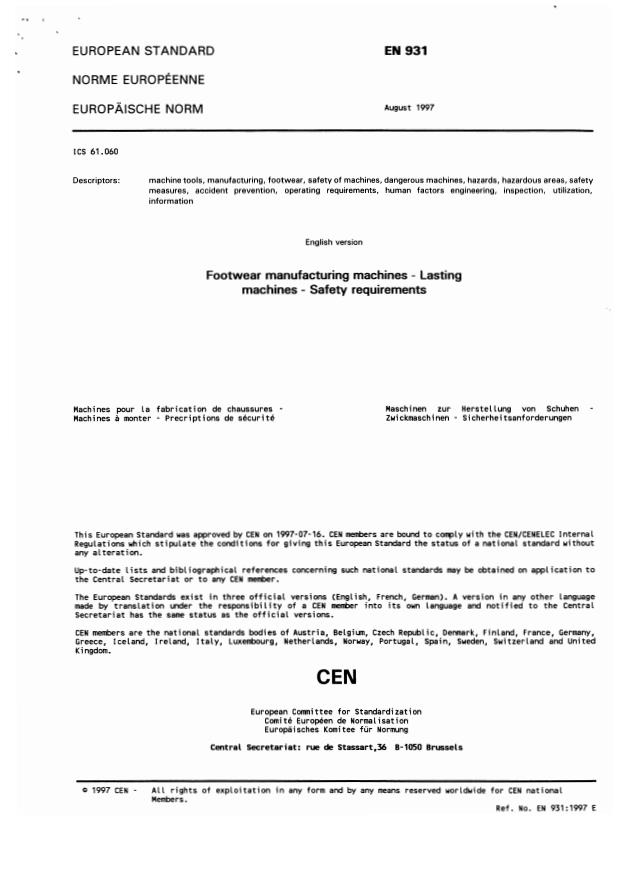
(Main)Footwear manufacturing machines - Lasting machines - Safety requirements
Footwear manufacturing machines - Lasting machines - Safety requirements
1.1 This standard is applicable to lasting machines used in the footwear manufacturing industry, namely: - adhesive fore part lasting machines (.), - hand operated adhesive side lasting machines (.), - adhesive seat lasting machines (.), - adhesive seat and side lasting machines (.), - hand operated tack/staple side lasting machines (.), - tack seat lasting machines (.), - tack seat and side thermocement lasting machines (.), - tack heel seat and thermocement side lasting machines (.), - tack heel seat and thermocement+tack side lasting machines (.). 1.2 This standard does not apply to lasting machines which process granular thermocement. 1.3 This standard specifies requirements for safe design, construction and use of the machines. No specific requirements are included for transport, commissioning and decommissioning. It takes account of intended use, foreseeable misuse, component and system failure. 1.4 This standard covers all hazards relevant to the footwear manufacturing industry. The use of machines within the scope of this standard in different industries may give rise to hazards which were not taken into account at the time of its preparation. 1.5 This standard applies to machines manufactured after its date of issue.
Maschinen zur Herstellung von Schuhen - Zwickmaschinen - Sicherheitsanforderungen
Diese Norm gilt für Zwickmaschinen, die in der Schuhindustrie verwendet werden nämlich: - Spitzen-Klebezwickmaschinen - handbetriebene Klebe-Seiten- zwickmaschinen; - Klebe-Fersenzwickmaschine; Klebe-Fersen- und Seitenzwick- maschinen; - handbetrieben Tacks-/Klammer-Seitenzwickmaschinen; - Tacks-Fersen- Zwickmaschinen; - Tacks-Fersen und Zement-Seiten-Zwickmaschinen; - Tacks-Fersen- und Zement-Seiten-Zwickmaschinen; - Tacks-Fersen- und Zement-/Tacks- Seitenzwickmaschinen.
Machines pour la fabrication de chaussures - Machines à monter - Préscriptions de sécurité
La présente norme s'applique aux machines à monter employées dans la fabrication de chaussures, à savoir: - machines à monter les embouts; - machinesmanuelles à monter les flancs; - machines à monter l'emboîtage; - machines à monter l'emboîtage et les flancs; - machines manuelles à monter les flancs par semences/agrafes; - machines à monter l'emboîtage par semences; - machines à monter l'emboîtage et les flancs par semences; - machines à monter l'emboîtage par semences et les flancs par adhésif thermoplastique; - machines à monter l'emboîtage par semences et les flancs par semences & thermoplastiques
Footwear manufacturing machines - Lasting machines - Safety requirements
General Information
- Status
- Withdrawn
- Publication Date
- 19-Aug-1997
- Withdrawal Date
- 11-Aug-2009
- Technical Committee
- CEN/TC 201 - Leather and imitation leather goods and footwear manufacturing machinery - Safety
- Drafting Committee
- CEN/TC 201/WG 4 - Lasting machines - Nailing machines
- Current Stage
- 9960 - Withdrawal effective - Withdrawal
- Start Date
- 12-Aug-2009
- Completion Date
- 12-Aug-2009
- Directive
- 89/392/EEC - Machinery - Safety of machinery: general essential health and safety requirements
- Directive
- 98/37/EC - Machinery
Relations
- Merged Into
EN 931:1997+A2:2009 - Footwear manufacturing machines - Lasting machines - Safety requirements - Effective Date
- 20-Jun-2009
- Effective Date
- 28-Jan-2026
- Effective Date
- 28-Jan-2026
- Effective Date
- 28-Jan-2026
- Amended By
EN 931:1997/prA2 - Footwear manufacturing machines - Lasting machines - Safety requirements - Effective Date
- 22-Dec-2008
- Amended By
EN 931:1997/A1:2004 - Footwear manufacturing machines - Lasting machines - Safety requirements - Effective Date
- 22-Dec-2008

Frequently Asked Questions
EN 931:1997 is a standard published by the European Committee for Standardization (CEN). Its full title is "Footwear manufacturing machines - Lasting machines - Safety requirements". This standard covers: 1.1 This standard is applicable to lasting machines used in the footwear manufacturing industry, namely: - adhesive fore part lasting machines (.), - hand operated adhesive side lasting machines (.), - adhesive seat lasting machines (.), - adhesive seat and side lasting machines (.), - hand operated tack/staple side lasting machines (.), - tack seat lasting machines (.), - tack seat and side thermocement lasting machines (.), - tack heel seat and thermocement side lasting machines (.), - tack heel seat and thermocement+tack side lasting machines (.). 1.2 This standard does not apply to lasting machines which process granular thermocement. 1.3 This standard specifies requirements for safe design, construction and use of the machines. No specific requirements are included for transport, commissioning and decommissioning. It takes account of intended use, foreseeable misuse, component and system failure. 1.4 This standard covers all hazards relevant to the footwear manufacturing industry. The use of machines within the scope of this standard in different industries may give rise to hazards which were not taken into account at the time of its preparation. 1.5 This standard applies to machines manufactured after its date of issue.
1.1 This standard is applicable to lasting machines used in the footwear manufacturing industry, namely: - adhesive fore part lasting machines (.), - hand operated adhesive side lasting machines (.), - adhesive seat lasting machines (.), - adhesive seat and side lasting machines (.), - hand operated tack/staple side lasting machines (.), - tack seat lasting machines (.), - tack seat and side thermocement lasting machines (.), - tack heel seat and thermocement side lasting machines (.), - tack heel seat and thermocement+tack side lasting machines (.). 1.2 This standard does not apply to lasting machines which process granular thermocement. 1.3 This standard specifies requirements for safe design, construction and use of the machines. No specific requirements are included for transport, commissioning and decommissioning. It takes account of intended use, foreseeable misuse, component and system failure. 1.4 This standard covers all hazards relevant to the footwear manufacturing industry. The use of machines within the scope of this standard in different industries may give rise to hazards which were not taken into account at the time of its preparation. 1.5 This standard applies to machines manufactured after its date of issue.
EN 931:1997 is classified under the following ICS (International Classification for Standards) categories: 61.060 - Footwear. The ICS classification helps identify the subject area and facilitates finding related standards.
EN 931:1997 has the following relationships with other standards: It is inter standard links to EN 931:1997+A2:2009, EN ISO 11546-1:2009, EN ISO 11203:2009, EN ISO 11200:2009, EN 931:1997/prA2, EN 931:1997/A1:2004. Understanding these relationships helps ensure you are using the most current and applicable version of the standard.
EN 931:1997 is associated with the following European legislation: EU Directives/Regulations: 89/392/EEC, 98/37/EC; Standardization Mandates: M/BC/CEN/88/13. When a standard is cited in the Official Journal of the European Union, products manufactured in conformity with it benefit from a presumption of conformity with the essential requirements of the corresponding EU directive or regulation.
EN 931:1997 is available in PDF format for immediate download after purchase. The document can be added to your cart and obtained through the secure checkout process. Digital delivery ensures instant access to the complete standard document.
Standards Content (Sample)
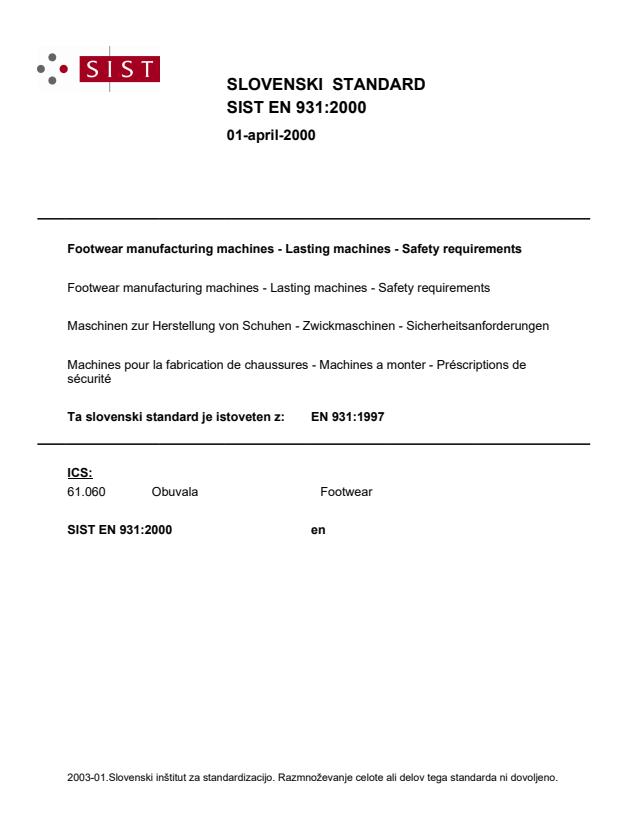
SLOVENSKI STANDARD
01-april-2000
Footwear manufacturing machines - Lasting machines - Safety requirements
Footwear manufacturing machines - Lasting machines - Safety requirements
Maschinen zur Herstellung von Schuhen - Zwickmaschinen - Sicherheitsanforderungen
Machines pour la fabrication de chauss
...
Questions, Comments and Discussion
Ask us and Technical Secretary will try to provide an answer. You can facilitate discussion about the standard in here.
Loading comments...