

EN 14382:2005
(Main)Safety devices for gas pressure regulating stations and installations - Gas safety shut-off devices for inlet pressures up to 100 bar
- Abstract
This document specifies constructional, functional, sizing, and testing requirements, also documentation and marking of gas safety shut-off devices used in the pressure regulating stations in accordance with EN 12186 or EN 12279:
- for inlet pressures up to 100 bar and nominal diameters up to DN 400;
- for an operating temperature range from -20 °C to +60 °C,
which operate with fuel gases of the 1st and 2nd family in accordance with EN 437 in transmission and distribution networks and also in commercial and industrial installations.
"Gas safety shut-off devices" will hereafter be called "SSDs" except in titles.
The harmonized part of this document deals with standard safety shut-off devices used in pressure regulating stations complying with EN 12186 or EN 12279. For standard safety shut-off devices integral strength type when used in pressure regulating stations complying with EN 12186 or EN 12279, Annex ZA lists all applicable Essential Requirements except the external resistance to environmental conditions where corrosion occurs.
This document considers the following classes of SSDs:
temperature classes:
- class 1: operating temperature range from -10 °C to 60 °C;
- class 2: operating temperature range from -20 °C to 60 °C;
functional classes:
- class A: SSDs that close when damage to the pressure sensing element occurs (applicable to overpressure SSDs only) or when external power fails;
- class B: SSDs that do not close when damage to the pressure sensing element occurs or are able to be opened automatically by the pressure control system (applicable to overpressure SSDs only).
SSDs complying with the requirements of this document may be declared as "in conformity with EN 14382" and bear the mark "EN 14382".
The material and functional requirements specified in this document may be applied to SSDs which use thermal energy or the effects of electrical energy to trip the operation of the closing member. For these SSDs the operational parameters are n
- Status
- Withdrawn
- Publication Date
- 08-Mar-2005
- Withdrawal Date
- 17-Mar-2009
- Current Stage
- 9960 - Withdrawal effective - Withdrawal
- Start Date
- 18-Mar-2009
- Completion Date
- 18-Mar-2009
- Directive
- 97/23/EC - Pressure equipment

Relations
- Effective Date
- 22-Dec-2008
- Effective Date
- 18-Jan-2023
- Effective Date
- 28-Jan-2026
- Effective Date
- 28-Jan-2026
- Effective Date
- 28-Jan-2026
- Effective Date
- 28-Jan-2026
- Effective Date
- 22-Dec-2008
Get Certified
Connect with accredited certification bodies for this standard

Institut za varilstvo d.o.o. (Welding Institute)
Slovenia's leading welding institute since 1952. ISO 3834, EN 1090, pressure equipment certification, NDT personnel, welder qualification. Only IIW Au
Sponsored listings
Frequently Asked Questions
EN 14382:2005 is a standard published by the European Committee for Standardization (CEN). Its full title is "Safety devices for gas pressure regulating stations and installations - Gas safety shut-off devices for inlet pressures up to 100 bar". This standard covers: This document specifies constructional, functional, sizing, and testing requirements, also documentation and marking of gas safety shut-off devices used in the pressure regulating stations in accordance with EN 12186 or EN 12279: - for inlet pressures up to 100 bar and nominal diameters up to DN 400; - for an operating temperature range from -20 °C to +60 °C, which operate with fuel gases of the 1st and 2nd family in accordance with EN 437 in transmission and distribution networks and also in commercial and industrial installations. "Gas safety shut-off devices" will hereafter be called "SSDs" except in titles. The harmonized part of this document deals with standard safety shut-off devices used in pressure regulating stations complying with EN 12186 or EN 12279. For standard safety shut-off devices integral strength type when used in pressure regulating stations complying with EN 12186 or EN 12279, Annex ZA lists all applicable Essential Requirements except the external resistance to environmental conditions where corrosion occurs. This document considers the following classes of SSDs: temperature classes: - class 1: operating temperature range from -10 °C to 60 °C; - class 2: operating temperature range from -20 °C to 60 °C; functional classes: - class A: SSDs that close when damage to the pressure sensing element occurs (applicable to overpressure SSDs only) or when external power fails; - class B: SSDs that do not close when damage to the pressure sensing element occurs or are able to be opened automatically by the pressure control system (applicable to overpressure SSDs only). SSDs complying with the requirements of this document may be declared as "in conformity with EN 14382" and bear the mark "EN 14382". The material and functional requirements specified in this document may be applied to SSDs which use thermal energy or the effects of electrical energy to trip the operation of the closing member. For these SSDs the operational parameters are n
This document specifies constructional, functional, sizing, and testing requirements, also documentation and marking of gas safety shut-off devices used in the pressure regulating stations in accordance with EN 12186 or EN 12279: - for inlet pressures up to 100 bar and nominal diameters up to DN 400; - for an operating temperature range from -20 °C to +60 °C, which operate with fuel gases of the 1st and 2nd family in accordance with EN 437 in transmission and distribution networks and also in commercial and industrial installations. "Gas safety shut-off devices" will hereafter be called "SSDs" except in titles. The harmonized part of this document deals with standard safety shut-off devices used in pressure regulating stations complying with EN 12186 or EN 12279. For standard safety shut-off devices integral strength type when used in pressure regulating stations complying with EN 12186 or EN 12279, Annex ZA lists all applicable Essential Requirements except the external resistance to environmental conditions where corrosion occurs. This document considers the following classes of SSDs: temperature classes: - class 1: operating temperature range from -10 °C to 60 °C; - class 2: operating temperature range from -20 °C to 60 °C; functional classes: - class A: SSDs that close when damage to the pressure sensing element occurs (applicable to overpressure SSDs only) or when external power fails; - class B: SSDs that do not close when damage to the pressure sensing element occurs or are able to be opened automatically by the pressure control system (applicable to overpressure SSDs only). SSDs complying with the requirements of this document may be declared as "in conformity with EN 14382" and bear the mark "EN 14382". The material and functional requirements specified in this document may be applied to SSDs which use thermal energy or the effects of electrical energy to trip the operation of the closing member. For these SSDs the operational parameters are n
EN 14382:2005 is classified under the following ICS (International Classification for Standards) categories: 23.060.40 - Pressure regulators. The ICS classification helps identify the subject area and facilitates finding related standards.
EN 14382:2005 has the following relationships with other standards: It is inter standard links to EN 14382:2002, EN 14382:2005+A1:2009, EN 15001-1:2009, EN 15001-1:2023, EN 746-2:2010, EN 334:2005+A1:2009, EN 14382:2005/prA1. Understanding these relationships helps ensure you are using the most current and applicable version of the standard.
EN 14382:2005 is associated with the following European legislation: EU Directives/Regulations: 97/23/EC; Standardization Mandates: M/071. When a standard is cited in the Official Journal of the European Union, products manufactured in conformity with it benefit from a presumption of conformity with the essential requirements of the corresponding EU directive or regulation.
EN 14382:2005 is available in PDF format for immediate download after purchase. The document can be added to your cart and obtained through the secure checkout process. Digital delivery ensures instant access to the complete standard document.
Standards Content (Sample)
2003-01.Slovenski inštitut za standardizacijo. Razmnoževanje celote ali delov tega standarda ni dovoljeno.Safety devices for gas pressure regulating stations and installations - Gas safety shut-off devices for inlet pressures up to 100 barVarnostne naprave za plinske regulacijske postaje in napeljave - Plinske varnostne zaporne naprave za vstopne tlake do 100 barDispositifs de sécurité pour postes et installations de détente-régulation de pression de gaz - Clapets de sécurité pour pressions amont jusqu'a 100 barSicherheitseinrichtungen für Gas-Druckregelanlagen und -einrichtungen - Gas-Sicherheitsabsperreinrichtungen für Betriebsdrücke bis 100 barTa slovenski standard je istoveten z:EN 14382:2005SIST EN 14382:2005en,fr,de23.060.40ICS:SIST EN 14382:20041DGRPHãþDSLOVENSKI
STANDARDSIST EN 14382:200501-junij-2005
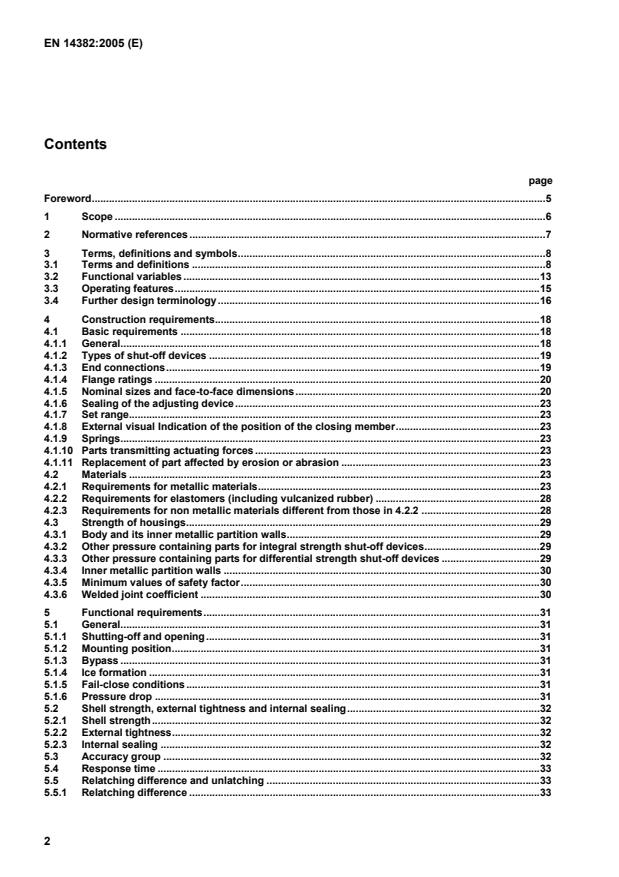
EUROPEAN STANDARD NORME EUROPÉENNE EUROPÄISCHE NORM
EN 14382
March 2005 ICS 23.060.40 Supersedes EN 14382:2002 English version
Safety devices for gas pressure regulating stations and installations - Gas safety shut-off devices for inlet pressures up to 100 bar
Dispositifs de sécurité pour postes et installations de détente-régulation de pression de gaz - Clapets de sécurité pour pressions amont jusqu'à 100 bar
Sicherheitseinrichtungen für Gas-Druckregelanlagen und -einrichtungen - Gas-Sicherheitsabsperreinrichtungen für Betriebsdrücke bis 100 bar This European Standard was approved by CEN on 30 December 2004.
CEN members are bound to comply with the CEN/CENELEC Internal Regulations which stipulate the conditions for giving this European Standard the status of a national standard without any alteration. Up-to-date lists and bibliographical references concerning such national standards may be obtained on application to the Central Secretariat or to any CEN member.
This European Standard exists in three official versions (English, French, German). A version in any other language made by translation under the responsibility of a CEN member into its own language and notified to the Central Secretariat has the same status as the official versions.
CEN members are the national standards bodies of Austria, Belgium, Cyprus, Czech Republic, Denmark, Estonia, Finland, France, Germany, Greece, Hungary, Iceland, Ireland, Italy, Latvia, Lithuania, Luxembourg, Malta, Netherlands, Norway, Poland, Portugal, Slovakia, Slovenia, Spain, Sweden, Switzerland and United Kingdom.
EUROPEAN COMMITTEE FOR STANDARDIZATION COMITÉ EUROPÉEN DE NORMALISATION EUROPÄISCHES KOMITEE FÜR NORMUNG
Management Centre: rue de Stassart, 36
B-1050 Brussels © 2005 CEN All rights of exploitation in any form and by any means reserved worldwide for CEN national Members. Ref. No. EN 14382:2005: E
Ice formation.54 A.1 General.54 A.2 Requirements.54 A.3 Tests.54 Annex B (informative)
Compliance evaluation.55 B.1 General.55 B.2 Introduction.55 B.3 Procedure.55 B.4 Manufacturer’s compliance evaluation.56 B.5 Issue of the certificate of compliance.56 Annex C (informative)
Pressure drop and flow coefficient.57 C.1 Calculation method for pressure drop throughout the SSD.57 C.2 Test method for the determination of the flow coefficient Cv.57 Annex D (informative)
Alternative test method for verification of the strength of the trip mechanism, valve seat and closing member.59 D.1 Test method.59 D.2 Test method for the determination of the dynamic factor Cr.59 D.3 Test method for a series of SSDs.60 Annex E (informative)
Sizing equation.62 Annex F (informative)
Inspection certificate.63 Annex G (informative)
Order specification.65 G.1 General.65 G.2 Minimum specifications.65 G.2.1 Details of construction.65 G.2.2 Dimensions.65 G.2.3 Performance.65 G.3 Optional specifications.66 Annex H (informative)
Acceptance test.67 Annex I (informative)
Seat leakage.68 Annex J (normative)
Materials.69 J.1 Steel materials for pressure containing parts and inner metallic partition walls.69 J.2 Metallic materials different from steel materials for pressure containing parts and inner metallic partition walls.75 J.3 Materials for fixtures, integral process and sensing lines, connectors and fasteners.80 Annex ZA (informative)
Relationship between this European Standard and the Essential Requirements of EU Directive 97/23/EC.83 Bibliography.84
Key 1 Bypass 6
Controller 2
Relatching device 7
Sensing line 3
Trip mechanism 8
Actuator 4
Breather line 9
Sensing point 5
Setting element 10
Closing member Figure 1 — Example of a direct acting safety shut-off device
Key 1
Bypass 7
Sensing line 2
Actuator 8
External loading pressure line 3
Relatching device 9
Internal loading pressure line 4
Exhaust line 10
Breather/exhaust line 5
Trip mechanism 11
Sensing point 6
Controller 12
Closing member Figure 2 — Example of an indirect acting shut-off device
Key 1
Bypass 7
Sensing line 2
Actuator 8
External loading pressure line 3
Relatching device 9
Internal loading pressure line 4
Exhaust line 10
Breather/exhaust line 5
Trip mechanism 11
Sensing point 6
Controller 12
Closing member
13 Pressure reducer (is applicable) Figure 3 — Example of an indirect acting shut-off device
3.1.12 direct acting shut-off device SSD in which the sensing element is directly connected to the trip mechanism (see Figure 1) 3.1.13 indirect acting shut-off device SSD in which the energy required to move the closing member or to operate the controller is supplied by an internal or external power supply (see Figures 2 and 3) 3.1.14 cut-off device SSD designed to shut-off the gas flow, which responds slower dynamically than a slam shut device when the monitored pressure exceeds the pre-set values EXAMPLE SSD using actuator driven by pipeline gas or external power 3.1.15 slam shut device SSD designed to quickly shut-off the gas flow when the monitored pressure exceeds the pre-set values EXAMPLE Spring or weight loaded SSD 3.1.16 Accessories of shut-off devices 3.1.16.1 loading pressure line line connecting the controller and/or actuator to the internal or external power source
flow rate fluctuations; temperature changes; mechanical impacts; influence of moisture; influence of gas conditioning agents;
1) 1 bar = 105 Pascal = 1 000 mbar = 10-1 MPa = 105 N/m2.
dynamic force on closing member created by gas flow 3.2.2.3 trip pressure pressure value at which the closing member starts to move 3.2.2.3.1 upper trip pressure pdo upper limit of the monitored pressure (over-pressure) 3.2.2.3.2 lower trip pressure pdu lower limit of the monitored pressure (under-pressure) 3.2.3 Possible values of all variables 3.2.3.1 actual value of the trip pressure pdio (upper trip pressure), pdiu (lower trip pressure) pressure value at which the closing member of an SSD starts to move 3.2.3.2 maximum value highest value, which is specified by the index “max” added to the symbol of the variable: to which any variable can be adjusted or to which it is limited; any variable may reach during a series of measurements, or during a certain time period 3.2.3.3 minimum value lowest value, which is specified by the index “min“ added to the symbol of the variable: to which any variable can be adjusted or to which it is limited; any variable may reach during a series of measurements or during a certain time period 3.2.4 Terms related to the set value of the trip pressure 3.2.4.1 set point pdso (for over-pressure), pdsu (for under-pressure) desired trip pressure value under specified conditions 3.2.4.2 set range
Wdo (for over-pressure), Wdu (for under-pressure) whole range of set points which can be obtained from an SSD by adjustment and/or the replacement of some components (e.g. replacement of the setting or sensing element)
Key 1
Set value of trip pressure (pdso) 2
Actual value of trip pressure (dio) 3
Trip pressure deviation 4
Accuracy group (AG) 5
Relatching difference (∆pw) Figure 4 — Monitored pressure and trip pressure 3.4 Further design terminology 3.4.1 Pressures 3.4.1.1 operating pressure p pressure applied to pressure containing parts of the SSD, normally the inlet pressure of the pressure regulating station/installation 3.4.1.2 maximum component operating pressure pmax highest operating pressure at which a component of an SSD will continuously operate within specified conditions 3.4.1.2.1 maximum inlet pressure pumax highest inlet pressure at which the SSD can continuously operate within specified conditions 3.4.1.3 maximum allowable pressure PS maximum pressure for which the body and its inner metallic partition walls are designed in accordance with the strength requirements in this document 3.4.1.4 loading pressure pressure of the gas from the upstream pipeline or of the gas from an external source used as an energy source for the controller and/or actuator
nominal inlet diameter nominal size DN of the inlet connection in accordance with EN ISO 6708 3.4.9 nominal outlet diameter nominal size DN of the outlet connection in accordance with EN ISO 6708 3.4.10 closing force FS force created by a spring, by a weight-piece or by pressure to operate the closing member 3.4.11 sensing point point from which the monitored variable is fed to the SSD 4 Construction requirements 4.1 Basic requirements 4.1.1 General SSDs shall not have any continuous discharge of gas into the atmosphere, however, temporary discharges from fixtures may occur. SSDs shall be so designed that external tightness and internal sealing meet the requirements of 5.2. If in the event of failure (e.g. of a diaphragm) leakage is possible, a tapping connection of at least DN 10 for an exhaust line shall be provided. Where there is a possibility of damage to external protrusions or other parts during transport and handling, the manual shall describe precautions to be taken to prevent the risk. The force required to operate the relatching device shall be: ≤ 250 N; ≤ 150 N when the relatching device needs more than 10 operations (e.g. for a cut-off device). For cut-off devices the operating and maintenance manual shall specify whether a by-pass shall be provided and how this will be accomplished. Any breather/exhaust line or device fitted shall be designed to prevent the ingress of foreign materials. SSDs may be stand-alone devices or may be built into gas pressure regulators.
...