


EN 14382:2002
(Main)Safety devices for gas pressure regulating stations and installations - Gas safety shut-off devices for inlet pressures up to 100 bar
Safety devices for gas pressure regulating stations and installations - Gas safety shut-off devices for inlet pressures up to 100 bar
This European Standard specifies constructional, functional, sizing, and testing requirements, also documentation and marking of gas safety shut-off devices:
¾ for operating pressures up to 100 bar and nominal diameters up to DN 400;
¾ used at an operating temperature range from -20 °C to +60 °C which operate with fuel gases of the 1st and 2nd family according to EN 437 in transmission and distribution networks and industrial installations.
For operating pressures higher than 100 bar or nominal diameters DN > 400 or operating temperatures outside the range -20 °C to 60 °C, this standard can be considered as a guideline.
Gas safety shut-off devices will hereafter be called SSDs except in titles.
This European Standard considers the following classes of SSD:
a) Temperature classes:
¾ class 1: operating temperature range from -10 °C to 60 °C;
¾ class 2: operating temperature range from -20 °C to 60 °C.
b) Functional classes:
¾ class A: SSDs that close when damage to the pressure sensing element occurs (applicable to overpressure SSDs only) or when external power fails;
¾ class B: SSDs that do not close when damage to the pressure sensing element occurs or are able to be opened automatically by the pressure control system (applicable to overpressure SSDs only).
Sicherheitseinrichtungen für Gas-Druckregelanlagen und -einrichtungen - Sicherheitsabsperreinrichtungen für Betriebsdrücke bis 100 bar
Diese Europäische Norm legt Bauanforderungen, Funktionsanforderungen, Dimensionierung, Prüfung, Dokumen-tation und Kennzeichnung von Gas- Sicherheitsabsperreinrichtungen fest für:
Eingangsdrücke bis 100 bar und Nennweiten bis DN 400
Betriebstemperaturen von 20 *C bis + 60 *C, soweit sie mit Brenngasen der 1. und 2. Familie nach EN 437 in Gasversorgungsnetzen wie auch in gewerblichen und industriellen Anlagen betrieben werden.
Für Eingangsdrücke über 100 bar und/oder DN 400 und/oder Betriebstemperaturen außerhalb des Bereiches 20 *C bis 60 °C kann diese Europäische Norm als Leitfaden herangezogen werden.
"Gas-Sicherheitsabsperreinrichtung" wird im weiteren, außer in Überschriften, mit "SAE" abgekürzt.
Diese Europäische Norm behandelt die folgenden Klassen von SAEs:
a) Temperaturklassen:
Klasse 1: Betriebstemperaturbereich von 10 *C bis 60 *C;
Klasse 2: Betriebstemperaturbereich von 20 *C bis 60 *C.
b) Funktionsklassen:
Klasse A: Schließen bei Schaden an der Vergleichmembran (nur bei Überdruckabsicherung) oder im Falle eines Ausfalls der externen Energiequelle;
Klasse B: kein Schließen bei Schaden an der Vergleichmembran bzw. mögliches automatisches Öffnen durch die Druckregelung (nur bei Überdruckabsicherung für SAEs).
ANMERKUNG 1 Einige Länder oder Vertreiber können die Verwendung einiger der o.g. Klassen einschränken.
ANMERKUNG 2 SAEs, die die Anforderungen dieser norm erfüllen, können als "in Übereinstimmung mit EN..." deklariert werden.
Die Anforderungen dieser Norm hinsichtlich Werkstoffe und Funktionsverhalten können auf SAEs angewendet werden, die thermische oder elektrische Energie für den Auslösevorgang verwenden. Die Betriebsparameter des Auslösevorgangs solcher SAEs werden nicht in dieser Norm festgelegt. Dieser Entwurf einer europäischen Norm gilt nicht für:
SAEs vor/an/in Gasgeräte des Haushalts, die hinter Hausgaszählern installiert sind.
SAEs zum Einbau in die Regelstrecken in Übereinstimmung mit EN 12279
Dispositifs de sécurité pour postes et installations de détente-régulation de pression de gaz - Clapets de sécurité pour pressions de service jusqu' à 100 bar
La présente Norme européenne spécifie les exigences relatives à la construction et au fonctionnement, le dimensionnement, les essais, la documentation et le marquage des clapets de sécurité :
pour des pressions amont jusqu'à 100 bar et diamètres nominaux jusqu'à DN 400 ;
utilisés sur une plage de température de service de - 20 °C à + 60 °C, et fonctionnant avec des gaz combustibles de la première et de la deuxième famille conformément à l'EN 437 dans les réseaux de transport et de distribution ainsi que dans les installations industrielles.
Pour des pressions amont supérieures à 100 bar ou des diamètres nominaux DN > 400 ou des températures de service extérieures à la plage 20 °C à + 60 °C, la présente norme peut être considérée comme une "ligne directrice".
Dans la suite du présent document, les "clapets de sécurité" sont désignés sous l'appellation "CS", sauf dans les titres.
La présente Norme européenne traite des classes suivantes de CS :
a) classes de température :
classe 1 : plage de température de service comprise entre - 10 °C et + 60 °C ;
classe 2 : plage de température de service comprise entre - 20 °C et + 60 °C.
b) classes de fonctionnement :
classe A : se ferme lorsqu'un dommage se produit sur la membrane de détection de la pression (applicable uniquement aux CS de surpression) et lors d'une défaillance d'alimentation en énergie externe ;
classe B : ne ferme pas lorsqu'un dommage se produit sur la membrane de détection de la pression ou peut être ouvert automatiquement par le système de commande de pression (applicable uniquement aux CS de surpression).
NOTE 1 Certains pays ou donneurs d'ordre peuvent restreindre l'usage de certaines de classes listées ci-dessus.
NOTE 2 Les CS satisfaisant aux exigences de la présente norme peuvent être déclarés "conformes à l'EN.....".
Les exigences relatives au fonctionnement et aux matériaux, spécifiées dans la présente norme, peuvent s'appliquer aux CS qui utilisent l'énergie thermique ou
Varnostne naprave za plinske regulacijske postaje in napeljave - Plinske varnostne zaporne naprave za vstopne tlake do 100 bar
General Information
- Status
- Withdrawn
- Publication Date
- 17-Dec-2002
- Withdrawal Date
- 08-Mar-2005
- Current Stage
- 9960 - Withdrawal effective - Withdrawal
- Start Date
- 09-Mar-2005
- Completion Date
- 09-Mar-2005
Relations
- Effective Date
- 22-Dec-2008

Get Certified
Connect with accredited certification bodies for this standard

Institut za varilstvo d.o.o. (Welding Institute)
Slovenia's leading welding institute since 1952. ISO 3834, EN 1090, pressure equipment certification, NDT personnel, welder qualification. Only IIW Au
Sponsored listings
Frequently Asked Questions
EN 14382:2002 is a standard published by the European Committee for Standardization (CEN). Its full title is "Safety devices for gas pressure regulating stations and installations - Gas safety shut-off devices for inlet pressures up to 100 bar". This standard covers: This European Standard specifies constructional, functional, sizing, and testing requirements, also documentation and marking of gas safety shut-off devices: ¾ for operating pressures up to 100 bar and nominal diameters up to DN 400; ¾ used at an operating temperature range from -20 °C to +60 °C which operate with fuel gases of the 1st and 2nd family according to EN 437 in transmission and distribution networks and industrial installations. For operating pressures higher than 100 bar or nominal diameters DN > 400 or operating temperatures outside the range -20 °C to 60 °C, this standard can be considered as a guideline. Gas safety shut-off devices will hereafter be called SSDs except in titles. This European Standard considers the following classes of SSD: a) Temperature classes: ¾ class 1: operating temperature range from -10 °C to 60 °C; ¾ class 2: operating temperature range from -20 °C to 60 °C. b) Functional classes: ¾ class A: SSDs that close when damage to the pressure sensing element occurs (applicable to overpressure SSDs only) or when external power fails; ¾ class B: SSDs that do not close when damage to the pressure sensing element occurs or are able to be opened automatically by the pressure control system (applicable to overpressure SSDs only).
This European Standard specifies constructional, functional, sizing, and testing requirements, also documentation and marking of gas safety shut-off devices: ¾ for operating pressures up to 100 bar and nominal diameters up to DN 400; ¾ used at an operating temperature range from -20 °C to +60 °C which operate with fuel gases of the 1st and 2nd family according to EN 437 in transmission and distribution networks and industrial installations. For operating pressures higher than 100 bar or nominal diameters DN > 400 or operating temperatures outside the range -20 °C to 60 °C, this standard can be considered as a guideline. Gas safety shut-off devices will hereafter be called SSDs except in titles. This European Standard considers the following classes of SSD: a) Temperature classes: ¾ class 1: operating temperature range from -10 °C to 60 °C; ¾ class 2: operating temperature range from -20 °C to 60 °C. b) Functional classes: ¾ class A: SSDs that close when damage to the pressure sensing element occurs (applicable to overpressure SSDs only) or when external power fails; ¾ class B: SSDs that do not close when damage to the pressure sensing element occurs or are able to be opened automatically by the pressure control system (applicable to overpressure SSDs only).
EN 14382:2002 is classified under the following ICS (International Classification for Standards) categories: 23.060.40 - Pressure regulators. The ICS classification helps identify the subject area and facilitates finding related standards.
EN 14382:2002 has the following relationships with other standards: It is inter standard links to EN 14382:2005. Understanding these relationships helps ensure you are using the most current and applicable version of the standard.
EN 14382:2002 is available in PDF format for immediate download after purchase. The document can be added to your cart and obtained through the secure checkout process. Digital delivery ensures instant access to the complete standard document.
Standards Content (Sample)
2003-01.Slovenski inštitut za standardizacijo. Razmnoževanje celote ali delov tega standarda ni dovoljeno.Varnostne naprave za plinske regulacijske postaje in napeljave - Plinske varnostne zaporne naprave za vstopne tlake do 100 barSicherheitseinrichtungen für Gas-Druckregelanlagen und -einrichtungen - Sicherheitsabsperreinrichtungen für Betriebsdrücke bis 100 barDispositifs de sécurité pour postes et installations de détente-régulation de pression de gaz - Clapets de sécurité pour pressions de service jusqu' a 100 barSafety devices for gas pressure regulating stations and installations - Gas safety shut-off devices for inlet pressures up to 100 bar23.060.40Pressure regulatorsICS:Ta slovenski standard je istoveten z:EN 14382:2002SIST EN 14382:2004en01-februar-2004SIST EN 14382:2004SLOVENSKI
STANDARD
EUROPEAN STANDARDNORME EUROPÉENNEEUROPÄISCHE NORMEN 14382December 2002ICS 23.060.40English versionSafety devices for gas pressure regulating stations andinstallations - Gas safety shut-off devices for inlet pressures upto 100 barDispositifs de sécurité pour postes et installations dedétente-régulation de pression de gaz - Clapets de sécuritépour pressions amont jusqu' à 100 barSicherheitseinrichtungen für Gas-Druckregelanlagen und -einrichtungen - Gas-Sicherheitsabsperreinrichtungen fürEingangsdrücke bis 100 barThis European Standard was approved by CEN on 7 November 2002.CEN members are bound to comply with the CEN/CENELEC Internal Regulations which stipulate the conditions for giving this EuropeanStandard the status of a national standard without any alteration. Up-to-date lists and bibliographical references concerning such nationalstandards may be obtained on application to the Management Centre or to any CEN member.This European Standard exists in three official versions (English, French, German). A version in any other language made by translationunder the responsibility of a CEN member into its own language and notified to the Management Centre has the same status as the officialversions.CEN members are the national standards bodies of Austria, Belgium, Czech Republic, Denmark, Finland, France, Germany, Greece,Iceland, Ireland, Italy, Luxembourg, Malta, Netherlands, Norway, Portugal, Spain, Sweden, Switzerland and United Kingdom.EUROPEAN COMMITTEE FOR STANDARDIZATIONCOMITÉ EUROPÉEN DE NORMALISATIONEUROPÄISCHES KOMITEE FÜR NORMUNGManagement Centre: rue de Stassart, 36
B-1050 Brussels© 2002 CENAll rights of exploitation in any form and by any means reservedworldwide for CEN national Members.Ref. No. EN 14382:2002 ESIST EN 14382:2004
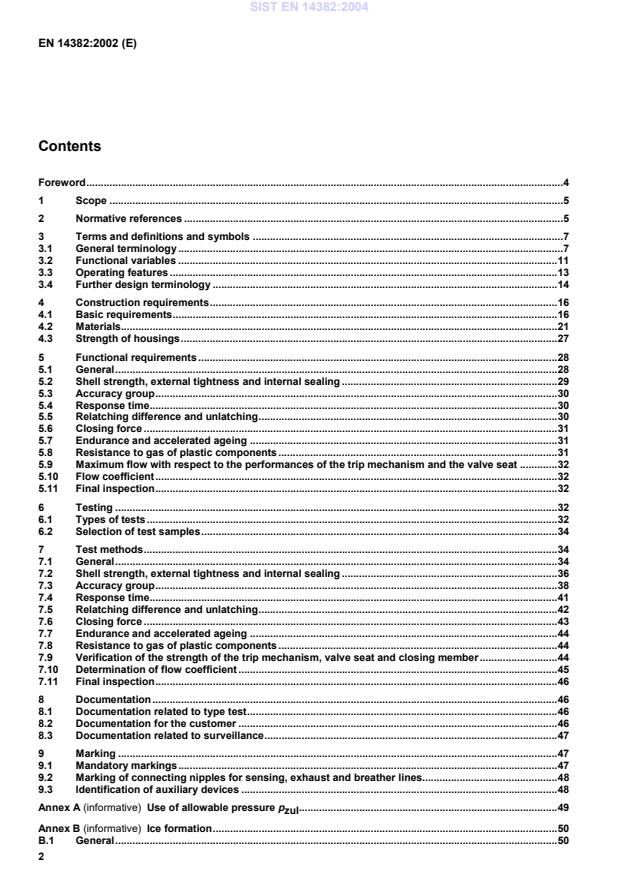
Use of allowable pressure pzul.49Annex B (informative)
Ice formation.50B.1General.50SIST EN 14382:2004
Conformity evaluation .51C.1General.51C.2Manufacturer’s conformity evaluation.51C.3Third parties’ conformity evaluation.51C.4Issue of the certificate of conformity.52Annex D (informative)
Pressure drop and flow coefficient.53D.1Calculation method for pressure drop throughout the safety shut-off device.53D.2Test method for the determination of the flow coefficient Cv.53Annex E (informative)
Alternative test method to verify the maximum flow with respect to theperformance of trip mechanism.55E.1Test method.55E.2Test method for the determination of the dynamic factor Cr.55E.3Test method for a series of safety shut-off devices.56Annex F (informative)
Sizing equation.58Annex G (informative)
Inspection certificate.59Annex H (informative)
Order specification.60H.1Minimum specifications.60H.2Optional specifications.60Annex I (informative)
Acceptance test.62Bibliography.63SIST EN 14382:2004
these parts are functionally connected. (see Figures 1, 2 and 3)3.1.3closing memberpart which shuts off the gas flow completely3.1.4trip mechanismmechanism which releases the closing member when activated by the controller3.1.5actuatordevice activated by the trip mechanism which shuts the closing member3.1.6relatching devicedevice which enables the complete opening of the SSD3.1.7SSD bodypart of the SSD which is the main pressure containing envelope. It provides the fluid flow passageway and the pipeend connections3.1.8valve seatcorresponding sealing surfaces within an SSD which make full contact only when the closing member is in theclosed position3.1.9seat ringpart assembled in a component of the SSD to provide a removable seat3.1.10controllerdevice which can include:¾ setting element to adjust the set value of the trip pressure;¾ sensing element for the control of the monitored pressure (e.g. a diaphragm);¾ unit which compares the set value of the trip pressure with the monitored pressure;¾ system which gives the energy to operate the trip mechanismSIST EN 14382:2004
dynamic force on closing member created by gas flow3.2.2.3trip pressurepressure value at which the closing member starts to move
1)1 bar = 105 Pascal = 1000 mbar = 10-1 MPa = 105 N/m2.SIST EN 14382:2004
(upper trip pressure), piu (lower trip pressure)pressure value at which the closing member of an SSD starts to move3.2.3.2maximum valuehighest value:¾ to which any variable can be adjusted or to which it is limited;¾ any variable may reach during a series of measurements, or during a certain time.It is specified by the index “max,” added to the symbol of the variable3.2.3.3minimum valuelowest value:¾ to which any variable can be adjusted or to which it is limited;¾ any variable may reach during a series of measurements or during a certain time.It is specified by the index “min“ added to the symbol of the variable.3.2.4 Terms related to the set value of the trip pressure3.2.4.1set value of the trip pressureps, pso
(for over-pressure), psu
(for under-pressure)desired trip pressure value under specified conditions.3.2.4.2set rangeWh, Who
(for over-pressure), Whu (for under-pressure)whole range of set values which can be obtained from an SSD by adjustment and the replacement of somecomponent (e.g. replacement of the setting or sensing element)3.2.4.3specific set rangeWa, Wao
(for over-pressure), Wau (for under-pressure)whole range of set values which can be obtained from an SSD by adjustment but with no replacement of itscomponents.SIST EN 14382:2004
2)For additional explanation see also annex A.SIST EN 14382:2004
to the value of the design pressure pd referred to:¾ bodySymbol: Sb¾ other components of the SSDSymbol: S3.4.3operating temperature rangetemperature range at which the SSD components and fixtures are capable of operating continuously3.4.4pressure containing partsparts whose failure to contain pressure would result in a release of retained fluid to the atmosphereNOTEThese Include bodies, controllers, bonnets and blind flanges but exclude compression fittings, diaphragms, boltsand other fasteners.3.4.5integral strength shut-off deviceSSD in which the pressure containing parts have a design pressure pd not less than the allowable pressure pzulSIST EN 14382:2004
less than the allowable pressure pzul3.4.7SSD size; nominal inlet diameternominal size DN of the inlet connection in accordance with EN ISO 67083.4.8nominal outlet diameternominal size DN of the outlet connection in accordance with EN ISO 67083.4.9closing forceFSthe force created by a spring, by a weight-piece or by pressure to operate the closing member.3.4.10sensing pointpoint from which the monitored variable is fed to the SSD.4 Construction requirements4.1 Basic requirements4.1.1 GeneralBoth classes of SSD have no continuous discharge of gas into the atmosphere, however, temporary discharges from fixturescan occur.SSDs shall be so designed that external tightness and internal sealing meet the requirements of 5.2. If in the eventof failure (e.g. of a diaphragm) leakage is possible, a tapping connection of at least DN 10 for an exhaust line shallbe provided.The force required to operate the relatching device shall be:¾ £ 250 N¾ £ 150 N when the relatching device needs more than 10 operations (e.g. for a cut-off device).For cut-off devices the operating and maintenance manual shall specify whether a by-pass shall be provided andhow this will be accomplished.Any breather/exhaust line or device fitted shall be designed to prevent the ingress of foreign materials.SSDs may be stand-alone devices or may be built into gas pressure regulators.After relatching, all functional units shall have returned to their starting position without impeding the closingfunction and the SSD shall be ready for operation. The handle of the relatching device may be detachable. Devicesto lock the relatching device in the open position are not permitted.Where pipeline gas is utilized as a source of energy for indirect acting SSDs, the location on the pipeline of theloading pressure connection shall not affect the safety performance of the SSD. If applicable, this information shallbe given in the operating manual.Pressure containing parts not intended to be dismantled during servicing, adjustment or conversion shall be sealedby means which will show evidence of interference (e.g. lacquer).SIST EN 14382:2004
is the percentage elongation after fracture (in accordance with EN 10002-1). For castings A is measuredon machined test pieces prepared from separately cast test samples in accordance with the relevant standardfor the selected material.bFor the housings of controllers or fixtures this term shall refer to their inlet connections.cMinimum tensile strength 200 N/mm2.4.2.2.2 Additional requirements for
minimum operating temperature down to –20 °CFor SSDs with pzul > 25 bar, in addition to the requirements of 4.2.2.1 the following supplementary requirementswith respect to resilient properties in accordance with EN 10045-1, shall be applied to bodies, bonnets, actuatorcasings
and blind flanges made of rolled, forged and cast steel and spheroidal cast iron:for carbon steel the resilient properties shall be at least:SIST EN 14382:2004
...
Questions, Comments and Discussion
Ask us and Technical Secretary will try to provide an answer. You can facilitate discussion about the standard in here.
Loading comments...