

EN 1366-4:2006
(Main)Fire resistance tests for service installations - Part 4: Linear joint seals
- Abstract
This European Standard specifies a method for determining the fire resistance of linear joint seals based on their intended end use. This European Standard is used in conjunction with EN 1363-1.
The following tests are included in this European Standard:
- no mechanically induced movement;
- mechanically induced movement, either prior to or during fire exposure.
This European Standard does not provide quantitative information on the rate of leakage of smoke and/or hot gases, or on the transmission or generation of fumes.
The load-bearing capacity of a linear joint seal is not addressed in this European Standard.
- Status
- Withdrawn
- Publication Date
- 16-May-2006
- Withdrawal Date
- 13-Apr-2010
- Technical Committee
- CEN/TC 127 - Fire safety in buildings
- Drafting Committee
- CEN/TC 127 - Fire safety in buildings
- Current Stage
- 9960 - Withdrawal effective - Withdrawal
- Start Date
- 14-Apr-2010
- Completion Date
- 14-Apr-2010

Relations
- Effective Date
- 19-Jan-2023
- Amended By
EN 1366-4:2006/FprA1 - Fire resistance tests for service installations - Part 4: Linear joint seals - Effective Date
- 22-Dec-2008
Get Certified
Connect with accredited certification bodies for this standard

CIS Institut d.o.o.
Personal Protective Equipment (PPE) certification body. Notified Body NB-2890 for EU Regulation 2016/425 PPE.

Kiwa BDA Testing
Building and construction product certification.
Kmetijski inštitut Slovenije
Agricultural Institute of Slovenia. Soil testing, plant health, agricultural product analysis.
Sponsored listings
Frequently Asked Questions
EN 1366-4:2006 is a standard published by the European Committee for Standardization (CEN). Its full title is "Fire resistance tests for service installations - Part 4: Linear joint seals". This standard covers: This European Standard specifies a method for determining the fire resistance of linear joint seals based on their intended end use. This European Standard is used in conjunction with EN 1363-1. The following tests are included in this European Standard: - no mechanically induced movement; - mechanically induced movement, either prior to or during fire exposure. This European Standard does not provide quantitative information on the rate of leakage of smoke and/or hot gases, or on the transmission or generation of fumes. The load-bearing capacity of a linear joint seal is not addressed in this European Standard.
This European Standard specifies a method for determining the fire resistance of linear joint seals based on their intended end use. This European Standard is used in conjunction with EN 1363-1. The following tests are included in this European Standard: - no mechanically induced movement; - mechanically induced movement, either prior to or during fire exposure. This European Standard does not provide quantitative information on the rate of leakage of smoke and/or hot gases, or on the transmission or generation of fumes. The load-bearing capacity of a linear joint seal is not addressed in this European Standard.
EN 1366-4:2006 is classified under the following ICS (International Classification for Standards) categories: 13.220.50 - Fire-resistance of building materials and elements. The ICS classification helps identify the subject area and facilitates finding related standards.
EN 1366-4:2006 has the following relationships with other standards: It is inter standard links to EN 1366-4:2006+A1:2010, EN 1366-4:2006/FprA1. Understanding these relationships helps ensure you are using the most current and applicable version of the standard.
EN 1366-4:2006 is associated with the following European legislation: EU Directives/Regulations: 305/2011, 89/106/EEC; Standardization Mandates: M/BC/CEN/91/9. When a standard is cited in the Official Journal of the European Union, products manufactured in conformity with it benefit from a presumption of conformity with the essential requirements of the corresponding EU directive or regulation.
EN 1366-4:2006 is available in PDF format for immediate download after purchase. The document can be added to your cart and obtained through the secure checkout process. Digital delivery ensures instant access to the complete standard document.
Standards Content (Sample)
2003-01.Slovenski inštitut za standardizacijo. Razmnoževanje celote ali delov tega standarda ni dovoljeno.Fire resistance tests for service installations - Part 4: Linear joint sealsPreskusi požarne odpornosti servisnih inštalacij – 4. del: Tesnilna sredstva za ravne stikeEssai de résistance au feu des installations - Partie 4: Calfeutrements de joints linéairesFeuerwiderstandsprüfungen für Installationen - Teil 4: Abdichtungssysteme für BauteilfugenTa slovenski standard je istoveten z:EN 1366-4:2006SIST EN 1366-4:2006en13.220.50Požarna odpornost gradbenih materialov in elementovFire-resistance of building materials and elementsICS:SLOVENSKI
STANDARDSIST EN 1366-4:200601-oktober-2006
EUROPEAN STANDARDNORME EUROPÉENNEEUROPÄISCHE NORMEN 1366-4May 2005ICS 13.220.50 English VersionFire resistance tests for service installations - Part 4: Linear jointsealsEssai de résistance au feu des installations - Partie 4:Calfeutrements de joints linéairesFeuerwiderstandsprüfungen für Installationen - Teil 4:Abdichtungssysteme für BauteilfugenThis European Standard was approved by CEN on 17 April 2006.CEN members are bound to comply with the CEN/CENELEC Internal Regulations which stipulate the conditions for giving this EuropeanStandard the status of a national standard without any alteration. Up-to-date lists and bibliographical references concerning such nationalstandards may be obtained on application to the Central Secretariat or to any CEN member.This European Standard exists in three official versions (English, French, German). A version in any other language made by translationunder the responsibility of a CEN member into its own language and notified to the Central Secretariat has the same status as the officialversions.CEN members are the national standards bodies of Austria, Belgium, Cyprus, Czech Republic, Denmark, Estonia, Finland, France,Germany, Greece, Hungary, Iceland, Ireland, Italy, Latvia, Lithuania, Luxembourg, Malta, Netherlands, Norway, Poland, Portugal, Romania,Slovakia, Slovenia, Spain, Sweden, Switzerland and United Kingdom.EUROPEAN COMMITTEE FOR STANDARDIZATIONCOMITÉ EUROPÉEN DE NORMALISATIONEUROPÄISCHES KOMITEE FÜR NORMUNGManagement Centre: rue de Stassart, 36
B-1050 Brussels© 2005 CENAll rights of exploitation in any form and by any means reservedworldwide for CEN national Members.Ref. No. EN 1366-4:2006: E
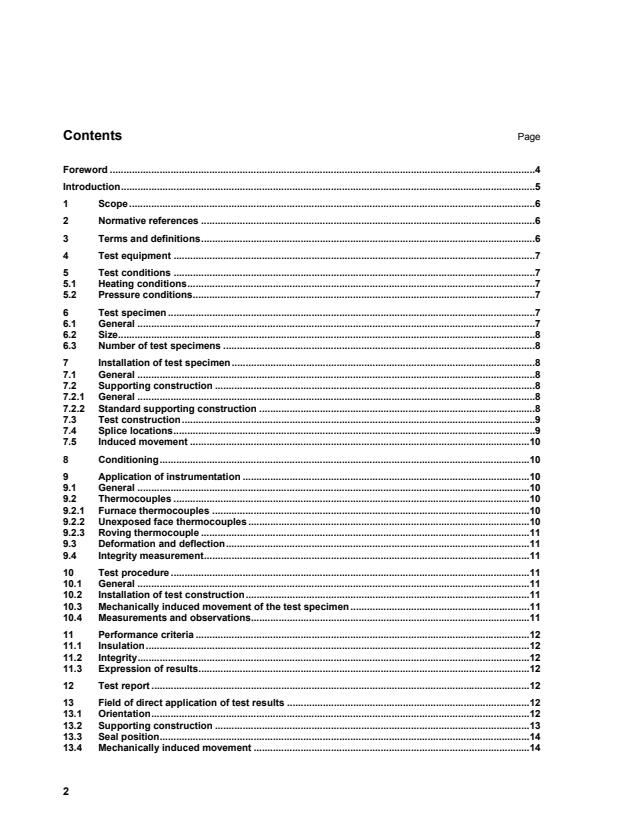
2 Contents Page Foreword.4 Introduction.5 1 Scope.6 2 Normative references.6 3 Terms and definitions.6 4 Test equipment.7 5 Test conditions.7 5.1 Heating conditions.7 5.2 Pressure conditions.7 6 Test specimen.7 6.1 General.7 6.2 Size.8 6.3 Number of test specimens.8 7 Installation of test specimen.8 7.1 General.8 7.2 Supporting construction.8 7.2.1 General.8 7.2.2 Standard supporting construction.8 7.3 Test construction.9 7.4 Splice locations.9 7.5 Induced movement.10 8 Conditioning.10 9 Application of instrumentation.10 9.1 General.10 9.2 Thermocouples.10 9.2.1 Furnace thermocouples.10 9.2.2 Unexposed face thermocouples.10 9.2.3 Roving thermocouple.11 9.3 Deformation and deflection.11 9.4 Integrity measurement.11 10 Test procedure.11 10.1 General.11 10.2 Installation of test construction.11 10.3 Mechanically induced movement of the test specimen.11 10.4 Measurements and observations.11 11 Performance criteria.12 11.1 Insulation.12 11.2 Integrity.12 11.3 Expression of results.12 12 Test report.12 13 Field of direct application of test results.12 13.1 Orientation.12 13.2 Supporting construction.13 13.3 Seal position.14 13.4 Mechanically induced movement.14
Standard condition for linear joint seals with no mechanically induced movement of the joint faces.27 A.1 Standard condition.27 A.2 Test procedure.27 Annex B (normative)
Standard condition for linear joint seals with mechanically induced movement of the joint faces.28 B.1 General.28 B.2 Standard condition(s).28 B.2.1 Standard conditions for lateral movement.28 B.2.2 Standard condition for shear movement.28 B.3 Conditions for other movements.29 Annex C (informative)
Guidance on the use of this European Standard.32 C.1 General.32 C.2 Application of the test.32 C.3 Test conditions.32 C.4 Specimen preparation.33 C.5 Notes on general performance criteria.33 C.6 Notes on validity of test results.33 C.7 Notes on Annex B.33
4 Foreword This European Standard (EN 1366-4:2006) has been prepared by Technical Committee CEN/TC 127 “Fire safety in buildings”, the secretariat of which is held by BSI. This European Standard shall be given the status of a national standard, either by publication of an identical text or by endorsement, at the latest by November 2006, and conflicting national standards shall be withdrawn at the latest by November 2006. This European Standard has been prepared under a mandate given to CEN by the European Commission and the European Free Trade Association, and supports essential requirements of the Construction Products Directive. EN 1366 ‘Fire resistance tests for service installations’ consists of the following Parts: Part 1:
Ducts Part 2:
Fire dampers Part 3:
Penetration seals Part 4:
Linear joint seals Part 5:
Service ducts and shafts Part 6:
Raised access and hollow core floors Part 7:
Conveyor systems and their closures Part 8:
Smoke extraction ducts Part 9:
Single compartment smoke extraction ducts Part 10: Smoke control dampers Part 11: Fire protection system for essential services (in course of preparation)1) According to the CEN/CENELEC Internal Regulations, the national standards organizations of the following countries are bound to implement this European Standard: Austria, Belgium, Cyprus, Czech Republic, Denmark, Estonia, Finland, France, Germany, Greece, Hungary, Iceland, Ireland, Italy, Latvia, Lithuania, Luxembourg, Malta, Netherlands, Norway, Poland, Portugal, Romania, Slovakia, Slovenia, Spain, Sweden, Switzerland and United Kingdom.
1) To be published.
6 1 Scope This European Standard specifies a method for determining the fire resistance of linear joint seals based on their intended end use. This European Standard is used in conjunction with EN 1363-1. The following tests are included in this European Standard: no mechanically induced movement; mechanically induced movement, either prior to or during fire exposure. This European Standard does not provide quantitative information on the rate of leakage of smoke and/or hot gases, or on the transmission or generation of fumes. The load-bearing capacity of a linear joint seal is not addressed in this European Standard. 2 Normative references The following referenced documents are indispensable for the application of this European Standard. For dated references, only the edition cited applies. For undated references, the latest edition of the referenced document (including any amendments) applies. EN 1363-1:1999, Fire resistance tests — Part 1: General requirements EN 1363-2, Fire resistance tests — Part 2: Alternative and additional procedures EN ISO 13943:2000, Fire safety – Vocabulary (ISO 13943:2000) 3 Terms and definitions For the purposes of this European Standard, the terms and definitions given in EN 1363-1:1999 and EN ISO 13943:2000 and the following apply. 3.1 linear joint linear void having a length to width ratio of at least 10:1 within one or between two or more juxtaposed construction elements NOTE Typical locations of linear joints include floors, the perimeter of floors, walls, ceilings and roofs. 3.2 linear joint seal system designed to maintain the fire separating function and, if relevant, to accommodate a specified degree of movement within the linear joint 3.3 movement capability maximum amount of movement the joint seal is able to tolerate as stated by the manufacturer or the sponsor, expressed as a percentage of the nominal width NOTE
The movement capability is usually the same over the entire range of the nominal widths. 3.4 nominal joint width specified width of a joint seal, to be selected by the manufacturer or test sponsor
3 m x 3 m x 1 m (see 6.2). Where the nominal width of the linear joint seal in the test specimen is greater than 100 mm and less than or equal to 300 mm, the size of the furnace shall at least be able to heat a length of
10 times the nominal width of the linear joint. 5 Test conditions 5.1 Heating conditions The heating and furnace atmosphere shall conform to those given in EN 1363-1 or, if applicable,
EN 1363-2. 5.2 Pressure conditions A vertical furnace shall be operated so that a minimum pressure of 15 Pa exists in the centre of the test specimen mounted in the lowest position. A horizontal furnace shall be operated so that a minimum pressure of (20 ± 2) Pa is established at a position (100 ± 10) mm below the lowest point of the test construction. 6 Test specimen 6.1 General The test specimen consists of a linear joint seal. One test specimen shall be prepared for each type of supporting construction and type of movement, if relevant, for which the sponsor seeks classification (see Annexes A and B).
8 6.2 Size A linear joint seal shall be of uniform design cross-sectional area and of the maximum length that can be accommodated in the separating element selected for test. For non-movement joints a shorter length may be used subject to a minimum of 900 mm. In order to avoid boundary effects, the distance between the long edge of the linear joint seal and the outer perimeter of the heated part of the separating element shall be not less than 200 mm at any point. A typical minimum length to width ratio for a linear joint seal is 10:1. In order to maintain this ratio a test furnace of appropriate dimensions shall be used. 6.3 Number of test specimens In the case of vertical elements two tests shall be carried out, one from each direction of exposure. If in practice the fire risk can be identified as coming from one side only, or where the linear joint seal is fully symmetrical, then only one specimen may be tested with the appropriate face exposed to the heating regime. Where it can be established clearly in a non-symmetrical construction that there is a weaker direction of exposure only one specimen may be tested. In such a case, a full justification for the procedure adopted shall be included in the report. In the case of horizontal elements the test specimen shall be exposed to heating from the underside. Where a linear joint seal is intended for use in both horizontal and vertical separating elements, each orientation shall be tested. 7 Installation of test specimen 7.1 General All materials used in the construction, fabrication and installation process of the test specimen shall be representative of the design, materials and workmanship of those to be used in practice. Where voids exist within a linear joint seal (e.g. when it is in the form of a tube), the ends shall be hermetically sealed in order to prevent airflow through the test specimen. The standard conditions are given in Annexes A and B. 7.2 Supporting construction 7.2.1 General The supporting construction shall be of known fire resistance and representative of that used in practice. The supporting construction for test purposes shall be as shown in Figures 1 and 2. The supporting construction may be either one of the standard constructions listed in 7.2.2 or a specific construction. In the latter case, however, the field of direct application is limited (see 13.2). 7.2.2 Standard supporting construction 7.2.2.1 Concrete and masonry elements a) Wall constructions Density: (650 ± 200) kg/m³
Material: Autoclaved aerated concrete
Material: Normal density concrete b) Floor constructions Density: (650 ± 200) kg/m³
Material: Autoclaved aerated concrete or (2 400 ± 200) kg/m³
Material: Normal density concrete 7.2.2.2 Timber elements Timber used for test constructions shall have a nominal density of (500 ± 50) kg/m³ as measured at 12 % moisture content. 7.2.2.3 Steel elements Any steel joint face may be simulated by the following test construction. The face of a concrete supporting construction is covered by 10 mm mineral fibre insulation of a density of at least 35 kg/m3 and by an 8 mm thick steel angle. The side of the test construction where the steel angle is visible shall be at the non-exposed side of the test construction (see Figure 14). 7.3 Test construction For the purpose of tests, joints may be formed in monolithic slabs or by adjacent discrete members (see Figure 1). The linear joint seal shall be installed in accordance with the manufacturer's instructions. The linear joint seal shall have a minimum heated length of 900 mm. The installation procedures shall be described in the test report. A test construction may incorporate several discrete linear joint seals, evaluating the performance of different systems or the effect of different joint face substrates (see Figures 2 and 3) provided that the following conditions are met: a) The minimum distance on the exposed side between adjacent seals shall be not less than the thickness of the supporting construction T, but not less than 200 mm. On the unexposed side the minimum distance between adjacent seals shall not be less than 200 mm (see Figure 4). Where a monolithic slab is used for non-movement joints the minimum distance between all edges of the joint and the edge of the supporting construction shall be minimum 200 mm. b) The test construction can either be inserted in the furnace opening or put onto the furnace walls. The minimum width of the supporting elements adjacent to the edges of the furnace opening shall be such that a distance of at least 200 mm exists between the longitudinal edge of the linear joi
...