

EN 15664-2:2010
(Main)Influence of metallic materials on water intended for human consumption - Dynamic rig test for assessment of metal release - Part 2: Test waters
General Information
- Abstract
This European Standard defines the requirements for test waters used in the dynamic test rig defined in EN 15664-1.
This document specifies test water(s) when the test procedure is used to:
a) assess a material for approval as a reference material for a category of materials;
b) assess a material for approval by way of comparative testing;
c) obtain data on the interaction of local water with a material.
NOTE Local waters used for test waters are not treated with corrosion inhibitors.
- Status
- Published
- Publication Date
- 23-Feb-2010
- Withdrawal Date
- 30-Aug-2010
- Technical Committee
- CEN/TC 164 - Water supply
- Drafting Committee
- CEN/TC 164/WG 3 - Effects of materials in contact with drinking water
- Current Stage
- 9020 - Submission to 2 Year Review Enquiry - Review Enquiry
- Start Date
- 15-Jul-2026
- Completion Date
- 15-Jul-2026


Overview
EN 15664-2:2010 is a European standard developed by CEN that defines the requirements for test waters used in the dynamic rig test to assess metal release from metallic materials into water intended for human consumption (drinking water). This standard supports the assessment of the influence of metallic materials on water quality by specifying the types of test water to be used during testing in accordance with EN 15664-1 (design and operation of the test rig).
The main objective of EN 15664-2 is to guide the selection of test waters for three specific applications:
- Approval of materials as reference materials for categories of metallic materials
- Comparative testing for material approval
- Evaluation of local water interaction with metallic materials
By standardizing test water selection, EN 15664-2 ensures consistent, realistic, and comparable results in testing metal release, contributing to safer drinking water.
Key Topics
Test Water Selection Principles:
Test waters must comply with the Council Directive 98/83/EC for drinking water quality, exclude corrosion inhibitors (except when assessing local waters for interaction), and represent realistic worst-case water conditions for metal release testing.Types of Test Waters:
EN 15664-2 outlines three principal types of test water for different testing purposes:- Very hard neutral water: pH 7.1–7.5, high alkalinity (>5 mmol/l), and high carbonate ion content, mimicking hard water conditions.
- Soft acidic water: pH 6.7–7.1, low alkalinity (0.5–1.3 mmol/l), representing acidic soft water.
- Soft alkaline water: pH 8.0–8.4, moderate alkalinity (0.7–1.3 mmol/l), simulating alkaline soft water.
These water types cover broad European water quality conditions for assessing reference materials.
Comparative Testing:
For approval by comparison, locally sourced drinking water with suitable corrosivity is used to ensure measurable metal release rates, facilitating valid material performance comparisons.Local Water Interaction:
Testing with actual local water from a specific supply zone enables evaluation of metal release under real-world conditions, including waters that may contain corrosion inhibitors.Test Rig Compliance:
Testing must be conducted on the dynamic rig configured per EN 15664-1, which simulates alternating flow and stagnation cycles typical of domestic distribution systems.
Applications
Material Certification:
Manufacturers and regulatory bodies utilize EN 15664-2 to select test waters that support the approval of new metallic materials intended for contact with drinking water, ensuring they do not contribute harmful metal contaminants.Quality Control:
Comparative testing against reference materials allows for quality monitoring of metal release behaviour in manufacturing processes and material batches.Water Supply Safety:
Water utilities and regulators apply this standard to understand how local water chemistry interacts with metallic pipes, fittings, or storage tanks, guiding corrosion control measures and ensuring compliance with drinking water safety regulations.Research and Development:
R&D laboratories use the test water conditions defined in EN 15664-2 to develop improved metallic materials and coatings with minimized metal leaching characteristics.
Related Standards
- EN 15664-1:2008 – Influence of metallic materials on water intended for human consumption - Dynamic rig test for assessment of metal release - Part 1: Design and operation
- EN 15664-3 – Guidance on interpretation of results (forthcoming)
- EN 12502-1:2004 – Protection of metallic materials against corrosion - Assessment of corrosion likelihood in water systems
- ISO 8044:1999 – Corrosion of metals and alloys - Basic terms and definitions
- Council Directive 98/83/EC – Quality of water intended for human consumption (drinking water directive)
By adhering to EN 15664-2:2010, stakeholders guarantee robust evaluation of metal release risks from metallic materials in contact with drinking water, supporting public health protection and compliance with European water quality standards.
Relations
- Refers
EN ISO 8044:1999 - Corrosion of metals and alloys - Basic terms and definitions (ISO 8044:1999) - Effective Date
- 28-Jan-2026
- Effective Date
- 28-Jan-2026
- Effective Date
- 28-Jan-2026
Get Certified
Connect with accredited certification bodies for this standard

BSI Group
BSI (British Standards Institution) is the business standards company that helps organizations make excellence a habit.

Bureau Veritas
Bureau Veritas is a world leader in laboratory testing, inspection and certification services.

DNV
DNV is an independent assurance and risk management provider.
Sponsored listings
Frequently Asked Questions
EN 15664-2:2010 is a standard published by the European Committee for Standardization (CEN). Its full title is "Influence of metallic materials on water intended for human consumption - Dynamic rig test for assessment of metal release - Part 2: Test waters". This standard covers: This European Standard defines the requirements for test waters used in the dynamic test rig defined in EN 15664-1. This document specifies test water(s) when the test procedure is used to: a) assess a material for approval as a reference material for a category of materials; b) assess a material for approval by way of comparative testing; c) obtain data on the interaction of local water with a material. NOTE Local waters used for test waters are not treated with corrosion inhibitors.
This European Standard defines the requirements for test waters used in the dynamic test rig defined in EN 15664-1. This document specifies test water(s) when the test procedure is used to: a) assess a material for approval as a reference material for a category of materials; b) assess a material for approval by way of comparative testing; c) obtain data on the interaction of local water with a material. NOTE Local waters used for test waters are not treated with corrosion inhibitors.
EN 15664-2:2010 is classified under the following ICS (International Classification for Standards) categories: 67.250 - Materials and articles in contact with foodstuffs; 77.060 - Corrosion of metals. The ICS classification helps identify the subject area and facilitates finding related standards.
EN 15664-2:2010 has the following relationships with other standards: It is inter standard links to EN ISO 8044:1999, EN 12502-1:2004, EN 15664-1:2008. Understanding these relationships helps ensure you are using the most current and applicable version of the standard.
EN 15664-2:2010 is associated with the following European legislation: EU Directives/Regulations: 305/2011, 89/106/EEC; Standardization Mandates: M/136 REV, M/136 rev1. When a standard is cited in the Official Journal of the European Union, products manufactured in conformity with it benefit from a presumption of conformity with the essential requirements of the corresponding EU directive or regulation.
EN 15664-2:2010 is available in PDF format for immediate download after purchase. The document can be added to your cart and obtained through the secure checkout process. Digital delivery ensures instant access to the complete standard document.
Standards Content (Sample)
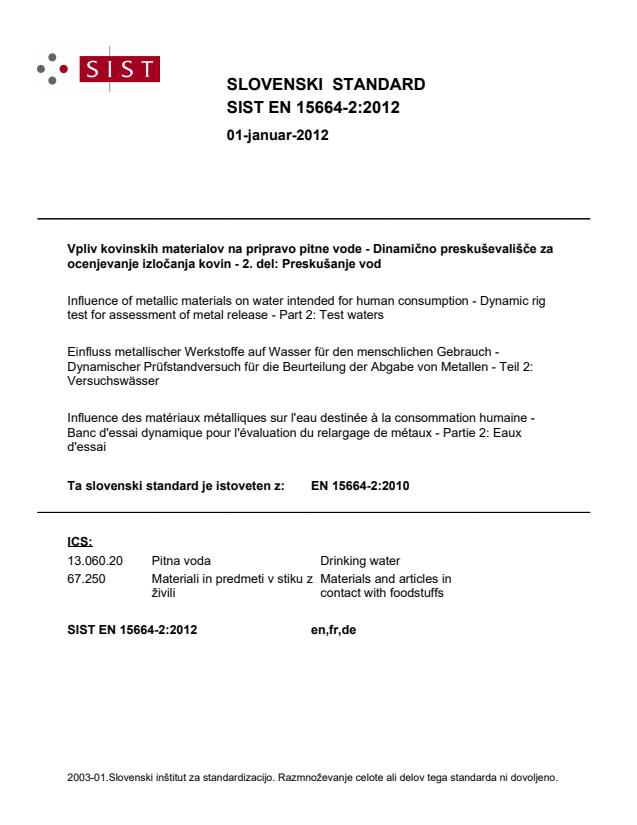
2003-01.Slovenski inštitut za standardizacijo. Razmnoževanje celote ali delov tega standarda ni dovoljeno.Einfluss metallischer Werkstoffe auf Wasser für den menschlichen Gebrauch - Dynamischer Prüfstandversuch für die Beurteilung der Abgabe von Metallen - Teil 2: VersuchswässerInfluence des matériaux métalliques sur l'eau destinée à la consommation humaine - Banc d'essai dynamique pour l'évaluation du relargage de métaux - Partie 2: Eaux d'essaiInfluence of metallic materials on water intended for human consumption - Dynamic rig test for assessment of metal release - Part 2: Test waters67.250Materiali in predmeti v stiku z živiliMaterials and articles in contact with foodstuffs13.060.20Pitna vodaDrinking waterICS:Ta slovenski standard je istoveten z:EN 15664-2:2010SIST EN 15664-2:2012en,fr,de01-januar-2012SIST EN 15664-2:2012SLOVENSKI
STANDARD
EUROPEAN STANDARD NORME EUROPÉENNE EUROPÄISCHE NORM
EN 15664-2
February 2010 ICS 67.250 English Version
Influence of metallic materials on water intended for human consumption - Dynamic rig test for assessment of metal release - Part 2: Test waters
Influence des matériaux métalliques sur l'eau destinée à la consommation humaine - Banc d'essai dynamique pour l'évaluation du relargage de métaux - Partie 2: Eaux d'essai Einfluss metallischer Werkstoffe auf Wasser für den menschlichen Gebrauch - Dynamischer Prüfstandversuch für die Beurteilung der Abgabe von Metallen - Teil 2: Prüfwässer This European Standard was approved by CEN on 9 January 2010.
CEN members are bound to comply with the CEN/CENELEC Internal Regulations which stipulate the conditions for giving this European Standard the status of a national standard without any alteration. Up-to-date lists and bibliographical references concerning such national standards may be obtained on application to the CEN Management Centre or to any CEN member.
This European Standard exists in three official versions (English, French, German). A version in any other language made by translation under the responsibility of a CEN member into its own language and notified to the CEN Management Centre has the same status as the official versions.
CEN members are the national standards bodies of Austria, Belgium, Bulgaria, Croatia, Cyprus, Czech Republic, Denmark, Estonia, Finland, France, Germany, Greece, Hungary, Iceland, Ireland, Italy, Latvia, Lithuania, Luxembourg, Malta, Netherlands, Norway, Poland, Portugal, Romania, Slovakia, Slovenia, Spain, Sweden, Switzerland and United Kingdom.
EUROPEAN COMMITTEE FOR STANDARDIZATION
COMITÉ EUROPÉEN DE NORMALISATION EUROPÄISCHES KOMITEE FÜR NORMUNG
Management Centre:
Avenue Marnix 17,
B-1000 Brussels © 2010 CEN All rights of exploitation in any form and by any means reserved worldwide for CEN national Members. Ref. No. EN 15664-2:2010: ESIST EN 15664-2:2012
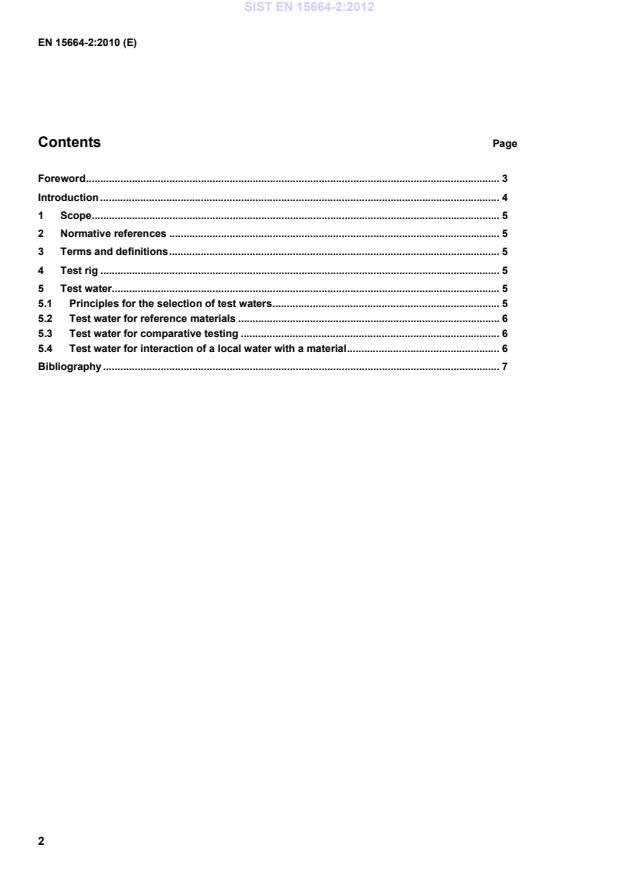
2 Contents Page Foreword . 3Introduction . 41Scope . 52Normative references . 53Terms and definitions . 54Test rig . 55Test water. 55.1Principles for the selection of test waters . 55.2Test water for reference materials . 65.3Test water for comparative testing . 65.4Test water for interaction of a local water with a material . 6Bibliography . 7 SIST EN 15664-2:2012
3 Foreword This document (EN 15664-2:2010) has been prepared by Technical Committee CEN/TC 164 “Water supply”, the secretariat of which is held by AFNOR. This European Standard shall be given the status of a national standard, either by publication of an identical text or by endorsement, at the latest by August 2010, and conflicting national standards shall be withdrawn at the latest by August 2010. Attention is drawn to the possibility that some of the elements of this document may be the subject of patent rights. CEN [and/or CENELEC] shall not be held responsible for identifying any or all such patent rights. This document is one of a series of test methods which support associated product standards. This document has been prepared under a mandate given to CEN by the European Commission and the European Free Trade Association, and supports essential requirements of EU Directive(s). In respect of potential adverse effects on the quality of water intended for human consumption caused by metallic materials, attention is drawn to the fact that the relevant national regulations remain in force until the adoption of verifiable European acceptance criteria. Water intended for human consumption is hereafter referred to as "drinking water" and means the same as the definition given at Article 2(1) of the Council Directive 98/83/EC on the quality of water intended for human consumption [1]. This document has been drafted in accordance with the CEN Internal Regulations, Part 3. This docum
...