

EN 13313:2010
(Main)Refrigerating systems and heat pumps - Competence of personnel
- Abstract
This European Standard defines the activities related to refrigerating circuits and the associated competence profiles and establishes procedures for assessing the competence of persons who carry out these activities.
NOTE As a refrigerating circuit is considered not to incorporate electrical and electronic systems, activities in this area are not part of this standard. For competences on electrical and electronic systems, it is recommended to refer to national regulations or appropriate European or national standards. This European Standard does not apply to persons carrying out work on self contained refrigerating systems as defined in EN 378-1 from the initial design of the product to the complete manufacture of the product, provided the process is controlled and the methods used are checked by an organisation or individual, responsible for the compliance with statutory requirements on health, safety and environment.
- Status
- Withdrawn
- Publication Date
- 23-Nov-2010
- Withdrawal Date
- 06-Oct-2026
- Technical Committee
- CEN/TC 182 - Refrigerating systems, safety and environmental requirements
- Drafting Committee
- CEN/TC 182/WG 4 - Disposal and environmental aspects
- Current Stage
- 9960 - Withdrawal effective - Withdrawal
- Start Date
- 05-Apr-2023
- Completion Date
- 07-Oct-2026



Relations
- Effective Date
- 22-Dec-2008
- Replaced By
EN ISO 22712:2023 - Refrigerating systems and heat pumps - Competence of personnel (ISO 22712:2023) - Effective Date
- 15-Jul-2015
- Effective Date
- 28-Jan-2026
- Effective Date
- 28-Jan-2026
Get Certified
Connect with accredited certification bodies for this standard

DNV
DNV is an independent assurance and risk management provider.

Lloyd's Register
Lloyd's Register is a global professional services organisation specialising in engineering and technology.
DNV Energy Systems
Energy and renewable energy certification.
Sponsored listings
Frequently Asked Questions
EN 13313:2010 is a standard published by the European Committee for Standardization (CEN). Its full title is "Refrigerating systems and heat pumps - Competence of personnel". This standard covers: This European Standard defines the activities related to refrigerating circuits and the associated competence profiles and establishes procedures for assessing the competence of persons who carry out these activities. NOTE As a refrigerating circuit is considered not to incorporate electrical and electronic systems, activities in this area are not part of this standard. For competences on electrical and electronic systems, it is recommended to refer to national regulations or appropriate European or national standards. This European Standard does not apply to persons carrying out work on self contained refrigerating systems as defined in EN 378-1 from the initial design of the product to the complete manufacture of the product, provided the process is controlled and the methods used are checked by an organisation or individual, responsible for the compliance with statutory requirements on health, safety and environment.
This European Standard defines the activities related to refrigerating circuits and the associated competence profiles and establishes procedures for assessing the competence of persons who carry out these activities. NOTE As a refrigerating circuit is considered not to incorporate electrical and electronic systems, activities in this area are not part of this standard. For competences on electrical and electronic systems, it is recommended to refer to national regulations or appropriate European or national standards. This European Standard does not apply to persons carrying out work on self contained refrigerating systems as defined in EN 378-1 from the initial design of the product to the complete manufacture of the product, provided the process is controlled and the methods used are checked by an organisation or individual, responsible for the compliance with statutory requirements on health, safety and environment.
EN 13313:2010 is classified under the following ICS (International Classification for Standards) categories: 27.080 - Heat pumps; 27.200 - Refrigerating technology. The ICS classification helps identify the subject area and facilitates finding related standards.
EN 13313:2010 has the following relationships with other standards: It is inter standard links to EN 13313:2001, EN ISO 22712:2023, EN 378-1:2008, EN 378-2:2016. Understanding these relationships helps ensure you are using the most current and applicable version of the standard.
EN 13313:2010 is available in PDF format for immediate download after purchase. The document can be added to your cart and obtained through the secure checkout process. Digital delivery ensures instant access to the complete standard document.
Standards Content (Sample)
2003-01.Slovenski inštitut za standardizacijo. Razmnoževanje celote ali delov tega standarda ni dovoljeno.VHEMDKälteanlagen und Wärmepumpen - Sachkunde von PersonalSystèmes de réfrigération et pompes à chaleur - Compétence du personnelRefrigerating systems and heat pumps - Competence of personnel27.200Hladilna tehnologijaRefrigerating technology27.080Heat pumps03.100.30Vodenje ljudiManagement of human resourcesICS:Ta slovenski standard je istoveten z:EN 13313:2010SIST EN 13313:2012en,fr,de01-januar-2012SIST EN 13313:2012SLOVENSKI
STANDARDSIST EN 13313:20041DGRPHãþD
EUROPEAN STANDARD NORME EUROPÉENNE EUROPÄISCHE NORM
EN 13313
November 2010 ICS 27.080; 27.200 Supersedes EN 13313:2001English Version
Refrigerating systems and heat pumps - Competence of personnel
Systèmes de réfrigération et pompes à chaleur - Compétence du personnel
Kälteanlagen und Wärmepumpen - Sachkunde von Personal This European Standard was approved by CEN on 16 October 2010.
CEN members are bound to comply with the CEN/CENELEC Internal Regulations which stipulate the conditions for giving this European Standard the status of a national standard without any alteration. Up-to-date lists and bibliographical references concerning such national standards may be obtained on application to the CEN Management Centre or to any CEN member.
This European Standard exists in three official versions (English, French, German). A version in any other language made by translation under the responsibility of a CEN member into its own language and notified to the CEN Management Centre has the same status as the official versions.
CEN members are the national standards bodies of Austria, Belgium, Bulgaria, Croatia, Cyprus, Czech Republic, Denmark, Estonia, Finland, France, Germany, Greece, Hungary, Iceland, Ireland, Italy, Latvia, Lithuania, Luxembourg, Malta, Netherlands, Norway, Poland, Portugal, Romania, Slovakia, Slovenia, Spain, Sweden, Switzerland and United Kingdom.
EUROPEAN COMMITTEE FOR STANDARDIZATION
COMITÉ EUROPÉEN DE NORMALISATION EUROPÄISCHES KOMITEE FÜR NORMUNG
Management Centre:
Avenue Marnix 17,
B-1000 Brussels © 2010 CEN All rights of exploitation in any form and by any means reserved worldwide for CEN national Members. Ref. No. EN 13313:2010: ESIST EN 13313:2012
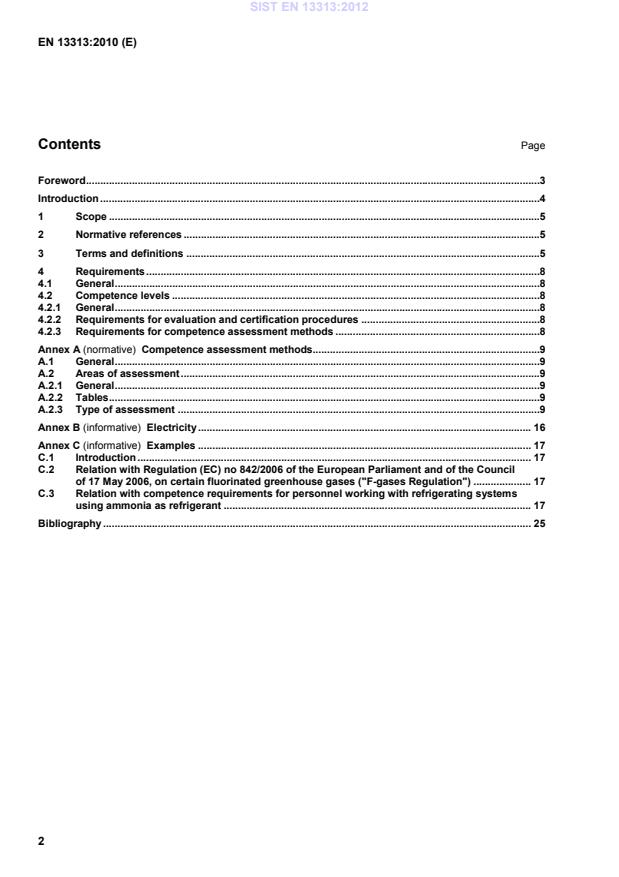
Competence assessment methods.9A.1 General .9A.2 Areas of assessment .9A.2.1 General .9A.2.2 Tables .9A.2.3 Type of assessment .9Annex B (informative)
Electricity . 16Annex C (informative)
Examples . 17C.1 Introduction . 17C.2 Relation with Regulation (EC) no 842/2006 of the European Parliament and of the Council of 17 May 2006, on certain fluorinated greenhouse gases ("F-gases Regulation") . 17C.3 Relation with competence requirements for personnel working with refrigerating systems using ammonia as refrigerant . 17Bibliography . 25 SIST EN 13313:2012
a) this European Standard is completely revised; b) this European Standard defines different competence levels; c) this European Standard defines the activities related to refrigerating circuits and the associated competence profiles; d) this European Standard takes into account an informative Annex B “Electricity”; e) this European Standard takes into account an informative Annex C “Examples". According to the CEN/CENELEC Internal Regulations, the national standards organizations of the following countries are bound to implement this European Standard: Austria, Belgium, Bulgaria, Croatia, Cyprus, Czech Republic, Denmark, Estonia, Finland, France, Germany, Greece, Hungary, Iceland, Ireland, Italy, Latvia, Lithuania, Luxembourg, Malta, Netherlands, Norway, Poland, Portugal, Romania, Slovakia, Slovenia, Spain, Sweden, Switzerland and the United Kingdom. SIST EN 13313:2012
Introduction Refrigerating systems, if not properly constructed, installed, operated and maintained, can be of danger to the health and safety of persons, the safety property, be detrimental to the environment and increase the energy consumption. It is therefore essential that personnel dealing with such systems are competent to carry out the activity, or activities, listed in this standard. These activities cover the particular sectors in which they may operate from original design to final dismantling and disposal. As job descriptions can vary from country to country and from company to company, this standard specifies the activities to be carried out. Job descriptions should specify these activities. This standard defines the activities related to the refrigerating circuit. SIST EN 13313:2012
NOTE
As a refrigerating circuit is considered not to incorporate electrical and electronic systems, activities in this area are not part of this standard. For competences on electrical and electronic systems, it is recommended to refer to national regulations or appropriate European or national standards. This European Standard does not apply to persons carrying out work on self contained refrigerating systems as defined in EN 378-1 from the initial design of the product to the complete manufacture of the product, provided the process is controlled and the methods used are checked by an organisation or individual, responsible for the compliance with statutory requirements on health, safety and environment. 2 Normative references The following referenced documents are indispensable for the application of this document. For dated references, only the edition cited applies. For undated references, the latest edition of the referenced document (including any amendments) applies. EN 378-1:2008, Refrigerating systems and heat pumps — Safety and environmental requirements — Part 1: Basic requirements, definitions, classification and selection criteria EN ISO/IEC 17024, Conformity assessment — General requirements for bodies operating certification of persons (ISO/IEC 17024:2003) 3 Terms and definitions For the purposes of this document, the terms and definitions given in EN 378-1:2008 and the following apply. 3.1 assessment process by which the evidence generated, gathered and provided about a person is judged to determine competence 3.2 assessment body
evaluation body organisation which is recognised to assess (evaluate) the competence of persons working on refrigerating circuits 3.3 certification body organisation which issues/awards certificates proving the competence of persons working on refrigerating circuits NOTE 1 Depending on national regulations, assessment bodies and certification bodies may be the same or different organisations.
NOTE 2 General criteria for certification bodies can be found in EN ISO/IEC 17024. 3.4 competence ability to perform safely and satisfactorily the activities within an occupation SIST EN 13313:2012
3.19 removing of refrigerant
recovering the refrigerant out of a refrigerating circuit 3.20 dismantling breaking the refrigerating circuit down into pieces NOTE This excludes removing of refrigerant. 3.21 basic appreciation level BA level of expertise required to discuss main elements of the skill with others3.22 working knowledge level WK level of expertise required for direct involvement in decisions and actions 3.23 fully operational level FO level of expertise required to perform personally the majority of the activities 3.24 leading edge level
LE level of expertise required for significant development of the skill area SIST EN 13313:2012
Persons shall be deemed competent if it can be demonstrated that they are capable of carrying out the activities listed in this standard. 4.2 Competence levels 4.2.1 General Persons shall demonstrate a level of predefined competence as defined in 3.21, 3.22, 3.23, and 3.24, of their theoretical and/or practical ability as necessary for the activity in question, as set out in Annex A. 4.2.2 Requirements for evaluation and certification procedures The evaluation and certification procedures dealing with the competence of persons related to the refrigerating circuit shall be done according to the procedures defined in EN ISO/IEC 17024.
4.2.3 Requirements for competence assessment methods If competence assessment methods are defined by national regulations, they shall be used. If competence assessment methods are not defined by national regulations, they shall be used according to Annex A.
Competence assessment methods A.1 General If no national legislation for a scheme to access and certify competence exists, the following methods shall be used.
A.2 Areas of assessment A.2.1 General All persons who demonstrate their practical and theoretical competence by being successfully assessed by an approved organisation should receive a certificate of competence. A.2.2 Tables The following tables indicate areas and subjects that need to be assessed to demonstrate competence. The row on the top of each table denotes the activities to be assessed as defined in Clause 3. The column on the left side of each table denotes the subject to be assessed.
The cells of the table give the level of expertise as defined in 3.21(BA), 3.22(WK), 3.23(FO) and 3.24(LE).
Theoretical assessment is shown by an unshaded cell and practical assessment by a shaded cell. A.2.3 Type of assessment A.2.3.1 Theory is the knowledge of the subject of operation without the ability to demonstrate practical skills. The assessment should be by written or oral examination. A.2.3.2 Practice is the ability to perform an operation by demonstrating practical skills in the subject the assessment should be by practical tests. SIST EN 13313:2012
Understand basic refrigeration terms, for example:
Enthalpy and Entropy, Pressure, Temperature, Refrigerating Capacity, Power consumption, COP, Superheat, Sub-cooling, Liquid and Vapour properties FO
BA FO FO WK WK WK BA FO BA WK
Know the layout as well as use of the log p-h-diagrams of refrigerants FO
BA WK WK WK WK BA BA BA BA BA
Know and
use of the saturated and superheated vapour tables of refrigerants in correlation with the log p-h-diagrams as well
FO
BA WK WK WK WK BA BA BA BA BA
Draw a scheme of a compression refrigeration cycle FO
BA WK WK WK WK BA BA BA BA BA
Understand the meaning of different kind of pressures (e.g. design pressure, absolute and gauge pressure, strength test pressure, test pressure for leak detection) FO BA BA WK WK WK WK FO BA FO BA BA
Components and tests of refrigeration systems Tasks Description of tasks, see Clause 3 Terms and definitions Design Pre-assembling Installation Putting into Operation Commissioning Operating In-service Inspection Leakage checking General Maintenance Circuit Maintenance Decommissioning Removing Refrigerant Dismantling 3.8 3.9 3.103.113.12 3.133.143.153.16 3.17 3.183.193.20 Ski
...