

EN 16603-20-06:2020
(Main)Space engineering - Spacecraft charging
- Abstract
This activity will be the update of EN16603-20-06 (published 2014).
This activity was started in ECSS to implement as urgent classified Change Requests.
- Status
- Published
- Publication Date
- 08-Sep-2020
- Withdrawal Date
- 30-Mar-2021
- Technical Committee
- CEN/CLC/TC 5 - Space
- Drafting Committee
- CEN/CLC/TC 5/WG 6 - Upstream standards
- Current Stage
- 9060 - Closure of 2 Year Review Enquiry - Review Enquiry
- Start Date
- 04-Mar-2026
- Completion Date
- 04-Mar-2026

Overview
EN 16603-20-06:2020 - a CEN standard in the space engineering series - defines engineering requirements and verification practices for spacecraft charging. Superseding the 2014 edition, this 2020 update consolidates requirements for surface and internal charging, secondary arcing, high-voltage systems, tethers and electric propulsion interactions with the plasma environment. The standard provides terms, protection programme guidance, material and grounding rules, testing and validation methods, plus normative and informative annexes (including an electrical hazard mitigation plan and physical background).
Key topics and requirements
- Scope and terminology: clear definitions, abbreviated terms and nomenclature used for spacecraft charging and plasma interactions.
- Surface material requirements: material selection, electrical continuity, grounding of metallic parts, limits on permitted voltages and resistivity, and material/assembly qualification and testing.
- Surface charging analysis: modelling guidelines and verification approaches to predict floating potentials and discharge risks.
- Secondary arc requirements: prevention and mitigation of arcing (with focused provisions for solar arrays and exposed power-system parts).
- High-voltage system requirements: design, validation and verification practices for HV systems on spacecraft.
- Internal/deep-dielectric charging: assessment of charge deposition, dielectric fields, grounding and validation of internal components.
- Tether requirements: hazards from conductive tethers, current collection, insulation continuity, and electrodynamic effects.
- Electric propulsion: requirements covering spacecraft neutralization, beam neutralization, sputtering, contamination, and validation (ground testing, modelling and in‑flight monitoring).
- Verification and testing: material tests, qualification, computer modelling characteristics, ESD triggering criteria and in‑flight validation.
- Annexes: Annex A (normative) - Electrical hazard mitigation plan (DRD); Annex B - tailoring guidelines for LEO/MEO/GEO, tethers, active spacecraft; Annex C - physical background on sheaths, Debye length, charging processes.
Applications
EN 16603-20-06:2020 is applied where spacecraft interact with space plasma and where charging poses a hazard:
- Design and verification of satellites (LEO, MEO, GEO and planetary missions)
- Solar array and power subsystem design to prevent secondary arcs
- Electric propulsion system integration and plume/sputtering assessment
- Tethered spacecraft projects and electrodynamic tether missions
- Spacecraft materials selection and qualification for ESD and charging resilience
Who uses this standard
- Systems, electrical and spacecraft architects designing power and HV systems
- Materials engineers and test laboratories performing surface and dielectric qualification
- Mission assurance, risk and safety engineers preparing mitigation plans (DRDs)
- Propulsion teams and mission planners addressing plasma–spacecraft interactions
- Standards and compliance teams aligning to CEN/CENELEC and ECSS processes
Related standards (applicability note)
EN 16603-20-06:2020 is part of the EN/ECSS family addressing space systems and should be used alongside other spacecraft environmental and electrical standards for comprehensive mission compliance and safety planning.
Relations
- Effective Date
- 16-Sep-2020
Get Certified
Connect with accredited certification bodies for this standard

BUREAU VERITAS Certification Germany
Bureau Veritas certification in Germany.

Element Materials Technology
Materials testing and product certification.

AQMS Ltd.
AQMS provides ISO certification to SMEs across the UK.
Sponsored listings
Frequently Asked Questions
EN 16603-20-06:2020 is a standard published by the European Committee for Standardization (CEN). Its full title is "Space engineering - Spacecraft charging". This standard covers: This activity will be the update of EN16603-20-06 (published 2014). This activity was started in ECSS to implement as urgent classified Change Requests.
This activity will be the update of EN16603-20-06 (published 2014). This activity was started in ECSS to implement as urgent classified Change Requests.
EN 16603-20-06:2020 is classified under the following ICS (International Classification for Standards) categories: 49.140 - Space systems and operations. The ICS classification helps identify the subject area and facilitates finding related standards.
EN 16603-20-06:2020 has the following relationships with other standards: It is inter standard links to EN 16603-20-06:2014. Understanding these relationships helps ensure you are using the most current and applicable version of the standard.
EN 16603-20-06:2020 is associated with the following European legislation: Standardization Mandates: M/496. When a standard is cited in the Official Journal of the European Union, products manufactured in conformity with it benefit from a presumption of conformity with the essential requirements of the corresponding EU directive or regulation.
EN 16603-20-06:2020 is available in PDF format for immediate download after purchase. The document can be added to your cart and obtained through the secure checkout process. Digital delivery ensures instant access to the complete standard document.
Standards Content (Sample)
SLOVENSKI STANDARD
01-november-2020
Nadomešča:
SIST EN 16603-20-06:2014
Vesoljska tehnika - Napajanje vesoljskih plovil
Space engineering - Spacecraft charging
Raumfahrttechnik - Aufladung von Raumfahrzeugen
Ingéniérie spatiale - Charges électrostatique des vehicules spatiales
Ta slovenski standard je istoveten z: EN 16603-20-06:2020
ICS:
49.140 Vesoljski sistemi in operacije Space systems and
operations
2003-01.Slovenski inštitut za standardizacijo. Razmnoževanje celote ali delov tega standarda ni dovoljeno.
EUROPEAN STANDARD
EN 16603-20-06
NORME EUROPÉENNE
EUROPÄISCHE NORM
September 2020
ICS 49.140
Supersedes EN 16603-20-06:2014
English version
Space engineering - Spacecraft charging
Ingéniérie spatiale - Charges électrostatiques des Raumfahrttechnik - Teil 20-06: Aufladung von
engins spatiaux Raumfahrzeugen
This European Standard was approved by CEN on 3 May 2020.
CEN and CENELEC members are bound to comply with the CEN/CENELEC Internal Regulations which stipulate the conditions for
giving this European Standard the status of a national standard without any alteration. Up-to-date lists and bibliographical
references concerning such national standards may be obtained on application to the CEN-CENELEC Management Centre or to
any CEN and CENELEC member.
This European Standard exists in three official versions (English, French, German). A version in any other language made by
translation under the responsibility of a CEN and CENELEC member into its own language and notified to the CEN-CENELEC
Management Centre has the same status as the official versions.
CEN and CENELEC members are the national standards bodies and national electrotechnical committees of Austria, Belgium,
Bulgaria, Croatia, Cyprus, Czech Republic, Denmark, Estonia, Finland, France, Germany, Greece, Hungary, Iceland, Ireland, Italy,
Latvia, Lithuania, Luxembourg, Malta, Netherlands, Norway, Poland, Portugal, Republic of North Macedonia, Romania, Serbia,
Slovakia, Slovenia, Spain, Sweden, Switzerland, Turkey and United Kingdom.
CEN-CENELEC Management Centre:
Rue de la Science 23, B-1040 Brussels
© 2020 CEN/CENELEC All rights of exploitation in any form and by any means Ref. No. EN 16603-20-06:2020 E
reserved worldwide for CEN national Members and for
CENELEC Members.
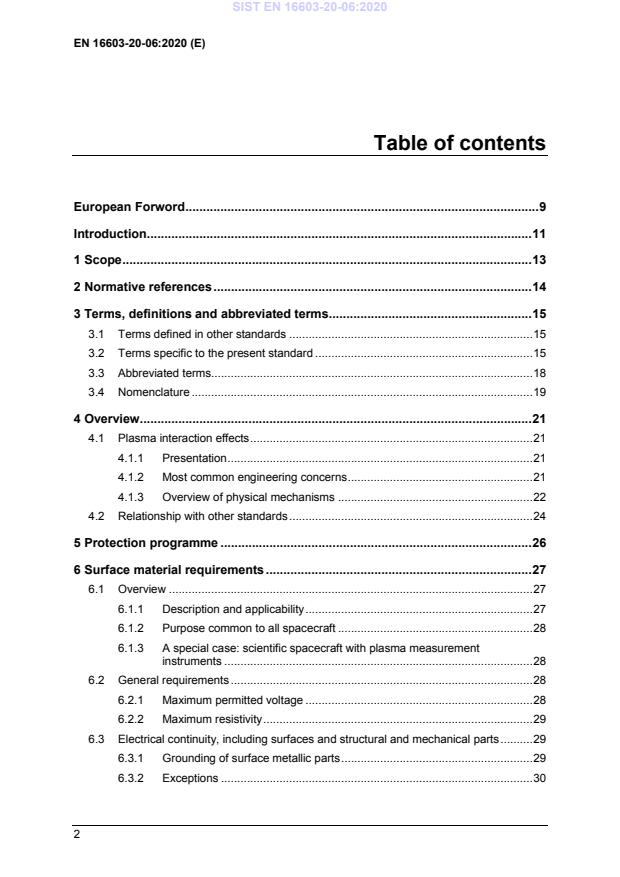
Table of contents
European Forword . 9
Introduction . 11
1 Scope . 13
2 Normative references . 14
3 Terms, definitions and abbreviated terms . 15
3.1 Terms defined in other standards . 15
3.2 Terms specific to the present standard . 15
3.3 Abbreviated terms. 18
3.4 Nomenclature . 19
4 Overview . 21
4.1 Plasma interaction effects . 21
4.1.1 Presentation . 21
4.1.2 Most common engineering concerns . 21
4.1.3 Overview of physical mechanisms . 22
4.2 Relationship with other standards . 24
5 Protection programme . 26
6 Surface material requirements . 27
6.1 Overview . 27
6.1.1 Description and applicability . 27
6.1.2 Purpose common to all spacecraft . 28
6.1.3 A special case: scientific spacecraft with plasma measurement
instruments . 28
6.2 General requirements . 28
6.2.1 Maximum permitted voltage . 28
6.2.2 Maximum resistivity . 29
6.3 Electrical continuity, including surfaces and structural and mechanical parts . 29
6.3.1 Grounding of surface metallic parts . 29
6.3.2 Exceptions . 30
6.3.3 Electrical continuity for surface materials . 31
6.4 Surface charging analysis . 35
6.5 Deliberate potentials . 35
6.6 Testing of materials and assemblies . 35
6.6.1 General . 35
6.6.2 Material characterization tests . 37
6.6.3 Material and assembly qualification . 37
6.7 Scientific spacecraft with plasma measurement instruments . 38
6.8 Verification . 38
6.8.1 Grounding . 38
6.8.2 Material selection . 39
6.8.3 Environmental effects . 39
6.8.4 Computer modelling . 39
6.9 Triggering of ESD . 40
7 Secondary arc requirements . 41
7.1 Description and applicability . 41
7.2 Solar arrays . 42
7.2.1 Overview . 42
7.2.2 General requirement . 42
7.2.3 Testing of solar arrays . 43
7.3 Other exposed parts of the power system including solar array drive
mechanisms . 47
8 High voltage system requirements . 48
8.1 Description . 48
8.2 Requirements . 48
8.3 Validation . 48
9 Internal parts and materials requirements . 49
9.1 Description . 49
9.2 General . 49
9.2.1 Internal charging and discharge effects . 49
9.2.2 Grounding and connectivity . 49
9.2.3 Dielectric electric fields and voltages . 50
9.3 Validation . 51
10 Tether requirements . 55
10.1 Description . 55
10.2 General . 55
10.2.1 Hazards arising on tethered spacecraft due to voltages generated by
conductive tethers . 55
10.2.2 Current collection and resulting problems . 55
10.2.3 Hazards arising from high currents flowing through the tether and
spacecraft structures . 56
10.2.4 Continuity of insulation. . 56
10.2.5 Hazards from undesired conductive paths . 56
10.2.6 Hazards from electro-dynamic tether oscillations . 56
10.2.7 Other effects . 56
10.3 Validation . 57
11 Electric propulsion requirements . 58
11.1 Overview . 58
11.1.1 Description . 58
11.1.2 Coverage of the requirements . 58
11.2 General . 60
11.2.1 Spacecraft neutralization . 60
11.2.2 Beam neutralization . 61
11.2.3 Contamination . 62
11.2.4 Sputtering . 62
11.2.5 Neutral gas effects . 62
11.3 Validation . 63
11.3.1 Ground testing . 63
11.3.2 Computer modelling characteristics . 63
11.3.3 In-flight monitoring. 63
11.3.4 Sputtering . 63
11.3.5 Neutral gas effects . 64
Annex A (normative) Electrical hazard mitigation plan - DRD . 65
A.1 DRD identification . 65
A.1.1 Requirement identification and source document . 65
A.1.2 Purpose and objective . 65
A.2 Expected response . 65
A.2.1 Scope and content . 65
A.2.2 Special remarks . 66
Annex B (informative) Tailoring guidelines . 67
B.1 Overview . 67
B.2 LEO . 67
B.2.1 General . 67
B.2.2 LEO orbits with high inclination . 68
B.3 MEO and GEO orbits . 68
B.4 Spacecraft with onboard plasma detectors . 68
B.5 Tethered spacecraft . 69
B.6 Active spacecraft . 69
B.7 Solar Wind . 69
B.8 Other planetary magnetospheres . 69
Annex C (informative) Physical background to the requirements . 70
C.1 Introduction . 70
C.2 Definition of symbols . 70
C.3 Electrostatic sheaths . 70
C.3.1 Introduction . 70
C.3.2 The electrostatic potential . 71
C.3.3 The Debye length . 71
C.3.4 Presheath . 72
C.3.5 Models of current through the sheath . 73
C.3.6 Thin sheath – space-charge-limited model . 73
C.3.7 Thick sheath – orbit motion limited (OML) model . 74
C.3.8 General case . 75
C.3.9 Magnetic field modification of charging currents . 75
C.4 Current collection and grounding to the plasma . 75
C.5 External surface charging . 76
C.5.1 Definition . 76
C.5.2 Processes . 76
C.5.3 Effects . 77
C.5.4 Surface emission processes . 77
C.5.5 Floating potential . 78
C.5.6 Conductivity and resistivity . 79
C.5.7 Time scales . 81
C.6 Spacecraft motion effects . 81
C.6.1 Wakes . 81
C.6.2 Motion across the magnetic field . 84
C.7 Induced plasmas . 85
C.7.1 Definition . 85
C.7.2 Electric propulsion thrusters . 86
C.7.3 Induced plasma characteristics . 86
C.7.4 Charge-exchange effects . 87
C.7.5 Neutral particle effects . 88
C.7.6 Effect on floating potential . 88
C.8 Internal and deep-dielectric charging . 88
C.8.1 Definition . 88
C.8.2 Relationship to surface charging . 89
C.8.3 Charge deposition . 90
C.8.4 Material conductivity . 90
C.8.5 Time dependence . 93
C.8.6 Geometric considerations. 93
C.8.7 Isolated internal conductors . 94
C.8.8 Electric field sensitive systems . 94
C.9 Discharges and transients . 95
C.9.1 General definition . 95
C.9.2 Review of the process . 95
C.9.3 Dielectric material discharge . 96
C.9.4 Metallic discharge . 98
C.9.5 Internal dielectric discharge . 99
C.9.6 Secondary powered discharge . 100
C.9.7 Discharge thresholds . 100
Annex D (informative) Charging simulation . 102
D.1 Surface charging codes . 102
D.1.1 Introduction . 102
D.2 Internal charging codes . 104
D.2.1 DICTAT . 104
D.2.2 ESADDC . 104
D.2.3 GEANT-4 . 105
D.2.4 NOVICE . 105
D.3 Environment model for internal charging . 105
D.3.1 FLUMIC . 105
D.3.2 Worst case GEO spectrum . 105
Annex E (informative) Testing and measurement. . 106
E.1 Definition of symbols . 106
E.2 Solar array testing. 106
E.2.1 Solar cell sample . 106
E.2.2 Pre-testing of the solar array simulator (SAS) . 107
E.2.3 Solar array test procedure . 109
E.2.4 Other elements . 113
E.2.5 The solar panel simulation device . 114
E.3 Measurement of conductivity and resistivity . 116
E.3.1 Determination of intrinsic bulk conductivity by direct measurement . 116
E.3.2 Determination of radiation-induced conductivity coefficients by direct
measurement . 117
E.3.3 Determination of conductivity and radiation-induced conductivity by
electron irradiation. 118
E.3.4 The ASTM method for measurement of surface resistivity and its
adaptation for space used materials . 118
References . 120
Bibliography . 124
Figures
Figure 6-1: Applicability of electrical continuity requirements . 32
Figure 7-1: Solar array test set-up . 45
Figure C-1 : Schematic diagram of potential variation through sheath and pre-sheath. . 72
Figure C-2 : Example secondary yield curve . 78
Figure C-3 : Schematic diagram of wake structure around an object at relative motion
with respect to a plasma . 82
Figure C-4 : Schematic diagram of void region . 83
Figure C-5 : Schematic diagram of internal charging in a planar dielectric . 89
Figure C-6 : Dielectric discharge mechanism. . 97
Figure C-7 :Shape of the current in relation to discharge starting point. . 97
Figure C-8 : Example of discharge on pierced aluminized Teflon® irradiated by
electrons with energies ranging from 0 to 220 keV. . 98
Figure C-9 : Schematic diagram of discharge at a triple point in the inverted voltage
gradient configuration with potential contours indicated by colour scale. . 99
Figure E-1 : Photograph of solar cells sample – Front face & Rear face
(Stentor Sample. Picture from Denis Payan - CNES®). 107
Figure E-2 : Schematic diagram of power supply test circuit . 108
Figure E-3 : Example of a measured power source switch response . 108
Figure E-4 : Example solar array simulator . 109
Figure E-5 : Absolute capacitance of the satellite . 110
Figure E-6 : Junction capacitance of a cell versus to voltage . 112
Figure E-7 : The shortened solar array sample and the missing capacitances . 113
Figure E-8 : Discharging circuit oscillations . 114
Figure E-9 : Effect of an added resistance in the discharging circuit (SAS + resistance) . 114
Figure E-10 : Setup simulating the satellite including flashover current . 115
Figure E-11 : Basic arrangement of apparatus for measuring dielectric conductivity in
planar samples . 116
Figure E-12 : Arrangement for measuring cable dielectric conductivity and cross-
section through co-axial cable . 116
Figure E-13 : Arrangement for carrying out conductivity tests on planar samples under
irradiation . 118
Figure E-14 : Basic experimental set up for surface conductivity . 119
Tables
Table 4-1: List of electrostatic and other plasma interaction effects on space systems . 23
Table 7-1: Tested voltage-current combinations . 42
Table 7-2: Typical inductance per unit length for cables . 46
Table C-1 : Parameters in different regions in space . 72
Table C-2 : Typical plasma parameters for LEO and GEO . 83
Table C-3 : Plasma conditions on exit plane of several electric propulsion thrusters . 87
Table C-4 : Emission versus backflow current magnitudes for several electric
propulsion thrusters . 87
Table C-5 : Value of Ea for several materials . 91
European Forword
This document (EN 16603-20-06:2020) has been prepared by Technical
Committee CEN-CENELEC/TC 5 “Space”, the secretariat of which is held by
DIN.
This document (EN 16603-20-06:2020) originates from ECSS-E-ST-20-06C Rev.1.
This European Standard shall be given the status of a national standard, either
by publication of an identical text or by endorsement, at the latest by March
2021, and conflicting national standards shall be withdrawn at the latest by
March 2021.
Attention is drawn to the possibility that some of the elements of this document
may be the subject of patent rights. CEN [and/or CENELEC] shall not be held
responsible for identifying any or all such patent rights.
This document supersedes 16603-20-06:2004.
The main changes with respect to 16603-20-06:2004 are listed below:
Addition of definition for the term "flashover current"
Addition of abbreviated terms "RIC" and "SPIS"
Addition of the “Nomenclature” in clause 3.4
Addition of informative text in 6.1.3 about neutralizers after deletion of
requirement 6.7e
Changes to maximum permitted voltages and acceptance of higher
voltages if the effect of worst-case ESD would be acceptable
Simplification of the grounding requirements for surface materials
Change in the permitted ESD energy where surface ESD cannot be
excluded
Change to explicitly allow surface charging analysis to justify acceptance
For surface charging analysis , removal of acceptance by similarity and
statement of the need for material testing
For internal charging, completely embedded floating metals may be
accepted under specified conditions
This document has been prepared under a standardization request given to
CEN by the European Commission and the European Free Trade Association.
This document has been developed to cover specifically space systems and has
therefore precedence over any EN covering the same scope but with a wider
domain of applicability (e.g. : aerospace).
According to the CEN-CENELEC Internal Regulations, the national standards
organizations of the following countries are bound to implement this European
Standard: Austria, Belgium, Bulgaria, Croatia, Cyprus, Czech Republic,
Denmark, Estonia, Finland, Former Yugoslav Republic of Macedonia, France,
Germany, Greece, Hungary, Iceland, Ireland, Italy, Latvia, Lithuania,
Luxembourg, Malta, Netherlands, Norway, Poland, Portugal, Romania, Serbia,
Slovakia, Slovenia, Spain, Sweden, Switzerland, Turkey and the United
Kingdom.
Introduction
The subject of spacecraft plasma interactions has been part of the spacecraft
design process since spacecraft surface charging was first encountered as a
problem in the earliest geostationary spacecraft. However, spacecraft surface
charging is only one of the ways in which the space environment can adversely
affect the electrical state of spacecraft and satellite technology has evolved over
the years.
A need was identified for a standard that is up to date and comprehensive in its
treatment of all the main environment-induced plasma and charging processes
that can affect the performance of satellites in geostationary and medium and
low Earth orbits. This standard is intended to be used by a number of users,
with their own design rules, and therefore it has been done to be compatible
with different alternative approaches.
This document aims to satisfy these needs and provides a consistent standard
that can be used in design specifications. The requirements are based on the
best current understanding of the processes involved and are not radical,
building on existing de-facto standards in many cases.
As well as providing requirements, it aims to provide a straightforward brief
explanation of the main effects so that interested parties at all stages of the
design chain can have a common understanding of the problems faced and the
meaning of the terms used. Guide for tailoring of the provisions for specific
mission types are described in Annex B. Further description of the main
processes are given in Annex C. Some techniques of simulation, testing and
measurement are described in Annex D and Annex E.
Electrical interactions between the space environment and a spacecraft can arise
from a number of external sources including the ambient plasma, radiation,
electrical and magnetic fields and sunlight. The nature of these interactions and
the environment itself can be modified by emissions from the spacecraft itself,
e.g. electric propulsion, plasma contactors, secondary emission and
photoemission. The consequences, in terms of hazards to spacecraft systems
depend strongly on the sensitivity of electronic systems and the potential for
coupling between sources of electrical transients and fields and electronic
components.
Proper assessment of the effects of these processes is part of the system
engineering process as defined in ECSS-E-ST-20. General assessments are
performed in the early phases of a mission when consideration is given to e.g.
orbit selection, mass budget, thermal protection, and materials and component
selection policy. Further into the design of a spacecraft, careful consideration is
given to material selection, coatings, radiation shielding and electronics
protection.
This standard begins with an overview of the electrical effects occurring in
space (Clause 4). The requirements, in terms of spacecraft testing, analysis and
design that arise from these processes (Clause 5 to Clause 11) form the core of
this document. Annex B holds a discussion of types of orbits and how to tailor
the requirements according to the mission. Annex C discusses the quantitative
assessment of the physical processes behind these main effects. Annex D
describes computer simulations and Annex E describes testing and
measurement.
Scope
This standard is a standard within the ECSS hierarchy. It forms part of the
electrical and electronic engineering discipline (ECSS-E-ST-20) of the
engineering branch of the ECSS system (ECSS-E). It provides clear and
consistent provisions to the application of measures to assess, in order to avoid
and minimize hazardous effects arising from spacecraft charging and other
environmental effects on a spacecraft’s electrical behaviour.
This standard is applicable to any type of spacecraft including launchers, when
above the atmosphere.
Although spacecraft systems are clearly subject to electrical interactions while
still on Earth (e.g. lightning and static electricity from handling), these aspects
are not covered, since they are common to terrestrial systems and covered
elsewhere. Instead this standard covers electrical effects occurring in space (i.e.
from the ionosphere upwards).
This standard may be tailored for the specific characteristic and constrains of a
space project in conformance with ECSS-S-ST-00.
Normative references
The following normative documents contain provisions which, through
reference in this text, constitute provisions of this ECSS Standard. For dated
references, subsequent amendments to, or revision of any of these publications
do not apply, However, parties to agreements based on this ECSS Standard are
encouraged to investigate the possibility of applying the more recent editions of
the normative documents indicated below. For undated references, the latest
edition of the publication referred to applies.
EN reference Reference in text Title
EN 16601-00-01 ECSS-S-ST-00-01 ECSS system - Glossary of terms
Terms, definitions and abbreviated terms
3.1 Terms defined in other standards
For the purpose of this Standard, the terms and definitions from
ECSS-S-ST-00-01 apply.
3.2 Terms specific to the present standard
3.2.1 aluminium equivalent thickness
thickness of aluminium with a mass density per unit area equal to that of the
material being described
-2
NOTE The mass density is normally measured in (g cm ).
3.2.2 auroral zone
region at a latitude between 60 and 70 degrees north or south where aurorae are
formed
3.2.3 deep-dielectric charging
electrical charge deposition within the bulk of an external or internal material
3.2.4 dielectric
pertaining to a medium in which an electric field can be maintained
NOTE Depending on their resistivity, dielectric materials
can be described as insulating, antistatic,
moderately conductive or conductive. The
following gives a classic example of classification
according to the resistivity:
more than 10 m: insulating
2 9
between 10 m and 10 m: antistatic
3 6
between 10 m and 10 m: static dissipative
-2 2
between 10 m and 10 m: moderately
conductive
-2
less than 10 m: conductive
3.2.5 dose
energy absorbed locally per unit mass as a result of radiation exposure
3.2.6 downstream
on side of an object in the same direction as the plasma velocity vector
3.2.7 electrostatic
pertaining to static electricity or electricity at rest
3.2.8 electrostatic breakdown
failure of the insulation properties of a dielectric, resulting in a sudden release
of charge and risk of damage to the dielectric concerned
3.2.9 electrostatic discharge
rapid, spontaneous transfer of electrical charge induced by a high electrostatic
field
3.2.10 external charging
electric charge deposition on external materials
3.2.11 flashover current
current arising from a surface propagating discharge
3.2.12 fluence
time-integration of the flux
3.2.13 insulator
insulating dielectric
3.2.14 internal charging
electrical charge deposition on internal materials shielded at least by the
spacecraft skin due to penetration of charged particles from the ambient
medium
NOTE Materials can be conductors or dielectrics.
3.2.15 internal dielectric charging
internal charging of dielectric materials
3.2.16 ion engine
propulsion system which operates by expelling ions at high velocities
3.2.17 L shell
parameter of the geomagnetic field
NOTE 1 It is also referred as L, and is used as a co-ordinate
to describe positions in near-Earth space.
NOTE 2 L or L shell has a complicated derivation based on
an invariant of the motion of charged particles in
the terrestrial magnetic field. However, it is useful
in defining plasma regimes within the
magnetosphere because, for a dipole magnetic
field, it is equal to the geocentric altitude in Earth-
radii of the local magnetic field line where it
crosses the equator.
3.2.18 omnidirectional flux
scalar integral of the flux over all directions
NOTE This implies that no consideration is taken of the
directional distribution of the particles which can
be non-isotropic. The flux at a point is the number
of particles crossing a sphere of unit cross-sectional
surface area (i.e. of radius). An omnidirectional
flux is not to be confused with an isotropic flux.
3.2.19 outgassing rate
mass of molecular species evolving from a material per unit time and unit
surface area
-2 -1
NOTE The units of outgassing rates are g cm s . It can
also be given in other units, such as in relative
-1 -1 -1 -2
mass unit per time unit: (g s ), (% s ) or (% s cm ).
3.2.20 plasma
partly or wholly ionized gas whose particles exhibit collective behaviour
through its electromagnetic field
3.2.21 primary discharge
initial electrostatic discharge which, by creating a temporary conductive path,
can lead to a secondary arc
3.2.22 radiation
transfer of energy by means of a particle (including photons)
NOTE In the context of this Standard, electromagnetic
radiation below the UV band is excluded. This
therefore excludes visible, thermal, microwave and
radio-wave radiation.
3.2.23 radiation belt
area of trapped or quasi-trapped energetic particles, contained by the Earth’s
magnetic field
3.2.24 ram
volume adjacent to the spacecraft and located in the same direction of the
spacecraft motion where modification to the surface or plasma can occur due to
the passage of the spacecraft through the medium
3.2.25 secondary arc
passage of current from an external source, such as a solar array, through a
conductive path initially generated by a primary discharge
3.2.26 surface charging
electrical charge deposition on the surface of an external or internal material
3.2.27 tether
flexible conductive or non-conductive cable linking two spacecraft or two parts
of the same spacecraft not mechanically attached in any other way
3.2.28 thruster
device for altering the attitude or orbit of a spacecraft in space through reaction
NOTE E.g. rocket, cold-gas emitter, and electric
propulsion.
3.2.29 triple point
point where dielectric, metal and vacuum meet
3.2.30 upstream
on the side of the object in the opposite direction to the plasma velocity vector
3.2.31 wake
volume adjacent to a spacecraft and located in the opposite direction to the
spacecraft motion where the ambient plasma is modified by the passage of the
spacecraft through the medium
3.3 Abbreviated terms
The following abbreviated terms are defined and used within this Standard.
Abbreviation Meaning
AOCS attitude and orbital control system
DGD direct gradient discharge
EMC electromagnetic compatibility
emf electro-motive force
EP electric propulsion
ESD electrostatic discharge
ETFE ethylene-tetrafluoroethylene copolymer
eV electron volt (also keV, MeV)
FEEP field emission electric propulsion
FEP fluoroethylene-propylene
GEO geostationary Earth orbit
HEO
highly eccentric orbit
ISS International Space Station
IVG inverted voltage gradient
IVGD inverted voltage gradient discharge
LEO
low Earth orbit
MEMS micro-electromechanical system(s)
MEO medium (altitude) Earth orbit
MLI multi-layer insulation
MLT magnetic local time
NASA National Aeronautics and Space Administration
NGD normal gradient discharge
PCB printed circuit board
PEO polar Earth orbit
PTFE poly-tetrafluoroethylene
PVA photo-voltaic assembly
RIC radiation induced conductivity
r.m.s. root-mean-square
SAS solar array simulator
SPIS spacecraft plasma interaction simulation
SPT stationary plasma thruster
SSM second surface mirror
UV ultra-violet light
3.4 Nomenclature
The following nomenclature applies throughout this document:
a. The word “shall” is used in this Standard to express requirements. All
the requirements are expressed with the word “shall”.
b. The word “should” is used in this Standard to express recommendations.
All the recommendations are expressed with the word “should”.
NOTE It is expected that, during tailoring,
recommendations in this docume
...