

EN 1846-3:2002+A1:2008
(Main + Amendment)Firefighting and rescue service vehicles - Part 3: Permanently installed equipment - Safety and performance
- Abstract
1.1 This Part of this European Standard specifies the minimum requirements for safety and performance of some optional specific permanently installed equipment on firefighting and rescue service vehicles, operated by trained persons, as designated in EN 1846-1 and specified in EN 1846-2.
NOTE 1 Categories and mass classes of the firefighting and rescue service vehicles are given in EN 1846-1.
The permanently installed equipment dealt with in this Part of this European Standard is given below:
- water installation;
- additive installation;
- monitor;
- equipment gantries.
NOTE 2 This Part of this European Standard should be read in conjunction with any national regulations in force for vehicles using the public roads and with any EU Directives and associated EFTA regulations in force relevant to vehicles and their equipment.
For the purposes of this European Standard, the normal ambient temperature range is - 15 °C to + 35 °C.
NOTE 3 In the case of utilization outside this temperature range, the particular temperature range should be specified by the user.
1.2 This Part of this European Standard is not applicable to:
- personnel carrying vehicles;
- vehicles with a gross laden mass not exceeding 2 t;
- boats;
- aircrafts;
- trains;
- ambulances;
- airport vehicles complying with International Civil Aviation Organisation (ICAO) recommendations.
1.3 This Part of this European Standard deals with the technical requirements to minimize the hazards listed in clause 4 which can arise during the commissioning, the operational use and the routine checking of firefighting and rescue service vehicles when carried out in accordance with the specifications given by the manufacturer or his authorized representative.
It deals also with performance requirements.
It does not cover the hazards generated by:
- noise ( as permanently installed equipment cannot be operated separately from the vehicle, this hazard is covered in Part 2);
- radiation (low frequ
- Status
- Withdrawn
- Publication Date
- 09-Sep-2008
- Withdrawal Date
- 23-Jul-2013
- Technical Committee
- CEN/TC 192 - Fire service equipment
- Drafting Committee
- CEN/TC 192 - Fire service equipment
- Current Stage
- 9960 - Withdrawal effective - Withdrawal
- Start Date
- 24-Jul-2013
- Completion Date
- 24-Jul-2013
- Directive
- 2006/42/EC - Directive 2006/42/EC of the European Parliament and of the Council of 17 May 2006 on machinery, and amending Directive 95/16/EC (recast)OJ Ref: C, C 214 OJ Date: 08-Sep-2009
98/37/EC - MachineryOJ Ref: C, C 22 OJ Date: 28-Jan-2009

Relations
- Effective Date
- 18-Jan-2023
- Effective Date
- 11-Jul-2009
- Effective Date
- 28-Jan-2026
- Effective Date
- 28-Jan-2026
- Effective Date
- 28-Jan-2026
- Effective Date
- 28-Jan-2026
- Refers
EN 1846-1:1998 - Firefighting and rescue service vehicles - Part 1: Nomenclature and designation - Effective Date
- 28-Jan-2026
- Effective Date
- 28-Jan-2026
- Effective Date
- 28-Jan-2026
- Effective Date
- 28-Jan-2026
- Effective Date
- 28-Jan-2026
- Effective Date
- 28-Jan-2026
Get Certified
Connect with accredited certification bodies for this standard

CIS Institut d.o.o.
Personal Protective Equipment (PPE) certification body. Notified Body NB-2890 for EU Regulation 2016/425 PPE.

Kiwa BDA Testing
Building and construction product certification.
Kmetijski inštitut Slovenije
Agricultural Institute of Slovenia. Soil testing, plant health, agricultural product analysis.
Sponsored listings
Frequently Asked Questions
EN 1846-3:2002+A1:2008 is a standard published by the European Committee for Standardization (CEN). Its full title is "Firefighting and rescue service vehicles - Part 3: Permanently installed equipment - Safety and performance". This standard covers: 1.1 This Part of this European Standard specifies the minimum requirements for safety and performance of some optional specific permanently installed equipment on firefighting and rescue service vehicles, operated by trained persons, as designated in EN 1846-1 and specified in EN 1846-2. NOTE 1 Categories and mass classes of the firefighting and rescue service vehicles are given in EN 1846-1. The permanently installed equipment dealt with in this Part of this European Standard is given below: - water installation; - additive installation; - monitor; - equipment gantries. NOTE 2 This Part of this European Standard should be read in conjunction with any national regulations in force for vehicles using the public roads and with any EU Directives and associated EFTA regulations in force relevant to vehicles and their equipment. For the purposes of this European Standard, the normal ambient temperature range is - 15 °C to + 35 °C. NOTE 3 In the case of utilization outside this temperature range, the particular temperature range should be specified by the user. 1.2 This Part of this European Standard is not applicable to: - personnel carrying vehicles; - vehicles with a gross laden mass not exceeding 2 t; - boats; - aircrafts; - trains; - ambulances; - airport vehicles complying with International Civil Aviation Organisation (ICAO) recommendations. 1.3 This Part of this European Standard deals with the technical requirements to minimize the hazards listed in clause 4 which can arise during the commissioning, the operational use and the routine checking of firefighting and rescue service vehicles when carried out in accordance with the specifications given by the manufacturer or his authorized representative. It deals also with performance requirements. It does not cover the hazards generated by: - noise ( as permanently installed equipment cannot be operated separately from the vehicle, this hazard is covered in Part 2); - radiation (low frequ
1.1 This Part of this European Standard specifies the minimum requirements for safety and performance of some optional specific permanently installed equipment on firefighting and rescue service vehicles, operated by trained persons, as designated in EN 1846-1 and specified in EN 1846-2. NOTE 1 Categories and mass classes of the firefighting and rescue service vehicles are given in EN 1846-1. The permanently installed equipment dealt with in this Part of this European Standard is given below: - water installation; - additive installation; - monitor; - equipment gantries. NOTE 2 This Part of this European Standard should be read in conjunction with any national regulations in force for vehicles using the public roads and with any EU Directives and associated EFTA regulations in force relevant to vehicles and their equipment. For the purposes of this European Standard, the normal ambient temperature range is - 15 °C to + 35 °C. NOTE 3 In the case of utilization outside this temperature range, the particular temperature range should be specified by the user. 1.2 This Part of this European Standard is not applicable to: - personnel carrying vehicles; - vehicles with a gross laden mass not exceeding 2 t; - boats; - aircrafts; - trains; - ambulances; - airport vehicles complying with International Civil Aviation Organisation (ICAO) recommendations. 1.3 This Part of this European Standard deals with the technical requirements to minimize the hazards listed in clause 4 which can arise during the commissioning, the operational use and the routine checking of firefighting and rescue service vehicles when carried out in accordance with the specifications given by the manufacturer or his authorized representative. It deals also with performance requirements. It does not cover the hazards generated by: - noise ( as permanently installed equipment cannot be operated separately from the vehicle, this hazard is covered in Part 2); - radiation (low frequ
EN 1846-3:2002+A1:2008 is classified under the following ICS (International Classification for Standards) categories: 13.220.10 - Fire-fighting. The ICS classification helps identify the subject area and facilitates finding related standards.
EN 1846-3:2002+A1:2008 has the following relationships with other standards: It is inter standard links to EN 1846-3:2002, EN 1846-3:2013, EN 1846-2:2001, EN 1028-2:2002+A1:2008, EN ISO 13850:2015, EN 1028-1:2002, EN 1846-1:1998, EN ISO 12100-2:2003, EN 1050:1996, EN 1947:2014, EN ISO 12100-1:2003, EN ISO 14120:2015. Understanding these relationships helps ensure you are using the most current and applicable version of the standard.
EN 1846-3:2002+A1:2008 is associated with the following European legislation: EU Directives/Regulations: 2006/42/EC, 98/37/EC; Standardization Mandates: M/079, M/396. When a standard is cited in the Official Journal of the European Union, products manufactured in conformity with it benefit from a presumption of conformity with the essential requirements of the corresponding EU directive or regulation.
EN 1846-3:2002+A1:2008 is available in PDF format for immediate download after purchase. The document can be added to your cart and obtained through the secure checkout process. Digital delivery ensures instant access to the complete standard document.
Standards Content (Sample)
SLOVENSKI STANDARD
01-januar-2009
Gasilska in reševalna vozila - 3. del: Trajno vgrajena oprema - Varnost in zahteve
za obnašanje v uporabi
Firefighting and rescue service vehicles - Part 3: Permanently installed equipment -
Safety and performance
Feuerwehrfahrzeuge - Teil 3: Fest eingebaute Ausrüstung - Sicherheits- und
Leistungsanforderungen
Véhicules des services de secours et de lutte contre l'incendie - Partie 3: Equipements
installés à demeure - Sécurité et performance
Ta slovenski standard je istoveten z: EN 1846-3:2002+A1:2008
ICS:
13.220.10 Gašenje požara Fire-fighting
43.160 Vozila za posebne namene Special purpose vehicles
2003-01.Slovenski inštitut za standardizacijo. Razmnoževanje celote ali delov tega standarda ni dovoljeno.
EUROPEAN STANDARD
EN 1846-3:2002+A1
NORME EUROPÉENNE
EUROPÄISCHE NORM
September 2008
ICS 13.220.10 Supersedes EN 1846-3:2002
English Version
Firefighting and rescue service vehicles - Part 3: Permanently
installed equipment - Safety and performance
Véhicules des services de secours et de lutte contre Feuerwehrfahrzeuge - Teil 3: Fest eingebaute Ausrüstung -
l'incendie - Partie 3: Equipements installés à demeure - Sicherheits- und Leistungsanforderungen
Sécurité et performances
This European Standard was approved by CEN on 9 September 2002 and includes Amendment 1 approved on 30 July 2008.
CEN members are bound to comply with the CEN/CENELEC Internal Regulations which stipulate the conditions for giving this European
Standard the status of a national standard without any alteration. Up-to-date lists and bibliographical references concerning such national
standards may be obtained on application to the CEN Management Centre or to any CEN member.
This European Standard exists in three official versions (English, French, German). A version in any other language made by translation
under the responsibility of a CEN member into its own language and notified to the CEN Management Centre has the same status as the
official versions.
CEN members are the national standards bodies of Austria, Belgium, Bulgaria, Cyprus, Czech Republic, Denmark, Estonia, Finland,
France, Germany, Greece, Hungary, Iceland, Ireland, Italy, Latvia, Lithuania, Luxembourg, Malta, Netherlands, Norway, Poland, Portugal,
Romania, Slovakia, Slovenia, Spain, Sweden, Switzerland and United Kingdom.
EUROPEAN COMMITTEE FOR STANDARDIZATION
COMITÉ EUROPÉEN DE NORMALISATION
EUROPÄISCHES KOMITEE FÜR NORMUNG
Management Centre: rue de Stassart, 36 B-1050 Brussels
© 2008 CEN All rights of exploitation in any form and by any means reserved Ref. No. EN 1846-3:2002+A1:2008: E
worldwide for CEN national Members.
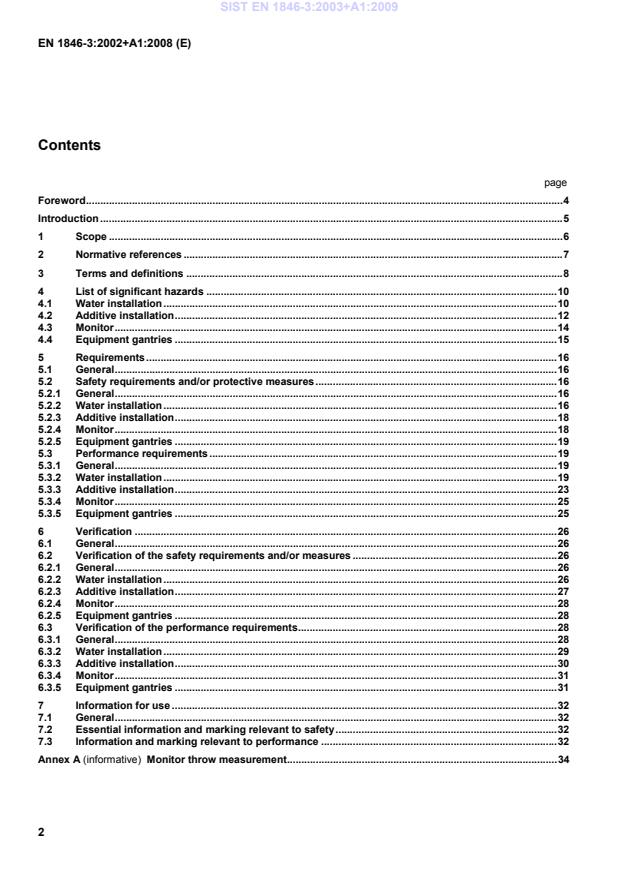
Contents
page
Foreword.4
Introduction .5
1 Scope .6
2 Normative references .7
3 Terms and definitions .8
4 List of significant hazards .10
4.1 Water installation.10
4.2 Additive installation.12
4.3 Monitor.14
4.4 Equipment gantries .15
5 Requirements.16
5.1 General.16
5.2 Safety requirements and/or protective measures.16
5.2.1 General.16
5.2.2 Water installation.16
5.2.3 Additive installation.18
5.2.4 Monitor.18
5.2.5 Equipment gantries .19
5.3 Performance requirements .19
5.3.1 General.19
5.3.2 Water installation.19
5.3.3 Additive installation.23
5.3.4 Monitor.25
5.3.5 Equipment gantries .25
6 Verification .26
6.1 General.26
6.2 Verification of the safety requirements and/or measures .26
6.2.1 General.26
6.2.2 Water installation.26
6.2.3 Additive installation.27
6.2.4 Monitor.28
6.2.5 Equipment gantries .28
6.3 Verification of the performance requirements.28
6.3.1 General.28
6.3.2 Water installation.29
6.3.3 Additive installation.30
6.3.4 Monitor.31
6.3.5 Equipment gantries .31
7 Information for use .32
7.1 General.32
7.2 Essential information and marking relevant to safety.32
7.3 Information and marking relevant to performance .32
Annex A (informative) Monitor throw measurement.34
Annex ZA (informative) !Relationship between this European Standard and the Essential
Requirements of EU Directive 98/37EC".35
Annex ZB (informative) !Relationship between this European Standard and the Essential
Requirements of EU Directive 2006/42/EC".36
Bibliography.37
Foreword
This document (EN 1846-3:2002+A1:2008) has been prepared by Technical Committee CEN/TC 192 "Fire service
equipment", the secretariat of which is held by BSI.
This European Standard shall be given the status of a national standard, either by publication of an identical text or
by endorsement, at the latest by March 2009, and conflicting national standards shall be withdrawn at the latest by
December 2009.
This document includes Amendment 1, approved by CEN on 2008-07-30.
This document supersedes EN 1846-3:2002.
The start and finish of text introduced or altered by amendment is indicated in the text by tags ! ".
The CEN/TC 192 entrusted the drafting of this standard to CEN/TC 192/WG3 "Firefighting and rescue service
vehicles".
This document has been prepared under a mandate given to CEN by the European Commission and the European
Free Trade Association, and supports essential requirements of !EU Directive(s)".
!For relationship with EU Directive(s), see informative Annexes ZA and ZB, which are integral parts of this
document."
EN 1846 "Firefighting and rescue service vehicles" is composed of three parts:
Part 1: Nomenclature and designation;
Part 2: Common requirements - Safety and performance;
Part 3: Permanently installed equipment - Safety and performance.
Annex A is for information only.
According to the CEN/CENELEC Internal Regulations, the national standards organizations of the following
countries are bound to implement this European Standard: Austria, Belgium, Bulgaria, Cyprus, Czech Republic,
Denmark, Estonia, Finland, France, Germany, Greece, Hungary, Iceland, Ireland, Italy, Latvia, Lithuania,
Luxembourg, Malta, Netherlands, Norway, Poland, Portugal, Romania, Slovakia, Slovenia, Spain, Sweden,
Switzerland and United Kingdom.
Introduction
This document is a type C standard as stated in !EN ISO 12100-1:2003".
This document is a complement to EN 1846-2 and deals with some optional specific permanently installed
equipment used by firefighters.
The equipment concerned and the extent to which hazards, hazardous situations and events are covered are
indicated in the scope of this document.
NOTE Other equipment not covered by this document can be dealt with later in another part, depending on the decision of
CEN.
When provisions of this type C standard are different from those which are stated in type A or B standards, the
provisions of this type C standard take precedence over the provisions of the other standards, for machines that
have been designed and built according to the provisions of this type C standard.
This document also deals with the performance requirements which apply to the equipment as defined in the
scope.
1 Scope
1.1 This Part of this European Standard specifies the minimum requirements for safety and performance of
some optional specific permanently installed equipment on firefighting and rescue service vehicles, operated by
trained persons, as designated in EN 1846-1 and specified in EN 1846-2.
NOTE 1 Categories and mass classes of the firefighting and rescue service vehicles are given in EN 1846-1.
The permanently installed equipment dealt with in this Part of this European Standard is given below:
water installation;
additive installation;
monitor;
equipment gantries.
NOTE 2 This Part of this European Standard should be read in conjunction with any national regulations in force for vehicles
using the public roads and with any EU Directives and associated EFTA regulations in force relevant to vehicles and their
equipment.
For the purposes of this European Standard, the normal ambient temperature range is - 15 °C to + 35 °C.
NOTE 3 In the case of utilization outside this temperature range, the particular temperature range should be specified by the
user.
1.2 This Part of this European Standard is not applicable to:
personnel carrying vehicles;
vehicles with a gross laden mass not exceeding 2 t;
boats;
aircrafts;
trains;
ambulances;
airport vehicles complying with International Civil Aviation Organisation (ICAO) recommendations.
1.3 This Part of this European Standard deals with the technical requirements to minimize the hazards listed in
clause 4 which can arise during the commissioning, the operational use and the routine checking of firefighting and
rescue service vehicles when carried out in accordance with the specifications given by the manufacturer or his
authorized representative.
It deals also with performance requirements.
It does not cover the hazards generated by:
noise ( as permanently installed equipment cannot be operated separately from the vehicle, this hazard is
covered in Part 2);
radiation (low frequency, radio frequency, radiation, microwaves);
errors in the software;
use in potentially explosive atmospheres;
construction, transportation, maintenance and decommissioning;
wind pressure in and out of use;
static electricity problems;
remote control;
electromagnetic compatibility;
oil hydraulic and pneumatic driving system.
1.4 This document is not applicable to the equipment which is manufactured before its date of publication by
CEN.
2 Normative references
This European Standard incorporates by dated or undated reference, provisions from other publications. These
normative references are cited at the appropriate places in the text, and the publications are listed hereafter. For
dated references, subsequent amendments to or revisions of any of these publications apply to this European
Standard only when incorporated in it by amendment of revision. For undated references the latest edition of the
publication referred to applies (including amendments).
!deleted text"
EN 418, Safety of machinery – Emergency stop equipment, functional aspects - Principles for design
EN 953, Safety of machinery – Guards – General requirements for the design and construction of fixed and
movable guards
EN 1050:1996, Safety of machinery – Principles for risk assessment
!deleted text"
EN 1028-1:2002, Fire-fighting pumps – Fire-fighting centrifugal pumps with primer – Part 1: Classification, general
and safety requirements
EN 1028-2, Fire-fighting pumps – Fire-fighting centrifugal pumps with primer – Part 2: Verification of general and
safety requirements
EN 1846-1:1998, Firefighting and rescue service vehicles – Part 1: Nomenclature and designation
EN 1846-2:2001, Firefighting and rescue service vehicles – Part 2: Common requirements - Safety and
performance
EN 1846-2:2001/prA1, Firefighting and rescue service vehicles – Part 2: Common requirements - Safety and
performance
prEN 1947, Fire-fighting hoses – Semi-rigid delivery hoses and hose assemblies for pumps and vehicles
!EN ISO 12100-1:2003, Safety of machinery – Basic concepts, general principles for design – Part 1: Basic
terminology, methodology (ISO 12100-1:2003)
EN ISO 12100-2:2003, Safety of machinery – Basic concepts, general principles for design – Part 2: Technical
principles (ISO 12100-2:2003)"
3 Terms and definitions
For the purposes of this Part of this European Standard, the terms and definitions given in
!EN ISO 12100-1:2003", EN 1846-1:1998, EN 1846-2:2001 together with the following apply.
3.1
water installation
combination of components for the collection, storage and delivery of water and/or water-additive mixture at varying
pressures and delivery rates
3.1.1
specified rate(s) of the water installation, Q
specified rate(s) corresponding to the nearest lower value(s) in the following list : 250 l/min – 500 l/min – 750 l/min
– 1 000 l/min – 1 500 l/min – 2 000 l/min – 3 000 l/min – 4 000 l/min – 6 000 l/min
3.1.2
specified outlet pressure(s) of the water installation, p
a1
specified outlet pressure(s) corresponding to the nearest lower value(s) in the following list : 6 bar – 10 bar – 15 bar
– 40 bar
3.1.3
height
difference of level between the standing surface of the vehicle and the water surface at the time of a pumping
appliance suction operation
3.1.4
specified height of the water installation, d
specified height where d equals 1,5 m or 3 m
3.1.5
standing surface of the vehicle
surface on which the vehicle wheels are resting when it is operating
3.1.6
standing surface of the operator
surface on which the operator stands
3.1.7
installed water pump
pump permanently installed on a vehicle and driven by the motive power of the vehicle, or a pump complete with
drive motor
3.1.8
installed water tank
container for storage of water for fire service purposes
3.1.9
supply and delivery connections for water
inlet and outlet devices for joining hoses to the pipework installation
3.1.10
pipework installation for water
any system linking the installed water pump(s), the installed water tank(s) and the supply and delivery connections
3.1.11
operating and control instruments for water
controls and gauges necessary to operate and monitor the water installation system
3.1.12
hosereel system
rotating hose storage system with semi-rigid hose(s) permanently connected to the pipework installation
3.1.13
wheeled hosereel
hosereel designed for the storage, the transport and the deployment of layflat hose
3.2
liquid additive
addition to water to enhance firefighting capabilities e.g. foam concentrate, fire retardant
NOTE In this document, the term "additive" means "liquid additive".
3.2.1
additive installation
combination of components for the collection, storage and delivery of additive at varying pressures and delivery
rates before mixing with water
3.2.2
installed additive pump
pump permanently installed on a vehicle and driven by the motive power of the vehicle, or a pump complete with
drive motor
3.2.3
installed additive tank
container for storage of additive for fire service purposes
3.2.4
supply and delivery connections for additive
inlet and outlet devices for joining hoses to the additive installation
3.2.5
pipework installation for additive
any system linking the installed additive pump(s), the additive installed tank(s) and the supply and delivery
connections
3.2.6
operating and control instruments for additive
controls and gauges necessary to operate and monitor the additive installation system
3.3
rated capacity of a tank
capacity of liquid contained in a tank that could be used by the corresponding pump(s)
3.4
mixing system
system to mix the additive (including foam concentrate) with water (and sometimes air) to produce the required
firefighting media
NOTE The mixing system is part of the water and/or additive installation.
3.5
monitor
device permanently fixed on the vehicle for projection of extinguishing agents
3.6
equipment gantry
mechanical system(s) to assist with the loading, unloading and storage of equipment
4 List of significant hazards
The significant hazards relevant to permanently installed equipment which are dealt with in this part of this
European Standard are given in 4.1 to 4.4 (Tables 1 to 4).
4.1 Water installation
Table 1 — List of significant hazards for water installation
Clause/sub-clause
Number of
reference in this
clause /
References to Part 2 Part of this
sub-clause
of this standard or standard (in
in
Corresponding hazard Situation/area
other standards addition to Part 2
EN 1050:
when dealt with in
it)
1 Mechanical hazards
Due to accumulation of
energy inside the machinery Variation of pressure
1 caused, for example, by for firefighters at the / 5.2.2
liquids and gases under end of the branch
pressure
• 5.1.1.4 of
Exposed power take
EN 1846-2:2001
off (PTO)/ /
Entanglement by a powered transmissions
1.4 • EN 953
system
Powered rewind / 5.2.2.7
hosereel(s)
Rupture or piercing of the Exposed parts of the / 5.2.2
1.9
water installation installation
Supply and delivery / 5.2.2.4
1.9 Ejection of coupling
location
3 Thermal hazards
Resulting in burns by contact Exposed parts of the
• 5.2.3 of EN 1028-
3.1 with the pump or by projection pump, pipework and 5.2.2
1:2002
of hot water from the pump delivery connections
7 Hazards generated by materials and substances processed or used by the machine
Bad location of the • 5.1.1.3.2 of
7.1 Inhalation of exhaust gases /
exhaust
EN 1846-2:2001
Table 1 — List of significant hazards for water installation (concluded)
Clause/sub-clause
Number of
reference in this
clause /
References to Part 2 Part of this
sub-clause
of this standard or standard (in
in
Corresponding hazard Situation/area
other standards addition to Part 2
EN 1050:
when dealt with in
it)
Hazards generated by neglecting ergonomic principles in machinery design
(see EN 614-1 and prEN 13861)
At the operating • 5.1.3.3/5.1.4.2 of
8.4 Inadequate local lighting /
position EN 1846-2:2001
Mental overload and
• 5.1.4.2 of
8.5
No logical relationship
underload, stress
EN 1846-2:2001
between the command
and the expected 5.2.2.6
rd
• !3 dash of
operation at the
Human error, human
8.6 4.8.7 of EN ISO
operating position
behaviour
12100-2:2003"
• 5.1.4.2/7.3 of
EN 1846-2:2001
Inadequate design, location or
At the operating
8.7 identification of manual /
rd
position
• !3 dash of
controls
4.8.7 of EN ISO
12100-2:2003"
Impossibility of stopping
At the operating
11 the machine in the best / 5.2.1
position
possible conditions
20 Relating to the travelling function
Overturning of vehicle.
Excessive oscillations when
• 5.1.1.1/5.1.1.2 of
20.5 Loss of lateral stability 5.2.2.3
moving EN 1846-2:2001
during braking
4.2 Additive installation
Table 2 — List of significant hazards for additive installation
Clause/sub-clause
Number of
reference in this
clause /
References to Part 2 Part of this
sub-clause
Corresponding hazard Situation/area of this standard or standard (in
in
other standards addition to Part 2
EN 1050:
when dealt with in
it)
1 Mechanical hazards
• 5.1.1.4 of
EN 1846-2:2001
Entanglement by a powered Exposed
1.4 /
system (if pump) PTO/transmissions
• EN 953
Rupture or piercing of the Exposed parts of the
1.9 / 5.2.3.1
additive installation additive installation
Supply and delivery
1.9 Ejection of coupling / 5.2.3.4
location
7 Hazards generated by materials
7.1
Contact with or inhalation of Point of contact with
7.1 /
harmful additive additive
7.2
Bad location of the
• 5.1.1.3.2 of
7.1 Inhalation of exhaust gases /
exhaust EN 1846-2:2001
Hazards generated by neglecting ergonomic principles in machinery design (see EN 614-1 and
prEN 13861)
At the operating • 5.1.3.3/5.1.4.2 of
8.4 Inadequate local lighting /
position EN 1846-2:2001
Mental overload and
• 5.1.4.2 of
8.5 No logical relationship
underload, stress EN 1846-2:2001
between the command
and the expected 5.2.3.6
rd
• !3 dash of
operation at the
Human error, human
8.6 4.8.7 of EN ISO
operating position
behaviour
12100-2:2003"
• 5.1.4.2/7.3 of
EN 1846-2:2001
Inadequate design, location or
At the operating
8.7 identification of manual /
rd
position
• !3 dash of
controls
4.8.7 of EN ISO
12100-2:2003"
Confusion between different At the operating
• 5.1.4.2/7.3 of
8.7 /
signals position EN 1846-2:2001
Table 2 — List of significant hazards for additive installation (concluded)
Clause/sub-clause
Number of
reference in this
clause /
References to Part 2 Part of this
sub-clause
Corresponding hazard Situation/area of this standard or standard (in
in
other standards
addition to Part 2
EN 1050:
when dealt with in
it)
Impossibility of stopping
At the operating
11 the machine in the best / 5.2.1
position
possible conditions
20 Relating to the travelling function
Overturning of the
Excessive oscillations when
• 5.1.1.1/5.1.1.2 of
20.5 vehicle. Loss of lateral 5.2.3.3
moving EN 1846-2:2001
stability during braking
4.3 Monitor
Table 3 — List of hazards for monitor
Clause/sub-clause
Number of
reference in this
clause /
References to Part 2 Part of this
sub-clause
Corresponding hazard Situation/area of this standard or standard (in
in
other standards addition to Part 2
EN 1050:
when dealt with in
it)
1 Mechanical hazards
Impact hazard when
monitor is operating :
movement (when remote
5.2.4
control) ;
1.6 Monitor location /
movement (vertical,
rotation)
Rupture or piercing of the Exposed pipework
1.9 / 5.2.4
pipework system or monitor installation
2 Electrical hazards
Electric shock by 7.1
Full stream on high voltage • 7.1.2.4 of
stream contact on high
2.2
conductors
EN 1846-2:2001
voltage conductors 7.2
7 Hazards generated by materials and substances processed or used by the machine
Bad location of the • 5.1.1.3.2 of
7.1 Inhalation of exhaust gases /
exhaust
EN 1846-2:2001
Hazards generated by neglecting ergonomic principles in machinery design (see EN 614-1 and
prEN 13861)
unhealthy postures or At the operating
• 5.1.4.2 of
8.1 /
excessive effort position EN 1846-2:2001
Inadequate lighting of the At the operating • 5.1.3.3/5.1.4.2 of
8.4 /
operating position position
EN 1846-2:2001
Loss of permanent control of At the operating
8.7 / 5.2.4
the monitor position
Confusion between different At the operating • 5.1.4.2/7.3 of
8.7 /
signals position
EN 1846-2:2001
Impossibility of stopping
At the operating
11 the machine in the best / 5.2.1
position
possible conditions
Table 3 — List of hazards for monitor (concluded)
Clause/sub-clause
Number of
reference in this
clause /
References to Part 2 Part of this
sub-clause
Corresponding hazard Situation/area of this standard or standard (in
in
other standards addition to Part 2
EN 1050:
when dealt with in
it)
At the operating
• 5.1.2.3.3/5.1.2.5 of
19 Slip, trip and fall of persons /
position EN 1846-2:2001
21 Linked to the work position
At the operating
Falling of person from the
• 5.1.2.5 of
21.1 position when the 5.2.4
work position EN 1846-2:2001
vehicle is in motion
4.4 Equipment gantries
Table 4 — List of hazards for equipment gantries
Clause/sub-clause
Number of
reference in this
clause /
References to Part 2 Part of this
sub-clause
Corresponding hazard Situation/area of this standard or standard (in
in
other standards addition to Part 2
EN 1050:
when dealt with in
it)
1 Mechanical hazards
due to machine parts or
1.c/1.d In vicinity of gantries / 5.2.5.1
workpieces
1.6 Impact In vicinity of gantries / 5.2.5.1
Hazards generated by neglecting ergonomic principles in machinery design (see EN 614-1 and
prEN 13861)
5.2.5.1
Unhealthy posture or At the operating
8.1 /
excessive efforts position
5.2.5.2
5.2.5.1
Inadequate consideration of At the operating
8.2 /
hand-arm or foot-leg anatomy position
5.2.5.2
At the operating • 5.1.3.3 of
8.4 Inadequate local lighting /
position
EN 1846-2:2001
5.2.5.1
Human error, human At the operating
8.6 /
behaviour position
7.1
Table 4 — List of hazards for equipment gantries (concluded)
Clause/sub-clause
Number of
reference in this
clause /
References to Part 2 Part of this
sub-clause
Corresponding hazard Situation/area of this standard or standard (in
in
other standards addition to Part 2
EN 1050:
when dealt with in
it)
• 5.1.4.2/7.1 of
EN 1846-2:2001
Inadequate design, location or
At the operating
8.7 identification of manual /
rd
position
• !3 dash of
control
4.8.7 of EN ISO
12100-2:2003"
Falling or ejected objects or
17 In vicinity of gantries / 5.2.5.1
fluids
At the operating
19 Slip, trip and fall of persons / 5.2.5.1
position and in vicinity
of gantries
20 relating to travelling function
Movement without all parts in When vehicle is in
• 5.1.4.1 of
20.3 5.2.5.1
a safe position motion EN 1846-2:2001
5 Requirements
5.1 General
a) Methods to verify the requirements in the following sub-clauses are given in the equivalent sub-clauses of
clause 6;
b) The manufacturer of the vehicle falling into the scope of this part of EN 1846 shall install the equipment in
accordance with the requirements of the chassis and equipment manufacturer.
5.2 Safety requirements and/or protective measures
5.2.1 General
a) Permanently installed equipment shall comply with the general safety requirements and/or protective
measures described in EN 1846-2 as well as with the safety requirements and/or measures of 5.2. In addition
the equipment shall be designed according to the principles of !EN ISO 12100" for hazards relevant but
not significant which are not dealt with in this document;
b) Each operating position for each item of equipment shall have a stop control which does not have to be an
emergency stop as specified in EN 418.
5.2.2 Water installation
5.2.2.1 General
a) All parts of the water installation designed to work at a pressure higher than atmospheric pressure shall
withstand the designed maximum working pressure specific to that part of the installation plus 5,5 bar without
any damage;
b) The maximum speed of the installed water pump shall be less than the maximum speed n as specified in 3.6.3
of EN 1028-1:2002.
NOTE Water tank(s) are considered to work at atmospheric pressure.
c) The deviation of the outlet pressure of the pump shall meet the requirements of Table 5 when operating at p
a1
and Q , as defined in 3.1.1 and 3.1.2 (see also 5.2.1).
Table 5 — Allowed pressure deviation
Flowrate variation Allowable pressure
deviation
Pump with Q < 3 000 l/min Q to 0,7 Q p to 1,25 p
1 1 1 a1 a1
Pump with Q ≥ 3 000 l/min Q to 0,85 Q p to 1,25 p
1 1 a1 a1
5.2.2.2 Installed water pump
For water pumps with nominal pressure P , as defined in EN 1028-1, exceeding 20 bar, water temperature in the
N
pump shall not exceed + 60 °C.
5.2.2.3 Water tank
In addition to the compliance with the stability requirements given in EN 1846-2, the design and mounting of the
water tank and the location and installation of baffles, when fitted, shall prevent any excessive dynamic force that
may cause vehicle instability under anticipated operational conditions.
5.2.2.4 Supply and delivery connections for water
a) The maximum height from the lowest point of the final supply and delivery connection(s) to the standing
surface of the operator shall not exceed 1,5 m under all load conditions;
b) The final supply and delivery connection(s) shall be angled downwards at 10° to 30° when they are higher than
0,5 m from the standing surface of the vehicle;
c) It shall be possible to relieve any pressure build up between the delivery connection and any blank cap fitted.
5.2.2.5 Pipework installation for water
a) The final delivery shall be equipped with valve(s).
5.2.2.6 Operating and control instruments
rd
a) Operating and control instruments shall conform to !3 dash of 4.8.7 of EN ISO 12100-2:2003" and
5.1.4.2 of EN 1846-2:2001.
b) Operating controls shall be easily accessible, easily adjustable without the use of tools and not deviate from
their set position.
5.2.2.7 Hosereel system
a) The operation of a powered rewind hosereel, if fitted, shall be controlled by a hold to run control;
b) When rewinding, the hosereel shall be visible by the operator of the hold to run control;
c) The hosereel system shall be fitted with a means which prevents unintended unwinding.
5.2.3 Additive installation
5.2.3.1 General
a) All parts of the additive installation designed to work at a pressure higher than atmospheric pressure shall
withstand the designed maximum working pressure specific to that part of the installation plus 5,5 bar without
any damage;
NOTE Additive tank(s) are considered to work at atmospheric pressure.
b) The design and materials chosen shall take into account the nature of the additive, especially concerning
corrosion;
c) Design data and documentation shall be given in the instruction handbook (see 7.1.1).
5.2.3.2 Installed additive pump
No specific requirements.
5.2.3.3 Additive tank
In addition to the compliance with the stability requirements given in EN 1846-2, the design and mounting of the
additive tank and the location and installation of baffles, when fitted, shall prevent any excessive dynamic force that
may cause vehicle instability under anticipated operational conditions.
5.2.3.4 Supply and delivery connections for additive
The maximum height from the lowest point of the final supply and delivery connection(s) to the standing surface of
the operator shall not exceed 1,5 m under all load conditions.
5.2.3.5 Pipework installation for additive
The final supply connection(s) and the final delivery shall be equipped with valve(s).
5.2.3.6 Operating and control instruments for additive
Operating controls shall be easily accessible, easily adjustable without the use of tools and not deviate from their
set position.
5.2.4 Monitor
a) At the monitor operating position, a visual indicator or other means shall identify the direction of the monitor;
b) At the monitor operating position, it shall be possible to open, close, move and maintain the monitor at the
required position;
c) Where firefighters are allowed to be in the vicinity of remote control monitors, (a) visual and/or audible warning
device(s) shall be provided to indicate the monitor is about to leave its travelling position;
d) Opening and closing the monitor shall be possible without causing hazard to any other operator;
e) Where there is an inlet monitor connection, the designed maximum working pressure shall be indicated close
to the inlet of this installation;
f) A means of communication between driver and operator of the monitor shall be provided if it is possible for the
monitor to be operated whilst the vehicle is in motion;
g) All parts of the pipework installation for the monitor shall withstand the designed maximum working pressure
specific to that part of the installation plus 5,5 bar without any damage;
h) Operating controls shall be easily accessible, easily adjustable without the use of tools and not deviate from
their set position.
NOTE The reaction force from a monitor is not considered as a significant hazard for the stability of the vehicle. However
the manufacturer should give consideration to this for the design of specific appliances.
5.2.5 Equipment gantries
5.2.5.1 General
a) Gantries shall be fitted with devices to prevent unintended movement of the gantry or the equipment carried
thereon;
b) The removal of equipment from gantries shall require an intentional act;
c) Where the gantry is power driven, any failure of the power supply shall allow the gantry or the equipment to
remain in a safe position;
d) Gantries which extend more than 25 cm horizontally outside of the vehicle, when deployed, shall be marked to
indicate possible impact hazard to operators moving around the vehicle.
NOTE Road regulation(s) should be taken into account for vehicles where gantries may extend out of the body of the
vehicle.
5.2.5.2 Wheeled hosereel
a) Unlocking and removal of the hosereel from the gantry shall only be possible from ground level;
b) When unlocked, the wheeled hosereel shall be maintained in its stowed position by a force less than 40 N
exerted by one hand of a firefighter.
5.3 Performance requirements
5.3.1 General
a) Permanently installed equipment shall comply with the general performance requirements described in
EN 1846-2 as well as the specific requirements of 5.3;
b) The construction techniques and materials of the permanently installed equipment shall be chosen so that they
are protected against corrosion;
c) The construction shall be protected against accumulation of water, dirt and corrosive substances, between and
within the construction elements. Particular care shall be taken to avoid electro-chemical corrosion;
d) The design of permanently installed equipment and their mountings shall withstand the physical stresses
applied in normal operational use.
5.3.2 Water installation
5.3.2.1 General
a) Components and connections shall meet the pressure (positive and/or negative) to which they may be
subjected without leakage;
b) The installation, including pump(s), tank(s) and monitor(s) shall be able to be drained. If drain points are used,
they shall be clearly identified, be easily accessible and protected, if necessary, against unintended opening;
c) Additional precautions against frost shall be provided where necessary;
d) Where the installation contains water/additive mixture, it shall be possible to flush the installation;
NOTE National water supply regulations should be taken into consideration.
e) Q , p and specified height d (as defined in 3.1.1, 3.1.2 and 3.1.4) values shall be agreed between the
1 a1
manufacturer and the user;
Classification of the water installation shall be achieved using Q , p and d (see Table 6)
1 a1
When the water installation containing a tank, the maximum flow-rate from the tank to the pump shall be
agreed between the manufacturer and the user.
Table 6 — Hydraulic classification of the water installation
d
Delivery rate/Pressure
(l/min)/ bar m
Q / p 1,5 or 3
1 a1
f) Q and p value(s) shall be agreed between the manufacturer and the user including the installation contained
1 a1
in a water tank.
When a tank is fitted, the water installation shall be designed to ensure that the specified delivery rate(s) when
using the tank is (are) achieved.
5.3.2.2 Installed water pump
NOTE The water pump should be installed as low as practicable.
a) If fitted with primer, the water pump shall be one of the types specified in EN 1028-1;
NOTE On user's request a water pump without primer may be installed.
b) The pump shall remain functional at vehicle maximum cross-axle capability according to EN 1846-2, Table 7;
c) The priming device shall achieve the performances given in Table 7 at 6 m height with the suction hose size
designed for the vehicle and with the shortest possible suction hose length.
Table 7 −− Priming times
−−
Type FPN 6 – 500 FPN 10 – 750 FPN 10 – 1 000 FPN 10 – 1 500 FPN 10 – 2 000 FPN 10 – 3 000 FPN 10 – 4 000 FPN 10 – 6 000
(EN FPN 15 – 1 000 FPN 15 – 2 000 FPN 15 – 3 000
1028)
a a
Time ≤ 30 ≤ 30 ≤ 30 ≤ 30 ≤ 40 See below
≤ 40 ≤ 60
(in s)
a
Unless otherwise agreed between manufactured and user.
If there is more than one suction line, and/or for the FPN10-6 000 pump, the priming times shall be agreed between
the manufacturer and the user.
If automatic pressure regulation is installed, the output pressure of the pump shall not vary by more than ± 10 %
from the set pressure under all operational conditions above 4 bar and up to the appliance manufacturer's
allowable pressure.
5.3.2.3 Water tank
a) A water tank level indicator shall be fitted and visible from the installed pump operating position;
b) The filling connection(s) to the water tank shall incorporate a strainer or filter (as defined in 6.10 of
EN 1028-1:2002) and a device to prevent water return (e.g. non-return valve);
c) A tank filling valve shall be fitted. A tank level indicator shall be visible at or near to the control position of the
tank filling valve.
NOTE A single tank level indicator can be used if it is visible from both the control position of the tank filling valve and from
the installed pump operating position.
The water tank shall be designed and installed to ensure that the tank is not damaged by filling or discharging in
normal operating conditions, including driving. Water tank installation shall allow filling at a flow rate of at least
800 l/min, unless otherwise specified;
NOTE It may be possible to fill the water tank by the installed water pump and/or through a fixed installation.
d) The design of the water tank shall avoid any excessive water spillage;
NOTE National regulations may apply to water spillage.
e) If personnel access holes are installed, the minimum clearance dimension shall be 450 mm and shall be
accessible w
...