

EN 1745:2002
(Main)Masonry and masonry products - Methods for determining design thermal values
- Abstract
This European Standard gives procedures for the determination of design thermal values (thermal resistance and/or thermal conductivity) of masonry and masonry products.
- Status
- Withdrawn
- Publication Date
- 16-Apr-2002
- Withdrawal Date
- 17-Apr-2012
- Technical Committee
- CEN/TC 125 - Masonry
- Drafting Committee
- CEN/TC 125/WG 4 - Test methods
- Current Stage
- 9960 - Withdrawal effective - Withdrawal
- Start Date
- 18-Apr-2012
- Completion Date
- 18-Apr-2012

Relations
- Effective Date
- 25-Apr-2012
- Effective Date
- 28-Jan-2026
- Effective Date
- 28-Jan-2026
- Effective Date
- 28-Jan-2026
- Referred By
EN 998-1:2010 - Specification for mortar for masonry - Part 1: Rendering and plastering mortar - Effective Date
- 28-Jan-2026
- Effective Date
- 28-Jan-2026
- Effective Date
- 28-Jan-2026
- Effective Date
- 28-Jan-2026
- Effective Date
- 28-Jan-2026
- Effective Date
- 28-Jan-2026
- Effective Date
- 28-Jan-2026
- Effective Date
- 28-Jan-2026
- Effective Date
- 28-Jan-2026
- Effective Date
- 28-Jan-2026
- Effective Date
- 28-Jan-2026
Get Certified
Connect with accredited certification bodies for this standard

DIBt (Deutsches Institut für Bautechnik)
German Institute for Building Technology.
DIN CERTCO
DIN Group product certification.

Aboma Certification B.V.
Specialized in construction, metal, and transport sectors.
Sponsored listings
Frequently Asked Questions
EN 1745:2002 is a standard published by the European Committee for Standardization (CEN). Its full title is "Masonry and masonry products - Methods for determining design thermal values". This standard covers: This European Standard gives procedures for the determination of design thermal values (thermal resistance and/or thermal conductivity) of masonry and masonry products.
This European Standard gives procedures for the determination of design thermal values (thermal resistance and/or thermal conductivity) of masonry and masonry products.
EN 1745:2002 is classified under the following ICS (International Classification for Standards) categories: 91.080.30 - Masonry; 91.120.10 - Thermal insulation of buildings. The ICS classification helps identify the subject area and facilitates finding related standards.
EN 1745:2002 has the following relationships with other standards: It is inter standard links to EN 1745:2012, EN ISO 105-B01:2014, EN ISO 11640:2012, EN ISO 105-B10:2011, EN 998-1:2010, EN ISO 11641:2012, EN ISO 105-B02:2013, EN 998-2:2010, EN ISO 11641:2025, EN ISO 105-E03:2010, EN ISO 11640:2018, EN ISO 105-C09:2003, EN ISO 105-C08:2010, EN ISO 17228:2006, EN ISO 105-E04:2013. Understanding these relationships helps ensure you are using the most current and applicable version of the standard.
EN 1745:2002 is associated with the following European legislation: EU Directives/Regulations: 305/2011, 89/106/EEC; Standardization Mandates: M/116. When a standard is cited in the Official Journal of the European Union, products manufactured in conformity with it benefit from a presumption of conformity with the essential requirements of the corresponding EU directive or regulation.
EN 1745:2002 is available in PDF format for immediate download after purchase. The document can be added to your cart and obtained through the secure checkout process. Digital delivery ensures instant access to the complete standard document.
Standards Content (Sample)
2003-01.Slovenski inštitut za standardizacijo. Razmnoževanje celote ali delov tega standarda ni dovoljeno.DþXQVNLKMauerwerk und Mauerwerksprodukte - Verfahren zur Ermittlungvon WärmeschutzrechenwertenMaçonnerie et éléments de maçonnerie - Détermination des valeurs thermiques de calculMasonry and masonry products - Methods for determining design thermal values91.120.10Toplotna izolacija stavbThermal insulation91.080.30Zidane konstrukcijeMasonryICS:Ta slovenski standard je istoveten z:EN 1745:2002SIST EN 1745:2004en01-januar-2004SIST EN 1745:2004SLOVENSKI
STANDARD
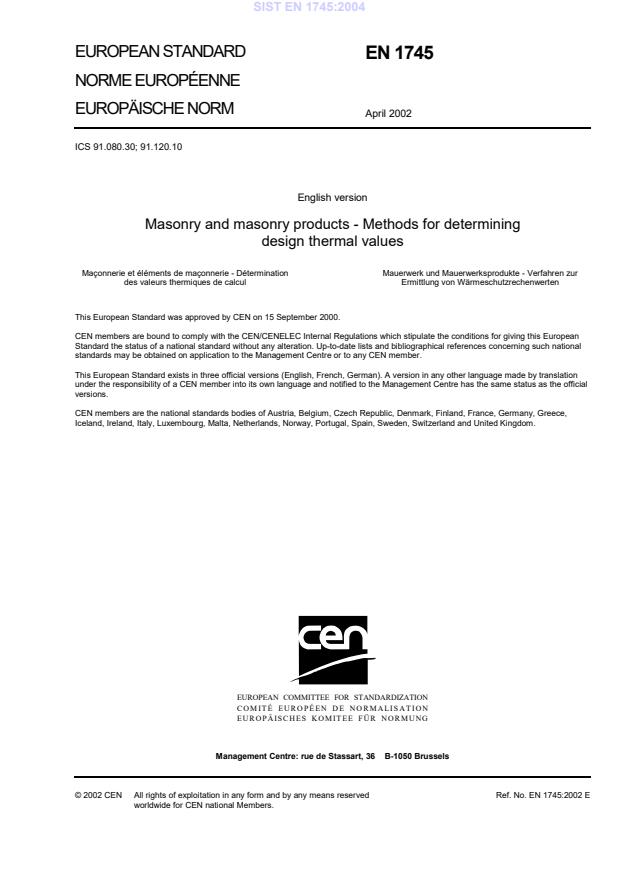
EUROPEAN STANDARDNORME EUROPÉENNEEUROPÄISCHE NORMEN 1745April 2002ICS 91.080.30; 91.120.10English versionMasonry and masonry products - Methods for determiningdesign thermal valuesMaçonnerie et éléments de maçonnerie - Déterminationdes valeurs thermiques de calculMauerwerk und Mauerwerksprodukte - Verfahren zurErmittlung von WärmeschutzrechenwertenThis European Standard was approved by CEN on 15 September 2000.CEN members are bound to comply with the CEN/CENELEC Internal Regulations which stipulate the conditions for giving this EuropeanStandard the status of a national standard without any alteration. Up-to-date lists and bibliographical references concerning such nationalstandards may be obtained on application to the Management Centre or to any CEN member.This European Standard exists in three official versions (English, French, German). A version in any other language made by translationunder the responsibility of a CEN member into its own language and notified to the Management Centre has the same status as the officialversions.CEN members are the national standards bodies of Austria, Belgium, Czech Republic, Denmark, Finland, France, Germany, Greece,Iceland, Ireland, Italy, Luxembourg, Malta, Netherlands, Norway, Portugal, Spain, Sweden, Switzerland and United Kingdom.EUROPEAN COMMITTEE FOR STANDARDIZATIONCOMITÉ EUROPÉEN DE NORMALISATIONEUROPÄISCHES KOMITEE FÜR NORMUNGManagement Centre: rue de Stassart, 36
B-1050 Brussels© 2002 CENAll rights of exploitation in any form and by any means reservedworldwide for CEN national Members.Ref. No. EN 1745:2002 ESIST EN 1745:2004
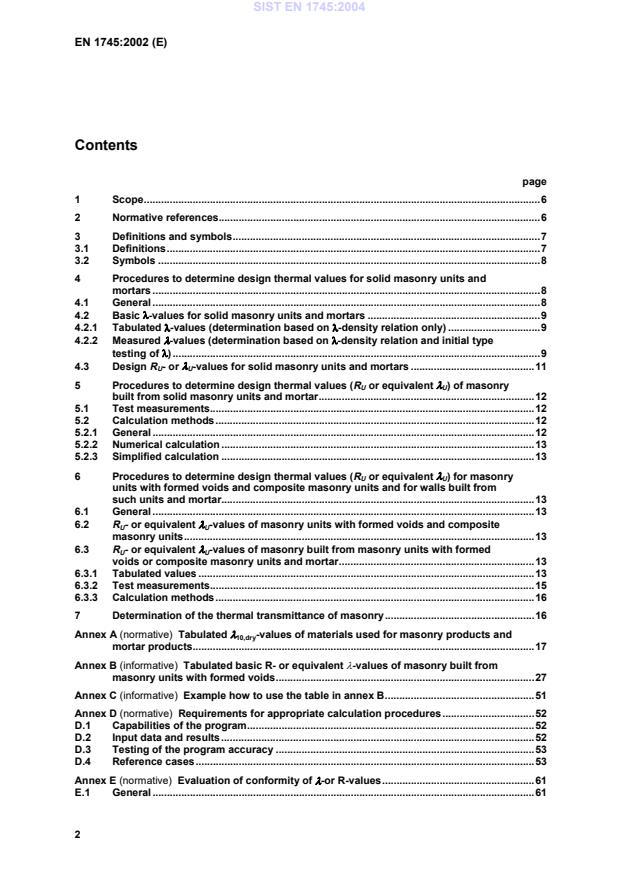
Tabulated 10,dry-values of materials used for masonry products andmortar products.17Annex B (informative)
Tabulated basic R- or equivalent -values of masonry built frommasonry units with formed voids.27Annex C (informative)
Example how to use the table in annex B.51Annex D (normative)
Requirements for appropriate calculation procedures.52D.1Capabilities of the program.52D.2Input data and results.52D.3Testing of the program accuracy.53D.4Reference cases.53Annex E (normative)
Evaluation of conformity of -or R-values.61E.1General.61SIST EN 1745:2004
(informative)
A-deviations.63Bibliography.65SIST EN 1745:2004
per percent increase of moisture content.These tabulated values are valid for materials where there is production control of density but no directlymeasured -values. The values are given as 50 % and 90 % fractiles (P) of the existing range of -valuesfor a certain material for a given density.4.2.2 Measured -values (determination based on -density relation and initial type testing of)When a manufacturer decides to determine a -value from test measurement, the following procedureshall be used:4.2.2.1 Test specimensTake detailed information about test specimens from ISO 8302 and from prEN 12664.NOTECare should be taken that the test specimens are representative of the masonry product itself. Anappropriate way to ensure this, is to cut specimens from masonry units.4.2.2.2 Conditioning of specimensNormally masonry materials are tested in a dry condition. It is also possible to carry out tests in amoist condition (e.g. conditioned to constant mass in an environment of 23 °C
2 °C and 50 %
5 %relative humidity), in which case the measured value has to be converted to the dry state.4.2.2.3 Test measurementUse as the reference test method ISO 8302. More detailed information about the testing procedure formasonry materials is given in prEN 12664.Alternative test methods, such as ISO 8301, which may require different test specimens and differentconditioning methods, may be used, if the correlation between the reference test method and thealternative method can be given.4.2.2.4 The determination of the basic -valueThe determination of the basic -value is based on the mean -value and the limit -value. Threeitems of information are necessary for this determination procedure:SIST EN 1745:2004
value3Mean
value4Lower limit
value5Curve resulting from tabulated values (annex A)6Parallel curve drawn through point A710 % of production8Mean density990 % of production10Product density range11Density (kg/m2)Figure 1 — Derivation of the basic -valueNOTEFor factory production control purposes thermal conductivity may be controlled indirectly from the drydensity of the material.4.3 Design RU- or U-values for solid masonry units and mortarsFrom the basic -values, design RU- or U-values are calculated using the moisture conversioncoefficients given in annex A for each type of material and the nationally given design moisturecontent for a certain material in a certain application. The calculation shall be done according toEN ISO 10456, using the following formulae:m12F or m12FRRwith)(m12feF or )(12uufmueFSIST EN 1745:2004
moisture correction (see 4.3)
U-value of the material calculation RU- or equivalent U-value of the masonry.SIST EN 1745:2004
+ 1 = SIST EN 1745:2004
U
h
U = UUMMTU - HH
U + H
U = UMMUUHR + d + R1UseMsimSIST EN 1745:2004
is defined as the factor, which describes how many times higherthe diffusion resistance of a material layer is, than the resistance of an air layer with the same thicknessunder the same conditions. To compare the diffusion resistance of two building elements, it is necessaryto multiply the -factor by the thickness of the respective layer, which leads to a figure with thedimension m. The diffusion behaviour is different, whether it is diffusion into a building component (lowervalues) or out of the building component (drying period, higher value).Table A.1 — Clay units (fired clay)10,dryDensity of thematerial[W/mK]Water vapourdiffusion coefficientc[kg/m3]P = 50 %P = 90 %[kJ/kgK]10000,200,275/101,011000,230,305/101,012000,260,335/101,013000,300,365/101,014000,340,405/101,015000,370,435/101,016000,410,475/101,017000,450,515/101,018000,490,555/101,019000,530,605/101,020000,580,645/101,021000,620,695/101,022000,670,745/101,023000,720,795/101,024000,770,845/101,0f = 10 (m3/m3)For clay materials with a density between 1800 kg/m3 and 2400 kg/m3 used as facing materials, whichare normally fired at a significantly higher temperature, the -value is 50/100 instead of 5/10.SIST EN 1745:2004
1)A lightweight aggregate produced by the expansion of molten blastfurnace slag with water. Blastfurnace slagis a by-product of the extraction of iron haematite ores.SIST EN 1745:2004
exists (e.g.for new products). Therefore, no 50 % and 90 % fractiles (P) can be given, the given -values are to beunderstood as safe values for all different types of aggregates.Table A.9 — Concrete units with other lightweight aggregatesDensity of thematerial10,dryWater vapour diffusioncoefficientc[kg/m3][W/mK][kJ/kgK]5000,245/151,06000,275/151,07000,305/151,0 8000,335/151,0 9000,375/151,010000,415/151,011000,465/151,012000,525/151,013000,585/151,014000,665/151,015000,745/151,016000,835/151,018001,085/151,020001,335/151,0f = 4 (m3/m3)SIST EN 1745:2004
2)For these materials the 50 % / 90 % approach is not applicable.SIST EN 1745:2004
...