

EN 3389:2009
(Main)Aerospace series - Fasteners, externally threaded, in heat resisting nickel base alloy NI-PH1302 (Waspaloy) - Classification: 1 210 MPa/730 °C - Manufacturing method optional - Technical specification
- Abstract
This standard specifies the technical and quality assurance requirements for externally threaded fasteners in material NI-PH1302 (Waspaloy) of tensile strength class 1 210 MPa at room temperature, maximum test temperature of material 730 °C.
The externally threaded fasteners specified herein may be manufactured by machining from bar or by forging at the manufacturers option, if forged there is no requirement for control of grainflow.
Primarily for Aerospace applications, it is applicable to such externally threaded fasteners when referenced on the product standard or drawing.
- Status
- Published
- Publication Date
- 24-Feb-2009
- Withdrawal Date
- 30-Aug-2009
- Technical Committee
- ASD-STAN - Aerospace
- Drafting Committee
- ASD-STAN/D 3 - Mechanical
- Current Stage
- 9093 - Decision to confirm - Review Enquiry
- Start Date
- 21-Jan-2025
- Completion Date
- 07-Oct-2026

Overview - EN 3389:2009 (Aerospace fasteners, Waspaloy NI‑PH1302)
EN 3389:2009 is a CEN technical specification for externally threaded aerospace fasteners manufactured from the heat‑resisting nickel‑base alloy NI‑PH1302 (Waspaloy). It defines the material, mechanical and metallurgical requirements, production options, inspection and quality‑assurance rules for fasteners of tensile strength class 1 210 MPa at room temperature and a maximum test temperature of 730 °C. The standard applies when referenced on a product standard or drawing for aerospace applications.
Key topics and technical requirements
- Material: Fasteners must be made from NI‑PH1302 (Waspaloy) supplied in accordance with referenced alloy bar specifications.
- Strength class: Minimum tensile strength 1 210 MPa (ambient); maximum test temperature 730 °C.
- Manufacturing method optional: Parts may be machined from bar or forged at the manufacturer's option. If forged, control of grain flow is not required.
- Heat treatment:
- Solution treatment: typically 1 010–1 080 °C, gas quench or faster.
- Stabilization: 850 ± 8 °C, hold ≥ 4 h.
- Precipitation: 760 ± 8 °C, hold ≥ 16 h.
- Threading and cold work:
- Threads formed/rolled on solution‑treated or machined parts (single thread rolling operation).
- Machined parts: thread rolling prior to precipitation treatment.
- Fillet radius may be cold‑rolled where specified; fillet and threads can be locally hardened by cold working.
- Mechanical checks:
- Tensile testing per ISO 7961 (with provisions for short/exceptional parts).
- Hardness range typically Rockwell C34–C44 (ISO 6508‑1).
- Surface and dimensional control: Surface roughness (ISO 4288), visual and microscopic examinations, and gauging per the product drawing.
- Quality assurance: Manufacturer responsibility for inspection and testing; quality system certification expected per ISO 9000 / EN 9100. Sampling and acceptance by statistical plans are specified.
Practical applications
- Use for aerospace bolts, screws and studs where high temperature strength and corrosion/creep resistance of Waspaloy are required (e.g., engine and hot‑section components where fasteners are externally threaded and called out to this spec).
- Applicable whenever a product standard or drawing references EN 3389:2009 for procurement, manufacture or inspection.
Who should use this standard
- Fastener manufacturers and forging/machining shops producing aerospace hardware
- Aerospace OEMs, component engineers and design teams specifying high‑temperature fasteners
- Quality, inspection and procurement teams verifying conformity and test reports
- Metallurgists and heat‑treatment specialists working with nickel‑base alloys
Related standards (referenced)
- EN 2959, EN 2960, EN 3220 (NI‑PH1302 / related bar specifications)
- EN 9100 / ISO 9000 (quality systems)
- ISO 7961 (bolt test methods), ISO 6508‑1 (Rockwell hardness), ISO 4288 (surface texture), ISO 3452‑1 (penetrant inspection)
Keywords: EN 3389:2009, Waspaloy, NI‑PH1302, aerospace fasteners, externally threaded fasteners, 1 210 MPa, 730 °C, thread rolling, heat treatment, EN 9100, tensile strength.
Relations
- Effective Date
- 03-Jun-2026
- Effective Date
- 03-Jun-2026
- Effective Date
- 03-Jun-2026
- Effective Date
- 03-Jun-2026
- Effective Date
- 03-Jun-2026
- Effective Date
- 03-Jun-2026
- Effective Date
- 09-Feb-2026
- Effective Date
- 09-Feb-2026
- Effective Date
- 28-Jan-2026
- Effective Date
- 28-Jan-2026
- Effective Date
- 28-Jan-2026
- Effective Date
- 28-Jan-2026
Get Certified
Connect with accredited certification bodies for this standard

BUREAU VERITAS Certification Germany
Bureau Veritas certification in Germany.

Element Materials Technology
Materials testing and product certification.

AQMS Ltd.
AQMS provides ISO certification to SMEs across the UK.
Sponsored listings
Frequently Asked Questions
EN 3389:2009 is a standard published by the European Committee for Standardization (CEN). Its full title is "Aerospace series - Fasteners, externally threaded, in heat resisting nickel base alloy NI-PH1302 (Waspaloy) - Classification: 1 210 MPa/730 °C - Manufacturing method optional - Technical specification". This standard covers: This standard specifies the technical and quality assurance requirements for externally threaded fasteners in material NI-PH1302 (Waspaloy) of tensile strength class 1 210 MPa at room temperature, maximum test temperature of material 730 °C. The externally threaded fasteners specified herein may be manufactured by machining from bar or by forging at the manufacturers option, if forged there is no requirement for control of grainflow. Primarily for Aerospace applications, it is applicable to such externally threaded fasteners when referenced on the product standard or drawing.
This standard specifies the technical and quality assurance requirements for externally threaded fasteners in material NI-PH1302 (Waspaloy) of tensile strength class 1 210 MPa at room temperature, maximum test temperature of material 730 °C. The externally threaded fasteners specified herein may be manufactured by machining from bar or by forging at the manufacturers option, if forged there is no requirement for control of grainflow. Primarily for Aerospace applications, it is applicable to such externally threaded fasteners when referenced on the product standard or drawing.
EN 3389:2009 is classified under the following ICS (International Classification for Standards) categories: 49.030.30 - Nuts. The ICS classification helps identify the subject area and facilitates finding related standards.
EN 3389:2009 has the following relationships with other standards: It is inter standard links to ISO 4288:1996, ISO 7961:1994, ISO 3534:1977, ISO 6508-1:2005, ISO 3453:1984, ISO 2859-1:1999, ISO 3452-1:2008, ISO 9000:2005, EN ISO 899-2:2003/A1:2015, EN 196-1:1994, EN 9100:2018, EN 14458:2004. Understanding these relationships helps ensure you are using the most current and applicable version of the standard.
EN 3389:2009 is available in PDF format for immediate download after purchase. The document can be added to your cart and obtained through the secure checkout process. Digital delivery ensures instant access to the complete standard document.
Standards Content (Sample)
2003-01.Slovenski inštitut za standardizacijo. Razmnoževanje celote ali delov tega standarda ni dovoljeno.Luft- und Raumfahrt - Verbindungselemente mit Außengewinde aus hochwarmfester Nickelbasislegierung NI-PH1302 (Waspaloy) - Klasse: 1 210 MPa/730 °C - Herstellverfahren nach Wahl - Technische LieferbedingungenSérie aérospatiale - Éléments de fixation, filetés, en alliage base nickel résistant à chaud NI-PH1302 (Waspaloy) - Classification: 1 210 MPa/730 °C - Mode de fabrication non imposé - Spécification techniqueAerospace series - Fasteners, externally threaded, in heat resisting nickel base alloy NI-PH1302 (Waspaloy) - Classification: 1 210 MPa/730 °C - Manufacturing method optional - Technical specification49.030.30MaticeNutsICS:Ta slovenski standard je istoveten z:EN 3389:2009SIST EN 3389:2009en,de01-maj-2009SIST EN 3389:2009SLOVENSKI
STANDARD
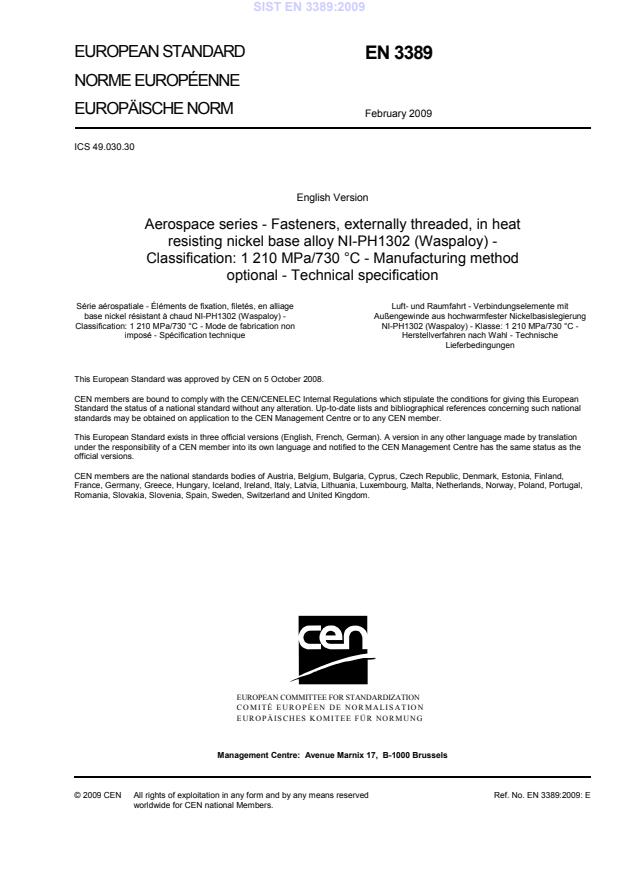
EUROPEAN STANDARD NORME EUROPÉENNE EUROPÄISCHE NORM
EN 3389
February 2009 ICS 49.030.30 English Version
Aerospace series - Fasteners, externally threaded, in heat resisting nickel base alloy NI-PH1302 (Waspaloy) - Classification: 1 210 MPa/730 °C - Manufacturing method optional - Technical specification
Série aérospatiale - Éléments de fixation, filetés, en alliage base nickel résistant à chaud NI-PH1302 (Waspaloy) - Classification: 1 210 MPa/730 °C - Mode de fabrication non imposé - Spécification technique
Luft- und Raumfahrt - Verbindungselemente mit Außengewinde aus hochwarmfester Nickelbasislegierung NI-PH1302 (Waspaloy) - Klasse: 1 210 MPa/730 °C - Herstellverfahren nach Wahl - Technische Lieferbedingungen This European Standard was approved by CEN on 5 October 2008.
CEN members are bound to comply with the CEN/CENELEC Internal Regulations which stipulate the conditions for giving this European Standard the status of a national standard without any alteration. Up-to-date lists and bibliographical references concerning such national standards may be obtained on application to the CEN Management Centre or to any CEN member.
This European Standard exists in three official versions (English, French, German). A version in any other language made by translation under the responsibility of a CEN member into its own language and notified to the CEN Management Centre has the same status as the official versions.
CEN members are the national standards bodies of Austria, Belgium, Bulgaria, Cyprus, Czech Republic, Denmark, Estonia, Finland, France, Germany, Greece, Hungary, Iceland, Ireland, Italy, Latvia, Lithuania, Luxembourg, Malta, Netherlands, Norway, Poland, Portugal, Romania, Slovakia, Slovenia, Spain, Sweden, Switzerland and United Kingdom.
EUROPEAN COMMITTEE FOR STANDARDIZATION
COMITÉ EUROPÉEN DE NORMALISATION EUROPÄISCHES KOMITEE FÜR NORMUNG
Management Centre:
Avenue Marnix 17,
B-1000 Brussels © 2009 CEN All rights of exploitation in any form and by any means reserved worldwide for CEN national Members. Ref. No. EN 3389:2009: ESIST EN 3389:2009
1 Published as ASD Prestandard at the date of publication of this standard. SIST EN 3389:2009
crack rupture in the material which may extend in any direction and which may be intercrystalline or transcrystallyne in character 3.3.2
seam longitudinal surface defect in the form of an unwelded open fold in the material 3.3.3
lap surface defect caused by folding over metal fins or sharp corners and then rolling or forging them into the surface 3.3.4
inclusion non-metallic particles originating from the material making process; they may exist as discrete particles or strings of particles extending longitudinally 3.4 test temperature ambient temperature, unless otherwise specified 3.5 simple random sampling the taking of n items from a population of N items in such a way that all possible combinations of n items have the same probability of being chosen [ISO 3534, see definition] 3.6 critical defect defect that according to judgment and experience, is likely to result in hazardous or unsafe conditions for individuals using, maintaining, or depending upon the considered product or that is likely to prevent performance of the function of a major end item [ISO 3534, see definition] 3.7 major defect defect other than critical, that is likely to result in a failure or to reduce materially the usability of the considered product for its intended purpose [ISO 3534, see definition] SIST EN 3389:2009
LQ10 in a sampling plan, a quality limit which corresponds to a specified and relatively low probability of acceptance in this case 10 % probability of acceptance; it is the limiting lot quality characteristic that a lot of this quality would occur When expressed as a per cent defective, it may be referred to as a lot tolerance per cent defective [ISO 3534, see definition] 3.11 acceptable quality limit
AQL quality limit which in a sampling plan corresponds to a specified but relatively high probability of acceptance; it is the maximum per cent defective (or the maximum number of defects per hundred units) that, for purposes of sampling inspection, can be considered satisfactory as a process average [ISO 3534, see definition] 3.12 finished part part ready for use, inclusive of any possible treatments and/or surface coatings, as specified in the dimensional standard or drawing 4 Certification and quality assurance 4.1.1 Qualification 4.1.2 Purpose The purpose of acceptance tests is to check, as simply as possible, by a method representative of actual use conditions, with the uncertainty inherent to statistical sampling, that the bolts constituting the batch satisfy the requirements of this standard 4.1.3 Conditions The acceptance tests are summarized in Table 3. They shall be performed on each batch. Table 1 specifies the test method and sampling plan to be used for each test. Bolts from the batch to be tested shall be selected by simple random sampling. Each boIt may be submitted to several tests. The bolts to be subjected to destructive tests may be those on which non-destructive tests have been performed. 4.2 Quality system certification SIST EN 3389:2009
Clause Characteristic Requirement Inspection and test method Q/A a Sample size 5.1
Material Material NI-P1302 (Waspaloy) to specification EN 2959, EN 2960 or EN 3220 supplied by an approved source: shall be used for the manufacture of bolts to this standard. As stated in the material specification.
5.2
Dimensions, tolerances and tolerances of form and position; threads and quality
A Tables 4 and 5 5.2.1
Dimensions The dimensions of the finished parts shall conform to the product standard or drawing. All dimensions shall be controlled by an approved system of gauging.
5.2.2
Tolerances of form and position Tolerances of form and position shall conform to the product standard or drawing. Tolerances of form and position shall be controlled by an approved system of gauging.
5.2.3
Threads Threads shall conform to the product standard or drawing. Threads shall be gauged by an approved system of gauging.
5.3
Manufacturing Parts may be manufactured by machining from material EN 2960 or by forging from material EN 2959 or EN 3220.
NOTE It is possible to finish grind the diameter and under head, and cold roll the fillet radius of close tolerance parts after precipitation treatment.
See also 5.3.3.3.
5.3.1
Machined from bar parts Machined from bar parts shall be finish machined, thread rolled prior to precipitation treatment (see 5.3).
Forged parts Forged parts may be formed by hot or cold forging. If hot forged the forging temperature shall not exceed 1 150 °C and shall be air cooled. The heating equipment for forging shall be of a type that ensures a consistent temperature throughout the batch.
5.3.3
Heat treatment The heat treatment medium or atmos
...