


EN 196-1:1994
(Main)Methods of testing cement - Part 1: Determination of strength
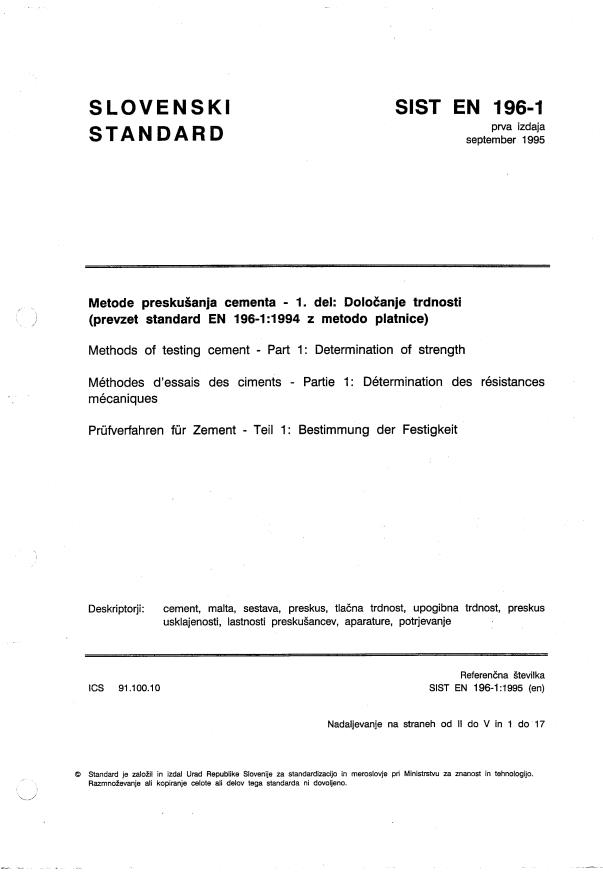
Methods of testing cement - Part 1: Determination of strength
This European standard describes a method of determining the compressive and flexural strengths of cement mortar. This standard describes the reference procedure; it allows the use of alternative procedures only in well defined cases provided that they do not affect the results significantly as specified in clause 11. In the event of a dispute, only the reference procedure described in this standard shall be used, excluding any alternatives. The method applies to the cement types defined in ENV 197-1. It may not be applicable to other cement types, for instance on account of their initial setting time.
Prüfverfahren für Zement - Teil 1: Bestimmung der Festigkeit
Diese Europäische Norm beschreibt ein Verfahren zur Bestimmung der Biegezug- u und Druckfestigkeit von Zementmörtel. Diese Norm beschreibt das Referenzverfahren; andere Verfahren dürfen nur in genau festgelegten Fällen angewendet werden, wenn sie - wie in Abschnitt 11 beschrieben - die Ergebnisse nicht signifikant beeinflussen. Im Streitfall ist das in dieser Norm beschriebene Referenzverfahren und kein anderes, davon abweichendes Verfahren massgebend. Das Verfahren ist für die in ENV 197-1 definierte Zementareten anwendbar. Es ist möglicherweise für andere Zementarten nicht anwendbar.
Méthodes d'essais des ciments - Partie 1: Détermination des résistances mécaniques
La présente norme européenne décrit une méthode de détermination des résistances à la compression et à la flexion d'un mortier de ciment. Cette norme décrit le mode opératoire de référence; l'utilisation de variantes n'est autorisée que dans des cas bien définis à condition qu'elles ne modifient pas de façon significative les résultats obtenus conformément aux prescriptions du chapitre 11. En cas de litige, seul le mode opératoire de référence décrit dans la présente norme, à l'exclusion de toute variante, doit être utilisé. La méthode est applicalbe aux catégories de ciment définies dans la norme ENV 197-1.
Metode preskušanja cementa - 1. del: Določanje trdnosti
General Information
- Status
- Withdrawn
- Publication Date
- 15-Dec-1994
- Withdrawal Date
- 14-Feb-2005
- Technical Committee
- CEN/TC 51 - Cement and building limes
- Drafting Committee
- CEN/TC 51 - Cement and building limes
- Current Stage
- 9960 - Withdrawal effective - Withdrawal
- Start Date
- 15-Feb-2005
- Completion Date
- 15-Feb-2005
- Directive
- 89/106/EEC - Construction products
Relations
- Effective Date
- 22-Dec-2008
- Effective Date
- 09-Feb-2026
- Referred By
EN IEC 62246-1-1:2018 - Reed switches - Part 1-1: Generic specification - Blank detail specification - Effective Date
- 09-Feb-2026
- Referred By
EN 61479:2001 - Live working - Flexible conductor covers (line hoses) of insulating material - Effective Date
- 09-Feb-2026
- Effective Date
- 09-Feb-2026
- Effective Date
- 09-Feb-2026
- Referred By
EN IEC 61897:2020 - Overhead lines - Requirements and tests for Aeolian vibration dampers - Effective Date
- 09-Feb-2026
- Effective Date
- 09-Feb-2026
- Referred By
EN 61230:1995 - Live working - Portable equipment for earthing or earthing and short-circuiting - Effective Date
- 09-Feb-2026
- Effective Date
- 09-Feb-2026
- Effective Date
- 09-Feb-2026
- Referred By
EN 60079-5:2015 - Explosive atmospheres - Part 5: Equipment protection by powder filling "q" - Effective Date
- 09-Feb-2026
- Effective Date
- 09-Feb-2026
- Effective Date
- 09-Feb-2026
- Effective Date
- 09-Feb-2026
EN 196-1:1995
Get Certified
Connect with accredited certification bodies for this standard

ICC Evaluation Service
Building products evaluation and certification.

QAI Laboratories
Building and construction product testing and certification.

Aboma Certification B.V.
Specialized in construction, metal, and transport sectors.
Sponsored listings
Frequently Asked Questions
EN 196-1:1994 is a standard + national annex and/or foreword published by the European Committee for Standardization (CEN). Its full title is "Methods of testing cement - Part 1: Determination of strength". This standard covers: This European standard describes a method of determining the compressive and flexural strengths of cement mortar. This standard describes the reference procedure; it allows the use of alternative procedures only in well defined cases provided that they do not affect the results significantly as specified in clause 11. In the event of a dispute, only the reference procedure described in this standard shall be used, excluding any alternatives. The method applies to the cement types defined in ENV 197-1. It may not be applicable to other cement types, for instance on account of their initial setting time.
This European standard describes a method of determining the compressive and flexural strengths of cement mortar. This standard describes the reference procedure; it allows the use of alternative procedures only in well defined cases provided that they do not affect the results significantly as specified in clause 11. In the event of a dispute, only the reference procedure described in this standard shall be used, excluding any alternatives. The method applies to the cement types defined in ENV 197-1. It may not be applicable to other cement types, for instance on account of their initial setting time.
EN 196-1:1994 is classified under the following ICS (International Classification for Standards) categories: 91.100.10 - Cement. Gypsum. Lime. Mortar. The ICS classification helps identify the subject area and facilitates finding related standards.
EN 196-1:1994 has the following relationships with other standards: It is inter standard links to EN 196-1:2005, EN 62047-4:2010, EN IEC 62246-1-1:2018, EN 61479:2001, EN IEC 60947-4-1:2019, EN 61243-1:1997, EN IEC 61897:2020, EN 62670-3:2017, EN 61230:1995, EN 61193-2:2007, EN IEC 63041-1:2021, EN 60079-5:2015, EN 61478:2001, EN 61235:1995, EN 61219:1993. Understanding these relationships helps ensure you are using the most current and applicable version of the standard.
EN 196-1:1994 is associated with the following European legislation: EU Directives/Regulations: 305/2011, 89/106/EEC; Standardization Mandates: M/114, M/128. When a standard is cited in the Official Journal of the European Union, products manufactured in conformity with it benefit from a presumption of conformity with the essential requirements of the corresponding EU directive or regulation.
EN 196-1:1994 is available in PDF format for immediate download after purchase. The document can be added to your cart and obtained through the secure checkout process. Digital delivery ensures instant access to the complete standard document.
Questions, Comments and Discussion
Ask us and Technical Secretary will try to provide an answer. You can facilitate discussion about the standard in here.
Loading comments...