

EN 197-5:2021
(Main)Cement - Part 5: Portland-composite cement CEM II/C-M and Composite cement CEM VI
- Abstract
This document deals with Portland-composite cement CEM II/C-M, not covered by EN 197-1, and a different type of Composite cement CEM VI, also not covered by EN 197-1, whose intended use is the preparation of concrete, mortar, grout etc.
This document does not cover:
- common cement covered by EN 197-1;
- very low heat special cement covered by EN 14216;
- supersulfated cement covered by EN 15743;
- calcium aluminate cement covered by EN 14647;
- masonry cement covered by EN 413-1.
- Status
- Published
- Publication Date
- 18-May-2021
- Withdrawal Date
- 29-Nov-2021
- Technical Committee
- CEN/TC 51 - Cement and building limes
- Drafting Committee
- CEN/TC 51/WG 6 - Definitions and terminology of cement
- Current Stage
- 9020 - Submission to 2 Year Review Enquiry - Review Enquiry
- Start Date
- 15-Jul-2026
- Completion Date
- 15-Jul-2026


Overview
EN 197-5:2021 (CEN) specifies requirements for two cement types not covered by EN 197-1: Portland‑composite cement CEM II/C‑M and Composite cement CEM VI. Its scope covers cements intended for the preparation of concrete, mortar, grout and similar products while excluding common cements (EN 197-1), very low heat special cements (EN 14216), supersulfated cements (EN 15743), calcium aluminate cements (EN 14647) and masonry cements (EN 413-1). The standard supports sustainability objectives by enabling lower clinker content through defined combinations of supplementary cementitious materials (SCMs) and limestone.
Key topics and technical requirements
- Composition and constituents: Defines permitted mixes of clinker, SCMs (granulated blast‑furnace slag, fly ash, pozzolana, calcined clays, silica fume) and limestone. Typical composition ranges cover lower clinker content (about 35–64% depending on cement type) with SCMs and limestone making up the balance (SCM proportions up to ~59% and limestone up to 20% where applicable).
- Strength classes and early strength: Uses the familiar EN strength classes (32,5 / 42,5 / 52,5) with early strength designations L, N, R and optional low‑heat notation LH.
- Chemical limits: Limits on sulfate (SO3) and chloride contents apply; sulfate can be up to around 4.5% in certain compositions and chloride is normally limited to ≤ 0.10% by mass unless otherwise declared for specific CEM VI formulations.
- Testing & conformity: References EN 196‑2 for chemical analysis and EN 197‑2:2020 for assessment and verification of constancy of performance (factory production control, initial inspection, continuing surveillance, audit testing).
- Designation, marking & labelling: Specifies how to designate product type (e.g., “CEM II/C‑M (S‑V) 42,5 N – LH”), and what information must appear on packaging or delivery documents (standard designation, manufacturer/plant, weight, certification body).
Practical applications
- Use in structural and non-structural concrete, mortars and grouts where reduced clinker content or specific SCM combinations are desired.
- Supports sustainable construction by enabling cement formulations with lower embodied CO2 through higher SCM/limestone content.
- Informs material selection for engineers, specifiers and contractors needing compliance with European cement standards and project durability requirements.
Who uses this standard
- Cement manufacturers and formulators developing CEM II/C‑M and CEM VI products
- Construction materials laboratories and test houses
- Specifiers, structural engineers and architects selecting cements for concrete and mortar
- Certification bodies and regulatory authorities performing conformity assessment
Related standards
- EN 197-1:2011 (common cements)
- EN 197-2:2020 (conformity assessment)
- EN 196-2 (chemical testing) and standards listed in exclusions (EN 14216, EN 15743, EN 14647, EN 413-1)
Keywords: EN 197-5:2021, Portland‑composite cement, CEM II/C‑M, Composite cement CEM VI, cement standard, concrete, mortar, compliance, clinker reduction, supplementary cementitious materials.
Relations
- Effective Date
- 28-Jan-2026
- Effective Date
- 28-Jan-2026
- Effective Date
- 28-Jan-2026
- Effective Date
- 15-Apr-2026
- Effective Date
- 28-Jan-2026
Get Certified
Connect with accredited certification bodies for this standard

DIBt (Deutsches Institut für Bautechnik)
German Institute for Building Technology.
DIN CERTCO
DIN Group product certification.

Aboma Certification B.V.
Specialized in construction, metal, and transport sectors.
Sponsored listings
Frequently Asked Questions
EN 197-5:2021 is a standard published by the European Committee for Standardization (CEN). Its full title is "Cement - Part 5: Portland-composite cement CEM II/C-M and Composite cement CEM VI". This standard covers: This document deals with Portland-composite cement CEM II/C-M, not covered by EN 197-1, and a different type of Composite cement CEM VI, also not covered by EN 197-1, whose intended use is the preparation of concrete, mortar, grout etc. This document does not cover: - common cement covered by EN 197-1; - very low heat special cement covered by EN 14216; - supersulfated cement covered by EN 15743; - calcium aluminate cement covered by EN 14647; - masonry cement covered by EN 413-1.
This document deals with Portland-composite cement CEM II/C-M, not covered by EN 197-1, and a different type of Composite cement CEM VI, also not covered by EN 197-1, whose intended use is the preparation of concrete, mortar, grout etc. This document does not cover: - common cement covered by EN 197-1; - very low heat special cement covered by EN 14216; - supersulfated cement covered by EN 15743; - calcium aluminate cement covered by EN 14647; - masonry cement covered by EN 413-1.
EN 197-5:2021 is classified under the following ICS (International Classification for Standards) categories: 91.100.10 - Cement. Gypsum. Lime. Mortar. The ICS classification helps identify the subject area and facilitates finding related standards.
EN 197-5:2021 has the following relationships with other standards: It is inter standard links to EN 197-2:2020, EN 196-2:2025, EN 197-1:2011, EN 206-1:2026, EN 13877-1:2023. Understanding these relationships helps ensure you are using the most current and applicable version of the standard.
EN 197-5:2021 is available in PDF format for immediate download after purchase. The document can be added to your cart and obtained through the secure checkout process. Digital delivery ensures instant access to the complete standard document.
Standards Content (Sample)
SLOVENSKI STANDARD
01-september-2021
Cement - 5. del: Portlandski mešani cement CEM II/C-M in Mešani cement CEM VI
Cement - Part 5: Portland-composite cement CEM II/C-M and Composite cement CEM
VI
Zement - Teil 5: Portlandkompositzement CEM II/C-M und Kompositzement CEM VI
Ciment - Partie 5 : Ciment Portland composé CEM II/C-M et Ciment composé CEM VI
Ta slovenski standard je istoveten z: EN 197-5:2021
ICS:
91.100.10 Cement. Mavec. Apno. Malta Cement. Gypsum. Lime.
Mortar
2003-01.Slovenski inštitut za standardizacijo. Razmnoževanje celote ali delov tega standarda ni dovoljeno.
EN 197-5
EUROPEAN STANDARD
NORME EUROPÉENNE
May 2021
EUROPÄISCHE NORM
ICS 91.100.10
English Version
Cement - Part 5: Portland-composite cement CEM II/C-M
and Composite cement CEM VI
Ciment - Partie 5 : Ciment Portland composé CEM II/C- Zement - Teil 5: Portlandkompositzement CEM II/C-M
M et Ciment composé CEM VI und Kompositzement CEM VI
This European Standard was approved by CEN on 8 February 2021.
CEN members are bound to comply with the CEN/CENELEC Internal Regulations which stipulate the conditions for giving this
European Standard the status of a national standard without any alteration. Up-to-date lists and bibliographical references
concerning such national standards may be obtained on application to the CEN-CENELEC Management Centre or to any CEN
member.
This European Standard exists in three official versions (English, French, German). A version in any other language made by
translation under the responsibility of a CEN member into its own language and notified to the CEN-CENELEC Management
Centre has the same status as the official versions.
CEN members are the national standards bodies of Austria, Belgium, Bulgaria, Croatia, Cyprus, Czech Republic, Denmark, Estonia,
Finland, France, Germany, Greece, Hungary, Iceland, Ireland, Italy, Latvia, Lithuania, Luxembourg, Malta, Netherlands, Norway,
Poland, Portugal, Republic of North Macedonia, Romania, Serbia, Slovakia, Slovenia, Spain, Sweden, Switzerland, Turkey and
United Kingdom.
EUROPEAN COMMITTEE FOR STANDARDIZATION
COMITÉ EUROPÉEN DE NORMALISATION
EUROPÄISCHES KOMITEE FÜR NORMUNG
CEN-CENELEC Management Centre: Rue de la Science 23, B-1040 Brussels
© 2021 CEN All rights of exploitation in any form and by any means reserved Ref. No. EN 197-5:2021 E
worldwide for CEN national Members.
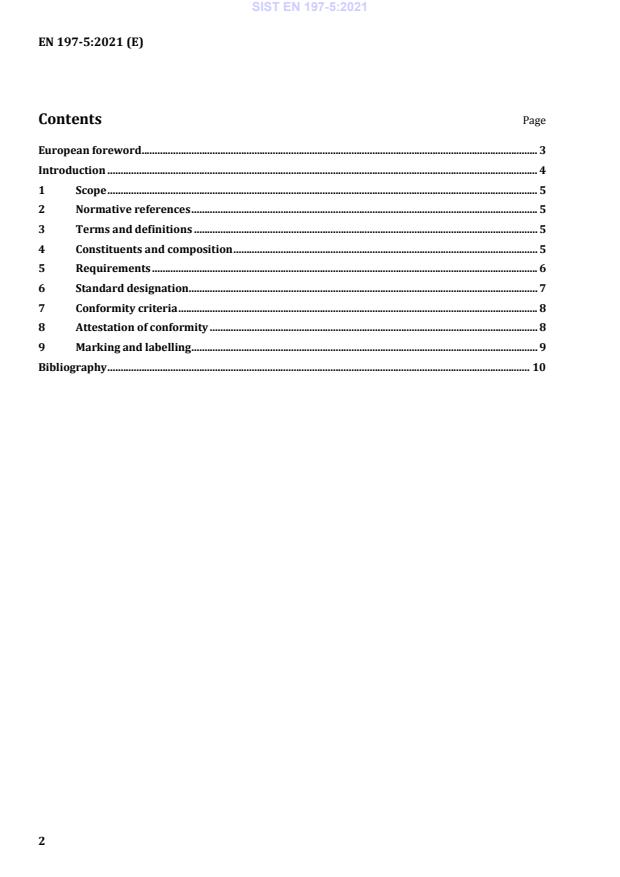
Contents Page
European foreword . 3
Introduction . 4
1 Scope . 5
2 Normative references . 5
3 Terms and definitions . 5
4 Constituents and composition . 5
5 Requirements . 6
6 Standard designation . 7
7 Conformity criteria . 8
8 Attestation of conformity . 8
9 Marking and labelling . 9
Bibliography . 10
European foreword
This document (EN 197-5:2021) has been prepared by Technical Committee CEN/TC 51 “Cement and
building lime”, the secretariat of which is held by NBN.
This European Standard shall be given the status of a national standard, either by publication of an
identical text or by endorsement, at the latest by November 2021, and conflicting national standards
shall be withdrawn at the latest by November 2021.
The purpose of this document is to specify the requirements for the two more recently developed
cement types, Portland-composite cement CEM II/C-M and Composite cement CEM VI, which are not
covered by the European Standard EN 197-1:2011. The fitness of these cement types for the intended
use to produce structural concrete (reinforced or not) has been experimentally assessed by testing
programs developed in the frame of CEN/TC 51/WG 6, the results of which have been included in three
dossiers [5, 6, 7] approved by CEN/TC 51.
The cement types and strength classes defined in this document allow the specifier and/or the user to
fulfil objectives of sustainability for cement-based constructions and to minimize the use of natural
resources in accordance with local conditions of production.
According to the CEN-CENELEC Internal Regulations, the national standards organisations of the
following countries are bound to implement this European Standard: Austria, Belgium, Bulgaria,
Croatia, Cyprus, Czech Republic, Denmark, Estonia, Finland, France, Germany, Greece, Hungary, Iceland,
Ireland, Italy, Latvia, Lithuania, Luxembourg, Malta, Netherlands, Norway, Poland, Portugal, Republic of
North Macedonia, Romania, Serbia, Slovakia, Slovenia, Spain, Sweden, Switzerland, Turkey and the
United Kingdom.
Introduction
It is recognized that different cements have different properties and performance. The performance
tests available at the time of publication of this document (i.e. for the determination of setting time,
strength, soundness and heat of hydration) have been included in this standard. In addition, work is
being carried out by CEN/TC 51 to identify any additional tests which are needed to specify further
performance characteristics of cement. Until further performance tests are available it is necessary that
the choice of cement, especially the type and/or strength class in relation to the requirements for
durability depending on exposure class and type of construction in which it is incorporated, follows the
appropriate standards and/or regulations for concrete, mortar, grout etc. valid in the place of use.
The European Committee for Standardization (CEN) draws attention to the fact that it is claimed that
compliance with this document may involve the use of a patent concerning Portland limestone calcined
clay cement given in Clause 4 as a possible CEM II/C-M cement and which is claimed to be relevant for
the following clauses of this document: Clause 1 and Clause 4.
CEN takes no position concerning the evidence, validity and scope of this patent right.
The holder of this patent right has assured CEN that he/she is willing to negotiate licences under
reasonable and non-discriminatory terms and conditions with applicants throughout the world. In this
respect, the statement of the holder of this patent right is registered with CEN. Information may be
obtained from:
Aalborg Portland A/S, 9220 Aalborg Ost, Denmark.
Attention is drawn to the possibility that some of the elements of this document may be the subject of
patent rights other than those identified above. CEN shall not be held responsible for identifying any or
all such patent rights.
1 Scope
This document deals with Portland-composite cement CEM II/C-M, not covered by EN 197-1, and a
different type of Composite cement CEM VI, also not covered by EN 197-1, whose intended use is the
preparation of concrete, mortar, grout etc.
This document does not cover:
— common cement covered by EN 197-1;
— very low heat special cement covered by EN 14216;
— supersulfated cement covered by EN 15743;
— calcium aluminate cement covered by EN 14647;
— masonry cement covered by EN 413-1.
2 Normative references
The following documents are referred to in the text in such a way that some or all of their content
constitutes requirements of this document. For dated references, only the edition cited applies. For
undated references, the latest edition of the referenced document (including any amendments) applies.
EN 197-1:2011, Cement — Part 1: Composition, specifications and conformity criteria for common
cements
EN 197-2:2020, Cement — Part 2: Assessment and verification of constancy of performance
EN 196-2, Method of testing cement — Part 2: Chemical analysis of cement
3 Terms and definitions
For the purposes of this document, the terms and definitions given in EN 197-1:2011 apply.
ISO and IEC maintain terminological databases for use in standardization at the following addresses:
— IEC Electropedia: available at http://www.electropedia.org/
— ISO Online browsing platform: available at https://www.iso.org/obp
4 Constituents and composition
Constituents of cement covered by this document shall fulfil
...