

prEN 15466-3
(Main)Primers for cold and hot applied joint sealants - Part 3: Test method for the determination of drying behaviour and solids content
General Information
- Abstract
This European Standard describes a method for determining the drying behaviour and solids content of primers for cold and hot applied joint sealants.
- Status
- Not Published
- Technical Committee
- CEN/TC 227 - Road materials
- Current Stage
- 3098 - Decision to reject - Consensus building
- Start Date
- 24-Jul-2008
- Completion Date
- 24-Jul-2008

Overview
The European Standard prEN 15466-3:2006, developed by the CEN Technical Committee CEN/TC 227, establishes a reliable test method for determining the drying behaviour and solids content of primers used with cold and hot applied joint sealants. These primers play a critical role in enhancing adhesion and performance in various sealing applications, especially in road construction and construction materials.
This standard provides a systematic procedure to evaluate how primers lose volatile substances during drying as well as measure their solid residue content after drying under controlled laboratory conditions. Understanding these properties is essential to ensure primer quality, consistency, and compliance with performance requirements for sealing joints.
Key Topics
Drying Behaviour: Measures the rate and extent of volatile substances evaporation from the primer under a standard atmosphere (23 ± 2 °C temperature and 50 ± 5% relative humidity). This is expressed as a percentage mass loss after 60 and 90 minutes.
Solids Content: Defines the non-volatile residue remaining after drying the primer at 110 °C for 24 hours. This parameter is crucial for understanding the primer composition and performance.
Test Apparatus and Procedure:
- Use of analytical balance (precision ≤ 1 mg)
- Single-use syringes and standardized Petri dishes for sample containment
- Conditioning of samples and equipment under defined atmospheres in line with EN ISO 291
- Laboratory oven capable of stable temperature maintenance (>120 °C)
- Stepwise testing including weighing before and after specific drying times, drying in an oven, and conditioning in a desiccator.
Calculations and Reporting:
- Specific formulas for calculating drying behaviour after 60 and 90 minutes and solids content based on mass measurements.
- Results are expressed as averages of three replicates for accuracy.
- Comprehensive test report requirements including product details, batch information, date of testing, results, and analyst identification.
Applications
The prEN 15466-3 standard is primarily applicable to:
Road Construction Materials: Ensuring primers for joint sealants meet required drying and solids content criteria to perform in road pavement joints.
Construction Sealants: Assess primers used in both cold and hot applied sealing compounds on building joints where durability and adhesion are vital.
Quality Control Laboratories: Provides standardized procedures for manufacturers and testing labs to verify primer quality in production batches.
Product Development: Assists R&D teams in evaluating new primer formulations by quantifying drying properties and solids content, enabling optimization before market release.
By adopting this standard, stakeholders can better predict primer performance during installation and service life, reducing failure risks and increasing sealant longevity.
Related Standards
prEN 15466-3:2006 is part of a series of standards focused on primers for joint sealants and should be used in conjunction with:
- prEN 15466-1: Test method for determination of homogeneity of primers for cold and hot applied joint sealants.
- prEN 15466-2: Test method for determination of primer resistance against alkali exposure.
- prEN 14188-4: Specifications for primers for cold and hot applied sealants, providing normative references for primer properties.
- EN ISO 291: Defines standard atmospheres for conditioning and testing, fundamental for the controlled environment in which primer testing is conducted.
These interconnected standards form a comprehensive framework ensuring that primers for joint sealants meet stringent quality and performance criteria within European and international markets.
Keywords: prEN 15466-3, primers for joint sealants, drying behaviour test, solids content determination, cold applied sealants, hot applied sealants, CEN standard, road construction materials, primer quality control, laboratory testing procedure.
Frequently Asked Questions
prEN 15466-3 is a draft published by the European Committee for Standardization (CEN). Its full title is "Primers for cold and hot applied joint sealants - Part 3: Test method for the determination of drying behaviour and solids content". This standard covers: This European Standard describes a method for determining the drying behaviour and solids content of primers for cold and hot applied joint sealants.
This European Standard describes a method for determining the drying behaviour and solids content of primers for cold and hot applied joint sealants.
prEN 15466-3 is available in PDF format for immediate download after purchase. The document can be added to your cart and obtained through the secure checkout process. Digital delivery ensures instant access to the complete standard document.
Standards Content (Sample)
SLOVENSKI STANDARD
01-april-2006
Primers for cold and hot applied joint sealants - Part 3: Test method for the
determination of drying behaviour and solids content
Primers for cold and hot applied joint sealants - Part 3: Test method for the determination
of drying behaviour and solids content
Voranstriche für kalt und heiß verarbeitbare Fugenmassen - Teil 3: Prüfverfahren zur
Bestimmung des Trocknungsverhaltens und des Feststoffanteils
Primaires pour produits de scellement de joints appliqués a froid et a chaud - Partie 3 :
Méthode d'essai pour la détermination du comportement au séchage et de la teneur en
matieres solides
Ta slovenski standard je istoveten z: prEN 15466-3
ICS:
91.100.50 Veziva. Tesnilni materiali Binders. Sealing materials
93.080.20 Materiali za gradnjo cest Road construction materials
2003-01.Slovenski inštitut za standardizacijo. Razmnoževanje celote ali delov tega standarda ni dovoljeno.
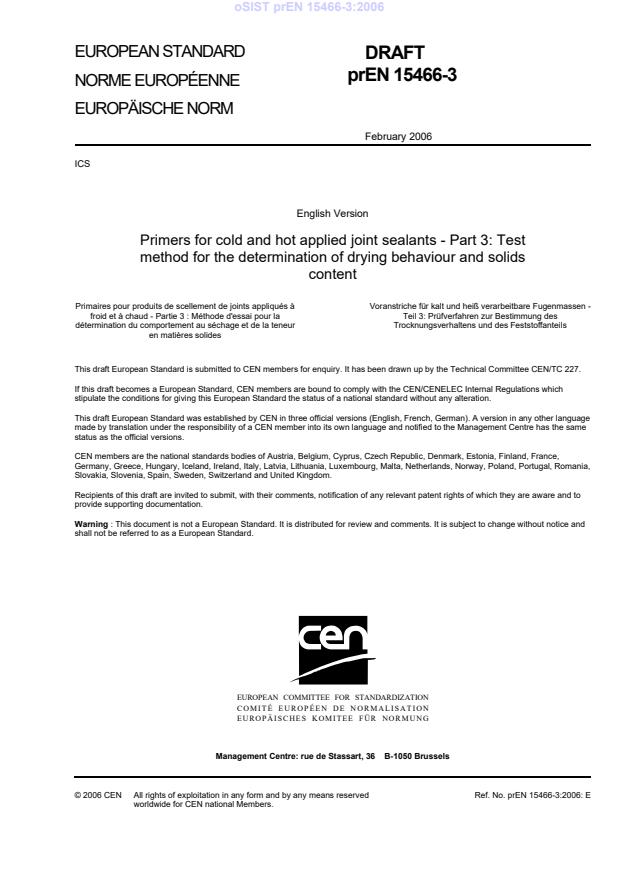
EUROPEAN STANDARD
DRAFT
NORME EUROPÉENNE
EUROPÄISCHE NORM
February 2006
ICS
English Version
Primers for cold and hot applied joint sealants - Part 3: Test
method for the determination of drying behaviour and solids
content
Primaires pour produits de scellement de joints appliqués à Voranstriche für kalt und heiß verarbeitbare Fugenmassen -
froid et à chaud - Partie 3 : Méthode d'essai pour la Teil 3: Prüfverfahren zur Bestimmung des
détermination du comportement au séchage et de la teneur Trocknungsverhaltens und des Feststoffanteils
en matières solides
This draft European Standard is submitted to CEN members for enquiry. It has been drawn up by the Technical Committee CEN/TC 227.
If this draft becomes a European Standard, CEN members are bound to comply with the CEN/CENELEC Internal Regulations which
stipulate the conditions for giving this European Standard the status of a national standard without any alteration.
This draft European Standard was established by CEN in three official versions (English, French, German). A version in any other language
made by translation under the responsibility of a CEN member into its own language and notified to the Management Centre has the same
status as the official versions.
CEN members are the national standards bodies of Austria, Belgium, Cyprus, Czech Republic, Denmark, Estonia, Finland, France,
Germany, Greece, Hungary, Iceland, Ireland, Italy, Latvia, Lithuania, Luxembourg, Malta, Netherlands, Norway, Poland, Portugal, Romania,
Slovakia, Slovenia, Spain, Sweden, Switzerland and United Kingdom.
Recipients of this draft are invited to submit, with their comments, notification of any relevant patent rights of which they are aware and to
provide supporting documentation.
Warning : This document is not a European Standard. It is distributed for review and comments. It is subject to change without notice and
shall not be referred to as a European Standard.
EUROPEAN COMMITTEE FOR STANDARDIZATION
COMITÉ EUROPÉEN DE NORMALISATION
EUROPÄISCHES KOMITEE FÜR NORMUNG
Management Centre: rue de Stassart, 36 B-1050 Brussels
© 2006 CEN All rights of exploitation in any form and by any means reserved Ref. No. prEN 15466-3:2006: E
worldwide for CEN national Members.
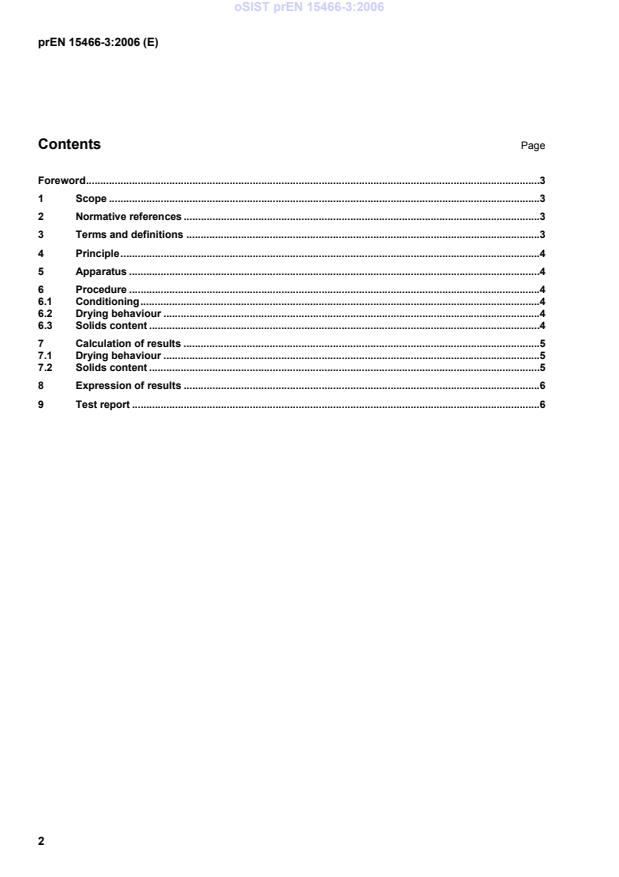
Contents Page
Foreword.3
1 Scope.3
2 Normative references.3
3 Terms and definitions .3
4 Principle.4
5 Apparatus.4
6 Procedure.4
6.1 Conditioning.4
6.2 Drying behaviour.4
6.3 Solids content.4
7 Calculation of results.5
7.1 Drying behaviour.5
7.2 Solids content.5
8 Expression of results.6
9 Test report.
...