

EN 3745-412:2022
(Main)Aerospace series - Fibres and cables, optical, aircraft use - Test methods - Part 412: Humidity resistance
- Abstract
This document evaluates the resistance of the fiber optic cable to humidity changes at different
temperatures.
- Status
- Published
- Publication Date
- 03-May-2022
- Withdrawal Date
- 29-Nov-2022
- Technical Committee
- ASD-STAN - Aerospace
- Drafting Committee
- ASD-STAN/D 2/S 10 - Optical
- Current Stage
- 6060 - Definitive text made available (DAV) - Publishing
- Start Date
- 04-May-2022
- Completion Date
- 04-May-2022



EN 3745-412:2022 Overview
EN 3745-412:2022 is a European standard established by CEN that specifies test methods to evaluate the humidity resistance of optical fibres and cables designed for aerospace and aircraft applications. This standard is part of the Aerospace series focused on fibres and cables for aircraft use, ensuring optical components maintain performance under varying humidity and temperature conditions representative of in-service aerospace environments.
The standard supersedes the previous version EN 3745-412:2006 and aligns with other aerospace fibre optic standards for electrical and optical connection testing, attenuation, and visual examination. It was approved in May 2022 and mandates harmonized test procedures to ensure reliability and durability of optical cables exposed to humid conditions in aviation.
Key Topics in EN 3745-412:2022
- Purpose: Assess resistance to humidity-induced degradation for aerospace optical fibres and cables under controlled cycling of temperature and humidity.
- Specimen Preparation: Requires standardized specimen length (10 ± 1 m), coil radius, and stabilization at standard test conditions before testing.
- Test Apparatus:
- Controlled temperature and humidity test chamber.
- Light Launch System (LLS) and Light Detector System (LDS) for continuous attenuation monitoring.
- Test Method:
- Multi-phase humidity cycling involving:
- Rapid temperature increase to 65 ± 3°C with 95% relative humidity,
- Holding phase maintaining these conditions for 6 hours,
- Gradual temperature decrease to 38 ± 4°C while humidity stays above 85%.
- Cycles repeated (default 56 cycles if unspecified).
- Multi-phase humidity cycling involving:
- Evaluation Criteria:
- Continuous attenuation measurement during test.
- Post-test recovery and final attenuation measurement per EN 3745-301.
- Visual inspection for physical damage per EN 3745-201.
- Attenuation variation must not exceed limits specified in product standards.
Applications of EN 3745-412:2022
This standard is critical for manufacturers and quality control specialists involved with:
- Aerospace Optical Cable Manufacturing: Ensuring fibre optic cables used in aircraft remain reliable and functional in humid and varying temperature environments.
- Aircraft Systems Maintenance: Verifying the ongoing performance and durability of optical networking and communication cables exposed to cabin and environmental humidity fluctuations.
- Aerospace Component Qualification: Supporting certification processes for aircraft subsystems incorporating optical fibres meeting rigorous environmental resistance standards.
- Design Verification: Enabling designers to select and validate moisture-resistant optical fibres to improve longevity and system integrity.
- Environmental Testing Laboratories: Providing a repeatable, industry-recognized method for humidity resistance testing aligned with aerospace industry requirements.
Related Standards
EN 3745-412:2022 is part of a comprehensive series of aerospace optical fibre and cable standards, which include:
- EN 3745-100: General test methods for aerospace fibres and cables.
- EN 3745-201: Visual examination methods for optical fibres and cables.
- EN 3745-301: Attenuation measurement and monitoring test methods.
- EN 2591-100: Test methods for elements of electrical and optical connections in aerospace applications.
- EN 4533: Aerospace Fibre Optic Systems Handbook, providing additional guidance and best practices.
These interconnected standards provide a full framework for the assessment, qualification, and continued reliability of fibre optic systems used in aviation and space applications.
Keywords: EN 3745-412:2022, aerospace optical fibres, humidity resistance testing, optical cable humidity test, fibre optic aircraft cables, aerospace cable standards, optical cable attenuation, temperature humidity cycling, aerospace fibre optic test methods, CEN aerospace standards.
Relations
- Effective Date
- 08-Jun-2022
- Effective Date
- 28-Jan-2026
- Effective Date
- 28-Jan-2026
- Effective Date
- 28-Jan-2026
- Effective Date
- 28-Jan-2026
- Effective Date
- 28-Jan-2026
- Effective Date
- 28-Jan-2026
- Effective Date
- 28-Jan-2026
- Effective Date
- 28-Jan-2026
- Effective Date
- 28-Jan-2026
- Effective Date
- 28-Jan-2026
- Effective Date
- 28-Jan-2026
- Effective Date
- 28-Jan-2026
- Effective Date
- 28-Jan-2026
- Effective Date
- 28-Jan-2026
Get Certified
Connect with accredited certification bodies for this standard

BUREAU VERITAS Certification Germany
Bureau Veritas certification in Germany.

Element Materials Technology
Materials testing and product certification.

AQMS Ltd.
AQMS provides ISO certification to SMEs across the UK.
Sponsored listings
Frequently Asked Questions
EN 3745-412:2022 is a standard published by the European Committee for Standardization (CEN). Its full title is "Aerospace series - Fibres and cables, optical, aircraft use - Test methods - Part 412: Humidity resistance". This standard covers: This document evaluates the resistance of the fiber optic cable to humidity changes at different temperatures.
This document evaluates the resistance of the fiber optic cable to humidity changes at different temperatures.
EN 3745-412:2022 is classified under the following ICS (International Classification for Standards) categories: 49.060 - Aerospace electric equipment and systems; 49.090 - On-board equipment and instruments. The ICS classification helps identify the subject area and facilitates finding related standards.
EN 3745-412:2022 has the following relationships with other standards: It is inter standard links to EN 3745-412:2005, EN 2591-100:2024, EN 3745-301:2012, EN 3745-100:2008, EN 3745-201:2002, EN 4641-100:2015, EN 4641-301:2011, EN 4641-102:2025, EN 4641-202:2018, EN 4641-301:2022, EN 4641-200:2018, EN 4641-101:2015, EN 4641-102:2009, EN 4641-201:2018, EN 4641-301:2024. Understanding these relationships helps ensure you are using the most current and applicable version of the standard.
EN 3745-412:2022 is available in PDF format for immediate download after purchase. The document can be added to your cart and obtained through the secure checkout process. Digital delivery ensures instant access to the complete standard document.
Standards Content (Sample)
SLOVENSKI STANDARD
01-julij-2022
Nadomešča:
SIST EN 3745-412:2006
Aeronavtika - Optična vlakna in kabli za uporabo v zračnih plovilih - Preskusne
metode - 412. del: Odpornost proti vlagi
Aerospace series - Fibres and cables, optical, aircraft use - Test methods - Part 412:
Humidity resistance
Luft- und Raumfahrt - Faseroptische Leitungen für Luftfahrzeuge - Prüfverfahren - Teil
412: Beständigkeit gegen Feuchtigkeit
Série aérospatiale - Fibres et câbles optiques à usage aéronautique - Méthodes d'essais
- Partie 412 : Résistance à l'humidité
Ta slovenski standard je istoveten z: EN 3745-412:2022
ICS:
33.180.10 (Optična) vlakna in kabli Fibres and cables
49.060 Letalska in vesoljska Aerospace electric
električna oprema in sistemi equipment and systems
2003-01.Slovenski inštitut za standardizacijo. Razmnoževanje celote ali delov tega standarda ni dovoljeno.
EN 3745-412
EUROPEAN STANDARD
NORME EUROPÉENNE
May 2022
EUROPÄISCHE NORM
ICS 49.090 Supersedes EN 3745-412:2005
English Version
Aerospace series - Fibres and cables, optical, aircraft use -
Test methods - Part 412: Humidity resistance
Série aérospatiale - Fibres et câbles optiques à usage Luft- und Raumfahrt - Faseroptische Leitungen für
aéronautique - Méthodes d'essais - Partie 412 : Luftfahrzeuge - Prüfverfahren - Teil 412: Beständigkeit
Résistance à l'humidité gegen Feuchtigkeit
This European Standard was approved by CEN on 10 January 2022.
CEN members are bound to comply with the CEN/CENELEC Internal Regulations which stipulate the conditions for giving this
European Standard the status of a national standard without any alteration. Up-to-date lists and bibliographical references
concerning such national standards may be obtained on application to the CEN-CENELEC Management Centre or to any CEN
member.
This European Standard exists in three official versions (English, French, German). A version in any other language made by
translation under the responsibility of a CEN member into its own language and notified to the CEN-CENELEC Management
Centre has the same status as the official versions.
CEN members are the national standards bodies of Austria, Belgium, Bulgaria, Croatia, Cyprus, Czech Republic, Denmark, Estonia,
Finland, France, Germany, Greece, Hungary, Iceland, Ireland, Italy, Latvia, Lithuania, Luxembourg, Malta, Netherlands, Norway,
Poland, Portugal, Republic of North Macedonia, Romania, Serbia, Slovakia, Slovenia, Spain, Sweden, Switzerland, Turkey and
United Kingdom.
EUROPEAN COMMITTEE FOR STANDARDIZATION
COMITÉ EUROPÉEN DE NORMALISATION
EUROPÄISCHES KOMITEE FÜR NORMUNG
CEN-CENELEC Management Centre: Rue de la Science 23, B-1040 Brussels
© 2022 CEN All rights of exploitation in any form and by any means reserved Ref. No. EN 3745-412:2022 E
worldwide for CEN national Members.
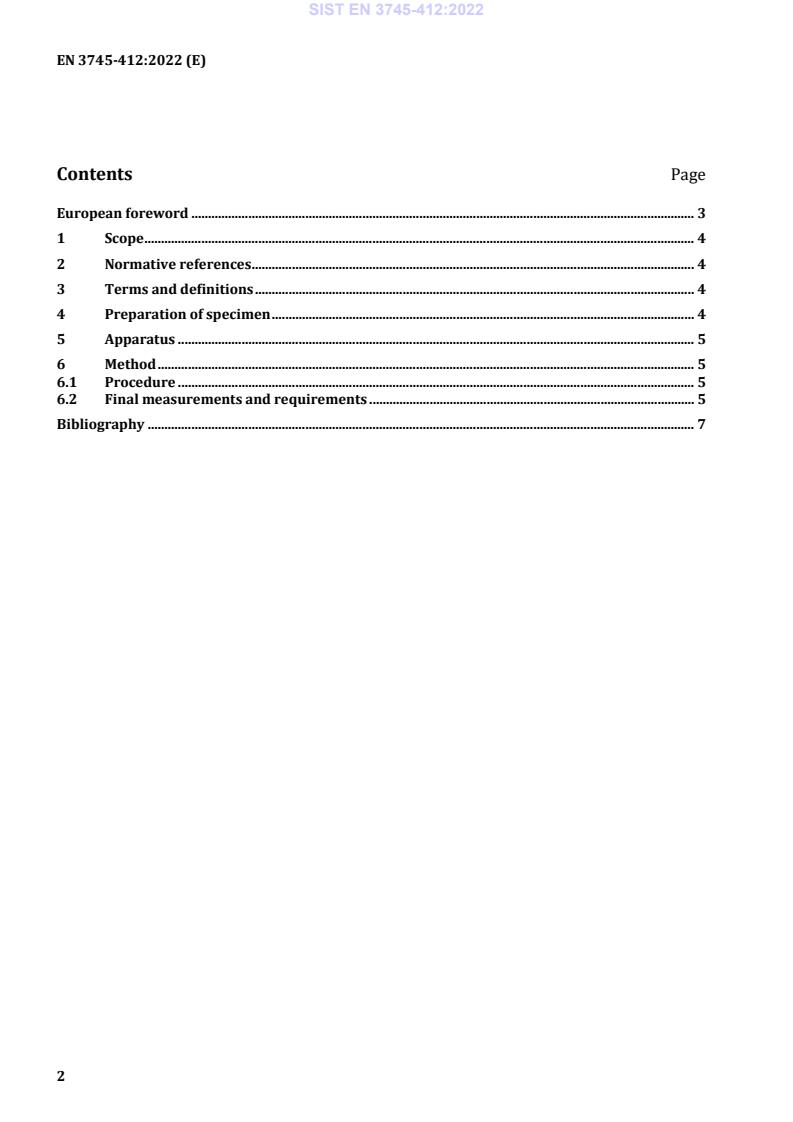
Contents Page
European foreword . 3
1 Scope . 4
2 Normative references . 4
3 Terms and definitions . 4
4 Preparation of specimen . 4
5 Apparatus . 5
6 Method . 5
6.1 Procedure . 5
6.2 Final measurements and requirements . 5
Bibliography . 7
European foreword
This document (EN 3745-412:2022) has been prepared by the Aerospace and Defence Industries
Association of Europe — Standardization (ASD-STAN).
After enquiries and votes carried out in accordance with the rules of this Association, this
document has received the approval of the National Associations and the Official Services of the
member countries of ASD, prior to its pres
...