


EN 1384:2012
(Main)Helmets for equestrian activities
Helmets for equestrian activities
This European Standard specifies requirement for protective helmets that can have a peak, for people involved in equestrian activities.
It gives safety requirements that include methods of test and levels of performance for shock absorption, for resistance to penetration and for the strength and effectiveness of the retention system and the deflection of a peak if fitted.
Schutzhelme für reiterliche Aktivitäten
Diese Europäische Norm legt Anforderungen an Schutzhelme für Reiter, die einen Schirm haben können, bei Reitsportaktivitäten fest. Sie enthält sicherheitstechnische Anforderungen einschließlich der Prüfverfahren sowie Anforderungen an die Funktionstauglichkeit hinsichtlich der stoßdämpfenden Eigenschaften, der Durchdringungsfestigkeit, Festigkeit und Wirksamkeit der Trageeinrichtung und der Durchbiegung des Schirmes, wenn vorhanden.
Casques de protection pour sports hippiques
La présente Norme européenne énonce les exigences relatives aux casques de protection, comportant ou
non une visière, destinés aux personnes pratiquant des activités hippiques.
Elle indique des exigences de sécurité qui comprennent des méthodes d'essai et les niveaux de performance
en matière d’absorption des chocs, de résistance à la pénétration, ainsi que de résistance et d’efficacité du
système de rétention ; elle traite également du fléchissement de la visière, si le casque en comporte une.
Čelade za konjeniške aktivnosti
Ta evropski standard določa zahtevo za zaščitne čelade, ki imajo lahko podaljšan sprednji del, namenjene ljudem, vključenim v konjeniške aktivnosti. Vključuje varnostne zahteve, ki zajemajo preskusne metode in ravni učinkovitosti absorpcije udarcev, odpornosti proti prediranju ter moči in učinkovitosti zadrževalnega sistema ter upogiba sprednjega dela, če je podaljšan.
General Information
- Status
- Withdrawn
- Publication Date
- 21-Feb-2012
- Withdrawal Date
- 08-Feb-2026
- Technical Committee
- CEN/TC 158 - Head protection
- Drafting Committee
- CEN/TC 158/WG 5 - Helmets for horse riders
- Current Stage
- 9960 - Withdrawal effective - Withdrawal
- Start Date
- 14-Jun-2017
- Completion Date
- 11-Feb-2026
Relations
- Effective Date
- 29-Feb-2012
- Effective Date
- 29-Feb-2012
- Effective Date
- 25-Jul-2012
- Effective Date
- 28-Jan-2026



Get Certified
Connect with accredited certification bodies for this standard

NSF International
Global independent organization facilitating standards development and certification.

CIS Institut d.o.o.
Personal Protective Equipment (PPE) certification body. Notified Body NB-2890 for EU Regulation 2016/425 PPE.

Kiwa BDA Testing
Building and construction product certification.
Sponsored listings
Frequently Asked Questions
EN 1384:2012 is a standard published by the European Committee for Standardization (CEN). Its full title is "Helmets for equestrian activities". This standard covers: This European Standard specifies requirement for protective helmets that can have a peak, for people involved in equestrian activities. It gives safety requirements that include methods of test and levels of performance for shock absorption, for resistance to penetration and for the strength and effectiveness of the retention system and the deflection of a peak if fitted.
This European Standard specifies requirement for protective helmets that can have a peak, for people involved in equestrian activities. It gives safety requirements that include methods of test and levels of performance for shock absorption, for resistance to penetration and for the strength and effectiveness of the retention system and the deflection of a peak if fitted.
EN 1384:2012 is classified under the following ICS (International Classification for Standards) categories: 13.340.10 - Protective clothing; 13.340.20 - Head protective equipment; 97.220.40 - Outdoor and water sports equipment. The ICS classification helps identify the subject area and facilitates finding related standards.
EN 1384:2012 has the following relationships with other standards: It is inter standard links to EN 1384:1996/A1:2001, EN 1384:1996, EN 1384:2017, EN ISO 23611-4:2011. Understanding these relationships helps ensure you are using the most current and applicable version of the standard.
EN 1384:2012 is associated with the following European legislation: EU Directives/Regulations: 89/686/EEC; Standardization Mandates: M/031. When a standard is cited in the Official Journal of the European Union, products manufactured in conformity with it benefit from a presumption of conformity with the essential requirements of the corresponding EU directive or regulation.
EN 1384:2012 is available in PDF format for immediate download after purchase. The document can be added to your cart and obtained through the secure checkout process. Digital delivery ensures instant access to the complete standard document.
Standards Content (Sample)
2003-01.Slovenski inštitut za standardizacijo. Razmnoževanje celote ali delov tega standarda ni dovoljeno.Schutzhelme für reiterliche AktivitätenCasques de protection pour sports hippiquesHelmets for equestrian activities97.220.40Oprema za športe na prostem in vodne športeOutdoor and water sports equipment13.340.20Varovalna oprema za glavoHead protective equipmentICS:Ta slovenski standard je istoveten z:EN 1384:2012SIST EN 1384:2012en,fr,de01-junij-2012SIST EN 1384:2012SLOVENSKI
STANDARDSIST EN 1384:1996/A1:2002SIST EN 1384:19961DGRPHãþD
EUROPEAN STANDARD NORME EUROPÉENNE EUROPÄISCHE NORM
EN 1384
February 2012 ICS 13.340.20 Supersedes EN 1384:1996English Version
Helmets for equestrian activities
Casques de protection pour sports hippiques
Schutzhelme für reiterliche Aktivitäten This European Standard was approved by CEN on 17 December 2011.
CEN members are bound to comply with the CEN/CENELEC Internal Regulations which stipulate the conditions for giving this European Standard the status of a national standard without any alteration. Up-to-date lists and bibliographical references concerning such national standards may be obtained on application to the CEN-CENELEC Management Centre or to any CEN member.
This European Standard exists in three official versions (English, French, German). A version in any other language made by translation under the responsibility of a CEN member into its own language and notified to the CEN-CENELEC Management Centre has the same status as the official versions.
CEN members are the national standards bodies of Austria, Belgium, Bulgaria, Croatia, Cyprus, Czech Republic, Denmark, Estonia, Finland, France, Germany, Greece, Hungary, Iceland, Ireland, Italy, Latvia, Lithuania, Luxembourg, Malta, Netherlands, Norway, Poland, Portugal, Romania, Slovakia, Slovenia, Spain, Sweden, Switzerland, Turkey and United Kingdom.
EUROPEAN COMMITTEE FOR STANDARDIZATION
COMITÉ EUROPÉEN DE NORMALISATION EUROPÄISCHES KOMITEE FÜR NORMUNG
Management Centre:
Avenue Marnix 17,
B-1000 Brussels © 2012 CEN All rights of exploitation in any form and by any means reserved worldwide for CEN national Members. Ref. No. EN 1384:2012: ESIST EN 1384:2012
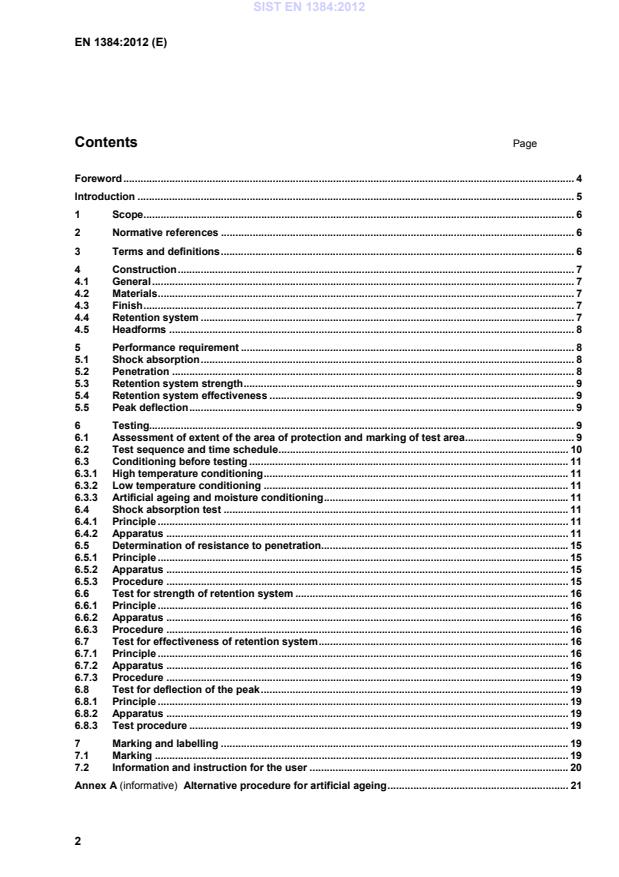
Alternative procedure for artificial ageing . 21SIST EN 1384:2012
Significant technical changes between this European Standard and EN 1384:1996 . 22Annex ZA (informative)
Relationship between this European Standard and the Essential Requirements of EU Directive 89/686/EEC Personal Protective Equipment . 23Bibliography . 24 SIST EN 1384:2012
Different sizes of the same design do not constitute different helmet types. 3.10 peak extension from the basic form of the helmet above the eyes 3.11 area of protection minimum area of the headform covered by the protective padding (liner) 4 Construction 4.1 General The helmet may be constructed either with or without a shell, and with or without means of ventilation. If a shell is used, then protective padding shall be securely fastened to it. The helmet shall not be fitted with nor have a chin cup. The minimum thickness of the protective padding (liner), measured at 12 mm from the edge of the area of protection, shall not be less than the minimum thickness of the protective padding (liner) in the test area as defined in 6.1. 4.2 Materials The characteristics of the materials used in the manufacture of helmets shall be not generally known to undergo substantial reduction in protective ability under the influence of ageing, or during the circumstances of use to which the helmet is normally subjected. For those parts of the helmet coming into contact with the skin, the materials used shall be not generally known to undergo reduction in protective ability arising from the effects of sweat or of toiletries. The manufacturer shall not use materials generally known to cause skin disorders of a non-allergic type. 4.3 Finish All edges shall be smooth and rounded. There shall be no rigid projections on the inside of the helmet. Any external projection shall not exceed 5 mm or shall be smoothly faired to the adjacent surface, except for a button on the top of the helmet and a peak. 4.4 Retention system A retention system shall be permanently fixed to the helmet and shall incorporate a chin strap not less than 15 mm wide. The system shall be permanently fitted with fastening and adjustment devices which may be combined. The retention system shall be freed by deliberate action only. SIST EN 1384:2012
retention effectiveness and retention strength Circumference of headform in mm Size designation (EN 960:1994 equivalent)Extent of protection, retention effectiveness and retention strength (mm) 495 (A) 495 505 (B) 495 515 (C) 515 525 (D) 515 535 (E) 535 545 (F) 535 555 (G) 555 575 (J) 575 585 (K) 585 595 (L) 585 605 (M) 605 615 (N) 605 625 (O) 625 635 (P) 625 645 (Q) 645 5 Performance requirement 5.1 Shock absorption When tested by the method in 6.4, the acceleration shall not exceed 250 g at any time, and the total time during which it exceeds 150 g shall not be greater than 5 ms. The helmet shall remain on the headform and the retention system shall remain fastened. 5.2 Penetration When tested by the method described in 6.5, the point of the striker shall not leave visible indentation on the test block. SIST EN 1384:2012
Key 1 helmet
6 line of sideways horizontal projection of headform point F 2 AA′ plane
7 headform 3 reference plane
8 section on the reference plane 4 basic plane
9 central vertical axis 5 longitudinal vertical plane
NOTE Longitudinal vertical plane – equivalent to EN 960:2006, 2.8 “vertical longitudinal plane”. Figure 1 — Test headform showing test area (area above line RF1F2) and area of protection (both the area above the AA′′′′ plane and the area above the RF1F2 line) 6.2 Test sequence and time schedule For each helmet type at least twelve helmets shall be tested. For each helmet type select three helmets of the largest size (set 1) and three helmets of the smallest size (set 2). Additionally select one hel
...
Questions, Comments and Discussion
Ask us and Technical Secretary will try to provide an answer. You can facilitate discussion about the standard in here.
Loading comments...