


EN 13135-2:2004+A1:2010
(Main + Amendment)Cranes - Equipment - Part 2: Non-electrotechnical equipment
General Information
- Abstract
This document specifies requirements for design and selection of non-electrotechnical equipment for all types of crane with the objectives of protecting personnel from hazards affecting their lives and health and of ensuring reliability of function. The fixed load lifting attachments are integral part of the crane and therefore belong also to the scope of this standard.
Non-electrotechnical equipment comprises:
- Structure and structural equipment;
- driving mechanisms;
- rope and chain drives;
- fixed load lifting attachments;
- safety devices;
- fluid power systems.
The significant hazards covered by this document are identified in clause 4.
Hazards due to noise are not covered by this standard. They are addressed in safety standards specific to each type of crane.
The principles to be applied for cranes transporting hazardous loads are given in this standard. Particular requirements are given for cranes transporting hot molten metal.
This standard does not give the additional requirements for:
- equipment requiring a high level of cleanliness for hygiene reasons, e.g. in direct contact with foodstuffs or pharmaceuticals;
- equipment operating in clean rooms with a dust controlled environment, (e.g. satellite assembling room, electronic industry, food processing, pharmaceuticals processing);
- hazards resulting from handling explosives and radiating material;
- hazards caused by operation subject to special regulations (e.g. explosive atmospheres);
- the risk related to lifting of persons.
This document is applicable to non-electrotechnical equipment which is manufactured after the date of approval by CEN of this standard.
- Status
- Withdrawn
- Publication Date
- 17-Aug-2010
- Withdrawal Date
- 26-Feb-2013
- Technical Committee
- CEN/TC 147 - Cranes - Safety
- Drafting Committee
- CEN/TC 147/WG 3 - Design - Requirements for equipment
- Current Stage
- 9960 - Withdrawal effective - Withdrawal
- Start Date
- 27-Feb-2013
- Completion Date
- 27-Feb-2013
- Directive
- Harmonized Standard2006/42/EC - Directive 2006/42/EC of the European Parliament and of the Council of 17 May 2006 on machinery, and amending Directive 95/16/EC (recast)OJ Ref: C, C 110 OJ Date: 08-Apr-2011
Not Harmonized98/37/EC - Machinery

Relations
- Effective Date
- 19-Jan-2023
- Effective Date
- 18-Jan-2023
- Effective Date
- 29-Aug-2012
- Effective Date
- 25-Aug-2026
- Effective Date
- 25-Aug-2026
- Refers
ISO 12488-1:2005 - Cranes — Tolerances for wheels and travel and traversing tracks — Part 1: General - Effective Date
- 25-Aug-2026
- Effective Date
- 25-Aug-2026
- Effective Date
- 25-Aug-2026
- Effective Date
- 28-Jan-2026
- Refers
EN 13411-4:2021 - Terminations for steel wire ropes - Safety - Part 4: Metal and resin socketing - Effective Date
- 28-Jan-2026
- Effective Date
- 28-Jan-2026
- Effective Date
- 28-Jan-2026
- Effective Date
- 28-Jan-2026
- Effective Date
- 28-Jan-2026
- Refers
EN 13001-1:2004+A1:2009 - Cranes - General design - Part 1: General principles and requirements - Effective Date
- 28-Jan-2026
Frequently Asked Questions
EN 13135-2:2004+A1:2010 is a standard published by the European Committee for Standardization (CEN). Its full title is "Cranes - Equipment - Part 2: Non-electrotechnical equipment". This standard covers: This document specifies requirements for design and selection of non-electrotechnical equipment for all types of crane with the objectives of protecting personnel from hazards affecting their lives and health and of ensuring reliability of function. The fixed load lifting attachments are integral part of the crane and therefore belong also to the scope of this standard. Non-electrotechnical equipment comprises: - Structure and structural equipment; - driving mechanisms; - rope and chain drives; - fixed load lifting attachments; - safety devices; - fluid power systems. The significant hazards covered by this document are identified in clause 4. Hazards due to noise are not covered by this standard. They are addressed in safety standards specific to each type of crane. The principles to be applied for cranes transporting hazardous loads are given in this standard. Particular requirements are given for cranes transporting hot molten metal. This standard does not give the additional requirements for: - equipment requiring a high level of cleanliness for hygiene reasons, e.g. in direct contact with foodstuffs or pharmaceuticals; - equipment operating in clean rooms with a dust controlled environment, (e.g. satellite assembling room, electronic industry, food processing, pharmaceuticals processing); - hazards resulting from handling explosives and radiating material; - hazards caused by operation subject to special regulations (e.g. explosive atmospheres); - the risk related to lifting of persons. This document is applicable to non-electrotechnical equipment which is manufactured after the date of approval by CEN of this standard.
This document specifies requirements for design and selection of non-electrotechnical equipment for all types of crane with the objectives of protecting personnel from hazards affecting their lives and health and of ensuring reliability of function. The fixed load lifting attachments are integral part of the crane and therefore belong also to the scope of this standard. Non-electrotechnical equipment comprises: - Structure and structural equipment; - driving mechanisms; - rope and chain drives; - fixed load lifting attachments; - safety devices; - fluid power systems. The significant hazards covered by this document are identified in clause 4. Hazards due to noise are not covered by this standard. They are addressed in safety standards specific to each type of crane. The principles to be applied for cranes transporting hazardous loads are given in this standard. Particular requirements are given for cranes transporting hot molten metal. This standard does not give the additional requirements for: - equipment requiring a high level of cleanliness for hygiene reasons, e.g. in direct contact with foodstuffs or pharmaceuticals; - equipment operating in clean rooms with a dust controlled environment, (e.g. satellite assembling room, electronic industry, food processing, pharmaceuticals processing); - hazards resulting from handling explosives and radiating material; - hazards caused by operation subject to special regulations (e.g. explosive atmospheres); - the risk related to lifting of persons. This document is applicable to non-electrotechnical equipment which is manufactured after the date of approval by CEN of this standard.
EN 13135-2:2004+A1:2010 is classified under the following ICS (International Classification for Standards) categories: 53.020.20 - Cranes. The ICS classification helps identify the subject area and facilitates finding related standards.
EN 13135-2:2004+A1:2010 has the following relationships with other standards: It is inter standard links to EN 13135-2:2004/AC:2005, EN 13135-2:2004, EN 13135:2013, ISO 4306-1:2007, ISO 4347:2004, ISO 12488-1:2005, ISO 2408:2004, ISO 5598:2008, EN 12644-1:2001+A1:2008, EN 13411-4:2021, EN 840-3:2012, EN 13411-6:2004+A1:2008, EN 818-1:1996+A1:2008, EN 13557:2003+A2:2008, EN 13001-1:2004+A1:2009. Understanding these relationships helps ensure you are using the most current and applicable version of the standard.
EN 13135-2:2004+A1:2010 is associated with the following European legislation: EU Directives/Regulations: 2006/42/EC, 98/37/EC; Standardization Mandates: M/396, M/BC/CEN/91/1. When a standard is cited in the Official Journal of the European Union, products manufactured in conformity with it benefit from a presumption of conformity with the essential requirements of the corresponding EU directive or regulation.
EN 13135-2:2004+A1:2010 is available in PDF format for immediate download after purchase. The document can be added to your cart and obtained through the secure checkout process. Digital delivery ensures instant access to the complete standard document.
Standards Content (Sample)
2003-01.Slovenski inštitut za standardizacijo. Razmnoževanje celote ali delov tega standarda ni dovoljeno.Krane -Ausrüstungen - Teil 2: Nicht-elektrotechnische AusrüstungenAppareils de levage à charge suspendue - Équipements - Partie 2: Équipements non électrotechniquesCranes - Equipment - Part 2: Non-electrotechnical equipment53.020.20DvigalaCranesICS:Ta slovenski standard je istoveten z:EN 13135-2:2004+A1:2010SIST EN 13135-2:2005+A1:2010en,fr,de01-oktober-2010SIST EN 13135-2:2005+A1:2010SLOVENSKI
STANDARDSIST EN 13135-2:2005/AC:2006SIST EN 13135-2:20051DGRPHãþD
EUROPEAN STANDARD NORME EUROPÉENNE EUROPÄISCHE NORM
EN 13135-2:2004+A1
August 2010 ICS 53.020.20 Supersedes EN 13135-2:2004English Version
Cranes - Equipment - Part 2: Non-electrotechnical equipment
Appareils de levage à charge suspendue - Equipements - Partie 2: Equipements non électrotechniques
Krane - Ausrüstungen - Teil 2: Nicht-elektrotechnische Ausrüstungen This European Standard was approved by CEN on 9 July 2004 and includes Corrigendum 1 issued by CEN on 19 October 2005 and Amendment 1 approved by CEN on 15 July 2010.
CEN members are bound to comply with the CEN/CENELEC Internal Regulations which stipulate the conditions for giving this European Standard the status of a national standard without any alteration. Up-to-date lists and bibliographical references concerning such national standards may be obtained on application to the CEN Management Centre or to any CEN member.
This European Standard exists in three official versions (English, French, German). A version in any other language made by translation under the responsibility of a CEN member into its own language and notified to the CEN Management Centre has the same status as the official versions.
CEN members are the national standards bodies of Austria, Belgium, Bulgaria, Croatia, Cyprus, Czech Republic, Denmark, Estonia, Finland, France, Germany, Greece, Hungary, Iceland, Ireland, Italy, Latvia, Lithuania, Luxembourg, Malta, Netherlands, Norway, Poland, Portugal, Romania, Slovakia, Slovenia, Spain, Sweden, Switzerland and United Kingdom.
EUROPEAN COMMITTEE FOR STANDARDIZATION
COMITÉ EUROPÉEN DE NORMALISATION EUROPÄISCHES KOMITEE FÜR NORMUNG
Management Centre:
Avenue Marnix 17,
B-1000 Brussels © 2010 CEN All rights of exploitation in any form and by any means reserved worldwide for CEN national Members. Ref. No. EN 13135-2:2004+A1:2010: ESIST EN 13135-2:2005+A1:2010
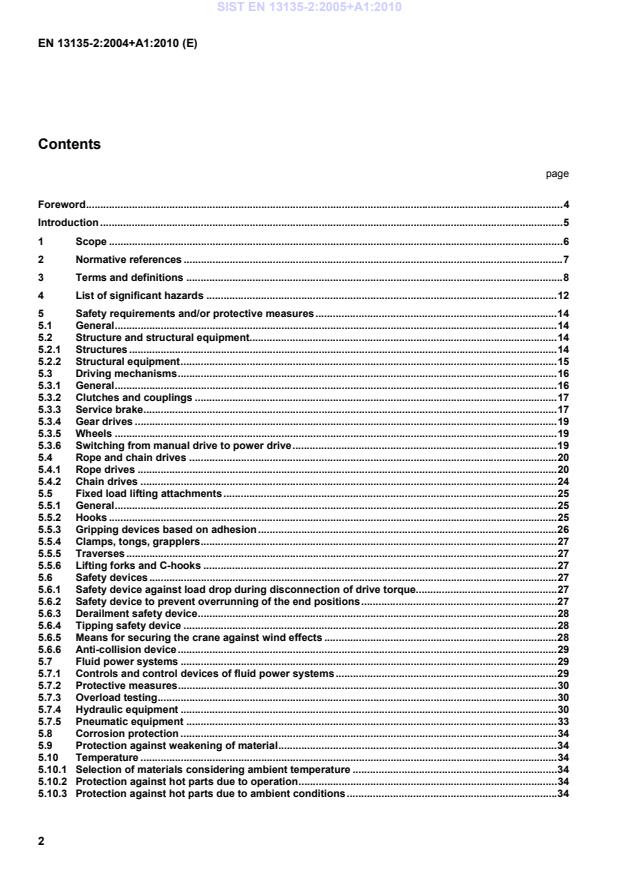
Selection of a suitable set of crane standards for a given application . 47Annex B (normative)
Cross list of vocabulary . 48Annex C (informative)
National systems of standards for hooks and brakes . 49C.1Hooks . 49C.2Brakes . 49Annex D (informative)
Design of rail wheel flanges . 50Annex E (normative)
Gripping devices based on adhesion . 52Annex ZA (informative)
!!!!Relationship between this European Standard and the Essential Requirements of EU Directive 2006/42/EC"""" . 53Bibliography . 54 SIST EN 13135-2:2005+A1:2010
the risk related to lifting of persons. This document is applicable to non-electrotechnical equipment which is manufactured after the date of approval by CEN of this standard. SIST EN 13135-2:2005+A1:2010
!deleted text" EN 818-1, Short link chain for lifting purposes Safety Part 1: General conditions of acceptance !EN 818-7:2002+A1:2008", Short-link chain for lifting purposes Safety Part 7: Fine tolerance hoist chain, Grade T (Types T, DAT and DT) !EN 982:1996+A1:2008", Safety of machinery Safety requirements for fluid power systems and their components Hydraulics !EN 983:1996+A1:2008", Safety of machinery Safety requirements for fluid power systems and their components Pneumatics EN 1037, Safety of machinery Prevention of unexpected start-up EN 1050:1996, Safety of machinery Principles for risk assessment !deleted text" !EN 12644-1:2001+A1:2008", Cranes Information for use and testing Part 1: Instructions !EN 12644-2:2000+A1:2008, Cranes Information for use and testing Part 2: Marking" !EN 13001-1:2004+A1:2009", Cranes General design Part 1: General principles and requirements !EN 13001-2:2004+A3:2009, Crane safety General design Part 2: Load effects" !CEN/TS 13001-3-1:2004", Cranes General design Part 3-1: Limit states and proof of competence of steel structures !deleted text" !EN 13135-1:2003+A1:2010, Cranes Equipment Part 1: Electrotechnical equipment" !EN 13155:2003+A2:2009", Cranes Safety Non-fixed load lifting attachments EN 13411-1, Terminations for steel wire ropes Safety Part 1: Thimbles for steel wire rope slings EN 13411-3, Terminations for steel wire ropes Safety Part 3: Ferrules and ferrule-securing EN 13411-4, Terminations for steel wire ropes Safety Part 4: Metal and resin socketing EN 13411-6, Terminations for steel wire ropes Safety Part 6: Asymmetric wedge socket !EN 13411-7", Terminations for steel wire ropes Safety Part 7: Symmetric wedge socket !EN 13557:2003+A2:2008", Cranes Controls and control stations EN ISO 12100-1:2003, Safety of machinery Basic concepts, general principles for design Part 1: Basic terminology, methodology (ISO 12100-1:2003) SIST EN 13135-2:2005+A1:2010
EN 982:1996+A1:2008, EN 983:1996+A1:2008, ISO 5598:2008 and ISO 4306-1:2007 and the following apply." 3.1 backup brake additional brake to the service brake that is able to stop and hold the load NOTE 1 A backup brake can have less lifetime than the service brake. NOTE 2 Such a brake is also known as emergency brake or safety brake. 3.2 chain drive device for supporting and moving loads via chain and wheel arrangements, comprising all the attachments and parts which transmit the force to the driving mechanism, for example, chain drive wheels, chains, chain reversing wheels, chain terminations and chain guides 3.3 clamp load handling device which generates the load holding forces by means of compression and friction 3.4 compensating lever beam to equalise forces in the ends of two ropes. The amount of compensation is limited by the permitted movement of the sheave 3.5 compensating sheave sheave which performs the compensating lever function in a single rope system. The amount of compensation is not limited by the movement of the sheave 3.6 crane machine for cyclic lifting or cyclic lifting and handling of loads suspended on hooks or other load handling devices, whether manufactured to an individual design, in series production, or from prefabricated components SIST EN 13135-2:2005+A1:2010
EN 1050:1996 Hazards (as listed in EN 1050:1996) Relevant clause(s) in this standard 1 Mechanical hazards 5.3.1; 5.3.3; 5.4.2.2
Generated by machine parts or workpieces caused, for example, by:
1.b) relative location 5.2.2.1; 5.6.6 1.c) mass and stability (potential energy of elements which may move under the effect of gravity) 5.2.2.1; 5.7.4.3 1.d) mass and velocity (kinetic energy of elements in controlled or uncontrolled motion) 5.2.2.1; 5.6.2; 5.6.6; 5.7.4.3 1.e) inadequacy of mechanical strength 5.2.1; 5.5.1; 5.13.2.2
Accumulation of energy inside the machinery caused, for example, by:
1.g) liquids and gases under pressure 5.7.2.2, 5.7.2.3; 5.7.4.3; 5.7.4.4; 5.7.4.5 1.5 Drawing–in or trapping hazard 5.4.1.4; 5.4.2.3 1.9 High pressure fluid injection or ejection hazard 5.5.1; 5.7.4.3 2 Electrical hazards due to:
2.5 Thermal radiation or other phenomena such as the projection of molten particles and chemical effects from short circuits, overloads, etc. 5.9; 5.13.2.4; 5.13.2.1 3 Thermal hazards, resulting in: 5.3.1; 5.13.2.1; 5.13.2.4 3.1 Burns and scalds by a possible contact of persons, by flames or explosions and also by the radiation of heat sources 5.7.4.5; 5.10.2 3.2 Health damaging affects by hot or cold work environment 5.7.4.4; 5.7.5.5; 5.10.2 5 Hazards generated by vibration
5.2 Whole body vibration, particularly when combined with poor postures 5.2.1; 5.3.1; 5.7.4.4 6 Hazards generated by radiation
6.2 Infrared, visible and ultraviolet light 5.9; 5.13.2 7 Hazards generated by materials and substances processed, used by the machinery and by its constituent materials 5.7.4; 5.7.4.2; 5.7.5; 5.13 7.1 Hazards from contact with or inhalation of harmful fluids, gases, mists, fumes, and dusts 5.7.4.2 7.2 Fire or explosion hazard 5.7.4.5.2; 5.7.4.5.3 8 Hazards generated by neglecting ergonomic principles in machinery design as - e.g. - hazards from:
8.6 Human error, human behaviour 5.6.2; 5.6.5.2 10 Unexpected start-up, unexpected overrun/ overspeed (or any similar malfunction) from:
10.1 Failure / disorder of the control system 5.3.2; 5.3.3; 5.5.1; 5.7.1; 5.7.4.2 10.2 Restoration of energy supply after an interruption 5.3.3; 5.7.1 10.4 Other external influences (gravity, wind, etc.) 5.2.1; 5.6.5.1; 5.6.5.2; 5.6.5.3; 5.7.2.2; 5.7.4.4; 5.7.4.5; 5.8; 5.9 SIST EN 13135-2:2005+A1:2010
EN 1050:1996 Hazards (as listed in EN 1050:1996) Relevant clause(s) in this standard 10.6 Errors made by the operator (due to mismatch of machinery with human characteristics and abilities, see 8.6) 5.3.3; 5.7.1 13 Failure of the power supply 5.3.3; 5.5.3.3; 5.7.1; 5.7.2.1; 5.7.2.2; 5.7.4.3; 5.7.5; 5.7.5.2; 5.7.5.6; 5.12 14 Failure of the control circuit
5.7.1 15 Errors of fitting 5.2.2.3 16 Break-up during operation
5.3.1; 5.3.3; 5.3.4.1; 5.3.4.2; 5.4.1; 5.4.1.3; 5.4.2.2; 5.5.1; 5.5.2.1; 5.5.2.2; 5.5.2.3; 5.5.5; 5.7.1; 5.7.4.2; 5.7.4.3; 5.7.4.4; 5.13.1.4 16T Thermal effect on crane 5.4.1; 5.4.1.3; 5.5.2.1; 5.5.2.2; 5.5.5 17 Falling or ejected objects or fluids 5.7.2.3; 5.7.4.4 20 Relating to the travelling function
20.3 Movement without all parts in a safe position 5.3.6 20.6 Insufficient ability of machinery to be slowed down, stopped and immobilised 5.6.5.1; 5.6.5.2; 5.6.5.3 21 Linked to the work position (including driving station) on the machine
21.3 Fire (flammability of the cab, lack of extinguishing means) 5.7.4.5 21.4 Mechanical hazards at the work position: a) contact with the wheels b) rollover c) fall of objects, penetration by objects d) break-up of parts rotating at high speed e) contact of persons with machine parts or tools
(pedestrian controlled machines) 5.2.2.1; 5.7.2.3
22 Due to the control system
22.1 Inadequate location of manual controls
5.7.1 22.2 Inadequate design of the manual controls and their mode of operation 5.7.1 24 Due to the power source and to the transmission of power
24.1 Hazards from the engine and the batteries 5.7.4.3; 5.7.5.5
24.2 Hazards from transmission of power between machines 5.3.2; 5.3.4.1; 5.3.4.2; 5.13.1.4 25 From / to third persons
25.1 Unauthorised start-up / use 5.3.6 25.2 Drift of a part away from its stopping position 5.7.4.3; 5.7.5.5 26 Insufficient instructions for the driver / operator 5.2.2.1 27 Mechanical hazards and hazardous events
27.1 From load falls, collisions, machine tipping caused by: 5.6.6 27.1.1 Lack of stability 5.2.2.3; 5.6.4
27.1.2 Uncontrolled loading – overloading – overturning moments exceeded
5.6.4; 5.7.3 27.1.3 Uncontrolled amplitude of movements
5.7.3; 5.7.4.3; 5.7.5; 5.7.5.3; 5.7.5.5 27.1.4 Unexpected/unintended movement of loads
5.3.2; 5.5.3.1; 5.6.1; 5.7.1; 5.7.3; 5.7.5.3; 5.7.5.5 27.1.5 Inadequate holding devices/accessories
5.5.1; 5.5.2.1; 5.5.3.1; 5.5.3.2; 5.5.3.3; 5.5.4; 5.5.6; 5.7.4.4 27.1.6 Collision of more than one machine 5.6.6 SIST EN 13135-2:2005+A1:2010
EN 1050:1996 Hazards (as listed in EN 1050:1996) Relevant clause(s) in this standard 27.2 From lifting of persons 5.2.2.3; 5.5.5 27.3 From derailment
5.2.2.1; 5.3.5; 5.6.3 27.4 From insufficient mechanical strength of parts 5.3.1; 5.3.4.1; 5.3.4.2; 5.4.1; 5.4.1.2; 5.4.1.3; 5.4.1.6.1; 5.4.1.6.2; 5.4.1.6.3; 5.4.2.2; 5.5.1; 5.5.2.2; 5.5.2.3; 5.5.5; 5.7.4.4; 5.7.5; 5.7.5.3 27.5 From inadequate design of pulleys, drums 4.4.1; 5.4.1.2; 5.4.1.4; 5.4.1.5; 5.4.1.6.1 27.6 From inadequate selection/integration into the machine of chains, ropes, lifting accessories
5.2.2.2; 5.4.1; 5.4.1.2; 5.4.1.3; 5.4.1.5; 5.4.1.6.1; 5.4.1.6.2; 5.4.1.6.3; 5.4.2; 5.4.2.2; 5.4.2.3; 5.4.2.4; 5.5.1; 5.5.2.1; 5.7.1; 5.7.4.2; 5.7.4.3; 5.7.4.4; 5.7.5; 5.7.5.3 27.7 From abnormal conditions of assembly/testing/ use/maintenance
5.3.3; 5.11 27.8 From abnormal conditions of assembly/testing/ use/maintenance
5.5.5; 5.6.1 31 Restricted movement of persons 5.3.1
5 Safety requirements and/or protective measures 5.1 General When designing or selecting non-electromechanical equipment for cranes the safety requirements or measures of this clause 5 shall apply. In addition, the machine shall be designed according to the principles of EN ISO 12100 for the relevant hazards which are not dealt with by this standard. 5.2 Structure and structural equipment 5.2.1 Structures The configuration and flexibility of the load bearing structure shall ensure that the braked wheels have such a contact to the rail or ground that is necessary for safe stopping of the crane or the trolley. The deformation and vibration behaviour of structures shall be limited considering the intended use of the crane. The limits are given in standards for specific crane types. Fasteners shall be secured in such a way that unintended loosening is prevented. If rails are integrated into the load bearing beams, they shall be fastened with fit bolts, friction grip bolts with adequate surfaces, or by welding. Discontinuities in the rail shall be considered adequately in fatigue assessment. If the connection of the rail to the structure is not shear-resistant, restraints shall be provided to prevent longitudinal movements/creeps of the rail. When the strength of a joint depends on pre-stressing of the fasteners, adequate contact of adjoining surfaces shall be ensured and the pre-stressing made by a controlled method (e.g. tightening with a torque wrench). Structures shall meet the tolerances for cranes specified in !ISO 12488-1" unless otherwise specified between the user and the manufacturer. Selection of tolerance classes shall be given in the standard for the specific crane type, if required. SIST EN 13135-2:2005+A1:2010
Rope saddles shall, if practicable, have a groove matched to the rope diameter. SIST EN 13135-2:2005+A1:2010
...