

EN 1672-1:2014
(Main)Food processing machinery - Basic concepts - Part 1: Safety requirements
- Abstract
This European Standard deals with the significant hazards, hazardous situations and events relevant to commercial and industrial food processing machines as defined in Clause 3 when they are used as intended and under conditions of misuse which are reasonably foreseeable by the manufacturer (see Clause 4).
This European Standard deals with the significant hazards, hazardous situations and events that occur during transport, assembly and installation, commissioning, setting, teaching, programming, process changeover, operation, cleaning, fault finding and maintenance.
This European Standard deals with those risks which occur commonly in food processing machines and for which common technical requirements can be set which can be applied at all (or most) machines which have that particular hazard.
Exclusions:
This European Standard is not applicable to the following machines:
- food processing machines intended for domestic use;
- food processing machines covered by the machine-specific standards listed in Annex C;
- packaging machines;
- machines used in the agricultural and animal rearing sectors.
This European Standard does not deal with the hygiene risks to the consumer of the food product handled in the food processing machine. These risks are dealt with in EN 1672 2:2005+A1:2009.
This European Standard is not applicable to food processing machines that were manufactured before the date of its publication as a European Standard.
- Status
- Published
- Publication Date
- 30-Sep-2014
- Withdrawal Date
- 29-Apr-2015
- Technical Committee
- CEN/TC 153 - Food processing machinery - Safety and hygiene specifications
- Drafting Committee
- CEN/TC 153/WG 12 - Safety
- Current Stage
- 9060 - Closure of 2 Year Review Enquiry - Review Enquiry
- Start Date
- 03-Jun-2020
- Completion Date
- 03-Jun-2020

Overview
EN 1672-1:2014 - published by CEN - defines the basic safety concepts and safety requirements for food processing machinery used in commercial and industrial environments. The standard addresses the significant hazards, hazardous situations and events that can arise when machines are used as intended or under reasonably foreseeable misuse, including risks that occur during transport, assembly, commissioning, operation, cleaning, maintenance and fault finding. It sets common technical requirements that can be applied across a wide range of food-processing machines, but excludes domestic machines, packaging machines, agricultural/animal‑rearing machinery, machine-specific standards listed in Annex C, and hygiene risks to consumers (handled in EN 1672-2:2005+A1:2009).
Key Topics
EN 1672-1:2014 covers a broad set of machine-safety topics relevant to food processing machinery:
- Hazard identification: lists significant hazards (mechanical, electrical, thermal, noise, vibration, radiation, materials/substances, ergonomics).
- Mechanical safeguards: protection of moving parts, feed hoppers, cutting devices and conveyors; prevention of stored‑energy and high‑pressure fluid hazards.
- Electrical safety: requirements for electrical equipment and managing electrostatic phenomena.
- Ergonomics and human factors: design to reduce human error, safe control layout and access for cleaning/maintenance.
- Controls and isolation: stop functions, emergency stop principles, means of isolating energy supplies.
- Verification and testing: visual inspections, functional tests, measurements, and design verification methods.
- Information for use: marking, accompanying documents, signals and warnings.
- Supporting methods: Annex A on noise measurement, Annex B on alternative safeguarding methods, Annex C on relationship to machine‑specific standards.
Applications
Who uses EN 1672-1:2014 and how:
- Machine manufacturers / OEMs - integrate common safety requirements into machine design and manufacture.
- Safety engineers and designers - perform risk assessments and select appropriate guards, controls and ergonomic solutions.
- Maintenance and operations teams - follow verification, testing and information-for-use guidance to keep equipment safe in service.
- Compliance and procurement - evaluate suppliers and technical documentation for safety compliance.
- Test laboratories and notified bodies - use verification methods (visual, functional, measurement) to assess conformity.
Practical use cases include designing hygienic yet safe guards for cutting devices, specifying stop/isolation systems for conveyors, and defining maintenance procedures that minimize exposure to mechanical and electrical hazards.
Related Standards
- EN 1672-2:2005+A1:2009 - addresses hygiene risks to consumers (complements EN 1672-1).
- Annex C of EN 1672-1 lists machine-specific food processing standards for more detailed, application-specific requirements.
- Refer to Annex A (noise measurement) and Annex B (alternative safeguarding) for technical measurement and protection options.
Keywords: EN 1672-1:2014, food processing machinery, safety requirements, machine safety, CEN, hygienic design, hazard identification, guards, electrical hazards, noise measurement.
Relations
- Effective Date
- 25-Aug-2026
- Effective Date
- 09-Feb-2026
- Effective Date
- 09-Feb-2026
- Effective Date
- 09-Feb-2026
- Effective Date
- 09-Feb-2026
- Effective Date
- 28-Jan-2026
- Effective Date
- 28-Jan-2026
- Effective Date
- 28-Jan-2026
- Effective Date
- 28-Jan-2026
- Effective Date
- 28-Jan-2026
- Effective Date
- 28-Jan-2026
- Refers
EN ISO 13850:2008 - Safety of machinery - Emergency stop - Principles for design (ISO 13850:2006) - Effective Date
- 28-Jan-2026
- Effective Date
- 28-Jan-2026
- Effective Date
- 28-Jan-2026
- Effective Date
- 28-Jan-2026
Get Certified
Connect with accredited certification bodies for this standard

BSI Group
BSI (British Standards Institution) is the business standards company that helps organizations make excellence a habit.

Bureau Veritas
Bureau Veritas is a world leader in laboratory testing, inspection and certification services.

DNV
DNV is an independent assurance and risk management provider.
Sponsored listings
Frequently Asked Questions
EN 1672-1:2014 is a standard published by the European Committee for Standardization (CEN). Its full title is "Food processing machinery - Basic concepts - Part 1: Safety requirements". This standard covers: This European Standard deals with the significant hazards, hazardous situations and events relevant to commercial and industrial food processing machines as defined in Clause 3 when they are used as intended and under conditions of misuse which are reasonably foreseeable by the manufacturer (see Clause 4). This European Standard deals with the significant hazards, hazardous situations and events that occur during transport, assembly and installation, commissioning, setting, teaching, programming, process changeover, operation, cleaning, fault finding and maintenance. This European Standard deals with those risks which occur commonly in food processing machines and for which common technical requirements can be set which can be applied at all (or most) machines which have that particular hazard. Exclusions: This European Standard is not applicable to the following machines: - food processing machines intended for domestic use; - food processing machines covered by the machine-specific standards listed in Annex C; - packaging machines; - machines used in the agricultural and animal rearing sectors. This European Standard does not deal with the hygiene risks to the consumer of the food product handled in the food processing machine. These risks are dealt with in EN 1672 2:2005+A1:2009. This European Standard is not applicable to food processing machines that were manufactured before the date of its publication as a European Standard.
This European Standard deals with the significant hazards, hazardous situations and events relevant to commercial and industrial food processing machines as defined in Clause 3 when they are used as intended and under conditions of misuse which are reasonably foreseeable by the manufacturer (see Clause 4). This European Standard deals with the significant hazards, hazardous situations and events that occur during transport, assembly and installation, commissioning, setting, teaching, programming, process changeover, operation, cleaning, fault finding and maintenance. This European Standard deals with those risks which occur commonly in food processing machines and for which common technical requirements can be set which can be applied at all (or most) machines which have that particular hazard. Exclusions: This European Standard is not applicable to the following machines: - food processing machines intended for domestic use; - food processing machines covered by the machine-specific standards listed in Annex C; - packaging machines; - machines used in the agricultural and animal rearing sectors. This European Standard does not deal with the hygiene risks to the consumer of the food product handled in the food processing machine. These risks are dealt with in EN 1672 2:2005+A1:2009. This European Standard is not applicable to food processing machines that were manufactured before the date of its publication as a European Standard.
EN 1672-1:2014 is classified under the following ICS (International Classification for Standards) categories: 67.260 - Plants and equipment for the food industry. The ICS classification helps identify the subject area and facilitates finding related standards.
EN 1672-1:2014 has the following relationships with other standards: It is inter standard links to ISO 8598:1996, EN 60529:1991, EN 61496-1:2013, EN 61310-1:2008, EN 61310-3:2008, EN 894-2:1997+A1:2008, EN ISO 4414:2010, EN ISO 11202:2010, EN 620:2002+A1:2010, EN ISO 13857:2008, EN ISO 14122-2:2001, EN ISO 13850:2008, EN ISO 13732-1:2008, EN ISO 13732-3:2008, EN ISO 14122-4:2004. Understanding these relationships helps ensure you are using the most current and applicable version of the standard.
EN 1672-1:2014 is associated with the following European legislation: EU Directives/Regulations: 2006/42/EC. When a standard is cited in the Official Journal of the European Union, products manufactured in conformity with it benefit from a presumption of conformity with the essential requirements of the corresponding EU directive or regulation.
EN 1672-1:2014 is available in PDF format for immediate download after purchase. The document can be added to your cart and obtained through the secure checkout process. Digital delivery ensures instant access to the complete standard document.
Standards Content (Sample)
2003-01.Slovenski inštitut za standardizacijo. Razmnoževanje celote ali delov tega standarda ni dovoljeno.Stroji za predelavo hrane - Osnovni koncepti - 1. del: Varnostne zahteveNahrungsmittelmaschinen - Allgemeine Gestaltungsleitsätze - Teil 1: SicherheitsanforderungenMachines pour les produits alimentaires - Notions fondamentales - Partie 1: Prescriptions relatives à la sécuritéFood processing machinery - Basic concepts - Part 1: Safety requirements67.260Tovarne in oprema za živilsko industrijoPlants and equipment for the food industryICS:Ta slovenski standard je istoveten z:EN 1672-1:2014SIST EN 1672-1:2014en,fr,de01-december-2014SIST EN 1672-1:2014SLOVENSKI
STANDARD
EUROPEAN STANDARD NORME EUROPÉENNE EUROPÄISCHE NORM
EN 1672-1
October 2014 ICS 67.260 English Version
Food processing machinery - Basic concepts - Part 1: Safety requirements
Machines pour les produits alimentaires - Notions fondamentales - Partie 1: Prescriptions relatives à la sécurité
Nahrungsmittelmaschinen - Allgemeine Gestaltungsleitsätze - Teil 1: Sicherheitsanforderungen This European Standard was approved by CEN on 9 August 2014.
CEN members are bound to comply with the CEN/CENELEC Internal Regulations which stipulate the conditions for giving this European Standard the status of a national standard without any alteration. Up-to-date lists and bibliographical references concerning such national standards may be obtained on application to the CEN-CENELEC Management Centre or to any CEN member.
This European Standard exists in three official versions (English, French, German). A version in any other language made by translation under the responsibility of a CEN member into its own language and notified to the CEN-CENELEC Management Centre has the same status as the official versions.
CEN members are the national standards bodies of Austria, Belgium, Bulgaria, Croatia, Cyprus, Czech Republic, Denmark, Estonia, Finland, Former Yugoslav Republic of Macedonia, France, Germany, Greece, Hungary, Iceland, Ireland, Italy, Latvia, Lithuania, Luxembourg, Malta, Netherlands, Norway, Poland, Portugal, Romania, Slovakia, Slovenia, Spain, Sweden, Switzerland, Turkey and United Kingdom.
EUROPEAN COMMITTEE FOR STANDARDIZATION
COMITÉ EUROPÉEN DE NORMALISATION EUROPÄISCHES KOMITEE FÜR NORMUNG
CEN-CENELEC Management Centre:
Avenue Marnix 17,
B-1000 Brussels © 2014 CEN All rights of exploitation in any form and by any means reserved worldwide for CEN national Members. Ref. No. EN 1672-1:2014 ESIST EN 1672-1:2014
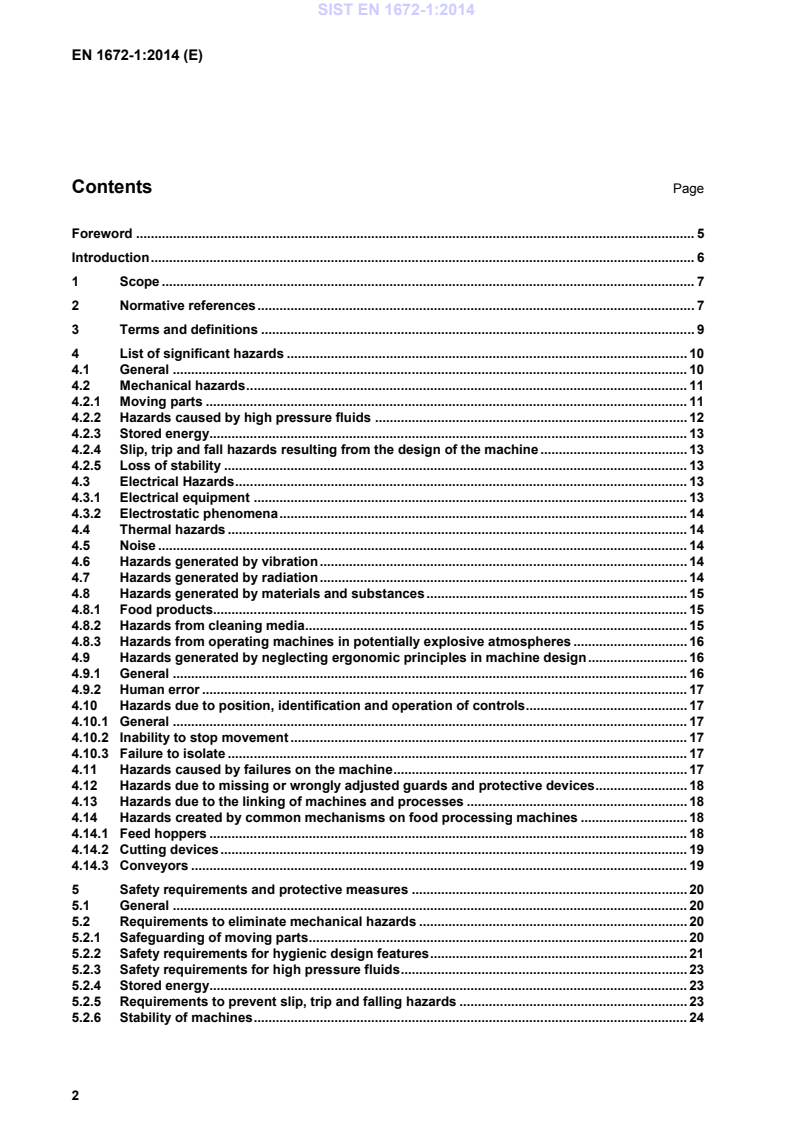
Noise measurement . 45 A.1 Scope . 45 SIST EN 1672-1:2014
Alternative methods of safeguarding medium-sized openings in guards . 49 Annex C (normative)
Relationship to machine-specific food processing machine standards . 50 Bibliography . 52
EN 61310-1:2008, Safety of machinery — Indication, marking and actuation — Part 1: Requirements for visual, acoustic and tactile signals (IEC 61310-1:2007) EN 61310-3:2008, Safety of machinery — Indication, marking and actuation — Part 3: Requirements for the location and operation of actuators (IEC 61310-3:2007) EN 61496-1:2013, Safety of machinery — Electro-sensitive protective equipment — Part 1: General requirements and tests (IEC 61496-1:2012) EN ISO 3744:2010, Acoustics — Determination of sound power levels and sound energy levels of noise sources using sound pressure — Engineering methods for an essentially free field over a reflecting plane (ISO 3744:2010) EN ISO 4413:2010, Hydraulic fluid power — General rules and safety requirements for systems and their components (ISO 4413:2010) EN ISO 4414:2010, Pneumatic fluid power — General rules and safety requirements for systems and their components (ISO 4414:2010) EN ISO 4871:2009, Acoustics — Declaration and verification of noise emission values of machinery and equipment (ISO 4871:1996) EN ISO 7010:2012, Graphical symbols — Safety colours and safety signs — Registered safety signs (ISO 7010:2011) EN ISO 11201:2010, Acoustics — Noise emitted by machinery and equipment — Determination of emission sound pressure levels at a work station and at other specified positions in an essentially free field over a reflecting plane with negligible environmental corrections (ISO 11201:2010) EN ISO 11202:2010, Acoustics — Noise emitted by machinery and equipment — Determination of emission sound pressure levels at a work station and at other specified positions applying approximate environmental corrections (ISO 11202:2010) EN ISO 11204:2010, Acoustics — Noise emitted by machinery and equipment — Determination of emission sound pressure levels at a work station and at other specified positions applying accurate environmental corrections (ISO 11204:2010) SIST EN 1672-1:2014
Figure 1 — Cleaning under food processing machinery 4.2.1.6 Spillage trays Food processing machines may be fitted with trays to collect spillages of food from the machine. It is good hygienic design practice for spillage trays to be easily removable so that product can be emptied frequently; however, when the trays are removed, the operator may be exposed to danger zones on the machine. 4.2.2 Hazards caused by high pressure fluids Some food processing machines incorporate pneumatic or hydraulic systems. Pneumatic and hydraulic equipment presents crushing, shearing, ejection of parts, explosion and injection of fluids hazards. Stored energy in pneumatic or hydraulic systems may cause mechanisms to move unexpectedly even when power supplies are disconnected. In addition, hydraulic oil and pneumatic lubricating oil present a potential fire hazard and can contaminate the food. Some food processing machines use high-pressure water to cut or dislodge food products. These high-pressure jets can cause cutting injuries. SIST EN 1672-1:2014
...