

EN 1037:1995+A1:2008
(Main + Amendment)Safety of machinery - Prevention of unexpected start-up
- Abstract
This standard specifies built-in safety measures aimed at preventing unexpected machine start-up (see 3.2) to
allow safe human interventions in danger zones (see Annex A).
This standard applies to unexpected start-up from all types of energy source, i.e.:
- Power supply, e.g. electrical, hydraulic, pneumatic;
- Stored energy due to, e.g., gravity, compressed springs;
- External influences, e.g. from wind;
- Status
- Withdrawn
- Publication Date
- 22-Apr-2008
- Withdrawal Date
- 06-Oct-2026
- Technical Committee
- CEN/TC 114 - Safety of machinery
- Drafting Committee
- CEN/TC 114/WG 9 - Emergency stop and safety hold
- Current Stage
- 9960 - Withdrawal effective - Withdrawal
- Start Date
- 07-Feb-2018
- Completion Date
- 07-Oct-2026
- Directive
- 2006/42/EC - Directive 2006/42/EC of the European Parliament and of the Council of 17 May 2006 on machinery, and amending Directive 95/16/EC (recast)OJ Ref: C, C 214 OJ Date: 08-Sep-2009
98/37/EC - MachineryOJ Ref: C, C 22 OJ Date: 28-Jan-2009

Relations
- Effective Date
- 22-Dec-2008
- Replaced By
EN ISO 14118:2018 - Safety of machinery - Prevention of unexpected start-up (ISO 14118:2017) - Effective Date
- 14-Feb-2018
- Effective Date
- 09-Feb-2026
- Effective Date
- 28-Jan-2026
- Effective Date
- 28-Jan-2026
- Effective Date
- 28-Jan-2026
- Effective Date
- 28-Jan-2026
- Effective Date
- 28-Jan-2026
- Effective Date
- 28-Jan-2026
- Effective Date
- 28-Jan-2026
- Effective Date
- 28-Jan-2026
- Effective Date
- 28-Jan-2026
- Effective Date
- 28-Jan-2026
- Effective Date
- 28-Jan-2026
- Effective Date
- 28-Jan-2026
Get Certified
Connect with accredited certification bodies for this standard

CIS Institut d.o.o.
Personal Protective Equipment (PPE) certification body. Notified Body NB-2890 for EU Regulation 2016/425 PPE.

Kiwa BDA Testing
Building and construction product certification.
Kmetijski inštitut Slovenije
Agricultural Institute of Slovenia. Soil testing, plant health, agricultural product analysis.
Sponsored listings
Frequently Asked Questions
EN 1037:1995+A1:2008 is a standard published by the European Committee for Standardization (CEN). Its full title is "Safety of machinery - Prevention of unexpected start-up". This standard covers: This standard specifies built-in safety measures aimed at preventing unexpected machine start-up (see 3.2) to allow safe human interventions in danger zones (see Annex A). This standard applies to unexpected start-up from all types of energy source, i.e.: - Power supply, e.g. electrical, hydraulic, pneumatic; - Stored energy due to, e.g., gravity, compressed springs; - External influences, e.g. from wind;
This standard specifies built-in safety measures aimed at preventing unexpected machine start-up (see 3.2) to allow safe human interventions in danger zones (see Annex A). This standard applies to unexpected start-up from all types of energy source, i.e.: - Power supply, e.g. electrical, hydraulic, pneumatic; - Stored energy due to, e.g., gravity, compressed springs; - External influences, e.g. from wind;
EN 1037:1995+A1:2008 is classified under the following ICS (International Classification for Standards) categories: 13.110 - Safety of machinery. The ICS classification helps identify the subject area and facilitates finding related standards.
EN 1037:1995+A1:2008 has the following relationships with other standards: It is inter standard links to EN 1037:1995, EN ISO 14118:2018, EN 60204-1:1992, EN ISO 12100:2010, EN 292-1:1991, EN 292-2:1991, EN 1034-8:2012, EN 1870-12:2013, EN 1870-15:2012, EN 1870-6:2017, EN 848-1:2007+A2:2012, EN 15954-2:2013, EN 1870-18:2013, EN 12750:2013, EN 1870-7:2012. Understanding these relationships helps ensure you are using the most current and applicable version of the standard.
EN 1037:1995+A1:2008 is associated with the following European legislation: EU Directives/Regulations: 2006/42/EC, 98/37/EC; Standardization Mandates: M/079, M/396. When a standard is cited in the Official Journal of the European Union, products manufactured in conformity with it benefit from a presumption of conformity with the essential requirements of the corresponding EU directive or regulation.
EN 1037:1995+A1:2008 is available in PDF format for immediate download after purchase. The document can be added to your cart and obtained through the secure checkout process. Digital delivery ensures instant access to the complete standard document.
Standards Content (Sample)
2003-01.Slovenski inštitut za standardizacijo. Razmnoževanje celote ali delov tega standarda ni dovoljeno.Sicherheit von Maschinen - Vermeidung von unerwartetem AnlaufSécurité des machines - Prévention de la mise en marche intempestiveSafety of machinery - Prevention of unexpected start-up13.110Varnost strojevSafety of machineryICS:Ta slovenski standard je istoveten z:EN 1037:1995+A1:2008SIST EN 1037:1999+A1:2008en,fr01-julij-2008SIST EN 1037:1999+A1:2008SLOVENSKI
STANDARD
EUROPEAN STANDARD NORME EUROPÉENNE EUROPÄISCHE NORM
EN 1037:1995+A1
April 2008 ICS 13.110 Supersedes EN 1037:1995 English Version
Safety of machinery - Prevention of unexpected start-up
Sécurité des machines - Prévention de la mise en marche intempestive
Sicherheit von Maschinen - Vermeidung von unerwartetem Anlauf This European Standard was approved by CEN on 14 July 1995 and includes Amendment 1 approved by CEN on 18 March 2008.
CEN members are bound to comply with the CEN/CENELEC Internal Regulations which stipulate the conditions for giving this European Standard the status of a national standard without any alteration. Up-to-date lists and bibliographical references concerning such national standards may be obtained on application to the CEN Management Centre or to any CEN member.
This European Standard exists in three official versions (English, French, German). A version in any other language made by translation under the responsibility of a CEN member into its own language and notified to the CEN Management Centre has the same status as the official versions.
CEN members are the national standards bodies of Austria, Belgium, Bulgaria, Cyprus, Czech Republic, Denmark, Estonia, Finland, France, Germany, Greece, Hungary, Iceland, Ireland, Italy, Latvia, Lithuania, Luxembourg, Malta, Netherlands, Norway, Poland, Portugal, Romania, Slovakia, Slovenia, Spain, Sweden, Switzerland and United Kingdom.
EUROPEAN COMMITTEE FOR STANDARDIZATION
COMITÉ EUROPÉEN DE NORMALISATION EUROPÄISCHES KOMITEE FÜR NORMUNG
Management Centre: rue de Stassart, 36
B-1050 Brussels © 2008 CEN All rights of exploitation in any form and by any means reserved worldwide for CEN national Members. Ref. No. EN 1037:1995+A1:2008: E
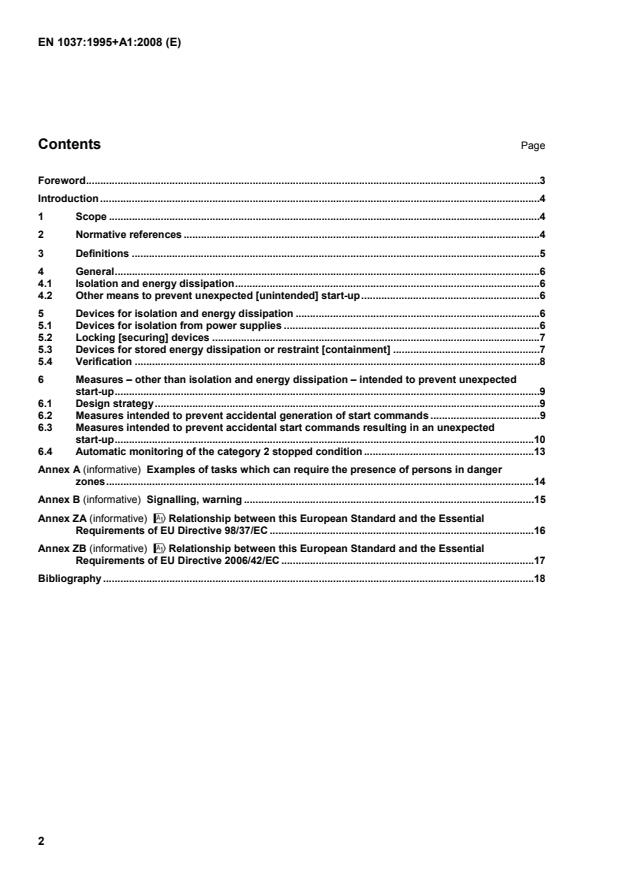
Examples of tasks which can require the presence of persons in danger zones.14 Annex B (informative)
Signalling, warning.15 Annex ZA (informative)
!Relationship between this European Standard and the Essential Requirements of EU Directive 98/37/EC.16 Annex ZB (informative)
!Relationship between this European Standard and the Essential Requirements of EU Directive 2006/42/EC.17 Bibliography.18
1)
Draft standard prepared by CEN/TC 114/WG 14
4 General 4.1 Isolation and energy dissipation Machines shall be provided with devices intended for isolation and energy dissipation (see clause 5), especially with a view to major maintenance, work on power circuits and decommissioning (see the essential safety requirement expressed in 1.6.3 of annex A of EN 292-2:1991). 4.2 Other means to prevent unexpected [unintended] start-up If the use of isolation and energy dissipation is not appropriate (e.g. for frequent short interventions in danger zones), the designer shall provide, according to the risk assessment (see prEN 1050), other measures (see clause 6) to prevent unexpected start-up. Additional means such as signalling and/or warning may be appropriate (see annex B). NOTE 1 Examples of tasks which can require the presence of persons in danger zones are given in annex A NOTE 2 According to 5.7.1 of EN 292-1:1991, the designer should as completely as possible determine the different machine operating modes and the need for the presence of persons in danger zones. Appropriate built-in safety measures can then be provided to prevent operators from being induced to use hazardous operating modes and hazardous intervention techniques caused by technical difficulties in the use of the machine (see also 3.12 "Intended use of a machine" of EN 292-1:1991). 5 Devices for isolation and energy dissipation 5.1 Devices for isolation from power supplies 5.1.1 Isolation devices shall: Ensure a reliable isolation (disconnection, separation); Have a reliable mechanical link between the manual control and the isolating element(s); Be equipped with clear and unambiguous identification of the state of the isolation device which corresponds to each position of its manual control (actuator). NOTE 1 For electrical equipment, a supply disconnecting device complying with 5.3 "Supply disconnecting (isolating) device" of EN 60204-1:1992 meets this requirement. NOTE 2 Plug and socket systems (for electrical supplies), or their pneumatic, hydraulic or mechanical equivalents, are examples of isolating devices with which it is possible to achieve a visible and reliable discontinuity in the power supply circuits. For electrical plug/socket combinations, see 5.3.2 d) of EN 60204-1:1992. NOTE 3 For hydraulic and pneumatic equipment, see also 5.1.6 of prEN 982 and 5.1.6 of prEN 983.
...