

EN 12828:2012
(Main)Heating systems in buildings - Design for water-based heating systems
- Abstract
This European Standard specifies design criteria for water based heating systems in buildings with a maximum operating temperature of up to 105 °C. In case of heating systems with maximum operating temperatures over 105 °C other safety aspects than those described in 4.6 may apply. The other clauses of this European Standard are still valid for those systems.
This European Standard does not amend product standards or product installation requirements. This standard covers the design of:
- heat supply systems;
- heat distribution systems;
- heat emission systems;
- control systems.
This European Standard takes into account heating requirements of attached systems (e.g. domestic hot water, process heat, air conditioning, ventilation) in the design of a heat supply, but does not cover the design of these systems.
This European Standard does not cover requirements for installation or commissioning or instructions for operation, maintenance and use of water based heating systems.
This European Standard does not cover the design of fuel and energy supply systems.
- Status
- Withdrawn
- Publication Date
- 20-Nov-2012
- Withdrawal Date
- 01-Apr-2014
- Technical Committee
- CEN/TC 228 - Heating systems in buildings
- Current Stage
- 9960 - Withdrawal effective - Withdrawal
- Start Date
- 02-Apr-2014
- Completion Date
- 02-Apr-2014

Relations
- Effective Date
- 28-Nov-2012
- Merged Into
EN 12828:2012+A1:2014 - Heating systems in buildings - Design for water-based heating systems - Effective Date
- 19-Jan-2023
- Effective Date
- 07-Jul-2026
- Effective Date
- 09-Feb-2026
- Refers
EN 1264-4:2021 - Water based surface embedded heating and cooling systems - Part 4: Installation - Effective Date
- 28-Jan-2026
- Refers
EN 1264-3:2021 - Water based surface embedded heating and cooling systems - Part 3: Dimensioning - Effective Date
- 28-Jan-2026
- Effective Date
- 28-Jan-2026
- Effective Date
- 28-Jan-2026
- Effective Date
- 28-Jan-2026
- Effective Date
- 28-Jan-2026
- Effective Date
- 28-Jan-2026
- Effective Date
- 28-Jan-2026
- Effective Date
- 28-Jan-2026
- Effective Date
- 28-Jan-2026
- Effective Date
- 28-Jan-2026
Get Certified
Connect with accredited certification bodies for this standard

DIBt (Deutsches Institut für Bautechnik)
German Institute for Building Technology.
DIN CERTCO
DIN Group product certification.

Aboma Certification B.V.
Specialized in construction, metal, and transport sectors.
Sponsored listings
Frequently Asked Questions
EN 12828:2012 is a standard published by the European Committee for Standardization (CEN). Its full title is "Heating systems in buildings - Design for water-based heating systems". This standard covers: This European Standard specifies design criteria for water based heating systems in buildings with a maximum operating temperature of up to 105 °C. In case of heating systems with maximum operating temperatures over 105 °C other safety aspects than those described in 4.6 may apply. The other clauses of this European Standard are still valid for those systems. This European Standard does not amend product standards or product installation requirements. This standard covers the design of: - heat supply systems; - heat distribution systems; - heat emission systems; - control systems. This European Standard takes into account heating requirements of attached systems (e.g. domestic hot water, process heat, air conditioning, ventilation) in the design of a heat supply, but does not cover the design of these systems. This European Standard does not cover requirements for installation or commissioning or instructions for operation, maintenance and use of water based heating systems. This European Standard does not cover the design of fuel and energy supply systems.
This European Standard specifies design criteria for water based heating systems in buildings with a maximum operating temperature of up to 105 °C. In case of heating systems with maximum operating temperatures over 105 °C other safety aspects than those described in 4.6 may apply. The other clauses of this European Standard are still valid for those systems. This European Standard does not amend product standards or product installation requirements. This standard covers the design of: - heat supply systems; - heat distribution systems; - heat emission systems; - control systems. This European Standard takes into account heating requirements of attached systems (e.g. domestic hot water, process heat, air conditioning, ventilation) in the design of a heat supply, but does not cover the design of these systems. This European Standard does not cover requirements for installation or commissioning or instructions for operation, maintenance and use of water based heating systems. This European Standard does not cover the design of fuel and energy supply systems.
EN 12828:2012 is classified under the following ICS (International Classification for Standards) categories: 91.140.10 - Central heating systems. The ICS classification helps identify the subject area and facilitates finding related standards.
EN 12828:2012 has the following relationships with other standards: It is inter standard links to EN 12828:2003, EN 12828:2012+A1:2014, EN IEC 60730-2-9:2026, EN IEC 60730-2-9:2019, EN 1264-4:2021, EN 1264-3:2021, EN ISO 13732-1:2008, EN 12171:2002, EN 806-2:2005, EN ISO 7730:2025, EN 1264-2:2021, EN 1264-1:2021, EN 442-2:2014, EN 15500-1:2017, EN 215:2019. Understanding these relationships helps ensure you are using the most current and applicable version of the standard.
EN 12828:2012 is available in PDF format for immediate download after purchase. The document can be added to your cart and obtained through the secure checkout process. Digital delivery ensures instant access to the complete standard document.
Standards Content (Sample)
2003-01.Slovenski inštitut za standardizacijo. Razmnoževanje celote ali delov tega standarda ni dovoljeno.Ogrevalni sistemi v stavbah - Projektiranje toplovodnih ogrevalnih sistemovHeizungsanlagen in Gebäuden - Planung von Warmwasser-HeizungsanlagenSystèmes de chauffage dans les bâtiments - Conceptions des systèmes de chauffage à eauHeating systems in buildings - Design for water-based heating systems91.140.10Sistemi centralnega ogrevanjaCentral heating systemsICS:Ta slovenski standard je istoveten z:EN 12828:2012SIST EN 12828:2013en,fr,de01-maj-2013SIST EN 12828:2013SLOVENSKI
STANDARDSIST EN 12828:20041DGRPHãþD
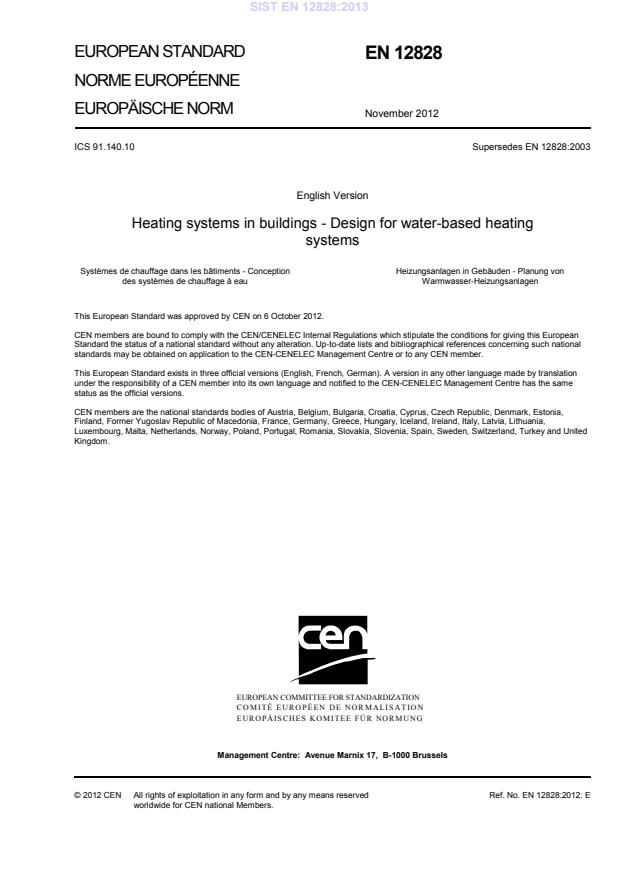
EUROPEAN STANDARD NORME EUROPÉENNE EUROPÄISCHE NORM
EN 12828
November 2012 ICS 91.140.10 Supersedes EN 12828:2003English Version
Heating systems in buildings - Design for water-based heating systems
Systèmes de chauffage dans les bâtiments - Conception des systèmes de chauffage à eau
Heizungsanlagen in Gebäuden - Planung von Warmwasser-Heizungsanlagen This European Standard was approved by CEN on 6 October 2012.
CEN members are bound to comply with the CEN/CENELEC Internal Regulations which stipulate the conditions for giving this European Standard the status of a national standard without any alteration. Up-to-date lists and bibliographical references concerning such national standards may be obtained on application to the CEN-CENELEC Management Centre or to any CEN member.
This European Standard exists in three official versions (English, French, German). A version in any other language made by translation under the responsibility of a CEN member into its own language and notified to the CEN-CENELEC Management Centre has the same status as the official versions.
CEN members are the national standards bodies of Austria, Belgium, Bulgaria, Croatia, Cyprus, Czech Republic, Denmark, Estonia, Finland, Former Yugoslav Republic of Macedonia, France, Germany, Greece, Hungary, Iceland, Ireland, Italy, Latvia, Lithuania, Luxembourg, Malta, Netherlands, Norway, Poland, Portugal, Romania, Slovakia, Slovenia, Spain, Sweden, Switzerland, Turkey and United Kingdom.
EUROPEAN COMMITTEE FOR STANDARDIZATION
COMITÉ EUROPÉEN DE NORMALISATION EUROPÄISCHES KOMITEE FÜR NORMUNG
Management Centre:
Avenue Marnix 17,
B-1000 Brussels © 2012 CEN All rights of exploitation in any form and by any means reserved worldwide for CEN national Members. Ref. No. EN 12828:2012: ESIST EN 12828:2013
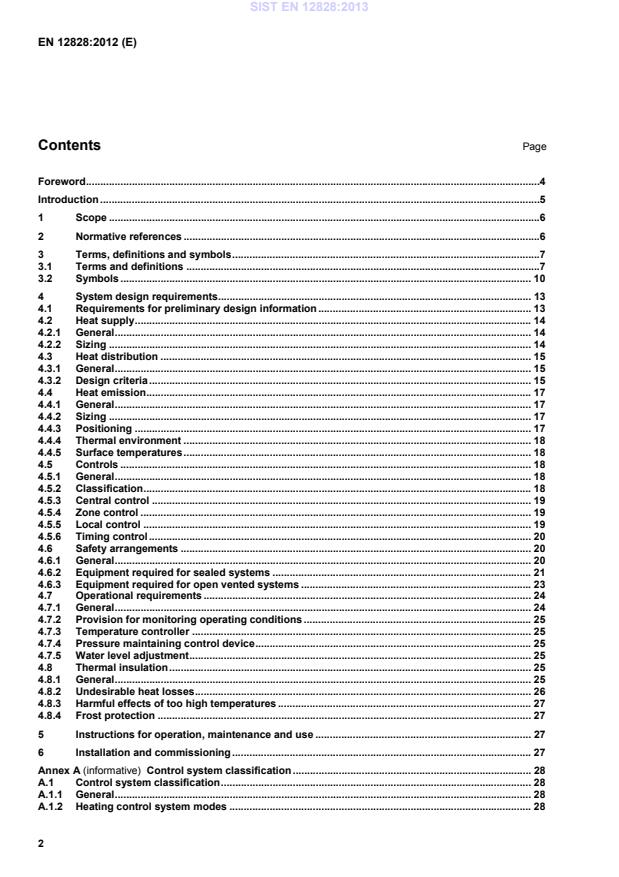
Control system classification . 28A.1 Control system classification . 28A.1.1 General . 28A.1.2 Heating control system modes . 28SIST EN 12828:2013
Thermal Environment . 34Annex C (informative)
Thermal insulation . 36Annex D (informative)
Guidance for dimensioning diaphragm expansion vessels and pressurisation systems (sealed systems) . 39D.1 General . 39D.2 Expansion vessel size calculation . 40Annex E (informative)
Safety valves for heating systems . 43E.1 Classification . 43E.2 General requirements . 43E.2.1 General . 43E.2.2 Materials . 43E.2.3 Protection against maladjustments . 43E.2.4 Guidance of the moveable parts . 43E.2.5 Easing gear . 43E.2.6 Protection of sliding and rotating elements . 44E.2.7 Design of coil compression springs . 44E.2.8 Transport protections . 44E.2.9 Pipes, installation and body . 44E.2.10 Marking . 44E.3 Calculation of the relief capacity . 46E.4 Requirements for safety valves marked H . 46E.4.1 General . 46E.4.2 Body and spring cap design . 46E.4.3 Threads on the inlet and outlet . 47E.4.4 Connections . 47E.4.5 Calculation . 47E.4.6 Setting. 47E.5 Requirements for safety valves marked D/G/H . 47E.5.1 General . 47E.5.2 Body and spring cap design . 48E.5.3 Design of the valve disc. 48E.5.4 Protection of sliding and rotating elements as well as springs . 48E.5.5 Safety valve with back pressure compensation . 48E.5.6 Setting. 48Annex F (informative)
A–deviations . 52Bibliography . 53 SIST EN 12828:2013
EXAMPLE Examples of such systems include:
domestic hot water systems;
ventilation and air conditioning systems;
process heating systems 3.1.2 central control method of controlling the heat flow to a heat emission system by changing the flow rate and/or the flow temperature at a central point 3.1.3 design heat load maximum heat output required from the heating system of a building, in order to maintain required internal temperatures without supplementary heating [SOURCE: EN ISO 15927-5:2004, 3.1.1]
3.1.4 design heat loss quantity of heat per unit time leaving the building to the external environment under specified design conditions [SOURCE: EN 12831:2003, 3.1.5] SIST EN 12828:2013
-N value of the thermal power output of the heat generator as declared by the manufacturer 3.1.29 efficiency ratio of the heat output to the heat input, expressed in % 3.1.30 pressurisation system system equipment (membrane expansion vessels, compressor-controlled pressurisation units and pump-controlled pressurisation units) for pressure maintenance in closed heating systems Note 1 to entry: The equipment provides to maintain the system pressure between defined limits and ensures the required minimal working pressure of the heating system. The equipment holds the accruing expansion water when the SIST EN 12828:2013
maximum system safety temperature highest temperature any component of the heating system can accommodate 3.1.32
lockout default condition resulting in a shutdown of the system and requiring a manual reset Note 1 to entry: The intention of a lockout is to require the operator to investigate and eliminate the cause of the lockout. 3.1.33
response overpressure pressure at which a safety valve opens at operating conditions 3.2 Symbols Table 1 — Symbols used in the standard (1 of 2) Symbol Description Unit Amin narrowest flow section of a safety valve mm2 de external pipe diameter mm dfe minimum internal diameter of the feed and expansion pipe mm din nominal size of the safety valve’s inlet
dmin narrowest flow diameter upstream of the valve seat mm dout nominal size of the safety valve’s outlet
ds minimum internal diameter of the safety pipe mm e expansion coefficient
fAS design factor for other attached systems
fDHW design factor for domestic hot water systems
fHL design factor for the heat load
fnrbl fraction of heat emission, considered as wasted;
hst static height bar hWin window height
m I operational parameter C⋅s/year⋅109 K constant kW/mm2 Kdr specified reduced discharge coefficient for gases/vapours / l specific latent heat quantity
kJ/kg pabs absolute pressure in the system (set pressure + admissible pressure increase) bar pfil filling pressure – the required pressure in the system if the lowest possible temperature is not given (for filling or water make-up) bar pfin final pressure
bar pini initial pressure
bar pv vapour pressure
bar SIST EN 12828:2013
Bar t time
s UL linear thermal transmission coefficient for pipes
W/m⋅K UW
thermal transmittance of the outside wall/window
W/m²⋅K Vex expansion volume m3 VN nominal volume of the expansion vessel to be determined m3 VN,min minimum nominal volume
m3 VSystem total water content of the system m3 Vwr real water reserve volume in the pressure vessel used m3 Vwr,min minimal water reserve volume m3 x coefficient of pressure medium for saturated steam
(h⋅mm2⋅bar)/kg . coefficient for valve design
utilisation degree
- heating capacity
kW -AS capacity of other attached systems
kW -DHW domestic hot water capacity
kW -HL heat load capacity
kW -N nominal heat output
kW -SU
capacity of the heat supply system
kW λ thermal conductivity of the insulation material
W/m⋅K ϑfil density of water at the average system temperature during fill or make-up process kg/m3 ϑmax
density of water at the maximum set operating temperature kg/m3 ϑmin density of water at the lowest system temperature kg/m3 ϑ temperature °C ϑa air temperature
°C ϑd,e external design temperature
°C ϑd,jnt internal design temperature
°C ϑenv temperature of the surrounding environment
°C ϑo operative temperature
°C rϑ mean radiant temperature
°C ϑW surface temperatures of outside wall/window °C ϑw water temperature
°C
air abs absolute AS other attached systems d design DHW domestic hot water systems dr reduced discharge e external env environment
ex expansion fe feed and expansion fil filling fin final HL heat load in Inlet ini initial
int
internal
j summation index L linear thermal transmission max maximum min minimum N nominal nrbl heat emission, considered as wasted o operative 0 minimum operational out outlet PAZ pressure limiter r radiant s safety st static SU
heat supply system sv safety valve System system V vapour w water W outside wall/window
Win window wr water reserve ϑmax maximum system temperature ϑmin minimum system temperature
NOTE The determination of the thermal power of other attached systems is not part of this European Standard. Any other recognised heat load calculation method may only be used if accepted by the client. The heat supply system shall be designed and dimensioned taking into account the type of energy source. 4.2.2 Sizing The heat supply to serve the system shall be sized to meet the design heat load and the necessary additional heat supply requirements of any attached domestic hot water and other attached systems in accordance with the specifications agreed upon in 4.1. If the total heat supply is provided by more than one heat generator or heat source, the following points shall additionally be considered: the fraction of the heat load supplied by each heat generator; different operating periods, such as summer and winter; different operating conditions, such as for heating or for hot water; operating requirements, such as standby. The capacity of the heat supply system shall be calculated as follows: ASASDHWDHWHLHLSUΦΦΦΦ⋅+⋅+⋅=fff (1) where SUΦ is the capacity of the heat supply system in kilo watts (kW); HLf is the design factor for the heat load; HLΦ is the design heat load of the building in kilo watts (kW); DHWf is the design factor for domestic hot water systems; DHWΦ is the domestic hot water capacity in kilo watts (kW); ASf is the design factor for other attached systems; ASΦ is the capacity of other attached systems in kilo watts (kW).
measurement of energy consumption; resistance to fire; oxygen permeability; SIST EN 12828:2013
NOTE Thermostatically controlled valves are not considered as manually operated valves. Classes for devices are given in Annex A. The design of control systems shall take into account the building, its intended use and the effective functioning of the heating system, the efficient use of energy and avoiding heating the building to full design conditions when not required. This shall include keeping distribution heat losses as low as possible, e.g. reducing flow temperature when normal comfort temperature level is not required. Additional control requirements may be necessary in accordance with other component manufacturer's instructions. Self-acting thermostatic radiator valves, excluding differential pressure independent radiator valves,, shall comply with EN 215.
Electronic radiator thermostats shall comply with EN 15500. 4.5.2 Classification The control system shall be classified as follows: a) classification based on heating control system level: Central control
(C); Zone control
(Z); Local control
(L). b) classification based on control system performance lev
...