

EN 1264-5:2021
(Main)Water based surface embedded heating and cooling systems - Part 5: Determination of the thermal output for wall and ceiling heating and for floor, wall and ceiling cooling
General Information
- Abstract
The EN 1264 series gives guidelines for surface embedded heating and cooling systems installed in buildings, residential and non-residential (e.g. office, public, commercial and industrial buildings) and focuses on systems installed for the purpose of thermal comfort.
The EN 1264 series gives guidelines for water based heating and cooling systems embedded into the enclosure surfaces of the room to be heated or to be cooled. It also specifies the use of other heating media instead of water, as appropriate.
The EN 1264 series specifies standardized product characteristics by calculation and testing the thermal output of heating for technical specifications and certification. For the design, construction and operation of these systems, see EN 1264-3 and EN 1264-4 for the types A, B, C, D, H, I and J. For the types E, F and G, see the EN ISO 11855 series.
The systems specified in the EN 1264 series are adjoined to the structural base of the enclosure surfaces of the building, mounted directly or with fixing supports. The EN 1264 series does not specify ceiling systems mounted in a suspended ceiling with a designed open air gap between the system and the building structure which allows the thermally induced circulation of the air. The thermal output of these systems can be determined according to the EN 14037 series and EN 14240.
EN 1264-5 specifies the recalculation of values determined in EN 1264-2 for the system in question. It enables the conversion of the calculation and measurement results of EN 1264-2 into results for other surface orientations in the room, i.e. for ceiling and wall heating, as well as for the application as cooling surfaces, i.e. for floor, ceiling and wall cooling. The test results of EN 1264-2 are the basis of all calculation, whether or not the system in question is used for heating or cooling application.
- Status
- Published
- Publication Date
- 18-May-2021
- Withdrawal Date
- 29-Nov-2021
- Technical Committee
- CEN/TC 130 - Space heating appliances without integral heat sources
- Drafting Committee
- CEN/TC 130/WG 9 - Floor heating - Systems and components
- Current Stage
- 9020 - Submission to 2 Year Review Enquiry - Review Enquiry
- Start Date
- 15-Jul-2026
- Completion Date
- 15-Jul-2026


Overview
EN 1264-5:2021 - part of the CEN EN 1264 series - covers the determination and recalculation of the thermal output of water‑based surface embedded heating and cooling systems when applied to walls, ceilings and floors. The standard specifies how to convert floor heating test and calculation results (from EN 1264-2:2021) into corresponding values for wall and ceiling heating and for floor, wall and ceiling cooling. It is intended for systems embedded in building enclosure surfaces for thermal comfort (residential and non‑residential).
Key topics and technical requirements
- Recalculation method: Provides the calculation method that converts EN 1264-2 floor test results into thermal outputs for other surface orientations and cooling applications by accounting for changes in surface thermal resistance (ΔR) and an equivalent heat transmission coefficient (K).
- Characteristic curves: Uses linear characteristic curves q = K · Δϑ to link specific thermal output q with the temperature difference Δϑ between medium and room (heating) or room and medium (cooling).
- Standard conditions: Defines standard temperature differences used for ratings - 10 K for heating and 8 K for cooling - and specifies reporting for thermal resistances R = 0, 0.05, 0.10 and 0.15 m²·K/W.
- Table A.1 and Annex B: Supplies additional thermal transfer resistance values and guidance on heat exchange coefficients for floor, wall and ceiling applications; clarifies that α values are for conversion purposes, not direct heat‑transfer calculation.
- Test report content: Requires documentation of construction drawings, pipe spacings and cover thicknesses, and that results apply only to the tested construction; changes affecting thermal behavior require retesting.
Practical applications and users
- Product manufacturers and testing laboratories: to rate and certify embedded heating/cooling products and generate standardized thermal output data.
- HVAC designers and building engineers: to convert floor heating measurement data into design inputs for wall and ceiling heating/cooling and to select systems for comfort applications.
- Specifiers, certification bodies and procurement teams: to compare system performance using a single, reproducible method.
- Facilities managers and installers: to understand performance limits and to ensure installed systems match rated outputs.
Related standards
- EN 1264-1 (definitions/symbols), EN 1264-2 (floor test methods), EN 1264-3 (dimensioning), EN 1264-4 (installation)
- EN ISO 11855 (embedded radiant systems types E/F/G)
- EN 14037 / EN 14240 (suspended ceilings and chilled ceilings)
- EN 442-2 (analogy for radiator testing methods)
Keywords: EN 1264-5:2021, water based surface embedded heating and cooling systems, wall heating, ceiling heating, floor cooling, thermal output, EN 1264-2, calculation method, radiant heating and cooling, test report.
Relations
- Effective Date
- 26-May-2021
- Effective Date
- 28-Jan-2026
- Referred By
EN 1264-3:2009 - Water based surface embedded heating and cooling systems - Part 3: Dimensioning - Effective Date
- 28-Jan-2026
- Referred By
EN 12828:2012+A1:2014 - Heating systems in buildings - Design for water-based heating systems - Effective Date
- 28-Jan-2026
- Effective Date
- 28-Jan-2026
- Effective Date
- 28-Jan-2026
- Referred By
EN 1264-3:2021 - Water based surface embedded heating and cooling systems - Part 3: Dimensioning - Effective Date
- 28-Jan-2026
- Effective Date
- 28-Jan-2026
- Effective Date
- 28-Jan-2026
- Effective Date
- 28-Jan-2026
- Effective Date
- 28-Jan-2026
Get Certified
Connect with accredited certification bodies for this standard

DIBt (Deutsches Institut für Bautechnik)
German Institute for Building Technology.
DIN CERTCO
DIN Group product certification.

Aboma Certification B.V.
Specialized in construction, metal, and transport sectors.
Sponsored listings
Frequently Asked Questions
EN 1264-5:2021 is a standard published by the European Committee for Standardization (CEN). Its full title is "Water based surface embedded heating and cooling systems - Part 5: Determination of the thermal output for wall and ceiling heating and for floor, wall and ceiling cooling". This standard covers: The EN 1264 series gives guidelines for surface embedded heating and cooling systems installed in buildings, residential and non-residential (e.g. office, public, commercial and industrial buildings) and focuses on systems installed for the purpose of thermal comfort. The EN 1264 series gives guidelines for water based heating and cooling systems embedded into the enclosure surfaces of the room to be heated or to be cooled. It also specifies the use of other heating media instead of water, as appropriate. The EN 1264 series specifies standardized product characteristics by calculation and testing the thermal output of heating for technical specifications and certification. For the design, construction and operation of these systems, see EN 1264-3 and EN 1264-4 for the types A, B, C, D, H, I and J. For the types E, F and G, see the EN ISO 11855 series. The systems specified in the EN 1264 series are adjoined to the structural base of the enclosure surfaces of the building, mounted directly or with fixing supports. The EN 1264 series does not specify ceiling systems mounted in a suspended ceiling with a designed open air gap between the system and the building structure which allows the thermally induced circulation of the air. The thermal output of these systems can be determined according to the EN 14037 series and EN 14240. EN 1264-5 specifies the recalculation of values determined in EN 1264-2 for the system in question. It enables the conversion of the calculation and measurement results of EN 1264-2 into results for other surface orientations in the room, i.e. for ceiling and wall heating, as well as for the application as cooling surfaces, i.e. for floor, ceiling and wall cooling. The test results of EN 1264-2 are the basis of all calculation, whether or not the system in question is used for heating or cooling application.
The EN 1264 series gives guidelines for surface embedded heating and cooling systems installed in buildings, residential and non-residential (e.g. office, public, commercial and industrial buildings) and focuses on systems installed for the purpose of thermal comfort. The EN 1264 series gives guidelines for water based heating and cooling systems embedded into the enclosure surfaces of the room to be heated or to be cooled. It also specifies the use of other heating media instead of water, as appropriate. The EN 1264 series specifies standardized product characteristics by calculation and testing the thermal output of heating for technical specifications and certification. For the design, construction and operation of these systems, see EN 1264-3 and EN 1264-4 for the types A, B, C, D, H, I and J. For the types E, F and G, see the EN ISO 11855 series. The systems specified in the EN 1264 series are adjoined to the structural base of the enclosure surfaces of the building, mounted directly or with fixing supports. The EN 1264 series does not specify ceiling systems mounted in a suspended ceiling with a designed open air gap between the system and the building structure which allows the thermally induced circulation of the air. The thermal output of these systems can be determined according to the EN 14037 series and EN 14240. EN 1264-5 specifies the recalculation of values determined in EN 1264-2 for the system in question. It enables the conversion of the calculation and measurement results of EN 1264-2 into results for other surface orientations in the room, i.e. for ceiling and wall heating, as well as for the application as cooling surfaces, i.e. for floor, ceiling and wall cooling. The test results of EN 1264-2 are the basis of all calculation, whether or not the system in question is used for heating or cooling application.
EN 1264-5:2021 is classified under the following ICS (International Classification for Standards) categories: 91.140.10 - Central heating systems. The ICS classification helps identify the subject area and facilitates finding related standards.
EN 1264-5:2021 has the following relationships with other standards: It is inter standard links to EN 1264-5:2008, EN 1264-2:2021, EN 1264-3:2009, EN 12828:2012+A1:2014, EN 16904:2025, CEN/TR 15316-6-2:2017, EN 1264-3:2021, EN 12828:2012, EN 15377-1:2008, EN 15316-2:2017, EN 1264-1:2021. Understanding these relationships helps ensure you are using the most current and applicable version of the standard.
EN 1264-5:2021 is available in PDF format for immediate download after purchase. The document can be added to your cart and obtained through the secure checkout process. Digital delivery ensures instant access to the complete standard document.
Standards Content (Sample)
SLOVENSKI STANDARD
01-julij-2021
Nadomešča:
SIST EN 1264-5:2009
Ploskovni sistemi za ogrevanje in hlajenje z vodo - 5. del: Določevanje oddaje
toplote za stensko in stropno ogrevanje ter talno, stensko in stropno hlajenje
Water based surface embedded heating and cooling systems - Part 5: Determination of
the thermal output for wall and ceiling heating and for floor, wall and ceiling cooling
Raumflächenintegrierte Heiz- und Kühlsysteme mit Wasserdurchströmung - Teil 5:
Bestimmung der Wärmeleistung von Wand- und Deckenheizung sowie Kühlleistung von
Fußboden-, Wand- und Deckenkühlung
Systèmes de surfaces chauffantes et rafraîchissantes hydrauliques intégrées - Partie 5 :
Détermination de l'émission thermique des surfaces chauffantes et rafraîchissantes
intégrées dans les sols, les plafonds et les murs
Ta slovenski standard je istoveten z: EN 1264-5:2021
ICS:
91.140.10 Sistemi centralnega Central heating systems
ogrevanja
2003-01.Slovenski inštitut za standardizacijo. Razmnoževanje celote ali delov tega standarda ni dovoljeno.
EN 1264-5
EUROPEAN STANDARD
NORME EUROPÉENNE
May 2021
EUROPÄISCHE NORM
ICS 91.140.10 Supersedes EN 1264-5:2008
English Version
Water based surface embedded heating and cooling
systems - Part 5: Determination of the thermal output for
wall and ceiling heating and for floor, wall and ceiling
cooling
Systèmes de surfaces chauffantes et rafraîchissantes Raumflächenintegrierte Heiz- und Kühlsysteme mit
hydrauliques intégrées - Partie 5 : Détermination de Wasserdurchströmung - Teil 5: Bestimmung der
l'émission thermique des surfaces chauffantes et Wärmeleistung von Wand- und Deckenheizung sowie
rafraîchissantes intégrées dans les sols, les plafonds et Kühlleistung von Fußboden-, Wand- und
les murs Deckenkühlung
This European Standard was approved by CEN on 12 April 2021.
CEN members are bound to comply with the CEN/CENELEC Internal Regulations which stipulate the conditions for giving this
European Standard the status of a national standard without any alteration. Up-to-date lists and bibliographical references
concerning such national standards may be obtained on application to the CEN-CENELEC Management Centre or to any CEN
member.
This European Standard exists in three official versions (English, French, German). A version in any other language made by
translation under the responsibility of a CEN member into its own language and notified to the CEN-CENELEC Management
Centre has the same status as the official versions.
CEN members are the national standards bodies of Austria, Belgium, Bulgaria, Croatia, Cyprus, Czech Republic, Denmark, Estonia,
Finland, France, Germany, Greece, Hungary, Iceland, Ireland, Italy, Latvia, Lithuania, Luxembourg, Malta, Netherlands, Norway,
Poland, Portugal, Republic of North Macedonia, Romania, Serbia, Slovakia, Slovenia, Spain, Sweden, Switzerland, Turkey and
United Kingdom.
EUROPEAN COMMITTEE FOR STANDARDIZATION
COMITÉ EUROPÉEN DE NORMALISATION
EUROPÄISCHES KOMITEE FÜR NORMUNG
CEN-CENELEC Management Centre: Rue de la Science 23, B-1040 Brussels
© 2021 CEN All rights of exploitation in any form and by any means reserved Ref. No. EN 1264-5:2021 E
worldwide for CEN national Members.
Contents Page
European foreword . 3
Introduction . 4
1 Scope . 5
2 Normative references . 5
3 Terms and definitions . 5
4 Calculation method . 6
5 Test report . 7
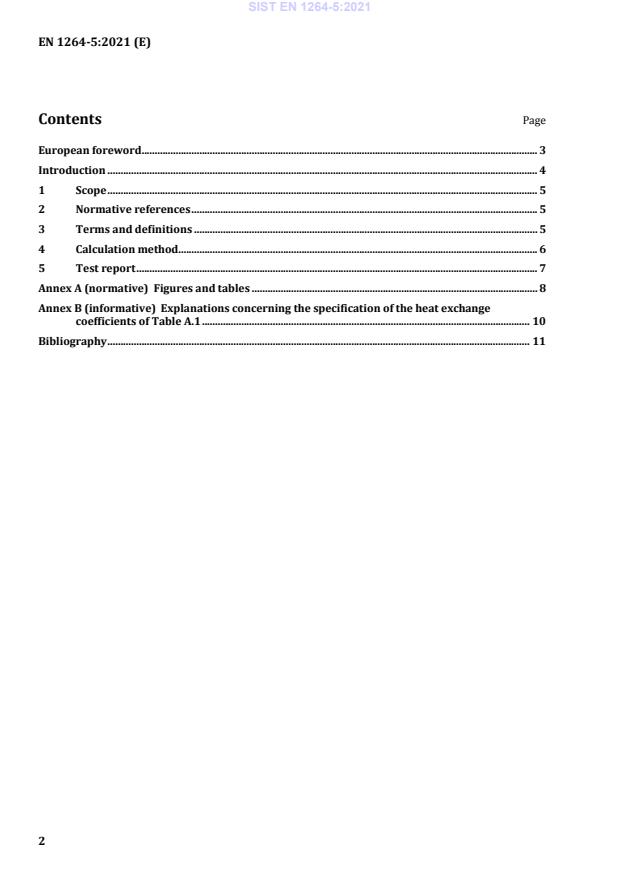
Annex A (normative) Figures and tables . 8
Annex B (informative) Explanations concerning the specification of the heat exchange
coefficients of Table A.1 . 10
Bibliography . 11
European foreword
This document (EN 1264-5:2021) has been prepared by Technical Committee CEN/TC 130 “Space
heating appliances without integral heat sources”, the secretariat of which is held by UNI.
This European Standard shall be given the status of a national standard, either by publication of an
identical text or by endorsement, at the latest by November 2021, and conflicting national standards
shall be withdrawn at the latest by November 2021.
Attention is drawn to the possibility that some of the elements of this document may be the subject of
patent rights. CEN shall not be held responsible for identifying any or all such patent rights.
This document supersedes EN 1264-5:2008.
The main changes compared to the previous edition are listed below:
a) Modification of the Title;
b) Clarification of the Scope;
c) Improved wording, especially the term “prove method”.
EN 1264, Water based surface embedded heating and cooling systems, consists of the following parts:
— Part 1: Definitions and symbols;
— Part 2: Floor heating: Methods for the determination of the thermal output using calculations and
experimental tests;
— Part 3: Dimensioning;
— Part 4: Installation;
— Part 5: Determination of the thermal output for wall and ceiling heating and for floor, wall and ceiling
cooling.
According to the CEN-CENELEC Internal Regulations, the national standards organisations of the
following countries are bound to implement this European Standard: Austria, Belgium, Bulgaria,
Croatia, Cyprus, Czech Republic, Denmark, Estonia, Finland, France, Germany, Greece, Hungary, Iceland,
Ireland, Italy, Latvia, Lithuania, Luxembourg, Malta, Netherlands, Norway, Poland, Portugal, Republic of
North Macedonia, Romania, Serbia, Slovakia, Slovenia, Spain, Sweden, Switzerland, Turkey and the
United Kingdom.
Introduction
The EN 1264 series is based on the realization that in the field of commercial trade the thermal output
of heating and cooling systems represents the basis of rating. In order to be able to evaluate and
compare different heating and cooling systems, it is therefore necessary to refer to values determined
using one single, unambiguously defined method. The basis for doing so are the test methods for the
determination of the thermal output of floor heating systems specified in EN 1264-2. In analogy to
EN 442-2, Radiators and convectors — Part 2: Test methods and rating, this test method provides
characteristic partial load curves under defined boundary conditions as well as the characteristic
output of the system represented by the standard thermal output together with the associated standard
temperature difference between the heating medium and the room temperature.
1 Scope
The EN 1264 series gives guidelines for surface embedded heating and cooling systems installed in
buildings, residential and non-residential (e.g. office, public, commercial and industrial buildings) and
focuses on systems installed for the purpose of thermal comfort.
The EN 1264 series gives guidelines for water based heating and cooling systems embedded into the
enclosure surfaces of the room to be heated or to be cooled. It also specifies the use of other heating
media instead of water, as appropriate.
The EN 1264 series specifies standardized product characteristics by calculation and testing the
thermal output of heating for technical specifications and certification. For the design, construction and
operation of these systems, see EN 1264-3 and EN 1264-4 for the types A, B, C, D, H, I and J. For the
types E, F and G, see the EN ISO 11855 series.
The systems specified in the EN 1264 series are adjoined to the structural base of the enclosure
surfaces of the building, mounted directly or with fixing supports. The EN 1264 series does not specify
ceiling systems mounted in a suspended ceiling with a designed open air gap between the system and
the building structure which allows the thermally induced circulation of the air. The thermal output of
these systems can be determined according to the EN 14037 series and EN 14240.
EN 1264-5 specifies the recalculation of values determined in EN 1264-2 for the system in question. It
enables the conversion of the calculation and measurement results of EN 1264-2 into results for other
surface orientations in the room, i.e. for ceiling and wall heating, as well as for
...