

EN 18191:2026
(Main)Industrial valves - Additional requirements for metallic valves for hydrogen application
- Abstract
This document applies to industrial metallic valves for hydrogen use. It contains recommendations and additional requirements applicable to material selection, design, manufacture, and final assessment.
This document addresses the following four services/damage mechanisms, which might exist in combinations:
— low temperature applications;
— hydrogen environmental embrittlement (HEE) or hydrogen-induced cracking (HIC);
— high temperature hydrogen attack (HTHA);
— hydrogen service with cyclic loads (fatigue).
This document considers the difference between gaseous hydrogen (GH2) and liquid hydrogen (LH2), where necessary.
The additional provisions set out in this document do not cover corrosion such as electro-chemical corrosion of metals under participation of hydrogen (e.g. sour gas).
This document is based on the requirements contained in the standards specified below:
— applications with a maximum allowable pressure PS greater than 0,5 bar in accordance with the European legislation for pressure equipment, the applicable provisions of EN 16668 apply;
— additional requirements for valves in chemical and petrochemical applications are specified in EN 12569;
— additional requirements for valves in gas distribution systems are specified in EN 13774;
— additional requirements for valves in gas transportation systems are specified in EN 14141.
- Status
- Published
- Publication Date
- 15-Jul-2026
- Technical Committee
- CEN/TC 69 - Industrial valves
- Drafting Committee
- CEN/TC 69/WG 19 - Valves for hydrogen applications and network
- Current Stage
- 6060 - Definitive text made available (DAV) - Publishing
- Start Date
- 05-Aug-2026
- Due Date
- 16-Jul-2026
- Completion Date
- 16-Jul-2026

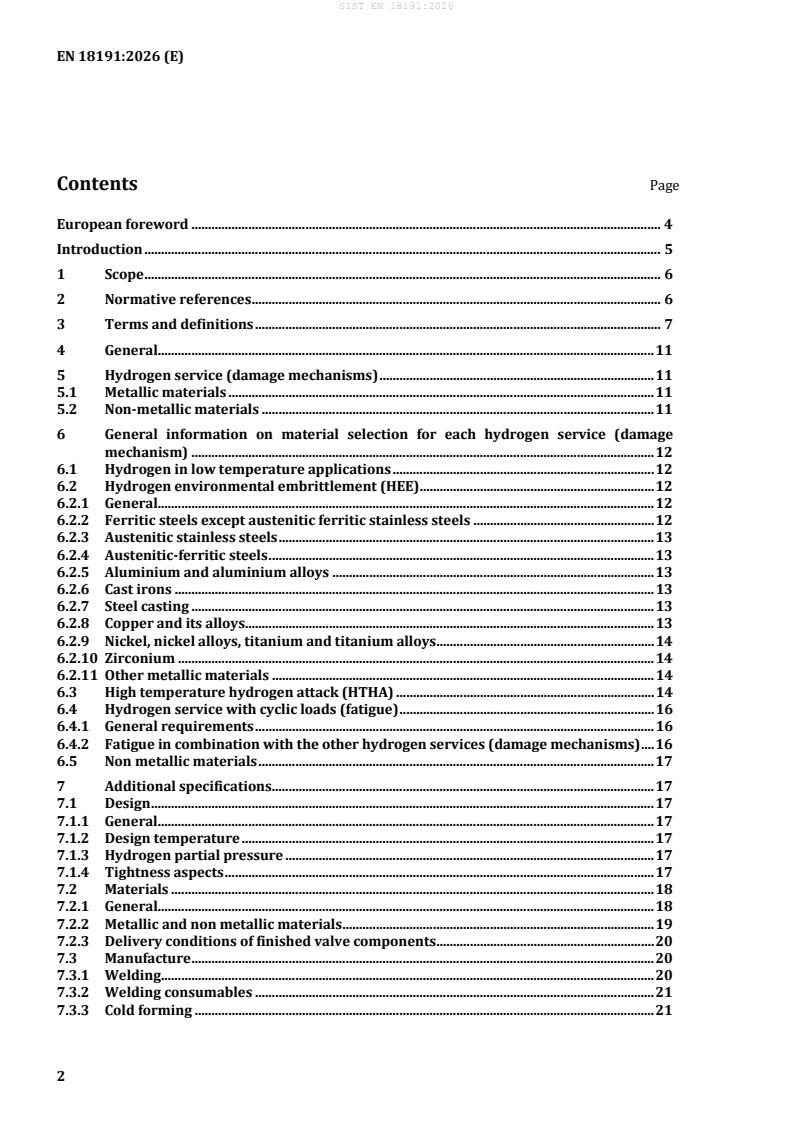
EN 18191:2026 is a CEN European Standard for industrial metallic valves used in hydrogen applications. It sets additional requirements for material selection, design, manufacture, final assessment, tightness testing, and marking, so designers, manufacturers, inspectors, and buyers can judge whether a metallic valve is suitable for hydrogen service. The standard addresses gaseous hydrogen (GH2) and liquid hydrogen (LH2) where needed, with a focus on damage mechanisms that matter in practice.
What does EN 18191:2026 specify?
EN 18191:2026 specifies extra requirements for industrial metallic valves intended for hydrogen use. It is organized around the hydrogen-related risks that can affect valve materials and sealing performance, then turns those risks into design, material, manufacturing, and test provisions.
The document is structured in clauses 1 to 7, followed by three annexes:
- Annex A lists harmonized European industrial valve product standards.
- Annex B gives material information for metallic and non-metallic valve components used in hydrogen applications.
- Annex C gives normative tightness and additional testing requirements, including test category (TC) levels.
| Annex | What it covers |
|---|---|
| Annex A | Harmonized European industrial valve product standards |
| Annex B | Materials for valve components intended for hydrogen applications |
| Annex C | Tightness and additional testing, including TC levels |
The scope focuses on four hydrogen service conditions or damage mechanisms: low temperature applications, hydrogen environmental embrittlement (HEE) or hydrogen-induced cracking (HIC), high temperature hydrogen attack (HTHA), and hydrogen service with cyclic loads (fatigue). It also states that electro-chemical corrosion in hydrogen-containing media, such as sour gas, is outside the additional provisions.
What are the key requirements of EN 18191:2026?
EN 18191:2026 requires the valve design, materials, manufacture, and final assessment to be chosen with the hydrogen service condition in mind. In practice, that means the user must identify the operating temperature, hydrogen partial pressure, load cycling, and the likely sealing and material degradation mechanisms before selecting a valve.
Service condition and risk-based selection
Clause 5 links the hydrogen service to the relevant damage mechanism. The document distinguishes low temperature service, HEE/HIC, HTHA, and fatigue, and uses temperature and hydrogen partial pressure to decide which mechanism is relevant. This matters because the same valve may need different materials or tests depending on whether it sees cold hydrogen, cyclic pressure, or hot hydrogen at pressure.
Material selection by mechanism
Clause 6 gives the main material guidance. For low temperature applications, the selected materials have to be checked for brittle fracture risk. For HEE, the standard gives conservative limits and material-family guidance: ferritic steels, austenitic stainless steels, austenitic-ferritic steels, aluminium alloys, cast irons, steel castings, copper and copper alloys, nickel alloys, titanium, and zirconium are treated differently because their hydrogen response is not the same.
For HEE, austenitic stainless steels in the stated groups must pass the intergranular corrosion test in EN ISO 3651-2:1998, Method A. For austenitic-ferritic steels, cold forming is limited and strain hardening is to be avoided. For copper, only oxygen-free grades are acceptable. For cast iron, lamellar graphite is to be avoided, while ductile cast iron can be used only after suitability evaluation.
HTHA selection and documented basis
For HTHA, Clause 6 requires material selection to follow Figure 1 and Table 2 using the relevant material temperature. The actual metal temperature has to be considered, not just the ambient process temperature, and any rise in operating temperature requires re-verification. Where HTHA is a possible factor, the basis for the material choice has to be recorded in the technical documentation. In practice, this is the part that tells a designer or buyer to document why a specific steel or alloy was chosen for hot hydrogen service.
Fatigue and combined mechanisms
Clause 6 also treats hydrogen service with cyclic loads as a fatigue problem. EN 12516-2:2014+A1:2021, Clause 12 applies for fatigue life assessment, and any reduced design life or cycle limit has to be stated in the accompanying documentation when relevant. When fatigue is combined with low temperature, HEE, or HTHA, the document adds design constraints such as avoiding welded shell constructions where possible and using full-penetration welds in low-load areas if welds cannot be avoided.
Design, tightness, and sealing
Clause 7 requires design verification for the intended hydrogen use and reasonably foreseeable conditions. It says the full temperature range must be considered, and it highlights hydrogen partial pressure as a design parameter. Tightness is treated as a key hydrogen issue: packing must provide positive sealing, foreseeable leakage paths have to be identified in hazard and risk analysis, sealing components must be chosen for long-term tightness, and bellows seals shall not be the sole sealing element against atmosphere.
Manufacture, welding, and final assessment
Clause 7 places strict attention on welding and post-weld condition. Pressure-bearing welds must follow EN 1708-1 and EN 1708-2 and are to be full penetration unless another weld design is qualified. Dissimilar pressure-bearing welds are not permitted, and welding on stems and shafts in the medium-contact area is not permitted. Hardness limits for certain welded valve-shell materials are specified, and the final valve has to be inspected and tested before despatch according to EN 16668, the relevant valve standard, and the applicable application standard.
Annex C adds the test-category system. TC levels 1, 2, and 3 are assigned from the service conditions, valve location, DN, PS/PN, and operation mode. Higher TC levels mean more demanding inspection and testing. For TC 2 and TC 3, the annex includes shell and seat tests, fugitive emissions testing, and additional low-temperature hydrogen tests where relevant.
What terms does EN 18191:2026 define?
EN 18191:2026 defines the terminology it uses so the hydrogen-related requirements can be applied consistently.
- Diffusion - the movement of hydrogen or another fluid through a material or another fluid due to a concentration gradient.
- Fugitive emission - an unplanned leak of a chemical or mixture from equipment on an industrial site.
- Hydrogen environmental embrittlement (HEE) - loss of strength, ductility, or fracture toughness caused by atomic hydrogen entering a susceptible material from the gas environment.
- Hydrogen partial pressure (HPP) - the operating pressure multiplied by the hydrogen fraction in the mixture.
- Liquid hydrogen (LH2) - hydrogen in liquid state.
- Rapid gas decompression (RGD) - a rapid pressure drop that can cause blistering or rupture in polymers.
- Trim - the functional valve components inside the shell that are in contact with the fluid, excluding the shell itself.
Who uses EN 18191:2026?
EN 18191:2026 is used by valve manufacturers, valve designers, material engineers, welding engineers, test laboratories, and quality managers working on hydrogen service valves. It is also relevant for buyers and specification writers who need to define acceptance conditions for hydrogen projects.
In practice, the standard supports work on hydrogen production, processing, storage, transportation, distribution, and end use. It is especially useful when a project has to decide whether a metallic valve material, weld detail, seal, or test program is acceptable for GH2 or LH2 service.
Which standards are used with EN 18191:2026?
EN 18191:2026 is built on other standards that supply the baseline valve rules, testing, welding, and material data.
- EN 16668:2025 - the main baseline for metallic valves as pressure accessories; EN 18191 adds hydrogen-specific requirements to it.
- EN 12266-1 and EN 12266-2 - pressure testing and supplementary testing of metallic valves.
- EN ISO 15848-1 and EN ISO 15848-2 - fugitive emissions type testing and production acceptance testing.
- EN ISO 28921-1 and EN ISO 28921-2 - low-temperature isolating valve requirements and type testing for liquid hydrogen service.
- EN 12516-1, EN 12516-2, and EN 12516-4 - shell strength, fatigue, and shell material-related design rules.
- EN 1011 series, EN 1708-1, EN 1708-2, EN 12074, EN 13479, and EN ISO 15792-1 - welding recommendations, joint details, consumables, and related test methods.
- EN 12569, EN 13774, and EN 14141 - application standards for chemical and petrochemical use, gas distribution, and gas transportation.
- EN 19 - marking of metallic valves.
What does the EN 18191:2026 document contain?
EN 18191:2026 contains a hydrogen-service framework for metallic industrial valves, followed by material guidance, design rules, welding provisions, and final assessment requirements. It includes Table 1 on service and damage mechanisms, Figure 1 and Table 2 for HTHA material selection, and detailed material-overview tables in Annex B.
Annex B is especially practical because it groups materials for shells, trim, wetted sub-components, seals, springs, and hardfacing, and it explains how hydrogen affects metals, polymers, elastomers, permeation, and rapid gas decompression. Annex C contains the test-category system, the mandatory and optional test program, the production and type-test requirements, worked application examples, documentation rules, and the additional marking to apply when TC 2 or TC 3 is used.
Relations
- Effective Date
- 18-Nov-2026
- Effective Date
- 18-Nov-2026
- Effective Date
- 18-Nov-2026
- Effective Date
- 02-Sep-2026
- Effective Date
- 02-Sep-2026
Get Certified
Connect with accredited certification bodies for this standard

DNV
DNV is an independent assurance and risk management provider.

Lloyd's Register
Lloyd's Register is a global professional services organisation specialising in engineering and technology.
DNV Energy Systems
Energy and renewable energy certification.
Sponsored listings
Frequently Asked Questions
EN 18191:2026 is a standard published by the European Committee for Standardization (CEN). Its full title is "Industrial valves - Additional requirements for metallic valves for hydrogen application". This standard covers: This document applies to industrial metallic valves for hydrogen use. It contains recommendations and additional requirements applicable to material selection, design, manufacture, and final assessment. This document addresses the following four services/damage mechanisms, which might exist in combinations: — low temperature applications; — hydrogen environmental embrittlement (HEE) or hydrogen-induced cracking (HIC); — high temperature hydrogen attack (HTHA); — hydrogen service with cyclic loads (fatigue). This document considers the difference between gaseous hydrogen (GH2) and liquid hydrogen (LH2), where necessary. The additional provisions set out in this document do not cover corrosion such as electro-chemical corrosion of metals under participation of hydrogen (e.g. sour gas). This document is based on the requirements contained in the standards specified below: — applications with a maximum allowable pressure PS greater than 0,5 bar in accordance with the European legislation for pressure equipment, the applicable provisions of EN 16668 apply; — additional requirements for valves in chemical and petrochemical applications are specified in EN 12569; — additional requirements for valves in gas distribution systems are specified in EN 13774; — additional requirements for valves in gas transportation systems are specified in EN 14141.
This document applies to industrial metallic valves for hydrogen use. It contains recommendations and additional requirements applicable to material selection, design, manufacture, and final assessment. This document addresses the following four services/damage mechanisms, which might exist in combinations: — low temperature applications; — hydrogen environmental embrittlement (HEE) or hydrogen-induced cracking (HIC); — high temperature hydrogen attack (HTHA); — hydrogen service with cyclic loads (fatigue). This document considers the difference between gaseous hydrogen (GH2) and liquid hydrogen (LH2), where necessary. The additional provisions set out in this document do not cover corrosion such as electro-chemical corrosion of metals under participation of hydrogen (e.g. sour gas). This document is based on the requirements contained in the standards specified below: — applications with a maximum allowable pressure PS greater than 0,5 bar in accordance with the European legislation for pressure equipment, the applicable provisions of EN 16668 apply; — additional requirements for valves in chemical and petrochemical applications are specified in EN 12569; — additional requirements for valves in gas distribution systems are specified in EN 13774; — additional requirements for valves in gas transportation systems are specified in EN 14141.
EN 18191:2026 is classified under the following ICS (International Classification for Standards) categories: 23.060.01 - Valves in general; 27.075 - Hydrogen technologies. The ICS classification helps identify the subject area and facilitates finding related standards.
EN 18191:2026 has the following relationships with other standards: It is inter standard links to EN 736-2:2016, EN 736-3:2008, EN 736-1:2018, EN 13479:2017, EN 12266-2:2012. Understanding these relationships helps ensure you are using the most current and applicable version of the standard.
EN 18191:2026 is associated with the following European legislation: EU Directives/Regulations: 2014/68/EU; Standardization Mandates: M/601. When a standard is cited in the Official Journal of the European Union, products manufactured in conformity with it benefit from a presumption of conformity with the essential requirements of the corresponding EU directive or regulation.
EN 18191:2026 is available in PDF format for immediate download after purchase. The document can be added to your cart and obtained through the secure checkout process. Digital delivery ensures instant access to the complete standard document.
Standards Content (Sample)
Contents
- Introduction
- 1 Scope
- 2 Normative references
- 3 Terms and definitions
- 3.1 diffusion
- 3.2 fugitive emission
- 3.3 gaseous hydrogen
- 3.4 glass transition
- 3.5 glass transition temperature
- 3.6 hardness
- 3.7 high-temperature hydrogen attack
- 3.8 hydrogen
- 3.9 hydrogen applications
- 3.10 hydrogen compatibility
- 3.11 hydrogen environmental embrittlement
- 3.12 hydrogen partial pressure
- 3.13 liquid hydrogen
- 3.14 permeability
- 3.15 permeation
- 3.16 rapid gas decompression
- 3.17 shell
- 3.18 sour gas
- 3.19 trim
- 3.20 wetted sub-components
- 4 General
- 5 Hydrogen service (damage mechanisms)
- 5.1 Metallic materials
- 5.2 Non-metallic materials
- 6 General information on material selection for each hydrogen service (damage
- 6.1 Hydrogen in low temperature applications
- 6.2 Hydrogen environmental embrittlement (HEE)
- 6.3 High temperature hydrogen attack (HTHA)
- 3 Cr – 1 Mo — —
- 6 Cr - 0,5 Mo — —
- 6.4 Hydrogen service with cyclic loads (fatigue)
- 6.5 Non metallic materials
- 7 Additional specifications
- 7.1 Design
- 7.2 Materials
- 7.3 Manufacture
- 7.4 Final assessment
- 7.5 Marking
- Annex A
- Annex B
- Annex C
- 1 Manually operated
- 2 Valve with actuator
- Bibliography
Introduction
Metallic industrial valves are considered as essential pressure accessories in hydrogen applications. They are used in various hydrogen technologies and applications, for example production, processing, storage, transportation, distribution, and usage.
Metallic industrial valves are integral pressure accessories of industrial piping, gas transportation and distribution systems.
CEN/TC 69 worked in cooperation with the following other technical committees: CEN/TC 267, CEN/TC 54, CEN/TC 234 and CEN/TC 235.
This document defines additional requirements for metallic industrial valves for hydrogen application from those in published European standards.
The document is an application standard to provide consolidation of requirements on known and proven solutions for hydrogen applications. Furthermore, it is intended to describe or exclude specific specifications for hydrogen service.
For this purpose, this document addresses damage mechanisms of hydrogen services, which might exist in combinations.
SIST EN 18191:2026 EN 18191:2026 (E)
1 Scope
This document applies to industrial metallic valves for hydrogen use. It contains recommendations and additional requirements applicable to material selection, design, manufacture, and final assessment. This document addresses the following four services/damage mechanisms, which might exist in combinations:
- low temperature applications;
- hydrogen environmental embrittlement (HEE) or hydrogen-induced cracking (HIC);
- high temperature hydrogen attack (HTHA);
- hydrogen service with cyclic loads (fatigue).
This document considers the difference between gaseous hydrogen (GH2) and liquid hydrogen (LH2), where necessary.
The additional provisions set out in this document do not cover corrosion such as electro-chemical corrosion of metals under participation of hydrogen (e.g. sour gas). This document is based on the requirements contained in the standards specified below:
- applications with a maximum allowable pressure PS greater than 0,5 bar in accordance with the European legislation for pressure equipment, the applicable provisions of EN 16668 apply;
- additional requirements for valves in chemical and petrochemical applications are specified in EN 12569;
- additional requirements for valves in gas distribution systems are specified in EN 13774;
- additional requirements for valves in gas transportation systems are specified in EN 14141.
2 Normative references
The following documents are referred to in the text in such a way that some or all of their content constitutes requirements of this document. For dated references, only the edition cited applies. For undated references, the latest edition of the referenced document (including any amendments) applies. EN 19, Industrial valves - Marking of metallic valves EN 736-1, Valves - Terminology - Part 1: Definition of types of valves EN 736-2, Valves - Terminology - Part 2: Definition of components of valves EN 736-3, Valves - Terminology - Part 3: Definition of terms EN 1011 (all parts), Welding - Recommendations for welding of metallic materials EN 1708-1, Welding - Basic welded joint details in steel - Part 1: Pressurized components EN 1708-2, Welding - Basic weld joint details in steel - Part 2: Non internal pressurized components EN 1976, Copper and copper alloys - Cast unwrought copper products
SIST EN 18191:2026 EN 18191:2026 (E) EN 12074, Welding consumables - Quality requirements for manufacture, supply and distribution of consumables for welding and allied processes EN 12266-1, Industrial valves - Testing of metallic valves - Part 1: Pressure tests, test procedures and acceptance criteria - Mandatory requirements EN 12266-2, Industrial valves - Testing of metallic valves - Part 2: Tests, test procedures and acceptance criteria - Supplementary requirements EN 13479, Welding consumables - General product standard for filler metals and fluxes for fusion welding of metallic materials EN 16668:2025, Industrial valves - Requirements and testing for metallic valves as pressure accessories EN ISO 3651-2:1998, Determination of resistance to intergranular corrosion of stainless steels - Part 2:
Ferritic, austenitic and ferritic-austenitic (duplex) stainless steels - Corrosion test in media containing sulfuric acid (ISO 3651-2:1998) EN ISO 15792-1, Welding consumables - Test methods - Part 1: Preparation of all-weld metal test pieces and specimens in steel, nickel and nickel alloys (ISO 15792-1) EN ISO 15848-1:2015, Industrial valves - Measurement, test and qualification procedures for fugitive emissions - Part 1: Classification system and qualification procedures for type testing of valves (ISO 15848- 1:2015) EN ISO 15848-2, Industrial valves - Measurement, test and qualification procedures for fugitive emissions - Part 2: Production acceptance test of valves (ISO 15848-2) EN ISO 28921-1, Industrial valves - Isolating valves for low-temperature applications - Part 1: Design, manufacturing and production testing (ISO 28921-1) EN ISO 28921-2, Industrial valves - Isolating valves for low-temperature applications - Part 2: Type testing (ISO 28921-2)
3 Terms and definitions
For the purposes of this document, the terms and definitions given in EN 736-1, EN 736-2, EN 736-3 and the following apply.
ISO and IEC maintain terminology databases for use in standardization at the following addresses:
- ISO Online browsing platform: available at https://www.iso.org/obp/
- IEC Electropedia: available at https://www.electropedia.org/
3.1 diffusion
flux of a fluid through another fluid or material due to concentration gradient EXAMPLE The motion of hydrogen gas through air, or the movement of hydrogen gas through the wall of a rubber hose.
Note 1 to entry: The diffusion coefficient is the mass of material diffusing across a unit of area in a unit of time at a unit concentration gradient.
SIST EN 18191:2026 EN 18191:2026 (E) [SOURCE: ISO/TR 15916:2015, 3.29]
3.2 fugitive emission
chemical or mixture of chemicals, in any physical form, which represents an unanticipated or spurious leak from equipment on an industrial site [SOURCE: EN ISO 15848-1:2015, 3.5]
3.3 gaseous hydrogen
hydrogen under gaseous form [SOURCE: ISO 14687:2019, 3.10]
3.4 glass transition
reversible change in an amorphous polymer or in amorphous regions of a partially crystalline polymer from (or to) a viscous or rubbery condition to (or from) a hard and relatively brittle one [SOURCE: EN ISO 472:2013, 2.440]
3.5 glass transition temperature
Tg approximate midpoint of the temperature range over which the glass transition takes place Note 1 to entry: The glass transition temperature varies significantly, depending upon the specific property and the test method and conditions selected to measure it.
Note 2 to entry: The glass transition temperatures of polymers and elastomers describe the temperature ranges at which polymers and elastomers turn from a hard, brittle material (below Tg) to a ductile or elastic material (above or equal Tg).
[SOURCE: EN ISO 472:2013, 2.441, modified— Symbol “Tg” added, Note 2 to entry added]
3.6 hardness
property of a material involving resistance to indentation, deformation, and/or abrasion Note 1 to entry: It is measured as yield strength, work hardening, true tensile strength, modulus of elasticity, and other material characteristics.
3.7 high-temperature hydrogen attack
HTHA damage mechanism which results from exposure of steels to hydrogen gas at elevated temperatures and pressures; dissociated hydrogen atoms react with carbon and carbides in the steel to form CH4
3.8 hydrogen
colourless, odourless, tasteless and flammable substance that is the simplest chemical element in the periodic table.
SIST EN 18191:2026 EN 18191:2026 (E)
3.9 hydrogen applications
wide range of industrial processes handling hydrogen in the physical state gaseous or liquified and gas mixtures with H in various concentrations
3.10 hydrogen compatibility
ability of a material to exhibit and maintain reliable mechanical integrity and low probability of failure, or leakage, in hydrogen applications within accepted risk parameters Note 1 to entry: Hydrogen compatibility is a function of material susceptibility, application, applied stress and environment.
3.11 hydrogen environmental embrittlement
HEE loss in strength, ductility, and/or fracture toughness of susceptible materials due to the penetration and diffusion of atomic hydrogen resulting from gaseous environment that can lead to brittle cracking Note 1 to entry: The term HEE is more appropriate to describe these phenomena, but in some parts of the industries it might be referred to as hydrogen induced cracking (HIC).
3.12 hydrogen partial pressure
HPP total operating pressure multiplied by mole fraction or percentage volume of hydrogen Note 1 to entry: HPP is calculated as the mole fraction of hydrogen multiplied by the total pressure of the mixture.
3.13 liquid hydrogen
hydrogen that has been liquefied, i.e. brought to a liquid state [SOURCE: ISO 14687:2019, 3.1.15]
3.14 permeability
rate of transmission of a pressurized gas through a material [SOURCE: ISO/TR 15916:2015, 3.78]
3.15 permeation
flow of a media through another (usually solid) material by diffusion without a defect or opening of the latter Note 1 to entry: To be distinguished from leak flow which is not based on diffusion. [SOURCE: ISO/TR 15916:2015, 3.79]
SIST EN 18191:2026 EN 18191:2026 (E)
3.16 rapid gas decompression
RGD depressurization explosive decompression rapid pressure-drop in a high pressure gas-containing system which disrupts the equilibrium between external gas pressure and the concentration of gas dissolved inside any polymer, with the result that excess gas tries to escape from the solution at points throughout the material, causing expansion Note 1 to entry: If large enough, and if the pressure drop rate is faster than the natural gas diffusion rate, blistering or rupturing can occur.
[SOURCE: ISO 23936-2:2011, 3.1.10]
3.17 shell
pressure containing envelope of the valve Note 1 to entry: It normally comprises the body and when included in the design a bonnet or cover and the body. [SOURCE: EN 736-2:2016, 3.1]
3.18 sour gas
gas containing significant amount of acid gases such as carbon dioxide and sulphur compounds Note 1 to entry: Sour gas is failing the qualification as pipeline quality natural gas due to the inclusion of undesirable components such as hydrogen sulfide (H S) or carbon dioxide in significantly greater amounts than those quoted
for pipeline quality natural gas.
[SOURCE: EN ISO 14532:2017, 2.1.1.8, modified — Notes to entry removed and new Note 1 to entry added
3.19 trim
functional components of a valve excluding the shell components which are in contact with the fluid inside the valve Note 1 to entry: The components are specified in the relevant product standards. Table B.1 provides an overview. Note 2 to entry: Metallic trim components are categorized into two subgroups, based on the requirement that the component is under an applied stress for the effect of hydrogen degradation of metallic materials to occur:
- loaded: trim components that are under tension or torsion, that is either constant or cyclic;
- other: all other trim components, either with no applied load or in compression. [SOURCE: EN 736-2:2016, 3.2, modified — Note 1 and Note 2 to entry added]
3.20 wetted sub-components
components fitted inside a valve exposed to or in direct contact with the medium, that do not fall under the definition of trim nor shell
SIST EN 18191:2026 EN 18191:2026 (E)
4 General
This document does not claim to define or restrict hydrogen applications as intended use in detail. It considers hydrogen use applications as wide range of industrial processes handling hydrogen. In the sense of an intended use, awareness should be given to the applicability of the specifications in this document with regard to the selection of material, specific design considerations, specific manufacturing processes and final assessment (testing and inspection).
Furthermore, the requirements of EN 16668 and, in addition, those of the respective application standard as well as the relevant harmonized European valve standards listed in Annex A are considered. The performance and life of valves that are exposed to hydrogen for long periods may be, among others, limited by material characteristics that increase the susceptibility of metals to absorption and permeation of hydrogen. To achieve an optimum between design life and service life of hydrogen-exposed valve components, detailed analysis of operating conditions, appropriate selection of materials, suitable valve design and effective quality control during all stages of engineering, processing and manufacturing are therefore recommended. effective maintenance and monitoring are additional factors to consider. Material groups used in this document are according to CEN ISO/TR 15608, EN 12516-1:2014+A1:2018, Annex B, and EN 1092-1:2018, Annex B.
NOTE Further information on material groups and corresponding materials are provided in CEN ISO/TR 20172.
5 Hydrogen service (damage mechanisms)
5.1 Metallic materials
Table 1 summarizes the services considered in this document. It contains damage mechanisms caused by hydrogen (HEE, HTHA) or applications in combination with hydrogen which require additional measures.
NOTE In Table 1 the temperature of 170 °C as lower limit of HTHA considers a safety margin of 30 °C. Table 1 — Summary of services Service/damage Hydrogen in low Hydrogen High Hydrogen mechanism temperature Environmental Temperature service with b application Embrittlement Hydrogen cyclic loads a,c (HEE) Attack (HTHA) (fatigue) Temperature −253 °C ≤ TS < −150 °C −150 °C ≤ TS < 170 °C TS ≥ 170 °C all Hydrogen All pressures p (H ) > 1 bar p (H ) > 3,5 bar p (H ) > 1 bar 2 2 2 partial pressure a HEE typically occurs up to a temperature of 150 °C. The temperature of 170 °C is specified to close the gap between HEE and HTHA.
b In accordance with EN 13445-3:2021, Clause 17 and 18.
For nickel and nickel alloys HEE can also occur at temperatures above 170 °C.
5.2 Non-metallic materials
Non-metallic materials exhibit varying behaviour in the presence of hydrogen service. The damaging mechanisms in the presence of hydrogen are different from those for metallic materials. Some general information has been included in Annex B.
SIST EN 18191:2026 EN 18191:2026 (E)
6 General information on material selection for each hydrogen service (damage
mechanism)
6.1 Hydrogen in low temperature applications
The proneness to brittle fracture of the selected materials shall be evaluated for the respective application.
For multiple process operation modes (e.g. H2 purging, cool-down, warm-up…), other requirements linked to HEE, HTHA damage mechanism that may apply shall be evaluated. NOTE Hydrogen plants to low temperature covered by EN 13445, EN 13480, Annex B method 2 are in safe operation for years. The influence of hydrogen to the transition temperature is investigated in separate scientific projects.
Unless there is any other information available, a limitation to −40 °C (NL1) and to −50 °C (NL2) is considered sound engineering practice according to harmonized material standards for plates, pipes and forging.
6.2 Hydrogen environmental embrittlement (HEE)
6.2.1 General
Materials shall be selected for industrial valves intended for hydrogen applications. In the following clauses, materials according to harmonized European material standards are considered.
6.2.2 Ferritic steels except austenitic ferritic stainless steels
Here are listed the main metallic materials:
a) Materials of group 1.1, 1.2 (3E0, 7E0, 7E1) and 1.2 (3E1, 8E2, 8E3):
- The nominal minimum yield strength shall be less than or equal to 370 MPa with a nominal minimum tensile strength less than or equal to 620 MPa as defined within the applicable material standard.
- Materials of group 1.1, 1.2 (3E0, 7E0, 7E1) and 1.2 (3E1, 8E2, 8E3) are suitable for hydrogen applications.
NOTE 1 Values for yield strength or tensile strength are nominal values as per material standard at room temperature.
b) Materials of group 5.1 (5E0), 5.2 (6E0) and 9.1 (7E2, 7E3): Materials belonging to these groups are suitable for hydrogen applications.
c) Material of group 6.3 (-) 20CrMoV13-5-5 (1.7779): Materials belonging to this group can be susceptible to hydrogen embrittlement and should be evaluated for application. NOTE 2 More information can be found in Annex B, Table B.2.
d) Material of group 9.2 (7E3) namely 12Ni14 (1.5637) may be considered, provided the application temperatures do not exceed 50°C and no welding takes place on the parent material. NOTE 3 The advice can also be found in Table B.2.
SIST EN 18191:2026 EN 18191:2026 (E)
6.2.3 Austenitic stainless steels
Materials of group 8.1 (11E0, 12E0, 13E0, 13E1, 14E0, 15E0) and 8.2 (13E0) are suitable for hydrogen applications.
All materials of group 8.1 and 8.2 shall satisfactorily pass intergranular corrosion test (ICC) according to EN ISO 3651-2:1998, Method A.
NOTE The intergranular corrosion test can be replaced by other methods to demonstrate a proper microstructure.
6.2.4 Austenitic-ferritic steels
Austenitic-ferritic steels of group 10.1 such as 1.4462 (16E0) are suitable for hydrogen applications if cold forming is below 5 %. During processing, strain-hardening shall be avoided.
6.2.5 Aluminium and aluminium alloys
Aluminium alloys as specified in EN 12516-4 are suitable for hydrogen dry environment applications otherwise additional provisions should be addressed. In case the aluminium alloy EN AW 6061 is used for welded constructions, it is susceptible to hydrogen embrittlement.
6.2.6 Cast irons
The use of cast iron containing lamellar graphite shall be avoided. Ductile cast iron may be selected based on suitability evaluation if product and application standards provide for it.
6.2.7 Steel casting
Steel castings according to EN 10213 are suitable for hydrogen applications, whereby the requirements mentioned for the corresponding material groups in this document shall be considered. Due to the nature of casting a higher porosity can be expected. Adverse effects of porosity (e.g. leakage) need to be considered. A sound casting design is crucial to enable foundries to achieve a high and reproducible casting quality, especially around large changes in thickness. Castings shall not be peened, plugged or impregnated.
NOTE Good manufacturing practice on casting quality and NDT can be found in EN 16668:2025, Annex E.
6.2.8 Copper and its alloys
Copper (material group 31 according to CEN ISO/TR 15608), and its alloys (material group 32-38 according to CEN ISO/TR 15608) can be embrittled in hydrogen gas due to a reaction between dissolved hydrogen and oxygen (either in solution or from oxides) to form water, resulting in pores that promote material failure. For this reason, the use of copper shall be limited to oxygen-free grades only. For copper alloys (material groups 32-38 according to CEN ISO/TR 15608), the effect of deoxidation and oxygen binding is achieved through alloying elements, so these material groups show no sensitivity to hydrogen. The oxygen content shall be controlled so that the material conforms to the hydrogen embrittlement requirements in accordance with EN 1976.
Some copper and its alloys (i.e. bronze, brass) are specified in EN 12516-4. NOTE More information on copper and its alloys can be found in EIGA IGC Doc 121/14 and ISO/TR 15916.
SIST EN 18191:2026 EN 18191:2026 (E)
...