


EN ISO 21856:2022
(Main)Assistive products - General requirements and test methods (ISO 21856:2022)
Assistive products - General requirements and test methods (ISO 21856:2022)
This document specifies general requirements and test methods for assistive products, considered to be medical devices, intended for use to alleviate or compensate for a disability.
This document does not apply to assistive products which achieve their intended purpose by administering pharmaceutical substances to the user.
NOTE 1 Assistive products are considered to be medical devices in some jurisdictions but not in others.
NOTE 2 Requirements and test methods for particular types of assistive products are given in other International Standards, e.g. see Reference [33].
NOTE 3 Not all the items listed in ISO 9999 are medical devices. Contracting parties might wish to consider if this document or specific clauses or subclauses can be used for assistive products that are not medical devices.
Hilfsmittel - Allgemeine Anforderungen und Prüfverfahren (ISO 21856:2022)
Dieses Dokument legt allgemeine Anforderungen und Prüfverfahren für Hilfsmittel fest, die als Medizinprodukte angesehen werden und zur Linderung oder zum Ausgleich einer Behinderung eingesetzt werden.
Dieses Dokument ist nicht anwendbar für Hilfsmittel, deren Zweckbestimmung es ist, dem Anwender pharmazeutische Substanzen zu verabreichen.
ANMERKUNG 1 Hilfsmittel gelten in einigen Rechtsordnungen als Medizinprodukte, in anderen nicht.
ANMERKUNG 2 Anforderungen und Prüfverfahren für bestimmte Hilfsmitteltypen werden in anderen Internationalen Normen behandelt, siehe z. B. Verweisung [33].
ANMERKUNG 3 Nicht alle der in ISO 9999 aufgeführten Gegenstände sind Medizinprodukte. Vertragspartner können erwägen, ob dieses Dokument oder bestimmte Abschnitte oder Unterabschnitte davon zur Festlegung von Hilfsmitteln, die nicht als Medizinprodukte eingestuft sind, herangezogen werden können.
Produits d’assistance - Exigences générales et méthodes d’essai (ISO 21856:2022)
Le présent document spécifie les exigences générales et les méthodes d’essai applicables aux produits d’assistance, considérés comme des dispositifs médicaux, destinés à soulager ou à compenser une incapacité.
Le présent document ne s’applique pas aux produits d’assistance dont la destination implique d’administrer à l’utilisateur des substances pharmacologiques.
NOTE 1 Les produits d’assistance sont considérés comme des dispositifs médicaux dans certaines régions, mais pas dans d’autres.
NOTE 2 Les exigences et les méthodes d’essai relatives à des types de produits d’assistance précis sont fournies dans d’autres Normes internationales, voir par exemple la Référence [33].
NOTE 3 Les articles énumérés dans l’ISO 9999 ne sont pas tous des dispositifs médicaux. Les parties contractantes peuvent souhaiter réfléchir à l’utilisation éventuelle du présent document, ou certains articles ou paragraphes peuvent être utilisés pour des produits d’assistance qui ne sont pas des dispositifs médicaux.
Tehnični pripomočki - Splošne zahteve in preskusne metode (ISO 21856:2022)
Ta evropski standard določa splošne zahteve in preskusne metode za tehnične pripomočke za invalidne osebe, ki so medicinski pripomočki v skladu z opredelitvijo iz Direktive 93/42/EGS.
Ta evropski standard se ne uporablja za tehnične pripomočke, katerih predvideni namen je dovajanje farmacevtskih sredstev uporabniku.
Kadar v zvezi s posebnimi vrstami tehničnih pripomočkov obstajajo drugi evropski standardi, se uporabljajo slednji. Vendar lahko še vedno veljajo nekatere zahteve iz tega standarda in se upoštevajo poleg zahtev iz drugih evropskih standardov.
OPOMBA: Nekateri pripomočki, ki so navedeni v standardu EN ISO 9999, niso medicinski pripomočki. Pogodbene stranke lahko preučijo, ali je ta standard oziroma dele tega standarda mogoče uporabiti za tehnične pripomočke, ki v Direktivi EU 93/42/EGS niso opredeljeni kot medicinski pripomočki.
General Information
- Status
- Published
- Publication Date
- 19-Jul-2022
- Withdrawal Date
- 30-Jan-2023
- Technical Committee
- CEN/TC 293 - Technical aids for disabled persons
- Drafting Committee
- CEN/TC 293 - Technical aids for disabled persons
- Current Stage
- 6060 - Definitive text made available (DAV) - Publishing
- Start Date
- 20-Jul-2022
- Completion Date
- 20-Jul-2022
Not Harmonized93/42/EEC - Medical devices
Relations
- Effective Date
- 27-Jul-2022
- Effective Date
- 30-May-2018
- Effective Date
- 09-Feb-2026
- Effective Date
- 09-Feb-2026
- Effective Date
- 09-Feb-2026
- Effective Date
- 09-Feb-2026
- Effective Date
- 09-Feb-2026
- Effective Date
- 09-Feb-2026
- Effective Date
- 09-Feb-2026
- Effective Date
- 09-Feb-2026
- Effective Date
- 09-Feb-2026
- Effective Date
- 09-Feb-2026
- Effective Date
- 09-Feb-2026
- Effective Date
- 09-Feb-2026
- Effective Date
- 09-Feb-2026
Overview
EN ISO 21856:2022 - Assistive products - General requirements and test methods (ISO 21856:2022) provides a unified, practical framework of general requirements and standardized test methods for assistive products that are considered medical devices in some jurisdictions. The standard applies to devices intended to alleviate or compensate for a disability, but excludes products that fulfil their purpose by administering pharmaceutical substances. Note that not all items in ISO 9999 are medical devices; EN ISO 21856 can be applied selectively where relevant.
Key topics and technical requirements
The standard covers broad safety, performance and documentation topics relevant to designers, manufacturers and test laboratories, including:
- Risk analysis and risk management for intended use and foreseeable misuse
- Intended performance and technical documentation, including clinical evaluation and investigations
- Materials: flammability, biocompatibility, contaminants, resistance to corrosion and microbiological contamination
- Mechanical safety: load limits, moving parts, prevention of traps, fastening and immobilising means, means to prevent falling out
- Electrical safety and EMC: battery indicators, electrical heating elements, ingress protection for liquids/particulates, wiring and pendant controls
- Acoustics and vibration: emitted sound levels and audible warning device characteristics
- Sterility and infection control: sterilization processes, maintenance of sterility, cleaning and machine-washable product requirements
- Usability and accessibility: design considerations for users with sensory or cognitive impairments and feedback mechanisms
- Test methods and pass/fail criteria for overflow, spillage, leakage, surface temperature and other hazards
Applications and who uses this standard
EN ISO 21856:2022 is intended for:
- Manufacturers and product developers of assistive technologies to design safe, compliant products
- Test laboratories and conformity assessment bodies performing verification and validation testing
- Regulatory authorities and procurement teams assessing device safety and performance for market access or purchasing decisions
- Clinicians, rehabilitation engineers and service providers who specify or evaluate assistive products for users
- Standards committees and policy makers harmonizing accessibility and medical device requirements
Practical uses include product design validation, risk management documentation, pre-market testing, clinical evaluation planning, and establishing cleaning/sterilization protocols.
Related standards
- ISO 9999 (classification of assistive products) - referenced for product categories
- Other product-specific International Standards (for particular types of assistive products) - consult the normative references in EN ISO 21856 for applicable specialized requirements
Keywords: EN ISO 21856:2022, assistive products, general requirements, test methods, medical devices, accessibility, ISO 21856, risk management.


Get Certified
Connect with accredited certification bodies for this standard

BSI Group
BSI (British Standards Institution) is the business standards company that helps organizations make excellence a habit.

TÜV Rheinland
TÜV Rheinland is a leading international provider of technical services.

TÜV SÜD
TÜV SÜD is a trusted partner of choice for safety, security and sustainability solutions.
Sponsored listings
Frequently Asked Questions
EN ISO 21856:2022 is a standard published by the European Committee for Standardization (CEN). Its full title is "Assistive products - General requirements and test methods (ISO 21856:2022)". This standard covers: This document specifies general requirements and test methods for assistive products, considered to be medical devices, intended for use to alleviate or compensate for a disability. This document does not apply to assistive products which achieve their intended purpose by administering pharmaceutical substances to the user. NOTE 1 Assistive products are considered to be medical devices in some jurisdictions but not in others. NOTE 2 Requirements and test methods for particular types of assistive products are given in other International Standards, e.g. see Reference [33]. NOTE 3 Not all the items listed in ISO 9999 are medical devices. Contracting parties might wish to consider if this document or specific clauses or subclauses can be used for assistive products that are not medical devices.
This document specifies general requirements and test methods for assistive products, considered to be medical devices, intended for use to alleviate or compensate for a disability. This document does not apply to assistive products which achieve their intended purpose by administering pharmaceutical substances to the user. NOTE 1 Assistive products are considered to be medical devices in some jurisdictions but not in others. NOTE 2 Requirements and test methods for particular types of assistive products are given in other International Standards, e.g. see Reference [33]. NOTE 3 Not all the items listed in ISO 9999 are medical devices. Contracting parties might wish to consider if this document or specific clauses or subclauses can be used for assistive products that are not medical devices.
EN ISO 21856:2022 is classified under the following ICS (International Classification for Standards) categories: 11.180.01 - Aids for disabled and handicapped persons in general. The ICS classification helps identify the subject area and facilitates finding related standards.
EN ISO 21856:2022 has the following relationships with other standards: It is inter standard links to EN ISO 16201:2006, EN 12182:2012, ISO 12952-1:2010, IEC 60332-1-2:2004, ISO 24415-1:2009, ISO 20417:2021, ISO 3746:2010, IEC 60601-2-35:2020, ISO 11135:2014, ISO 11607-1:2019, ISO 12100:2010, ISO 15223-1:2021, ISO 24415-2:2011, ISO 11137-2:2013, ISO 12952-2:2010. Understanding these relationships helps ensure you are using the most current and applicable version of the standard.
EN ISO 21856:2022 is associated with the following European legislation: EU Directives/Regulations: 2007/47/EC, 93/42/EEC; Standardization Mandates: M/295. When a standard is cited in the Official Journal of the European Union, products manufactured in conformity with it benefit from a presumption of conformity with the essential requirements of the corresponding EU directive or regulation.
EN ISO 21856:2022 is available in PDF format for immediate download after purchase. The document can be added to your cart and obtained through the secure checkout process. Digital delivery ensures instant access to the complete standard document.
Standards Content (Sample)
SLOVENSKI STANDARD
01-september-2022
Nadomešča:
SIST EN 12182:2012
SIST EN ISO 16201:2006
Tehnični pripomočki - Splošne zahteve in preskusne metode (ISO 21856:2022)
Assistive products - General requirements and test methods (ISO 21856:2022)
Hilfsmittel - Allgemeine Anforderungen und Prüfverfahren (ISO 21856:2022)
Produits d’assistance - Exigences générales et méthodes d’essai (ISO 21856:2022)
Ta slovenski standard je istoveten z: EN ISO 21856:2022
ICS:
11.180.01 Pripomočki za Aids for disabled and
onesposobljene in handicapped persons in
hendikepirane osebe na general
splošno
2003-01.Slovenski inštitut za standardizacijo. Razmnoževanje celote ali delov tega standarda ni dovoljeno.
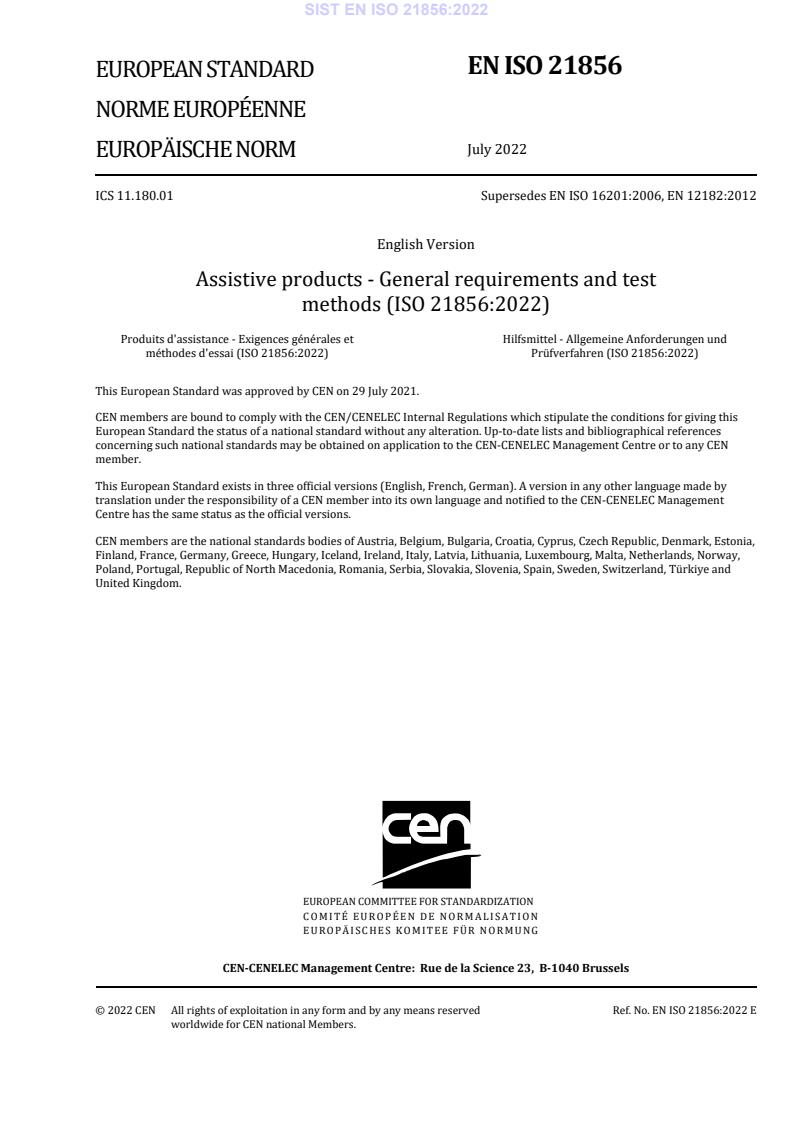
EN ISO 21856
EUROPEAN STANDARD
NORME EUROPÉENNE
July 2022
EUROPÄISCHE NORM
ICS 11.180.01 Supersedes EN ISO 16201:2006, EN 12182:2012
English Version
Assistive products - General requirements and test
methods (ISO 21856:2022)
Produits d'assistance - Exigences générales et Hilfsmittel - Allgemeine Anforderungen und
méthodes d'essai (ISO 21856:2022) Prüfverfahren (ISO 21856:2022)
This European Standard was approved by CEN on 29 July 2021.
CEN members are bound to comply with the CEN/CENELEC Internal Regulations which stipulate the conditions for giving this
European Standard the status of a national standard without any alteration. Up-to-date lists and bibliographical references
concerning such national standards may be obtained on application to the CEN-CENELEC Management Centre or to any CEN
member.
This European Standard exists in three official versions (English, French, German). A version in any other language made by
translation under the responsibility of a CEN member into its own language and notified to the CEN-CENELEC Management
Centre has the same status as the official versions.
CEN members are the national standards bodies of Austria, Belgium, Bulgaria, Croatia, Cyprus, Czech Republic, Denmark, Estonia,
Finland, France, Germany, Greece, Hungary, Iceland, Ireland, Italy, Latvia, Lithuania, Luxembourg, Malta, Netherlands, Norway,
Poland, Portugal, Republic of North Macedonia, Romania, Serbia, Slovakia, Slovenia, Spain, Sweden, Switzerland, Türkiye and
United Kingdom.
EUROPEAN COMMITTEE FOR STANDARDIZATION
COMITÉ EUROPÉEN DE NORMALISATION
EUROPÄISCHES KOMITEE FÜR NORMUNG
CEN-CENELEC Management Centre: Rue de la Science 23, B-1040 Brussels
© 2022 CEN All rights of exploitation in any form and by any means reserved Ref. No. EN ISO 21856:2022 E
worldwide for CEN national Members.
Contents Page
European foreword . 3
European foreword
This document (EN ISO 21856:2022) has been prepared by Technical Committee ISO/TC 173 "Assistive
products" in collaboration with Technical Committee CEN/TC 293 “Assistive products and accessibility”
the secretariat of which is held by SIS.
This European Standard shall be given the status of a national standard, either by publication of an
identical text or by endorsement, at the latest by January 2023, and conflicting national standards shall
be withdrawn at the latest by January 2023.
Attention is drawn to the possibility that some of the elements of this document may be the subject of
patent rights. CEN shall not be held responsible for identifying any or all such patent rights.
This document supersedes EN ISO 16201:2006 and EN 12182:2012.
Any feedback and questions on this document should be directed to the users’ national standards
body/national committee. A complete listing of these bodies can be found on the CEN website.
According to the CEN-CENELEC Internal Regulations, the national standards organizations of the
following countries are bound to implement this European Standard: Austria, Belgium, Bulgaria,
Croatia, Cyprus, Czech Republic, Denmark, Estonia, Finland, France, Germany, Greece, Hungary, Iceland,
Ireland, Italy, Latvia, Lithuania, Luxembourg, Malta, Netherlands, Norway, Poland, Portugal, Republic of
North Macedonia, Romania, Serbia, Slovakia, Slovenia, Spain, Sweden, Switzerland, Türkiye and the
United Kingdom.
Endorsement notice
The text of ISO 21856:2022 has been approved by CEN as EN ISO 21856:2022 without any modification.
INTERNATIONAL ISO
STANDARD 21856
First edition
2022-07
Assistive products — General
requirements and test methods
Produits d’assistance — Exigences générales et méthodes d’essai
Reference number
ISO 21856:2022(E)
ISO 21856:2022(E)
© ISO 2022
All rights reserved. Unless otherwise specified, or required in the context of its implementation, no part of this publication may
be reproduced or utilized otherwise in any form or by any means, electronic or mechanical, including photocopying, or posting on
the internet or an intranet, without prior written permission. Permission can be requested from either ISO at the address below
or ISO’s member body in the country of the requester.
ISO copyright office
CP 401 • Ch. de Blandonnet 8
CH-1214 Vernier, Geneva
Phone: +41 22 749 01 11
Email: copyright@iso.org
Website: www.iso.org
Published in Switzerland
ii
ISO 21856:2022(E)
Contents Page
Foreword . vi
Introduction .vii
1 Scope . 1
2 Normative references . 1
3 Terms and definitions . 3
4 General requirements . 7
4.1 Risk analysis and management. 7
4.2 Intended performance and technical documentation . 8
4.3 Clinical evaluation and investigation . 8
4.4 Assistive products that can be dismantled . 8
4.5 Fasteners . 8
4.6 Load limits . 8
4.7 Immobilising means . 9
4.8 Usability . 9
4.9 Design requirements in relation to persons with sensory and cognitive
impairments . 9
4.10 Considerations for accessibility . 9
4.11 Feedback . 9
5 Materials . 9
5.1 General . 9
5.2 Flammability . 9
5.2.1 General . 9
5.2.2 Upholstered parts, mattresses, bed bases, bedding and textiles . 10
5.2.3 Polymeric parts . 11
5.2.4 Electrical components . 11
5.2.5 Wiring . 11
5.3 Biocompatibility and toxicity . 11
5.4 Contaminants and residues . 12
5.4.1 General .12
5.4.2 Substances that can leak from an assistive product in intended use and in
fault conditions .12
5.5 Infection and microbiological contamination .12
5.5.1 Introduction . 12
5.5.2 Cleaning and disinfection .12
5.5.3 Machine washable assistive products .13
5.5.4 Animal tissue . 14
5.6 Resistance to corrosion . 14
6 Emitted sound and vibration .14
6.1 Noise and vibration . 14
6.2 Sound levels and frequencies of audible warning devices. 14
7 Electromagnetic compatibility .15
8 Electrical safety .15
8.1 General . 15
8.2 Battery powered assistive products - Charge level indicator . 15
8.3 Electrically heated blankets, pads and similar flexible heating appliances .15
8.4 Ingress of liquids or particulate matter . 15
8.4.1 Ingress of liquids . 15
8.4.2 Ingress of particulate matter . 16
8.5 Pendant controls . 16
9 Overflow, spillage, leakage and ingress of liquids .16
9.1 Overflow . 16
iii
ISO 21856:2022(E)
9.1.1 Requirements . 16
9.1.2 Test method . 16
9.2 Spillage . . 17
9.2.1 Requirements . 17
9.2.2 Test method . 17
9.3 Leakage . 17
9.4 Ingress of liquids . . . 17
9.4.1 Requirements . 17
9.4.2 Test method . 17
10 Surface temperature . .17
11 Sterility .18
11.1 Sterility requirements . 18
11.2 Sterilization processes . 18
11.3 Maintenance of sterility in transit . 19
12 Safety of moving parts .19
12.1 Squeezing . 19
12.2 Mechanical wear .20
12.3 Emergency stopping functions .20
13 Means to prevent falling out .20
13.1 General . 20
13.2 Protection against inadvertent user falls in relation to side rails . 20
14 Prevention of traps for parts of the human body .22
14.1 Holes and clearances . 22
14.2 V-shaped openings . 23
15 Folding and locking mechanisms .23
15.1 General .23
15.2 Locking mechanisms . 23
15.3 Prevention of trap and squeeze hazards . 24
16 Carrying handles .24
16.1 General . 24
16.2 Requirement . 24
16.3 Test method . 24
17 Assistive products that support or suspend users .25
17.1 General . 25
17.2 Static forces . 25
17.2.1 Assistive products that support users . 25
17.2.2 Assistive products that suspend users . 26
17.3 Dynamic forces . 26
17.4 Requirements and test method for tips . . 26
17.4.1 General . 26
17.4.2 Friction of tips .26
17.4.3 Durability of tips . . 26
18 Portable and mobile assistive products.27
18.1 Portable assistive products . 27
18.2 Mobile assistive products . 27
19 Surfaces, corners, edges and protruding parts .28
20 Hand-held assistive products .28
21 Assistive products for children .29
22 Stability .29
23 Forces in soft tissues of the human body .30
24 Ergonomic principles .30
iv
ISO 21856:2022(E)
25 Requirements for information supplied by the manufacturer .30
25.1 General .30
25.2 Instructions for use . 31
25.2.1 General . 31
25.2.2 Pre-sale information . 31
25.2.3 User information . 32
25.2.4 Service information . 32
25.3 Labelling . 33
26 Packaging.34
27 Test report .34
28 Guidelines for accessible information on assistive products .35
Annex A (informative) General recommendations .36
Annex B (informative) Environmental and consumer related guidance . 44
Annex C (informative) Guidelines for accessible information on assistive products .49
Bibliography .53
v
ISO 21856:2022(E)
Foreword
ISO (the International Organization for Standardization) is a worldwide federation of national standards
bodies (ISO member bodies). The work of preparing International Standards is normally carried out
through ISO technical committees. Each member body interested in a subject for which a technical
committee has been established has the right to be represented on that committee. International
organizations, governmental and non-governmental, in liaison with ISO, also take part in the work.
ISO collaborates closely with the International Electrotechnical Commission (IEC) on all matters of
electrotechnical standardization.
The procedures used to develop this document and those intended for its further maintenance are
described in the ISO/IEC Directives, Part 1. In particular, the different approval criteria needed for the
different types of ISO documents should be noted. This document was drafted in accordance with the
editorial rules of the ISO/IEC Directives, Part 2 (see www.iso.org/directives).
Attention is drawn to the possibility that some of the elements of this document may be the subject of
patent rights. ISO shall not be held responsible for identifying any or all such patent rights. Details of
any patent rights identified during the development of the document will be in the Introduction and/or
on the ISO list of patent declarations received (see www.iso.org/patents).
Any trade name used in this document is information given for the convenience of users and does not
constitute an endorsement.
For an explanation of the voluntary nature of standards, the meaning of ISO specific terms and
expressions related to conformity assessment, as well as information about ISO's adherence to the
World Trade Organization (WTO) principles in the Technical Barriers to Trade (TBT), see www.iso.org/
iso/foreword.html.
This document was prepared by Technical Committee ISO/TC 173, Assistive products, in collaboration
with the European Committee for Standardization (CEN) Technical Committee CEN/TC 293, Assistive
products and accessibility, in accordance with the Agreement on technical cooperation between ISO and
CEN (Vienna Agreement).
This first edition of ISO 21856 cancels and replaces ISO 16201:2006, which has been technically revised.
The main changes compared to the previous edition are as follows:
— scope changed to requirements and test methods for assistive products in general.
Any feedback or questions on this document should be directed to the user’s national standards body. A
complete listing of these bodies can be found at www.iso.org/members.html.
vi
ISO 21856:2022(E)
Introduction
This document is developed due to a need to provide safety requirements and recommendations for
assistive products that are not covered by another International Standard. Users of this document
should check if there is a more relevant standard. Where requirements in this document are not covered
in a standard for a particular type of assistive product, this document can be used as a supplement.
This document can also serve as reference material when developing standards for a particular type of
assistive product.
The general requirements and related test methods in this document are relevant to assistive products
in different application environments such as hospitals, home care, and institutions. Some of the devices
can apply in more than one application environment. This means that different requirements and test
methods can apply to the same assistive product depending on the application environment.
Annex A gives general recommendations, Annex B gives environmental and consumer related guidance
and Annex C provides guidelines for accessible information on assistive products.
This document is based on EN 12182:2012.
vii
INTERNATIONAL STANDARD ISO 21856:2022(E)
Assistive products — General requirements and test
methods
1 Scope
This document specifies general requirements and test methods for assistive products, considered to
be medical devices, intended for use to alleviate or compensate for a disability.
This document does not apply to assistive products which achieve their intended purpose by
administering pharmaceutical substances to the user.
NOTE 1 Assistive products are considered to be medical devices in some jurisdictions but not in others.
NOTE 2 Requirements and test methods for particular types of assistive products are given in other
International Standards, e.g. see Reference [33].
NOTE 3 Not all the items listed in ISO 9999 are medical devices. Contracting parties might wish to consider if
this document or specific clauses or subclauses can be used for assistive products that are not medical devices.
2 Normative references
The following documents are referred to in the text in such a way that some or all of their content
constitutes requirements of this document. For dated references, only the edition cited applies. For
undated references, the latest edition of the referenced document (including any amendments) applies.
ISO 3746, Acoustics — Determination of sound power levels and sound energy levels of noise sources using
sound pressure — Survey method using an enveloping measurement surface over a reflecting plane
ISO 7000, Graphical symbols for use on equipment — Registered symbols
ISO 10993-1, Biological evaluation of medical devices — Part 1: Evaluation and testing within a risk
management process
ISO 11135, Sterilization of health-care products — Ethylene oxide — Requirements for the development,
validation and routine control of a sterilization process for medical devices
ISO 11137-1, Sterilization of health care products — Radiation — Part 1: Requirements for development,
validation and routine control of a sterilization process for medical devices
ISO 11137-2, Sterilization of health care products — Radiation — Part 2: Establishing the sterilization dose
ISO 11607-1, Packaging for terminally sterilized medical devices — Part 1: Requirements for materials,
sterile barrier systems and packaging systems
ISO 12100, Safety of machinery — General principles for design — Risk assessment and risk reduction
ISO 12952-1, Textiles — Assessment of the ignitability of bedding items — Part 1: Ignition source:
smouldering cigarette
ISO 12952-2, Textiles — Assessment of the ignitability of bedding items — Part 2: Ignition source: match-
flame equivalent
ISO 14155:2020, Clinical investigation of medical devices for human subjects — Good clinical practice
ISO 14971, Medical devices — Application of risk management to medical devices
ISO 21856:2022(E)
ISO 15223-1, Medical devices — Symbols to be used with information to be supplied by the manufacturer
— Part 1: General requirements
ISO 20417, Medical devices — Information to be supplied by the manufacturer
ISO 22442-1, Medical devices utilizing animal tissues and their derivatives — Part 1: Application of risk
management
ISO 24415-1, Tips for assistive products for walking — Requirements and test methods — Part 1: Friction
of tips
ISO 24415-2, Tips for assistive products for walking — Requirements and test methods — Part 2: Durability
of tips for crutches
ISO 25424, Sterilization of health care products — Low temperature steam and formaldehyde —
Requirements for development, validation and routine control of a sterilization process for medical devices
IEC 60068-2-31, Environmental testing — Part 2-31: Tests — Test Ec: Rough handling shocks, primarily for
equipment-type specimens
IEC 60204-1, Safety of machinery — Electrical equipment of machines — Part 1: General requirements
IEC 60332-1-2, Tests on electric and optical fibre cables under fire conditions - Part 1-2: Test for vertical
flame propagation for a single insulated wire or cable - Procedure for 1 kWpre-mixed flame
IEC 60529, Degrees of protection provided by enclosures (IP Code)
IEC 60601-1:2005+AMD1: 2012+ AMD2: 2020, Medical electrical equipment — Part 1: General requirements
for basic safety and essential performance
IEC 60601-1-2, Medical electrical equipment — Part 1-2: General requirements for basic safety and essential
performance — Collateral Standard: Electromagnetic disturbances - Requirements and tests
IEC 60601-1-6, Medical electrical equipment — Part 1-6: General requirements for basic safety and essential
performance — Collateral standard: Usability
IEC 60601-1-11, Medical electrical equipment — Part 1-11: General requirements for basic safety and
essential performance — Collateral standard: Requirements for medical electrical equipment and medical
electrical systems used in the home healthcare environment
IEC 60695-11-10, Fire hazard testing — Part 11-10: Test flames - 50 W horizontal and vertical flame test
methods
IEC 62366-1:2015, Medical devices — Part 1: Application of usability engineering to medical devices
IEC 60601-2-35, Medical electrical equipment — Part 2-35: Particular requirements for the basic safety
and essential performance of heating devices using blankets, pads or mattresses and intended for heating
in medical use
EN 556-1, Sterilization of medical devices — Requirements for medical devices to be designated “STERILE”
— Part 1: Requirements for terminally sterilized medical devices
EN 597-1, Furniture — Assessment of the ignitability of mattresses and upholstered bed bases — Part 1:
Ignition source smouldering cigarette
EN 597-2, Furniture — Assessment of the ignitability of mattresses and upholstered bed bases — Part 2:
Ignition source: match flame equivalent
EN 614-1, Safety of machinery — Ergonomic design principles — Part 1: Terminology and general principles
EN 716-2:2017, Furniture — Children’s cots and folding cots for domestic use —Part 2: Test methods
ISO 21856:2022(E)
EN 1021-2, Furniture — Assessment of the ignitability of upholstered furniture — Part 2: Ignition source
match flame equivalent
UL 1581(Ed. 4), Reference Standard for Electrical Wires, Cables, and Flexible Cords
3 Terms and definitions
For the purposes of this document, the terms and definitions given in IEC 60601-1:2005+AMD1: 2012+
AMD2: 2020 and the following apply.
ISO and IEC maintain terminological databases for use in standardization at the following addresses:
— ISO Online browsing platform: available at https:// www .iso .org/ obp
— IEC Electropedia: available at https:// www .electropedia .org/
3.1
applied part
part of an assistive product (3.3) that in normal use (3.20) necessarily comes into physical contact with
the user (3.32) to perform its function
3.2
assistant
person who is helping/supporting a person with disability (3.23) in using the assistive product (3.3)
Note 1 to entry: Examples of the ways assistants help persons with disability are pushing wheelchairs operating
hoists, and assisting with entering and leaving seats, beds and wheelchairs.
Note 2 to entry: An assistant can be a health care professional or a non-professional, for example, a relative.
3.3
assistive product
instrument, equipment, or technical system intended by the manufacturer (3.15) to be used for the
prevention, treatment, or alleviation of or compensation for impairment (3.13)
Note 1 to entry: The definition is not identical to the definition in ISO 9999 because this document is restricted
to medical devices.
3.4
assistive product which supports or suspends users
assistive product (3.3) intended to support (3.4.1) or suspend (3.4.2) persons with disability (3.11) and/or
an assistant (3.2) or load (3.16)
3.4.1
support
bear or hold up
3.4.2
suspend
hang by attachment to something above
3.5
autonomy
ability to perform intended tasks based on current state and sensing, without human intervention
Note 1 to entry: For a particular application, degree of autonomy can be evaluated according to the quality of
decision making and independence from human. For example, metrics for degree of autonomy exist for medical
electrical equipment in IEC/TR 60601-4-1.
[SOURCE: ISO 8373:2021, 3.2]
ISO 21856:2022(E)
3.6
bedding
items normally placed on a mattress
Note 1 to entry: Bedding includes mattress covers, underlays, incontinence sheets and pads, sheets, blankets,
electric blankets, quilts (duvets) and their covers, pillows and bolsters, and pillow cases.
3.7
body mass index
BMI
simple index of weight-for-height that is commonly used to classify underweight, overweight and
obesity in adults and defined as the weight in kilograms divided by the square of the height in meters
(kg/m )
3.8
clinical evaluation
means for confirming that an assistive product (3.3) conforms to the intended use (3.14) specified by the
manufacturer (3.15)
Note 1 to entry: A clinical evaluation can include a compilation of clinical data, any scientific literature and the
results of any clinical investigations, taking into account any relevant standards.
3.9
clinical investigation
clinical trial
clinical study
systematic investigation in one or more human subjects, undertaken to assess the clinical performance,
effectiveness or safety of a medical device (3.18)
[SOURCE: ISO 14155:2020, 3.8, modified — Content of Note 1 to entry incorporated to the terms.]
3.10
detachable part
part designed to be unfastened or disconnected without damage to the part or the whole
[SOURCE: ISO 20342-1:2019, 3.10]
3.11
disability
umbrella term for impairments (3.13), activity limitations and participation restrictions denoting the
negative aspects of the interaction between an individual (with a health condition) and that individual's
contextual factors (environmental and personal factors)
[SOURCE: ICF 2001, WHO]
3.12
hand-held device
hand-held assistive product
equipment or part of equipment intended to be supported by the hand during normal use (3.20)
3.13
impairment
problem in body function or structure
EXAMPLE A significant deviation or loss.
[SOURCE: ICF 2001, WHO]
ISO 21856:2022(E)
3.14
intended use
use of a product, process or service in accordance with the specifications, instructions and information
provided by the manufacturer (3.15)
Note 1 to entry: This information includes pre-sale information.
3.15
manufacturer
natural or legal person with responsibility for the design, manufacture, packaging and labelling of a
device before it is placed on the market under his own name, regardless of whether these operations
are carried out by that person himself or on his behalf by a third party
3.16
load
permissible weight
3.16.1
maximum user mass
greatest permissible mass of the person using the product, measured in kilograms (kg)
3.16.2
minimum user mass
lowest possible user (3.32) mass needed for activating or using an assistive product (3.3), measured in
kilograms (kg)
3.16.3
maximum load
safe working load
maximum external mechanical load (3.16) (mass) on equipment or an equipment part that is permitted
in normal use (3.20)
Note 1 to entry: Depending on the type of assistive product, the maximum load can be either higher or lower than
the user mass. In case of a product intended to carry both a user and an assistant and possibly accessories, the
maximum load will be higher than the maximum user mass. In case of a product intended for the user to (just)
lean on for support, the maximum user mass will be higher than the maximum load.
[SOURCE: IEC 60601-1:2005+AMD1: 2012+ AMD2: 2020, 3.109, modified —Note 1 to entry added.]
3.17
mechanism
system of parts working together
3.17.1
locking mechanism
mechanism (3.17) that ensure that the assistive product (3.3) will stay in an intended position
3.18
medical device
instrument, apparatus, implement, machine, appliance, implant, reagent for in vitro use, software,
material or other similar or related a
...
Questions, Comments and Discussion
Ask us and Technical Secretary will try to provide an answer. You can facilitate discussion about the standard in here.
Loading comments...