

prEN 18178-1
(Main)Respiratory infection prevention devices for self- and third-party protection - Part 1: Requirements, test methods, classification and marking
- Abstract
This document specifies minimum performance requirements, test methods, classification as well as marking for respiratory infection prevention devices (RIPDs).
RIPDs are intended to reduce the emission of infective agents from the user’s airways into the environment and also reduce exposure to the user from inhalation of infective agents.
RIPDs are intended for use by the general population.
- Status
- Not Published
- Publication Date
- 21-Sep-2027
- Technical Committee
- CEN/TC 205 - Non-active medical devices
- Drafting Committee
- CEN/TC 205/WG 17 - Infection protection masks
- Current Stage
- 4020 - Submission to enquiry - Enquiry
- Start Date
- 06-Aug-2026
- Completion Date
- 06-Aug-2026

Overview
The European standard prEN 18178-1:2025, developed by the CEN Technical Committee CEN/TC 205, establishes the minimum functional and performance requirements for respiratory infection prevention devices (RIPDs). These devices are designed to protect both the user and third parties by reducing the emission and inhalation of infective agents via the respiratory tract. Intended for use by the general public, RIPDs contribute significantly to mitigating respiratory infection transmission in various settings.
This standard is part of a comprehensive EN 18178 series, which covers requirements, testing, classification, human factors, sustainability, and guidance for selection and use of RIPDs. Specifically, Part 1 focuses on the requirements and mandatory marking for RIPDs, ensuring clear information and performance expectations.
Key Topics
Scope and Purpose
The standard specifies that RIPDs must both limit emission of pathogens from the wearer’s airways (outward protection) and protect the wearer from inhaling infectious agents (inward protection). RIPDs can be used in settings where EU Medical Device (MDR) and Personal Protective Equipment (PPE) regulations apply or may fall under general product safety directives.Performance Requirements
- Inward Protection Level
Measured using Total Inward Leakage (TIL), which quantifies the percent of airborne particles that enter the mask. The standard defines five protection levels with TIL limits ranging from greater than 20% (Level 1) to as low as 1% maximum (Level 5). Testing is carried out with multiple subjects to ensure consistent fit and seal. - Total Outward Leakage (TOL)
This assesses the device's ability to limit pathogen emission from the wearer to the environment, reducing contamination risk to others. Specific TOL criteria are subject to further review following public and expert consultation. - Filtration Efficiency
Includes bacterial filtration efficiency (BFE) and particle filtration performance requirements pertinent to protection against bioaerosols. - Breathing Resistance and Work of Breathing
Standards assess ease of breathing through the device to balance protection and wearability. - Additional Requirements
Compatibility with other protective devices, resistance to flame, facial expression visibility, microbial cleanliness, biocompatibility, splash resistance, and auditory interference are all considered.
- Inward Protection Level
Marking and Information
Devices must be clearly marked with their protection class and other essential information to facilitate correct user selection and safe application. The marking includes mandatory symbols ensuring easy recognition and comprehension.Test Methods and Conditioning
Testing procedures for various parameters are detailed in the associated prEN 18178-2 document, which complements Part 1 by providing standardized test protocols for assessing compliance.
Applications
Public Health Protection
RIPDs play a critical role in community, healthcare, and workplace settings to reduce the transmission of airborne infectious diseases, particularly during outbreaks or pandemics.General Use by the Public
Designed for broad usage, RIPDs meet safety and performance demands while remaining accessible to the general population, including individuals without specialized training.Medical and Occupational Environments
RIPDs classified under this standard can be integrated into infection control strategies within hospitals and workplaces requiring respiratory protection.Regulatory Compliance
Manufacturers aiming to market RIPDs across European countries must meet prEN 18178-1 requirements to ensure alignment with EU regulations on Medical Devices (MDR) and Personal Protective Equipment (PPE).
Related Standards
- prEN 18178-2: Specifies the test methods for measuring the performance factors outlined in Part 1.
- prEN 18178-3: Addresses sustainability, human factors, and rationales underpinning the design and testing.
- prEN 18178-4: Provides guidance for the selection and proper use of respiratory infection prevention devices.
- prEN 18178-5: Defines classification criteria for RIPDs, essential for marking and user information.
- EN 14683:2025: Medical face masks - requirements and test methods, applicable in regulated medical environments.
- EN IEC 60812:2018: Failure modes and effects analysis (FMEA), referenced for risk assessment.
- EN ISO 16972:2020: Vocabulary and symbols for respiratory protective devices, ensuring standardized terminology.
- EU Regulations (EU) 2017/745 and 2016/425: Regulatory frameworks covering medical devices and personal protective equipment.
By adhering to prEN 18178-1:2025, manufacturers, healthcare providers, and consumers can ensure that respiratory infection prevention devices offer effective protection, are properly classified, and are easy to select and use. This standard fosters greater safety and transparency in the global effort to reduce airborne disease transmissions.
Relations
- Effective Date
- 28-Jan-2026
Get Certified
Connect with accredited certification bodies for this standard

CIS Institut d.o.o.
Personal Protective Equipment (PPE) certification body. Notified Body NB-2890 for EU Regulation 2016/425 PPE.

Kiwa BDA Testing
Building and construction product certification.
Kmetijski inštitut Slovenije
Agricultural Institute of Slovenia. Soil testing, plant health, agricultural product analysis.
Sponsored listings
Frequently Asked Questions
prEN 18178-1 is a draft published by the European Committee for Standardization (CEN). Its full title is "Respiratory infection prevention devices for self- and third-party protection - Part 1: Requirements, test methods, classification and marking". This standard covers: This document specifies minimum performance requirements, test methods, classification as well as marking for respiratory infection prevention devices (RIPDs). RIPDs are intended to reduce the emission of infective agents from the user’s airways into the environment and also reduce exposure to the user from inhalation of infective agents. RIPDs are intended for use by the general population.
This document specifies minimum performance requirements, test methods, classification as well as marking for respiratory infection prevention devices (RIPDs). RIPDs are intended to reduce the emission of infective agents from the user’s airways into the environment and also reduce exposure to the user from inhalation of infective agents. RIPDs are intended for use by the general population.
prEN 18178-1 is classified under the following ICS (International Classification for Standards) categories: 13.340.20 - Head protective equipment. The ICS classification helps identify the subject area and facilitates finding related standards.
prEN 18178-1 has the following relationships with other standards: It is inter standard links to EN ISO 13702:2024. Understanding these relationships helps ensure you are using the most current and applicable version of the standard.
prEN 18178-1 is associated with the following European legislation: EU Directives/Regulations: 2016/425, 2017/745; Standardization Mandates: M/571, M/571 AMD 1, M/575, M/575 AMD 2. When a standard is cited in the Official Journal of the European Union, products manufactured in conformity with it benefit from a presumption of conformity with the essential requirements of the corresponding EU directive or regulation.
prEN 18178-1 is available in PDF format for immediate download after purchase. The document can be added to your cart and obtained through the secure checkout process. Digital delivery ensures instant access to the complete standard document.
Standards Content (Sample)
SLOVENSKI STANDARD
01-oktober-2026
Naprave za preprečevanje respiratornih okužb za lastno zaščito in zaščito tretjih
oseb - 1. del: Zahteve in označevanje
Respiratory infection prevention devices for self- and third-party protection - Part 1:
Requirements and marking
Atemwegsinfektionsschutzgeräte für den Selbst- und Fremdschutz - Teil 1:
Anforderungen und Kennzeichnung
Dispositifs de prévention des infections respiratoires pour la protection individuelle et de
tiers - Partie 1 : Exigences et marquage
Ta slovenski standard je istoveten z: prEN 18178-1
ICS:
13.340.20 Varovalna oprema za glavo Head protective equipment
2003-01.Slovenski inštitut za standardizacijo. Razmnoževanje celote ali delov tega standarda ni dovoljeno.
DRAFT
EUROPEAN STANDARD
NORME EUROPÉENNE
EUROPÄISCHE NORM
August 2026
ICS 13.340.20
English Version
Respiratory infection prevention devices for self- and
third-party protection - Part 1: Requirements, test
methods, classification and marking
Dispositifs de prévention des infections respiratoires Atemwegsinfektionsschutzgeräte für den Selbst- und
pour la protection individuelle et de tiers - Partie 1: Fremdschutz - Teil1: Anforderungen, Prüfverfahren,
Exigences, méthodes d'essai, classification et marquage Klassifizierung und Kennzeichnung
This draft European Standard is submitted to CEN members for second enquiry. It has been drawn up by the Technical
Committee CEN/TC 205.
If this draft becomes a European Standard, CEN members are bound to comply with the CEN/CENELEC Internal Regulations
which stipulate the conditions for giving this European Standard the status of a national standard without any alteration.
This draft European Standard was established by CEN in three official versions (English, French, German). A version in any other
language made by translation under the responsibility of a CEN member into its own language and notified to the CEN-CENELEC
Management Centre has the same status as the official versions.
CEN members are the national standards bodies of Austria, Belgium, Bulgaria, Croatia, Cyprus, Czech Republic, Denmark, Estonia,
Finland, France, Germany, Greece, Hungary, Iceland, Ireland, Italy, Latvia, Lithuania, Luxembourg, Malta, Netherlands, Norway,
Poland, Portugal, Republic of North Macedonia, Romania, Serbia, Slovakia, Slovenia, Spain, Sweden, Switzerland, Türkiye and
United Kingdom.
Recipients of this draft are invited to submit, with their comments, notification of any relevant patent rights of which they are
aware and to provide supporting documentation.
Warning : This document is not a European Standard. It is distributed for review and comments. It is subject to change without
notice and shall not be referred to as a European Standard.
EUROPEAN COMMITTEE FOR STANDARDIZATION
COMITÉ EUROPÉEN DE NORMALISATION
EUROPÄISCHES KOMITEE FÜR NORMUNG
CEN-CENELEC Management Centre: Rue de la Science 23, B-1040 Brussels
© 2026 CEN All rights of exploitation in any form and by any means reserved Ref. No. prEN 18178-1:2026 E
worldwide for CEN national Members.
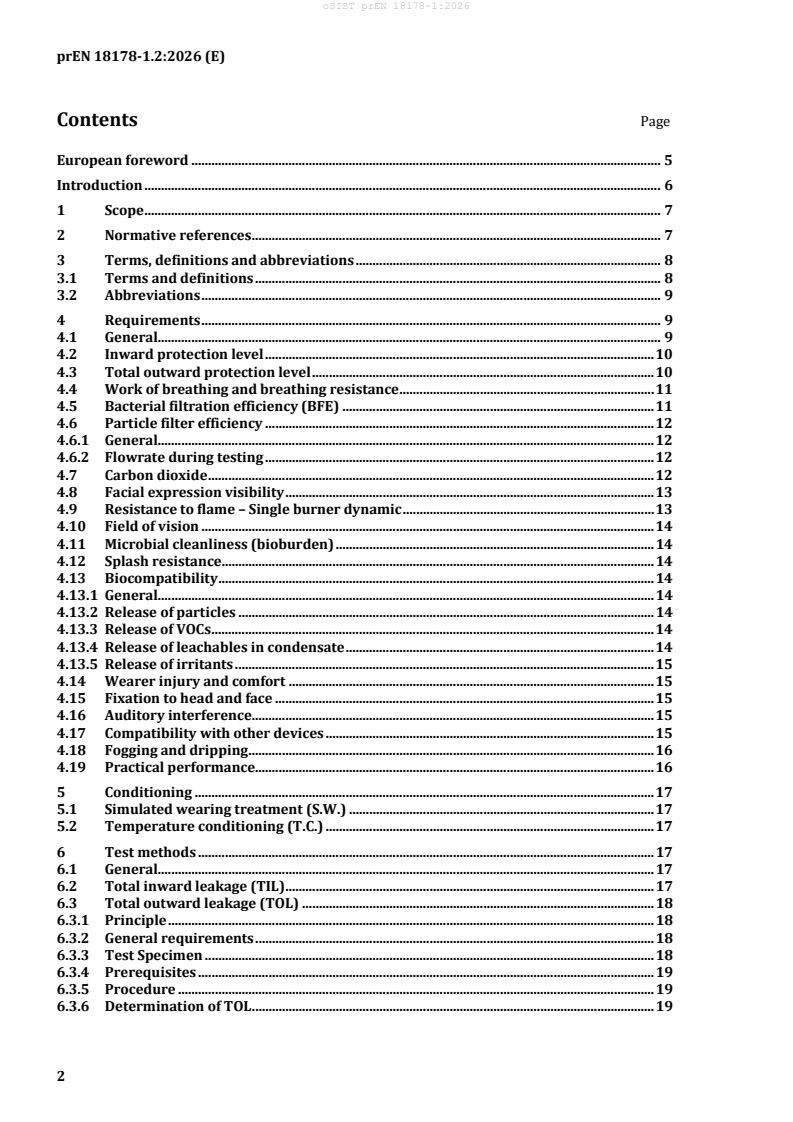
Contents Page
European foreword . 5
Introduction . 6
1 Scope . 7
2 Normative references . 7
3 Terms, definitions and abbreviations . 8
3.1 Terms and definitions . 8
3.2 Abbreviations . 9
4 Requirements . 9
4.1 General. 9
4.2 Inward protection level . 10
4.3 Total outward protection level . 10
4.4 Work of breathing and breathing resistance . 11
4.5 Bacterial filtration efficiency (BFE) . 11
4.6 Particle filter efficiency . 12
4.6.1 General. 12
4.6.2 Flowrate during testing . 12
4.7 Carbon dioxide . 12
4.8 Facial expression visibility . 13
4.9 Resistance to flame – Single burner dynamic . 13
4.10 Field of vision . 14
4.11 Microbial cleanliness (bioburden) . 14
4.12 Splash resistance . 14
4.13 Biocompatibility . 14
4.13.1 General. 14
4.13.2 Release of particles . 14
4.13.3 Release of VOCs . 14
4.13.4 Release of leachables in condensate . 14
4.13.5 Release of irritants . 15
4.14 Wearer injury and comfort . 15
4.15 Fixation to head and face . 15
4.16 Auditory interference. 15
4.17 Compatibility with other devices . 15
4.18 Fogging and dripping . 16
4.19 Practical performance. 16
5 Conditioning . 17
5.1 Simulated wearing treatment (S.W.) . 17
5.2 Temperature conditioning (T.C.) . 17
6 Test methods . 17
6.1 General. 17
6.2 Total inward leakage (TIL) . 17
6.3 Total outward leakage (TOL) . 18
6.3.1 Principle . 18
6.3.2 General requirements . 18
6.3.3 Test Specimen . 18
6.3.4 Prerequisites . 19
6.3.5 Procedure . 19
6.3.6 Determination of TOL . 19
6.4 Work of breathing and breathing resistance . 20
6.4.1 General . 20
6.4.2 Test Specimen . 20
6.4.3 Prerequisites . 21
6.5 Bacterial filtration efficiency (BFE) . 21
6.5.1 General . 21
6.5.2 Test Specimen . 21
6.5.3 Prerequisites . 21
6.6 Particle filter efficiency . 21
6.6.1 General . 21
6.6.2 Test Specimen . 21
6.6.3 Prerequisites . 22
6.7 Carbon dioxide. 22
6.7.1 General . 22
6.7.2 Test Specimens . 22
6.7.3 Prerequisites . 22
6.8 Facial expression visibility . 22
6.9 Resistance to flame – Single burner dynamic . 22
6.9.1 General . 22
6.9.2 Test Specimens . 22
6.9.3 Prerequisites . 23
6.10 Field of vision . 23
6.10.1 General . 23
6.10.2 Test specimen . 23
6.10.3 Prerequisites . 23
6.11 Microbial cleanliness (bioburden) . 23
6.11.1 General . 23
6.11.2 Test Specimens . 23
6.11.3 Prerequisites . 24
6.12 Splash resistance . 24
6.13 Biocompatibility . 24
6.14 Wearer injury and comfort . 24
6.15 Fixation to head and face . 24
6.16 Auditory interference . 24
6.17 Compatibility . 24
6.18 Fogging and dripping . 24
6.19 Practical performance tests . 24
6.19.1 General . 24
6.19.2 Test Specimens . 24
6.19.3 Prerequisites . 25
7 Classification . 25
7.1 General . 25
7.2 Inward Protection Class (IPC) based on Total Inward Leakage (TIL) . 25
7.3 Outward Protection Class (OPC) based on Total Outward Leakage (TOL) . 25
7.4 Classification of Work Rate based on Respiratory Minute Volume . 26
7.5 Classification of Work of Breathing Classes . 26
7.6 Classification of Breathability . 26
7.7 Classification of Carbon Dioxide Limits . 27
7.8 RIPD Interface class . 27
7.9 Sequence of Respiratory Infection Prevention Device Classification . 29
7.10 RIPD-Types . 29
8 Marking . 30
9 Information supplied by the manufacturer . 30
10 Packaging . 31
Bibliography . 33
European foreword
This document (prEN 18178-1.2:2026) has been prepared by Technical Committee CEN/TC 205 “Non-
active medical devices”, the secretariat of which is held by DIN.
This document is currently submitted to the second CEN Enquiry.
The EN 18178 series consists of the following parts, under the general title Respiratory infection
prevention devices for self- and third-party protection:
— Part 1: Requirements, test methods, classification and markings
— Part 3: Sustainability, human factors and rationales
— Part 4: Selection and use
Introduction
A device that protects in both directions of breathing (outward and inward) can be required to reduce
infection for example during outbreaks of respiratory infections or similar situations.
This document aims to specify requirements for devices for the prevention of respiratory infections that
are harmonized under both the MDR and the Personal Protective Equipment (PPE) Regulation.
The EN 18178 series of standards is a user- and performance-oriented series of standards.
A product that meets all the requirements of this document, regardless of its design, can be used as a
respiratory infection prevention device (RIPD) and offers protection against infective agents at the level
described in the classification.
Requirements, test methods, classification and marking are described in this document.
The classification is part of the mandatory marking. As the intended users of the standardized devices are
the general population, the performance class is also intended to be indicated by easily recognizable and
clearly interpretable information. This will enable the safe and appropriate selection of a product.
Supplementary parts of the EN 18178 series are CEN/TS 18178-3 and CEN/TS 18178-4.
CEN/TS 18178-3 contains references and descriptions of the ‘human factors’ used to determine the limit
values in EN 18178-1. In addition, CEN/TS 18178-3 takes into account aspects of environmental
compatibility and sustainability.
CEN/TS 18178-4 provides a procedure for the ‘selection and use’ of appropriate devices. This is based on
factors such as infectivity, the environment of use, the activities and physical capabilities of the wearers
on the one hand, and the classification on the other.
1 Scope
This document specifies minimum performance requirements, test methods, classification as well as
marking for respiratory infection prevention devices (RIPDs).
RIPDs are intended to reduce the emission of infective agents from the user’s airways into the
environment and also reduce exposure to the user from inhalation of infective agents.
RIPDs are intended for use by the general population.
2 Normative references
The following documents are referred to in the text in such a way that some or all of their content
constitutes requirements of this document. For dated references, only the edition cited applies. For
undated references, the latest edition of the referenced document (including any amendments) applies.
EN 13274-2:2019, Respiratory protective devices — Methods of test — Part 2: Practical performance tests
EN 14683:2025, Medical face masks — Requirements and test methods
EN ISO 16972:2020, Respiratory protective devices — Vocabulary and graphical symbols (ISO 16972:2020)
EN ISO 10993-1:2026, Biological evaluation of medical devices — Part 1: Requirements and general
principles for the evaluation of biological safety within a risk management process (ISO 10993-1:2025)
EN ISO 10993-23:2021, Biological evaluation of medical devices — Part 23: Tests for irritation
(ISO 10993-23:2021)
EN IEC 60812:2018, Failure modes and effects analysis (FMEA and FMECA)
ISO 16900-1:2019, Respiratory protective devices — Methods of test and test equipment — Part 1:
Determination of inward leakage
ISO 16900-2:2017, Respiratory protective devices — Methods of test and test equipment — Part 2:
Determination of breathing resistance
ISO 16900-5:2016, Respiratory protective devices — Methods of test and test equipment — Part 5:
Breathing machine, metabolic simulator, RPD headforms and torso, tools and verification tools
ISO 16900-7:2020, Respiratory protective devices — Methods of test and test equipment — Part 7: Practical
performance test methods
ISO 16900-9:2015, Respiratory protective devices — Methods of test and test equipment — Part 9:
Determination of carbon dioxide content of the inhaled gas
ISO 16900-10:2015, Respiratory protective devices — Methods of test and test equipment — Part 10:
Resistance to ignition, flame, radiant heat and heat
ISO 16900-11:2025, Respiratory protective devices — Methods of test and test equipment — Part 11:
Determination of field of vision
ISO 16900-12:2016, Respiratory protective devices — Methods of test and test equipment — Part 12:
Determination of volume-averaged work of breathing and peak respiratory pressures
This document is impacted by an amendment ISO 16900-5:2016/Amd 1:2018.
EN ISO 18562-2:2024, Biocompatibility evaluation of breathing gas pathways in healthcare applications
— Part 2: Tests for emissions of particulate matter (ISO 18562-2:2024)
EN ISO 18562-3:2024, Biocompatibility evaluation of breathing gas pathways in healthcare applications
— Part 3: Tests for emissions of volatile organic substances (ISO 18562-3:2024)
EN ISO 18562-4:2024, Biocompatibility evaluation of breathing gas pathways in healthcare applications
— Part 4: Tests for leachables in condensate (ISO 18562-4:2024)
ISO 7000:2019, Graphical symbols for use on equipment — Registered symbols
ISO 22609:2004, Clothing for protection against infectious agents — Medical face masks — Test method
for resistance against penetration by synthetic blood (fixed volume, horizontally projected)
3 Terms, definitions and abbreviations
3.1 Terms and definitions
For the purposes of this document, the terms and definitions given in EN ISO 16972:2020 and the
following apply.
ISO and IEC maintain terminology databases for use in standardization at the following addresses:
— ISO Online browsing platform: available at https://www.iso.org/obp/
— IEC Electropedia: available at https://www.electropedia.org/
3.1.1
as received
not preconditioned or modified to carry out a test
[Source: EN ISO 16972:2020, 3.16]
3.1.2
comfort
state of physical ease and freedom from pain or constraint
[SOURCE: EN ISO 35101:2019, 3.3]
3.1.3
RPD head form
laboratory test head simulating human heads used in testing RPD
[Source: ISO 16900-5:2016, 3.1]
3.1.4
loose fitting device
respiratory interface that does not rely on forming a complete seal to the wearer’s skin
[SOURCE: EN ISO 16972:2020, 3.132 – modified: RI was change to respiratory interface in the term.]
3.1.5
respiratory infection prevention device
RIPD
device intended to reduce the emission of infective agents from the user’s airways into the environment,
and also reduce exposure to the user from inhalation of infective agents
3.1.6
tight fitting device
respiratory interface that forms a protective barrier between the wearer’s respiratory tract and the
ambient atmosphere by forming a seal to the wearer’s skin
[SOURCE: EN ISO 16972:2020, 3.241 – modified: RI was change to respiratory interface in the term]
3.2 Abbreviations
BFE bacterial filtration efficiency
BR breathability
BTPS body temperature pressure saturated
C carbon dioxide class
CFU colony forming unit
F particle filter class
FMEA failure mode and effects analysis
IFU instructions for use
IPC inward protection class
MD medical device
OPC outward protection class
PPE personal protective equipment
RIPD respiratory infection prevention device
RPD respiratory prevention device
TIL total inward leakage
TOL total outward leakage
VFS visual field score
VOC volatile organic compound
W work rate
WOB Work of Breathing
4 Requirements
4.1 General
RIPDs shall be tested in accordance with Clause 6.
The results and associated test methods shall be documented or any reason why the test was not
conducted.
Where it is required in a specific clause, it shall be declared that a risk assessment, e.g. a Failure Modes
and Effect Analysis (FMEA), in accordance with EN IEC 60812:2018, concerning these specific
requirements has been conducted.
4.2 Inward protection level
The results of the total inward leakage (TIL) test determine the protection level of the RIPD as given in
Table 1.
Table 1 — Inward protection level
Maximum TIL %
Inward
protection level
Mass
1 50
2 20
3 5
4 1
Prior to TIL testing, RIPD shall be selected for the test subject in accordance with the information supplied
by the manufacturer. Test subjects shall be free of facial hair in the area of the face seal if such wearers
are excluded by the information supplied by the manufacturer.
Testing shall be performed with 10 test subjects.
If more than one size is available, each size shall be tested at least once and pass the TIL test.
Test in accordance with the exercise regime given in ISO 16900-1:2019, Table B.1, after an
acclimatization according to number 1 in the following sequence:
— walk (exercise number 6);
— walk, head rotation (exercise number 7);
— walk, speaking (exercise number 8);
— hand and knees, head rotation (exercise number 5);
— standing still (exercise number 2).
The inward protection level shall be derived as follows:
— Calculate the arithmetic mean of the TIL test results in % for all exercises for each test subject.
— Order all 10 results from smallest to largest. The overall percentage TIL value for the RIPD is
max
equivalent to the second largest result.
RIPDs shall meet the performance of one of the levels in Table 1.
RIPDs shall be tested for TIL in accordance with 6.2.
4.3 Total outward protection level
The results of the total outward leakage (TOL) test determine the protection level of the RIPD as given in
Table 2 in accordance with 6.3.
Table 2 — Outward protection level
Maximum TOL %
Outward
protection level
Mass
1 80
2 50
3 15
4 5
The measurement shall be done in accordance with 6.3.
4.4 Work of breathing and breathing resistance
RIPD shall be tested for work of breathing and breathing resistance.
Depending on its level(class) RIPDs shall have a WOB not higher than shown in Table 3.
Table 3 — Level of work of breathing and breathing resistance
Breathing resistance limit (peak
Work of breathing limit
pressures)
Level
[kPa]
[kPa]
Inhalation Exhalation Inhalation Exhalation
1 0,9 0,9 −1,2 1,2
2 0,9 0,9 −1,2 1,2
3 0,7 0,7 −1,0 1,0
4 0,5 0,5 −0,7 0,7
The work of breathing and breathing resistance (peak pressure) shall be calculated from the average
pressure volume loop based on 10 consecutive breathing cycles given in Table 4 according to its level.
The settings for the breathing machine for each work rate are given in Table 4.
Table 4 — Setting of breathing machine at work rates
Flow rate (dynamic sinusoidal) Frequency Tidal volume
Work rate
l/min cycles/min l
W1 5 with a tolerance of ± 3 % 10,0 0,5
W2 10 with a tolerance of ± 3 % 10,0 1,0
W3 35 with a tolerance of ± 2 % 23,3 1,5
W4 65 with a tolerance of ± 2 % 32,5 2,0
Testing shall be performed in accordance with 6.4.
4.5 Bacterial filtration efficiency (BFE)
If applicable, the bacterial filtration efficiency (BFE) of the RIPD shall fulfil the requirements of
EN 14683:2025 for type II (≥98 %).
Number of samples and conditioning shall comply with EN 14683:2025.
Testing shall be performed in accordance with 6.5.
4.6 Particle filter efficiency
4.6.1 General
If applicable, RIPDs shall meet one of the following particle efficiency classes listed in Table 5 when tested
against NaCl aerosol.
Table 5 — Particle filter level
Efficiency Penetration
Filter level
% %
5 ≥ 99,99 ≤ 0,01
4 ≥ 99,90 ≤ 0,1
3 ≥ 99,00 ≤ 1,0
2 ≥ 95,00 ≤ 5,0
1 ≥ 80,00 ≤ 20,0
4.6.2 Flowrate during testing
For RIPDs classified as W1, testing shall be conducted at a continuous test air flow rate of 13 l/min with
a tolerance of ± 3 %.
For RIPDs classified as W2, testing shall be conducted at a continuous test air flow rate of 25 l/min with
a tolerance of ± 3 %.
For RIPDs classified as W3, testing shall be conducted at a continuous test air flow rate of 85 l/min with
a tolerance of ± 2 %.
For RIPDs classified as W4, testing shall be conducted at a continuous test air flow rate of 135 l/min with
a tolerance of ± 2 %.
RIPDs shall be tested in accordance with 6.6.
4.7 Carbon dioxide
The carbon dioxide content of the inhalation air shall not exceed an average volume fraction as given in
Table 6. After stabilization, the measurement of at least 10 cycles shall be taken to determine the average.
Within at least 10 cycles the average value of CO at the end of each exhalation cycle shall contain
(5,3 ± 0,1) % CO .
Table 6 — Maximum average volume fraction of CO concentration in the inhalation air in
relation to flow rate
Flow rate (dynamic sinusoidal) max CO concentration
Class
l/min %
5 with a tolerance of ± 3 %
2,50
10 with a tolerance of ± 3 %
35 with a tolerance of ± 2 %
2,00
65 with a tolerance of ± 2 %
5 with a tolerance of ± 3 %
1,00
10 with a tolerance of ± 3 %
35 with a tolerance of ± 2 %
0,70
65 with a tolerance of ± 2 %
RIPDs shall meet one of the following CO concentration classes listed in Table 6 when tested.
Testing shall be performed in accordance with 6.7.
4.8 Facial expression visibility
For RIPDs intended to be worn in an environment where visibility of facial expressions is required, the
RIPD shall not obstruct the view of the face to a third party.
If applicable, the transparent area of the RIPD shall be large enough to ensure that facial expressions can
be seen, not just the lips.
NOTE 1 There is no consensus yet on a minimum size. For example, it can be determined by practical testing
with appropriate users.
NOTE 2 The design can facilitate communication not only to those dependent on lip reading but also individuals
with cognitive impairments. Audio-visual cues can also improve speech intelligibility for wearers with no hearing
impairment.
Testing shall be performed in accordance with 6.8.
4.9 Resistance to flame – Single burner dynamic
The RIPD shall be tested by subjecting all the parts or components exposed to the flame of a single burner
dynamic test while the RIPD is in its as worn state. The flame needs to touch only one area of each
part/component that is exposed while the RIPD is in it is as worn state.
When tested, the materials shall not:
— drip at all;
— undergo complete combustion; or
— continue to burn for more than 5 s after removal from the flame.
Deformation/decomposition is allowed.
One sample shall be tested.
The sample does not need to fulfil any other requirement of this document after this test.
Testing shall be performed in accordance with 6.9.
4.10 Field of vision
The RIPD shall not cause undue visual obstruction to the wearer.
The RIPD shall have an average visual field score (VFS) of at least 98. Six out of eight dots of the section
between 20° and 30°; 340° and 350°, 150° and 160° and 190° and 200° in the modified VFS scale shall be
included in the visual field score.
In addition, at least two of the four critical dots which lie in the section between 20° and 30°; 340° and
350°, 150° and 160° and 190° and 200° shall be included in the field score.
Number of samples and conditioning shall be decided.
Testing shall be performed in accordance with 6.10.
4.11 Microbial cleanliness (bioburden)
This document does not relate to sterile devices.
The bioburden of the RIPD shall be ≤ 30 CFU/g, if tested.
NOTE EN ISO 11737-1:2018 gives more information on the enumeration and microbial characterization of the
population of viable microorganisms on or in a medical device, component, raw material or package.
The minimum number of devices that shall be tested is 5 (five).
Testing shall be performed in accordance with 6.11.
4.12 Splash resistance
The resistance of the RIPD to penetration of splashes of liquid shall conform to the minimum value
of ≥ 16,0 kPa.
Testing shall be performed in accordance with 6.12.
4.13 Biocompatibility
4.13.1 General
As a minimum, EN ISO 10993-1:2026 shall be considered.
The test results shall be available upon request.
Testing shall be performed in accordance with 6.13.
4.13.2 Release of particles
The requirements of EN ISO 18562-2:2024 shall be met.
Testing shall be performed in accordance with 6.13.
4.13.3 Release of VOCs
The requirements of EN ISO 18562-3:2024 shall be met.
Testing shall be performed in accordance with 6.13.
4.13.4 Release of leachables in condensate
The requirements of EN ISO 18562-4:2024 shall be met.
Testing shall be performed in accordance with 6.13.
4.13.5 Release of irritants
The requirements of EN ISO 10993-23:2021 shall be met.
Testing shall be performed in accordance with 6.13.
4.14 Wearer injury and comfort
RIPDs shall not cause injury to the wearer when used according to the IFU.
An iterative risk assessment shall be used to demonstrate that injuries to the wearer can be ruled out.
Components of the risk assessment may include:
— the sensitivity of the areas of the wearer where the RIPD is in contact;
— any sharp or hard edges or points;
— the degree of compression required to maintain an adequate fit;
— the temperature and humidity of the intended environment of use;
— the reasonably expected duration of use by the intended wearer.
The comfort assessment shall be carried out with the group of wearers for whom the RIPD is designed.
Testing shall be performed in accordance with 6.14.
4.15 Fixation to head and face
The fixation mechanism for retaining the device on the wearers head and face shall be strong enough to
hold the device in position. The fixation mechanism shall be comfortable to wear and shall not cause
injury to the wearer. If there is more than one way of wearing the device as intended by the manufacturer
by using e.g. removable parts or accessories, all requirements shall be met for all intended ways of
wearing the device.
Testing shall be performed in accordance with 6.15.
4.16 Auditory interference
The RIPD shall meet the communication performance requirements when subjected to a communication
performance test using the numbers “1” to “20” in random order (see ISO 17420-1:2021,5.8.3).
Two samples shall be tested as received by two test subjects.
At least 15 numbers out of 20 shall be understood.
Testing shall be in accordance with 6.16.
4.17 Compatibility with other devices
The compatibility of the RIPD with other devices shall be considered. Consideration shall be given at least
to the following:
— spectacles, glasses or protective eyewear;
— cochlear implants;
— hearing aids;
— protective caps;
— helmets;
— hats.
Any interferences shall be noted in the information provided by the manufacturer.
Testing shall be in accordance with 6.17.
4.18 Fogging and dripping
Condensation of breath in the RIPD shall not drip under any foreseeable environment.
Areas intended to remain transparent shall not fog up in the intended environment.
The test subject shall be able to finalize the test procedure.
Antifogging agents shall fulfil the requirements of clause 4.13, if applicable.
Testing shall be in accordance with 6.18.
4.19 Practical performance
Prior to the test there shall be an inspection to ensure that the RIPD is in good working condition and that
it can be used without hazard.
All tests shall be carried out by two test subjects at ambient temperature and the test temperature and
humidity shall be recorded.
Two RIPD, one in as received state and one preconditioned in accordance with 5.1 and 5.2 shall be tested.
The RIPD shall undergo practical performance tests under realistic conditions.
These general tests serve the purpose of checking the RIPD for imperfections that cannot be determined
by the tests described elsewhere in this document.
Where practical performance tests show the RIPD has imperfections related to wearer's acceptance, the
test house shall provide full details of those parts of the practical performance tests which revealed these
imperfections.
If during any activity, by any test subject, the test subject fails to finalize the selected activity due to the
RIPD being not fit for the purpose for which it has been designed or due to imperfection claimed, the RIPD
shall be deemed to have failed.
The risk assessment carried out under 4.14 shall be taken into account in the practical performance test
and the points relating to the test subjects (the sensitivity of the areas of the wearer where the RIPD is in
contact; any sharp or hard edges or points) shall be considered.
The test subjects shall be selected for the RIPD according to the information provided by the
manufacturer. If no information or other restrictions regarding size, etc. are specified, the RIPD shall fit
each test subject. If a manufacturer produces different types (e.g. different sizes), each RIPD shall be
tested.
The RIPD shall fit the test subject. This shall be determined in an appropriate manner.
The test subjects shall perform the following activities in accordance with EN 13274-2:2019, Table 1
however the sequence is at the discretion of the test house:
— activity number 2;
— activity number 3;
— activity number 9;
— activity number 14;
— the test subject shall inhale five times within one minute with a wide opened mouth.
Testing shall be performed in accordance with 6.19.
5 Conditioning
5.1 Simulated wearing treatment (S.W.)
Conditioning by simulated wearing treatment shall be carried out by the following process.
A breathing machine is adjusted to 25 cycles/min and 2,0 l/stroke. The RIPD is mounted on a RPD head
form according to ISO 16900-5. Size of the RPD head form shall be according to the size of the RIPD, as
declared by the manufacturer.
For testing, a saturator is incorporated in the exhalation line between the breathing machine and the RPD
head form, the saturator being set at a temperature more than of 37 °C to allow for the cooling of the air
before it reaches the mouth of the RPD head form.
The air shall be saturated at (37 ± 2) °C at the mouth of the RPD head form. In order to prevent excess
water spilling out of the RPD head form’s mouth and contaminating the RIPD the head shall be inclined
so that the water runs away from the mouth and is collected in a trap.
The breathing machine is brought into operation, the saturator switched on and the apparatus allowed
to stabilize.
The RIPD under test shall then be mounted on the RPD head form and shall be exposed to the test flow
for 200 min. During the test time at approximately 20 min intervals the RIPD shall be completely removed
from the RPD head form and refitted such that during the test period it is fitted ten times to the RPD head
form.
5.2 Temperature conditioning (T.C.)
Expose the RIPD to the following thermal cycle:
a) for 24 h to a dry atmosphere of (70 ± 3) °C;
b) for 24 h to a temperature of (−30 ± 3) °C;
and allow to return to room temperature for at least 4 h between exposures and prior to subsequent
testing.
The conditioning shall be carried out in a manner which ensures that no thermal shock occurs.
6 Test methods
6.1 General
All tests shall be carried out on finished products or samples taken thereof. The numbering within this
Clause is aligned with Clause 4, where the requirements are given.
6.2 Total inward leakage (TIL)
RIPDs shall be tested for TIL in accordance with ISO 16900-1:2019, method 2 (Sodium Chloride) and
subject’s facial dimensions, face width and face length shall be measured and recorded.
Test specimen shall be preconditioned in accordance with Table 7.
Table 7 — Test Specimen
Total number As received Temperature Simulated
of Specimen Conditioned Wearing
according to according to
5.2 5.1
10 6 2 2
The following list of prerequisites shall be used:
a) minimum number of test specimen: see Table 7
b) operating conditions of the RIPD: i
...