

oSIST prEN 18178-1:2026
(Main)Respiratory infection prevention devices for self- and third-party protection - Part 1: Requirements and marking
- Abstract
This document specifies minimum performance requirements, test methods, classification as well as marking for respiratory infection prevention devices (RIPDs).
RIPDs are intended to reduce the emission of infective agents from the user’s airways into the environment and also reduce exposure to the user from inhalation of infective agents.
RIPDs are intended for use by the general population.
- Status
- Not Published
- Public Enquiry End Date
- 28-Oct-2026
- Technical Committee
- VAZ - Healthcare
- Current Stage
- 4020 - Public enquire (PE) (Adopted Project)
- Start Date
- 14-Aug-2026
- Due Date
- 01-Jan-2027
- Completion Date
- 02-Nov-2026

oSIST prEN 18178-1:2026 is the Slovenian publication of the draft European Standard prEN 18178-1 from CEN on respiratory infection prevention devices (RIPDs) for self- and third-party protection. It specifies minimum performance requirements, test methods, classification and marking for RIPDs intended for the general population. In practice, it tells manufacturers, test laboratories and buyers how to describe and verify devices that are meant to reduce both emission of infective agents from the wearer and exposure of the wearer to infective agents.
What does oSIST prEN 18178-1:2026 specify?
oSIST prEN 18178-1:2026 specifies the requirements, test methods, classification and marking for RIPDs. The standard is organized as clauses 1 to 10, covering scope, normative references, terms and abbreviations, requirements, conditioning, test methods, classification, marking, manufacturer information and packaging.
The scope is aimed at RIPDs for the general population, and the introduction places the series in the context of both the MDR and the PPE Regulation. Clause 4.11 also notes that the bioburden requirement is not about sterile devices, which matters if a product is being positioned as a clean but non-sterile respiratory device.
What are the key requirements of oSIST prEN 18178-1:2026?
The central idea of oSIST prEN 18178-1:2026 is that RIPDs are judged by measured performance, not by design alone. Manufacturers must test finished products or samples in Clause 6, record the results, and document any reason a test was not carried out. Where a clause requires it, a risk assessment such as Failure Modes and Effects Analysis (FMEA) is part of the evidence package.
Protection performance and classification
Clause 4 links inward and outward protection to leakage testing. TIL drives the inward protection level and TOL drives the outward protection level, so the product can be chosen and compared by measured leakage rather than by appearance or marketing claims. If the manufacturer specifies size restrictions or facial-hair limitations, the test subject selection has to follow that information.
Breathing performance is also classified. Clause 4.4 covers work of breathing and breathing resistance, and Clause 4.7 covers carbon dioxide in the inhalation air. For a buyer, this matters because a device can protect well but still be difficult to breathe through or uncomfortable in longer use.
Clause 4.5 and 4.6 add filter-performance checks where applicable. Bacterial filtration efficiency (BFE) follows EN 14683, and particle filter efficiency is measured against NaCl aerosol. These results feed the overall picture of how the RIPD performs as a filter, even though particle efficiency is not part of the final classification sequence.
Wearability, safety and user acceptance
Clause 4 goes beyond filtration. It checks flame resistance, field of vision, microbial cleanliness, splash resistance, biocompatibility, wearer injury and comfort, fixation to the head and face, auditory interference, compatibility with other devices, and fogging and dripping. This is important in practice because a device that tests well in filtration may still fail if it blocks vision, clashes with glasses or hearing aids, fogs up, or is uncomfortable enough that people will not keep it on.
Clause 4.14 and 4.15 focus on injury, comfort and retention. The device has to stay in place, feel acceptable to the intended wearer group, and avoid contact-related injury. Clause 4.19 then checks practical performance under realistic conditions, which is where fit, usability and small defects often become visible.
Conditioning before testing
Clause 5 uses two conditioning routes before testing: simulated wearing treatment and temperature conditioning. That matters because a RIPD has to keep its performance after use-like exposure and after thermal extremes, not only when it is fresh from the package.
Classification, marking and user information
Clause 7 turns the test results into classes: IPC for inward protection, OPC for outward protection, BR for breathability, W for work rate, C for carbon dioxide, and the RIPD interface class. The standard also defines RIPD-Type A, B, C and D as grouped class profiles, which helps users and buyers match a product to the intended scenario.
Clauses 8 to 10 then make the result visible to the user. Marking must include the manufacturer identification, type marking, document reference and RIPD class. The manufacturer information has to explain application limits, checks before use, donning and doffing, fitting, maintenance, storage, symbols and compatibility. Packaging has its own marking and protection requirements so the device arrives clean and undamaged.
What terms does oSIST prEN 18178-1:2026 define?
- RIPD - Respiratory infection prevention device, a device intended to reduce emission of infective agents from the user and reduce inhalation exposure to the user.
- IPC - Inward Protection Class, the class derived from total inward leakage testing.
- OPC - Outward Protection Class, the class derived from total outward leakage testing.
- WOB - Work of Breathing, the breathing effort measured from pressure-volume behavior during testing.
- BR - Breathability, the class that groups RIPDs by work of breathing at defined work rates.
- TIL - Total Inward Leakage, the inward leakage result used for IPC.
- TOL - Total Outward Leakage, the outward leakage result used for OPC.
- IFU - Instructions for Use, the manufacturer information that accompanies the device.
Who uses oSIST prEN 18178-1:2026?
oSIST prEN 18178-1:2026 is used by RIPD manufacturers, product developers and test laboratories that need a common way to measure performance and assign classes. It is also relevant to quality managers, regulatory teams and conformity assessment bodies that review leakage, breathability, biocompatibility, usability and marking evidence.
Buyers, procurement teams and distributors can use the classification and type system to compare products for different use cases, such as own protection, source control, or mixed protection. The standard is written for devices intended for the general population, so it also supports product selection for broad public use.
Which standards are used with oSIST prEN 18178-1:2026?
| Standard | What it contributes |
|---|---|
| EN 13274-2 | Practical performance tests used for real-use checking. |
| EN 14683 | BFE and bioburden-related test methods. |
| EN ISO 16972 | Vocabulary and graphical symbols for respiratory protective devices. |
| EN ISO 10993-1 | Biological evaluation framework for the device. |
| EN ISO 10993-23 | Irritation testing for biocompatibility. |
| EN IEC 60812 | FMEA method for risk assessment. |
| ISO 16900-1 / -2 / -3 / -5 / -7 / -9 / -10 / -11 / -12 | Leakage, breathing resistance, test equipment, practical performance, CO, flame, field of vision and work-of-breathing methods. |
| EN ISO 18562-2 / -3 / -4 | Emissions of particulate matter, VOCs and leachables in condensate. |
| ISO 22609 | Splash-resistance test method. |
| ISO 7000 | Graphical symbols used on packaging and marking. |
| ISO 17420-1 | Communication-performance reference used for auditory interference testing. |
| EN 18178-3 and CEN/TS 18178-4 | Companion parts on human factors, sustainability, and selection and use. |
What does the oSIST prEN 18178-1:2026 document contain?
Clause 4 contains the performance requirements and the tables that define the main classes for leakage, breathability, carbon dioxide and RIPD type. Clause 5 gives the simulated wearing and temperature conditioning methods that prepare products for testing. Clause 6 sets out the test methods for leakage, breathing resistance, filtration, carbon dioxide, flame, field of vision, bioburden, splash resistance, biocompatibility, comfort, fixation, auditory interference, compatibility, fogging and practical performance.
The document also contains the classification rules in Clause 7, including the class sequence and the RIPD-Type grouping. Clauses 8 to 10 cover marking, manufacturer-supplied information and packaging, so the measured performance can be communicated clearly at point of use and sale.
Relations
- Effective Date
- 28-Jan-2026
Get Certified
Connect with accredited certification bodies for this standard

CIS Institut d.o.o.
Personal Protective Equipment (PPE) certification body. Notified Body NB-2890 for EU Regulation 2016/425 PPE.

Kiwa BDA Testing
Building and construction product certification.
Kmetijski inštitut Slovenije
Agricultural Institute of Slovenia. Soil testing, plant health, agricultural product analysis.
Sponsored listings
Frequently Asked Questions
oSIST prEN 18178-1:2026 is a draft published by the Slovenian Institute for Standardization (SIST). Its full title is "Respiratory infection prevention devices for self- and third-party protection - Part 1: Requirements and marking". This standard covers: This document specifies minimum performance requirements, test methods, classification as well as marking for respiratory infection prevention devices (RIPDs). RIPDs are intended to reduce the emission of infective agents from the user’s airways into the environment and also reduce exposure to the user from inhalation of infective agents. RIPDs are intended for use by the general population.
This document specifies minimum performance requirements, test methods, classification as well as marking for respiratory infection prevention devices (RIPDs). RIPDs are intended to reduce the emission of infective agents from the user’s airways into the environment and also reduce exposure to the user from inhalation of infective agents. RIPDs are intended for use by the general population.
oSIST prEN 18178-1:2026 is classified under the following ICS (International Classification for Standards) categories: 13.340.20 - Head protective equipment. The ICS classification helps identify the subject area and facilitates finding related standards.
oSIST prEN 18178-1:2026 has the following relationships with other standards: It is inter standard links to SIST EN ISO 13702:2024. Understanding these relationships helps ensure you are using the most current and applicable version of the standard.
oSIST prEN 18178-1:2026 is associated with the following European legislation: EU Directives/Regulations: 2016/425, 2017/745; Standardization Mandates: M/571, M/575, M/575 Amd 2. When a standard is cited in the Official Journal of the European Union, products manufactured in conformity with it benefit from a presumption of conformity with the essential requirements of the corresponding EU directive or regulation.
oSIST prEN 18178-1:2026 is available in PDF format for immediate download after purchase. The document can be added to your cart and obtained through the secure checkout process. Digital delivery ensures instant access to the complete standard document.
Standards Content (Sample)
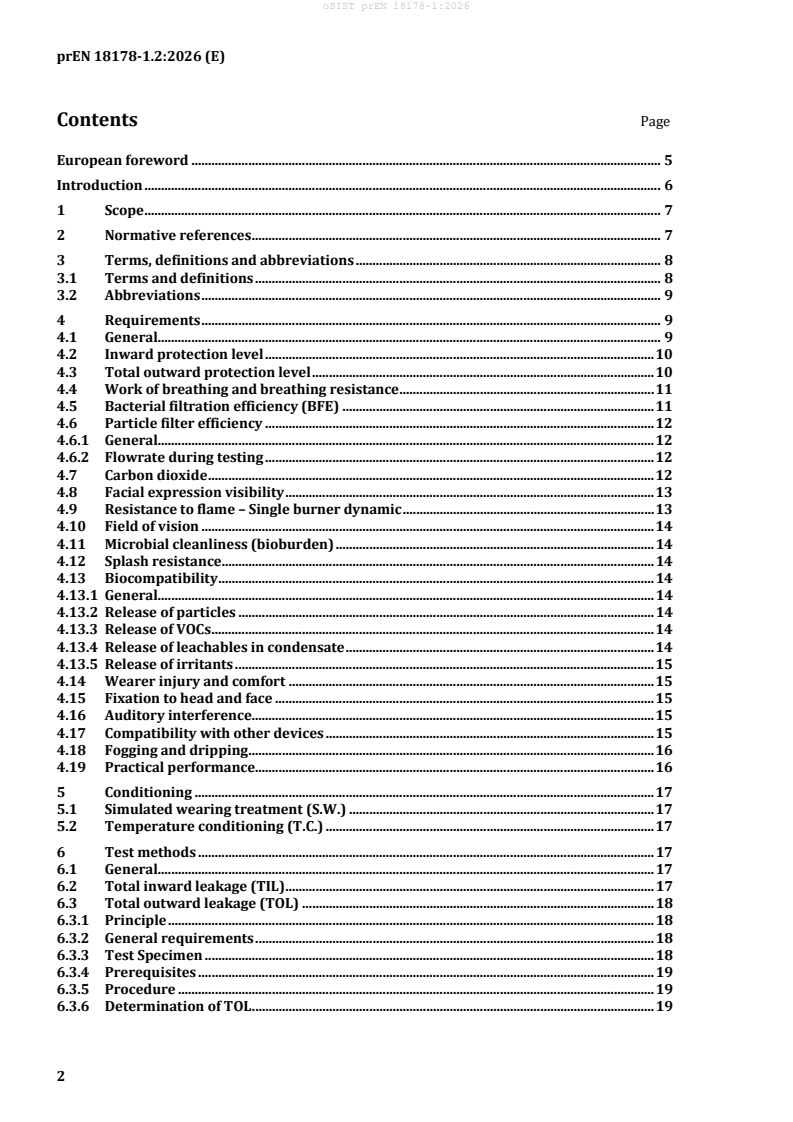
Contents
- Introduction
- 1 Scope
- 2 Normative references
- 3 Terms, definitions and abbreviations
- 3.1 Terms and definitions
- 3.1.1 as received
- 3.1.2 comfort
- 3.1.3 RPD head form
- 3.1.4 loose fitting device
- 3.1.5 respiratory infection prevention device
- 3.1.6 tight fitting device
- 3.2 Abbreviations
- 4 Requirements
- 4.1 General
- 4.2 Inward protection level
- 4.3 Total outward protection level
- 4.4 Work of breathing and breathing resistance
- 4.5 Bacterial filtration efficiency (BFE)
- 4.6 Particle filter efficiency
- 4.7 Carbon dioxide
- 4.8 Facial expression visibility
- 4.9 Resistance to flame – Single burner dynamic
- 4.10 Field of vision
- 4.11 Microbial cleanliness (bioburden)
- 4.12 Splash resistance
- 4.13 Biocompatibility
- 4.14 Wearer injury and comfort
- 4.15 Fixation to head and face
- 4.16 Auditory interference
- 4.17 Compatibility with other devices
- 4.18 Fogging and dripping
- 4.19 Practical performance
- 5 Conditioning
- 5.1 Simulated wearing treatment (S.W.)
- 5.2 Temperature conditioning (T.C.)
- 6 Test methods
- 6.1 General
- 6.2 Total inward leakage (TIL)
- 6.3 Total outward leakage (TOL)
- 6.4 Work of breathing and breathing resistance
- 6.5 Bacterial filtration efficiency (BFE)
- 6.6 Particle filter efficiency
- 6.7 Carbon dioxide
- 6.8 Facial expression visibility
- 6.9 Resistance to flame – Single burner dynamic
- 6.10 Field of vision
- 6.11 Microbial cleanliness (bioburden)
- 6.12 Splash resistance
- 6.13 Biocompatibility
- 6.14 Wearer injury and comfort
- 6.15 Fixation to head and face
- 6.16 Auditory interference
- 6.17 Compatibility
- 6.18 Fogging and dripping
- 6.19 Practical performance tests
- 7 Classification
- 7.1 General
- 7.2 Inward Protection Class (IPC) based on Total Inward Leakage (TIL)
- 7.3 Outward Protection Class (OPC) based on Total Outward Leakage (TOL)
- 7.4 Classification of Work Rate based on Respiratory Minute Volume
- 7.5 Classification of Work of Breathing Classes
- 7.6 Classification of Breathability
- 7.7 Classification of Carbon Dioxide Limits
- 7.8 RIPD Interface class
- 7.9 Sequence of Respiratory Infection Prevention Device Classification
- 7.10 RIPD-Types
- 8 Marking
- 9 Information supplied by the manufacturer
- 10 Packaging
- Bibliography
Introduction
A device that protects in both directions of breathing (outward and inward) can be required to reduce infection for example during outbreaks of respiratory infections or similar situations. This document aims to specify requirements for devices for the prevention of respiratory infections that are harmonized under both the MDR and the Personal Protective Equipment (PPE) Regulation. The EN 18178 series of standards is a user- and performance-oriented series of standards. A product that meets all the requirements of this document, regardless of its design, can be used as a respiratory infection prevention device (RIPD) and offers protection against infective agents at the level described in the classification.
Requirements, test methods, classification and marking are described in this document. The classification is part of the mandatory marking. As the intended users of the standardized devices are the general population, the performance class is also intended to be indicated by easily recognizable and clearly interpretable information. This will enable the safe and appropriate selection of a product. Supplementary parts of the EN 18178 series are CEN/TS 18178-3 and CEN/TS 18178-4. CEN/TS 18178-3 contains references and descriptions of the ‘human factors’ used to determine the limit values in EN 18178-1. In addition, CEN/TS 18178-3 takes into account aspects of environmental compatibility and sustainability.
CEN/TS 18178-4 provides a procedure for the ‘selection and use’ of appropriate devices. This is based on factors such as infectivity, the environment of use, the activities and physical capabilities of the wearers on the one hand, and the classification on the other.
oSIST prEN 18178-1:2026 prEN 18178-1.2:2026 (E)
1 Scope
This document specifies minimum performance requirements, test methods, classification as well as marking for respiratory infection prevention devices (RIPDs).
RIPDs are intended to reduce the emission of infective agents from the user’s airways into the environment and also reduce exposure to the user from inhalation of infective agents. RIPDs are intended for use by the general population.
2 Normative references
The following documents are referred to in the text in such a way that some or all of their content constitutes requirements of this document. For dated references, only the edition cited applies. For undated references, the latest edition of the referenced document (including any amendments) applies. EN 13274-2:2019, Respiratory protective devices — Methods of test — Part 2: Practical performance tests EN 14683:2025, Medical face masks — Requirements and test methods EN ISO 16972:2020, Respiratory protective devices — Vocabulary and graphical symbols (ISO 16972:2020) EN ISO 10993-1:2026, Biological evaluation of medical devices — Part 1: Requirements and general principles for the evaluation of biological safety within a risk management process (ISO 10993-1:2025) EN ISO 10993-23:2021, Biological evaluation of medical devices — Part 23: Tests for irritation (ISO 10993-23:2021) EN IEC 60812:2018, Failure modes and effects analysis (FMEA and FMECA) ISO 16900-1:2019, Respiratory protective devices — Methods of test and test equipment — Part 1:
Determination of inward leakage ISO 16900-2:2017, Respiratory protective devices — Methods of test and test equipment — Part 2:
Determination of breathing resistance
ISO 16900-5:2016, Respiratory protective devices — Methods of test and test equipment — Part 5:
Breathing machine, metabolic simulator, RPD headforms and torso, tools and verification tools ISO 16900-7:2020, Respiratory protective devices — Methods of test and test equipment — Part 7: Practical performance test methods ISO 16900-9:2015, Respiratory protective devices — Methods of test and test equipment — Part 9:
Determination of carbon dioxide content of the inhaled gas ISO 16900-10:2015, Respiratory protective devices — Methods of test and test equipment — Part 10:
Resistance to ignition, flame, radiant heat and heat ISO 16900-11:2025, Respiratory protective devices — Methods of test and test equipment — Part 11:
Determination of field of vision ISO 16900-12:2016, Respiratory protective devices — Methods of test and test equipment — Part 12:
Determination of volume-averaged work of breathing and peak respiratory pressures
This document is impacted by an amendment ISO 16900-5:2016/Amd 1:2018.
oSIST prEN 18178-1:2026 prEN 18178-1.2:2026 (E) EN ISO 18562-2:2024, Biocompatibility evaluation of breathing gas pathways in healthcare applications - Part 2: Tests for emissions of particulate matter (ISO 18562-2:2024) EN ISO 18562-3:2024, Biocompatibility evaluation of breathing gas pathways in healthcare applications - Part 3: Tests for emissions of volatile organic substances (ISO 18562-3:2024) EN ISO 18562-4:2024, Biocompatibility evaluation of breathing gas pathways in healthcare applications - Part 4: Tests for leachables in condensate (ISO 18562-4:2024) ISO 7000:2019, Graphical symbols for use on equipment — Registered symbols ISO 22609:2004, Clothing for protection against infectious agents — Medical face masks — Test method for resistance against penetration by synthetic blood (fixed volume, horizontally projected)
3 Terms, definitions and abbreviations
3.1 Terms and definitions
For the purposes of this document, the terms and definitions given in EN ISO 16972:2020 and the following apply.
ISO and IEC maintain terminology databases for use in standardization at the following addresses:
- ISO Online browsing platform: available at https://www.iso.org/obp/
- IEC Electropedia: available at https://www.electropedia.org/
3.1.1 as received
not preconditioned or modified to carry out a test [Source: EN ISO 16972:2020, 3.16]
3.1.2 comfort
state of physical ease and freedom from pain or constraint [SOURCE: EN ISO 35101:2019, 3.3]
3.1.3 RPD head form
laboratory test head simulating human heads used in testing RPD [Source: ISO 16900-5:2016, 3.1]
3.1.4 loose fitting device
respiratory interface that does not rely on forming a complete seal to the wearer’s skin [SOURCE: EN ISO 16972:2020, 3.132 – modified: RI was change to respiratory interface in the term.]
oSIST prEN 18178-1:2026 prEN 18178-1.2:2026 (E)
3.1.5 respiratory infection prevention device
RIPD device intended to reduce the emission of infective agents from the user’s airways into the environment, and also reduce exposure to the user from inhalation of infective agents
3.1.6 tight fitting device
respiratory interface that forms a protective barrier between the wearer’s respiratory tract and the ambient atmosphere by forming a seal to the wearer’s skin [SOURCE: EN ISO 16972:2020, 3.241 – modified: RI was change to respiratory interface in the term]
3.2 Abbreviations
BFE bacterial filtration efficiency BR breathability BTPS body temperature pressure saturated C carbon dioxide class CFU colony forming unit F particle filter class FMEA failure mode and effects analysis IFU instructions for use IPC inward protection class MD medical device OPC outward protection class PPE personal protective equipment RIPD respiratory infection prevention device RPD respiratory prevention device TIL total inward leakage TOL total outward leakage VFS visual field score VOC volatile organic compound W work rate WOB Work of Breathing
4 Requirements
4.1 General
RIPDs shall be tested in accordance with Clause 6.
The results and associated test methods shall be documented or any reason why the test was not conducted.
oSIST prEN 18178-1:2026 prEN 18178-1.2:2026 (E) Where it is required in a specific clause, it shall be declared that a risk assessment, e.g. a Failure Modes and Effect Analysis (FMEA), in accordance with EN IEC 60812:2018, concerning these specific requirements has been conducted.
4.2 Inward protection level
The results of the total inward leakage (TIL) test determine the protection level of the RIPD as given in Table 1.
Table 1 — Inward protection level Maximum TIL % Inward protection level Mass 1 50 2 20 3 5 4 1 Prior to TIL testing, RIPD shall be selected for the test subject in accordance with the information supplied by the manufacturer. Test subjects shall be free of facial hair in the area of the face seal if such wearers are excluded by the information supplied by the manufacturer.
Testing shall be performed with 10 test subjects.
If more than one size is available, each size shall be tested at least once and pass the TIL test. Test in accordance with the exercise regime given in ISO 16900-1:2019, Table B.1, after an acclimatization according to number 1 in the following sequence:
- walk (exercise number 6);
- walk, head rotation (exercise number 7);
- walk, speaking (exercise number 8);
- hand and knees, head rotation (exercise number 5);
- standing still (exercise number 2).
The inward protection level shall be derived as follows:
- Calculate the arithmetic mean of the TIL test results in % for all exercises for each test subject.
- Order all 10 results from smallest to largest. The overall percentage TIL value for the RIPD is max equivalent to the second largest result.
RIPDs shall meet the performance of one of the levels in Table 1. RIPDs shall be tested for TIL in accordance with 6.2.
4.3 Total outward protection level
The results of the total outward leakage (TOL) test determine the protection level of the RIPD as given in Table 2 in accordance with 6.3.
oSIST prEN 18178-1:2026 prEN 18178-1.2:2026 (E) Table 2 — Outward protection level Maximum TOL % Outward protection level Mass 1 80 2 50 3 15 4 5 The measurement shall be done in accordance with 6.3.
4.4 Work of breathing and breathing resistance
RIPD shall be tested for work of breathing and breathing resistance. Depending on its level(class) RIPDs shall have a WOB not higher than shown in Table 3. Table 3 — Level of work of breathing and breathing resistance Breathing resistance limit (peak Work of breathing limit pressures) Level [kPa] [kPa] Inhalation Exhalation Inhalation Exhalation 1 0,9 0,9 −1,2 1,2 2 0,9 0,9 −1,2 1,2 3 0,7 0,7 −1,0 1,0 4 0,5 0,5 −0,7 0,7 The work of breathing and breathing resistance (peak pressure) shall be calculated from the average pressure volume loop based on 10 consecutive breathing cycles given in Table 4 according to its level. The settings for the breathing machine for each work rate are given in Table 4. Table 4 — Setting of breathing machine at work rates Flow rate (dynamic sinusoidal) Frequency Tidal volume Work rate l/min cycles/min l W1 5 with a tolerance of ± 3 % 10,0 0,5 W2 10 with a tolerance of ± 3 % 10,0 1,0 W3 35 with a tolerance of ± 2 % 23,3 1,5 W4 65 with a tolerance of ± 2 % 32,5 2,0 Testing shall be performed in accordance with 6.4.
4.5 Bacterial filtration efficiency (BFE)
If applicable, the bacterial filtration efficiency (BFE) of the RIPD shall fulfil the requirements of EN 14683:2025 for type II (≥98 %).
oSIST prEN 18178-1:2026 prEN 18178-1.2:2026 (E) Number of samples and conditioning shall comply with EN 14683:2025. Testing shall be performed in accordance with 6.5.
4.6 Particle filter efficiency
4.6.1 General
If applicable, RIPDs shall meet one of the following particle efficiency classes listed in Table 5 when tested against NaCl aerosol.
Table 5 — Particle filter level Efficiency Penetration Filter level
5 ≥ 99,99 ≤ 0,01 4 ≥ 99,90 ≤ 0,1 3 ≥ 99,00 ≤ 1,0 2 ≥ 95,00 ≤ 5,0 1 ≥ 80,00 ≤ 20,0
4.6.2 Flowrate during testing
For RIPDs classified as W1, testing shall be conducted at a continuous test air flow rate of 13 l/min with a tolerance of ± 3 %.
For RIPDs classified as W2, testing shall be conducted at a continuous test air flow rate of 25 l/min with a tolerance of ± 3 %.
For RIPDs classified as W3, testing shall be conducted at a continuous test air flow rate of 85 l/min with a tolerance of ± 2 %.
For RIPDs classified as W4, testing shall be conducted at a continuous test air flow rate of 135 l/min with a tolerance of ± 2 %.
RIPDs shall be tested in accordance with 6.6.
4.7 Carbon dioxide
The carbon dioxide content of the inhalation air shall not exceed an average volume fraction as given in Table 6. After stabilization, the measurement of at least 10 cycles shall be taken to determine the average. Within at least 10 cycles the average value of CO at the end of each exhalation cycle shall contain
(5,3 ± 0,1) % CO .
oSIST prEN 18178-1:2026 prEN 18178-1.2:2026 (E) Table 6 — Maximum average volume fraction of CO concentration in the inhalation air in
relation to flow rate Flow rate (dynamic sinusoidal) max CO concentration
Class l/min % 5 with a tolerance of ± 3 %
2,50
10 with a tolerance of ± 3 %
35 with a tolerance of ± 2 % 2,00 65 with a tolerance of ± 2 % 5 with a tolerance of ± 3 %
1,00
10 with a tolerance of ± 3 %
35 with a tolerance of ± 2 % 0,70 65 with a tolerance of ± 2 % RIPDs shall meet one of the following CO concentration classes listed in Table 6 when tested.
Testing shall be performed in accordance with 6.7.
4.8 Facial expression visibility
For RIPDs intended to be worn in an environment where visibility of facial expressions is required, the RIPD shall not obstruct the view of the face to a third party. If applicable, the transparent area of the RIPD shall be large enough to ensure that facial expressions can be seen, not just the lips.
NOTE 1 There is no consensus yet on a minimum size. For example, it can be determined by practical testing with appropriate users.
NOTE 2 The design can facilitate communication not only to those dependent on lip reading but also individuals with cognitive impairments. Audio-visual cues can also improve speech intelligibility for wearers with no hearing impairment.
Testing shall be performed in accordance with 6.8.
4.9 Resistance to flame – Single burner dynamic
The RIPD shall be tested by subjecting all the parts or components exposed to the flame of a single burner dynamic test while the RIPD is in its as worn state. The flame needs to touch only one area of each part/component that is exposed while the RIPD is in it is as worn state. When tested, the materials shall not:
- drip at all;
- undergo complete combustion; or
- continue to burn for more than 5 s after removal from the flame. Deformation/decomposition is allowed.
One sample shall be tested.
The sample does not need to fulfil any other requirement of this document after this test.
oSIST prEN 18178-1:2026 prEN 18178-1.2:2026 (E) Testing shall be performed in accordance with 6.9.
4.10 Field of vision
The RIPD shall not cause undue visual obstruction to the wearer. The RIPD shall have an average visual field score (VFS) of at least 98. Six out of eight dots of the section between 20° and 30°; 340° and 350°, 150° and 160° and 190° and 200° in the modified VFS scale shall be included in the visual field score.
In addition, at least two of the four critical dots which lie in the section between 20° and 30°; 340° and 350°, 150° and 160° and 190° and 200° shall be included in the field score. Number of samples and conditioning shall be decided.
Testing shall be performed in accordance with 6.10.
4.11 Microbial cleanliness (bioburden)
This document does not relate to sterile devices.
The bioburden of the RIPD shall be ≤ 30 CFU/g, if tested.
NOTE EN ISO 11737-1:2018 gives more information on the enumeration and microbial characterization of the population of viable microorganisms on or in a medical device, component, raw material or package. The minimum number of devices that shall be tested is 5 (five). Testing shall be performed in accordance with 6.11.
4.12 Splash resistance
The resistance of the RIPD to penetration of splashes of liquid shall conform to the minimum value of ≥ 16,0 kPa.
Testing shall be performed in accordance with 6.12.
4.13 Biocompatibility
4.13.1 General
As a minimum, EN ISO 10993-1:2026 shall be considered.
The test results shall be available upon request.
Testing shall be performed in accordance with 6.13.
4.13.2 Release of particles
The requirements of EN ISO 18562-2:2024 shall be met.
Testing shall be performed in accordance with 6.13.
4.13.3 Release of VOCs
The requirements of EN ISO 18562-3:2024 shall be met.
Testing shall be performed in accordance with 6.13.
4.13.4 Release of leachables in condensate
The requirements of EN ISO 18562-4:2024 shall be met.
Testing shall be performed in accordance with 6.13.
oSIST prEN 18178-1:2026 prEN 18178-1.2:2026 (E)
4.13.5 Release of irritants
The requirements of EN ISO 10993-23:2021 shall be met.
Testing shall be performed in accordance with 6.13.
4.14 Wearer injury and comfort
RIPDs shall not cause injury to the wearer when used according to the IFU. An iterative risk assessment shall be used to demonstrate that injuries to the wearer can be ruled out. Components of the risk assessment may include:
- the sensitivity of the areas of the wearer where the RIPD is in contact;
- any sharp or hard edges or points;
- the degree of compression required to maintain an adequate fit;
- the temperature and humidity of the intended environment of use;
- the reasonably expected duration of use by the intended wearer. The comfort assessment shall be carried out with the group of wearers for whom the RIPD is designed. Testing shall be performed in accordance with 6.14.
...