

prEN 15154-6
(Main)Emergency safety showers - Part 6: Plumbed-in multiple nozzle body showers for sites other than laboratories
- Abstract
This document is a product specification, giving performance requirements for plumbed-in multiple nozzle emergency safety body showers which are permanently connected to a water supply and installed on industrial and logistic sites.
Emergency safety body showers using fluid other than water are not considered in this document.
This document also specifies requirements in respect of installation, adjustment and marking of the showers as well as operation and maintenance instructions to be given by the manufacturer.
NOTE 1 Plumbed-in emergency safety body showers designed for laboratory facilities are dealt with in EN 15154-1.
NOTE 2 Water overhead body showers for sites other than laboratories are dealt with in FprEN 15154-5.
NOTE 3 Attention is drawn to national regulations which can apply in respect of the installation and use of emergency safety showers.
- Status
- Not Published
- Publication Date
- 13-Dec-2027
- Technical Committee
- CEN/TC 332 - Laboratory equipment
- Drafting Committee
- CEN/TC 332/WG 6 - Emergency safety showers
- Current Stage
- 4020 - Submission to enquiry - Enquiry
- Start Date
- 03-Sep-2026
- Due Date
- 01-Sep-2026
- Completion Date
- 01-Sep-2026

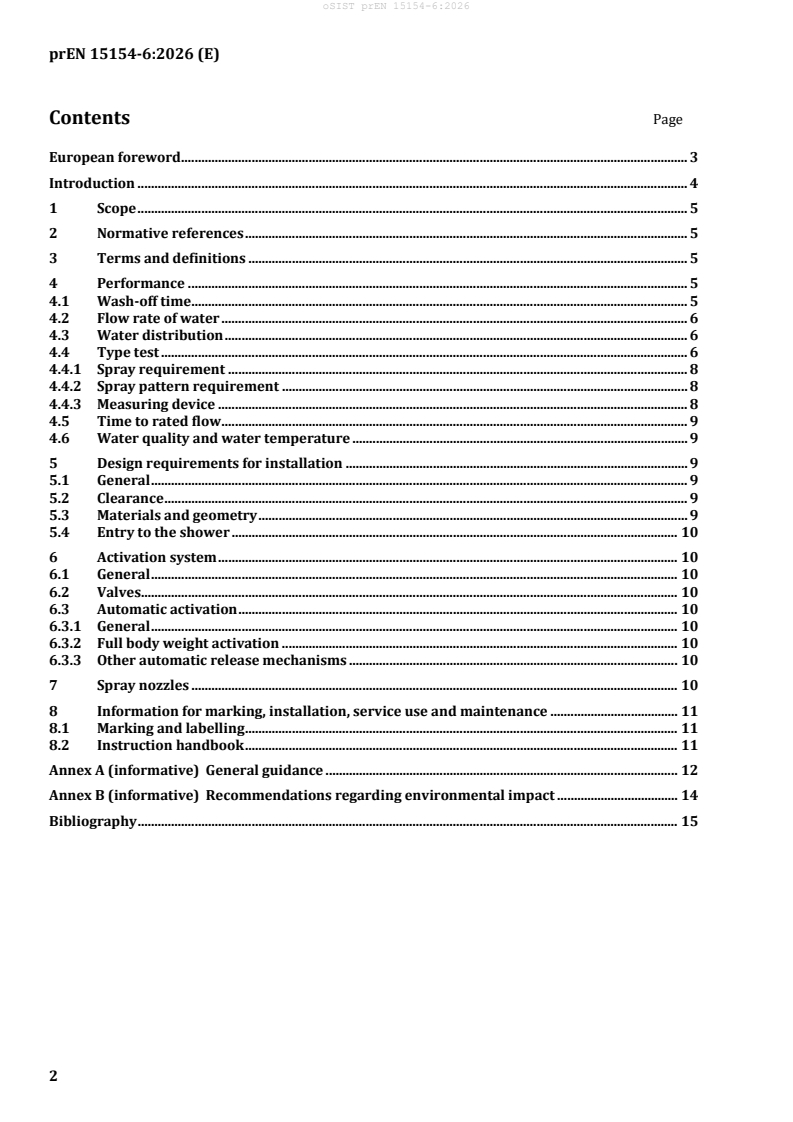
prEN 15154-6 is a CEN draft European Standard for plumbed-in multiple nozzle emergency safety body showers used on industrial and logistic sites other than laboratories. It specifies performance requirements, installation and adjustment rules, marking, and the manufacturer’s instructions for use, operation and maintenance. The standard is for showers connected to a water supply and intended for emergency flushing after heat, flames, or hazardous splashes.
What does prEN 15154-6 specify?
prEN 15154-6 specifies a product standard for emergency safety body showers with multiple spray heads that are permanently connected to water. It covers the shower itself, how it is installed and marked, and what information the manufacturer must supply.
The document is organized into:
- Clause 1 Scope
- Clause 2 Normative references
- Clause 3 Terms and definitions
- Clauses 4 to 8 on performance, installation, activation, spray nozzles, and information for marking and maintenance
- Informative Annex A and Annex B
| Annex | What it covers |
|---|---|
| Annex A | General guidance on water temperature, installation, cleaning, and testing |
| Annex B | Recommendations regarding environmental impact |
The scope is limited to water-fed, plumbed-in multiple nozzle body showers for sites other than laboratories. Showers using fluids other than water are outside the subject of this part. The introduction places this part in the EN 15154 series and points readers to the laboratory and overhead-shower parts for related applications.
What are the key requirements of prEN 15154-6?
Performance and spray coverage
Clause 4 requires the shower to deliver water for at least 15 min at a manufacturer-specified pressure and flow condition. In practice, this means the designer and buyer need to know the required supply performance at the connection point and verify that the site plumbing can sustain it.
Clause 4 also requires the spray to cover the whole body model used in the type test. The test uses a cylinder representing a person, a fluorescent wash-off check, and a water-collection arrangement. For users, this is the core proof that the spray reaches head-to-foot areas in an emergency.
Water delivery and response time
Clause 4.5 requires the shower to reach rated flow within 3 s of activation. That matters because emergency showers must start quickly enough to limit exposure and reduce harm.
Clause 4.6 requires potable water or water of similar quality, and materials must not affect water quality or contaminate the supply. The document also points to a recommended water-temperature range in Annex A, which helps reduce scalding, hypothermia, and bacterial growth.
Installation and physical layout
Clause 5 sets installation requirements. The shower needs at least 800 mm diameter clearance, a minimum height of 2 100 mm, and free access at least 800 mm wide. The activator is the only fitting allowed to intrude into the clearance space, and only by up to 200 mm.
Clause 5 also asks for materials and geometry that limit limescale and stagnant water. In practice, this affects product selection, pipe routing, and maintenance planning.
Activation and nozzles
Clause 6 requires a single unassisted person to activate the shower to full flow. Manual valves must be easy to identify and operate, including when wearing protective gloves. Automatic activation must open the valve within 1 s, and the shower must not close automatically once opened.
Clause 6.3.2 gives requirements for full-body-weight activation systems, including the load range, load-bearing capacity, and minimum activation area. Clause 7 adds that spray adjustments must only be possible with a tool, the nozzles must be self-draining, and removal must also require a tool. These points reduce accidental misuse and help keep the spray reliable.
Marking and instructions
Clause 8 requires permanent identification marking, a safety sign complying with ISO 3864-1, and a maintenance label. The instruction handbook must explain water-supply quality, microbiological precautions, pipework connection, positioning, operation, cleaning, maintenance, and routine testing.
What terms does prEN 15154-6 define?
- Emergency safety shower - A device designed to deliver flushing fluid to extinguish flames and wash away or dilute contaminants.
- Multiple nozzle emergency safety body shower - An emergency safety body shower with multiple spray heads that deliver water from head to feet.
- Rated flow - The flow condition the shower must achieve quickly after activation and sustain during use.
- Flow pressure - The pressure at the point where the shower connects to the water system and where the supply performance is specified and measured.
- Type test - The performance test that checks spray distribution and wash-off behavior using the specified body model and collecting device.
- Activation system - The manual or automatic mechanism that starts the shower and opens it to full flow.
Who uses prEN 15154-6?
This standard is used by manufacturers of emergency safety showers, designers and installers of industrial safety equipment, and site operators responsible for emergency response facilities. It is also relevant to facility managers, HSE staff, maintenance teams, inspectors, and buyers who need to specify showers for industrial or logistic sites. In practice, they use it to select the right product, plan installation, check performance, and organize inspection and maintenance.
What changed in prEN 15154-6 from the previous edition?
The foreword says this draft will supersede EN 15154-6:2019. It also lists two changes:
- harmonization with EN 15154-1
- addition of informative Annex B on environmental impact
Which standards are used with prEN 15154-6?
- EN ISO 21420 - supports the glove-related usability requirement for the valve actuator.
- ISO 3864-1 - provides the rules for the required safety sign and safety markings.
- EN 15154-1 - the laboratory body-shower part of the same series and the source of the shared emergency safety shower definition.
- EN 15154-5 - covers water overhead body showers for sites other than laboratories and helps distinguish the scope of this part.
- EN 15154-3 and EN 15154-4 - are part of the same series for non-plumbed-in body showers and non-plumbed-in eyewash units.
What does the prEN 15154-6 document contain?
The document includes a detailed type-test setup for spray distribution, shown in Figure 1, with a body cylinder and a water-collection device made of five vats. It also includes a series overview table in the introduction that places this part within EN 15154. Annex A gives practical guidance on water temperature, installation location, cleaning, and routine testing, while Annex B gives environmental-impact recommendations. The bibliography points to related shower standards, anthropometric references, and safety-sign and health-related documents.
Relations
- Effective Date
- 15-Oct-2025
Get Certified
Connect with accredited certification bodies for this standard

ECOCERT
Organic and sustainability certification.

Eurofins Food Testing Global
Global leader in food, environment, and pharmaceutical product testing.

Intertek Bangladesh
Intertek certification and testing services in Bangladesh.
Sponsored listings
Frequently Asked Questions
prEN 15154-6 is a draft published by the European Committee for Standardization (CEN). Its full title is "Emergency safety showers - Part 6: Plumbed-in multiple nozzle body showers for sites other than laboratories". This standard covers: This document is a product specification, giving performance requirements for plumbed-in multiple nozzle emergency safety body showers which are permanently connected to a water supply and installed on industrial and logistic sites. Emergency safety body showers using fluid other than water are not considered in this document. This document also specifies requirements in respect of installation, adjustment and marking of the showers as well as operation and maintenance instructions to be given by the manufacturer. NOTE 1 Plumbed-in emergency safety body showers designed for laboratory facilities are dealt with in EN 15154-1. NOTE 2 Water overhead body showers for sites other than laboratories are dealt with in FprEN 15154-5. NOTE 3 Attention is drawn to national regulations which can apply in respect of the installation and use of emergency safety showers.
This document is a product specification, giving performance requirements for plumbed-in multiple nozzle emergency safety body showers which are permanently connected to a water supply and installed on industrial and logistic sites. Emergency safety body showers using fluid other than water are not considered in this document. This document also specifies requirements in respect of installation, adjustment and marking of the showers as well as operation and maintenance instructions to be given by the manufacturer. NOTE 1 Plumbed-in emergency safety body showers designed for laboratory facilities are dealt with in EN 15154-1. NOTE 2 Water overhead body showers for sites other than laboratories are dealt with in FprEN 15154-5. NOTE 3 Attention is drawn to national regulations which can apply in respect of the installation and use of emergency safety showers.
prEN 15154-6 is classified under the following ICS (International Classification for Standards) categories: 71.040.10 - Chemical laboratories. Laboratory equipment. The ICS classification helps identify the subject area and facilitates finding related standards.
prEN 15154-6 has the following relationships with other standards: It is inter standard links to EN 15154-6:2019. Understanding these relationships helps ensure you are using the most current and applicable version of the standard.
prEN 15154-6 is available in PDF format for immediate download after purchase. The document can be added to your cart and obtained through the secure checkout process. Digital delivery ensures instant access to the complete standard document.
Standards Content (Sample)
Contents
- Introduction
- 1 Body shower X - - X
- 2 Eyewash unit X X - X
- 3 Body shower X X X -
- 4 Eyewash unit X X X -
- 5 Body shower - X X X
- 6 Body shower - X - aaX
- 1 Scope
- 2 Normative references
- 3 Terms and definitions
- 3.1 emergency safety shower
- 3.2 multiple nozzle emergency safety body shower
- 4 Performance
- 4.1 Wash-off time
- 4.2 Flow rate of water
- 4.3 Water distribution
- 4.4 Type test
- 4.5 Time to rated flow
- 4.6 Water quality and water temperature
- 5 Design requirements for installation
- 5.1 General
- 5.2 Clearance
- 5.3 Materials and geometry
- 5.4 Entry to the shower
- 6 Activation system
- 6.1 General
- 6.2 Valves
- 6.3 Automatic activation
- 7 Spray nozzles
- 8 Information for marking, installation, service use and maintenance
- 8.1 Marking and labelling
- 8.2 Instruction handbook
- Annex A
- Annex B
- 5. Transparency and Reporting: Organizations are encouraged to disclose their environmental
- Bibliography
Introduction
Plumbed-in multiple nozzle body showers for sites other than laboratories are designed and intended to be installed in close range of persons working in a potentially hazardous area exposed to the risk of burning/burns and/or hazardous chemical substances getting splashed onto all or part of the body, despite other risk mitigation measures.
The main purpose of these devices is to deliver immediately a flushing fluid in a volume sufficient to extinguish flames and/or to flush the body following exposure to injurious substances or heat. Once this is accomplished, the injured person can proceed to medical care. Emergency safety showers are primarily emergency facilities and not intended for use for personal cleaning or personal hygiene.
Annex A provides recommendations on general settings for shower installations and Annex B provides recommendations regarding environmental impact.
This document, EN 15154-6, is part of a series of standards on emergency safety showers dealing with plumbed-in multiple nozzle body showers, used on sites other than laboratories (see Table 1). Table 1 — Subject areas covered under the EN 15154 series of standards Part of Sites other than Type Laboratories Non plumbed-in Plumbed-in EN 15154 Laboratories
1 Body shower X - - X
2 Eyewash unit X X - X
a a a
3 Body shower X X X -
4 Eyewash unit X X X -
c b
5 Body shower - X X X
6 Body shower - X - aaX
a Non plumbed-in body showers affected by EN 15154-3 are fixed, transportable or portable. b Non plumbed-in body showers affected by EN 15154-5 are tank showers or trailer-mounted.
In possible combination with eyewash units.
NOTE Attention is drawn to national regulations in some European countries, e.g. Germany, which can request to connect emergency safety showers to a water supply.
oSIST prEN 15154-6:2026 prEN 15154-6:2026(E)
1 Scope
This document is a product specification, giving performance requirements for multiple nozzle emergency safety body showers connected to the water supply. It is applicable to plumbed-in multiple nozzle emergency safety body showers only, located in sites other than laboratories. Emergency safety body showers using fluid other than water are not considered in this document. Requirements are given in respect of the performance, installation, adjustment and marking of the showers as well as installation, operation and maintenance instructions to be given by the manufacturer. NOTE 1 Plumbed-in emergency safety body showers designed for laboratory facilities are dealt with in EN 15154-1.
NOTE 2 Water overhead body showers for sites other than laboratories are dealt with in EN 15154-5. NOTE 3 Attention is drawn to national regulations which might apply in respect of the installation and use of emergency safety showers.
2 Normative references
The following documents are referred to in the text in such a way that some or all of their content constitutes requirements of this document. For dated references, only the edition cited applies. For undated references, the latest edition of the referenced document (including any amendments) applies. EN ISO 21420, Protective gloves — General requirements and test methods (ISO 21420) ISO 3864-1, Graphical symbols — Safety colours and safety signs — Part 1: Design principles for safety signs and safety markings
3 Terms and definitions
For the purposes of this document, the following terms and definitions apply. ISO and IEC maintain terminology databases for use in standardization at the following addresses:
- ISO Online browsing platform: available at https://www.iso.org/obp
- IEC Electropedia: available at https://www.electropedia.org/
3.1 emergency safety shower
device specially designed and intended to deliver a flushing fluid to extinguish flames and to sufficiently wash away contaminants or to dilute them, rendering them harmless [SOURCE: EN 15154-1:2025, 3.1]
3.2 multiple nozzle emergency safety body shower
emergency safety body shower with multiple spray heads delivering water from head to feet
4 Performance
4.1 Wash-off time
The plumbed-in body shower shall be able to deliver water at a constant manufacturer-specified pressure, and continued for at least 15 min.
NOTE Attention is drawn to national regulations.
oSIST prEN 15154-6:2026 prEN 15154-6:2026 (E)
4.2 Flow rate of water
The water supplied by the multiple nozzle emergency safety body shower shall be of constant flow rate at a flow pressure to be specified by the manufacturer. The flow pressure shall be specified and measured where the shower is connected to the water system. The multiple nozzle emergency safety body shower shall be capable of delivering this supply for a minimum of 15 min. NOTE When no national or local regulations apply, a constant flow rate of minimum 60 l/min is suitable.
4.3 Water distribution
The velocity of the water spray shall be low enough to be non-injurious to the user. Water distribution shall meet the requirements listed below and illustrated in Figure 1.
4.4 Type test
4.4.1 General
Type test shall be performed as shown in Figure 1.
oSIST prEN 15154-6:2026 prEN 15154-6:2026(E)
Key A total net height of the cylinder representing the human body = 2 000 mm. B height of the cylinder corresponding to the lower limbs = 825 mm. C height of the cylinder corresponding to the abdomen = 325 mm. D height of the cylinder corresponding to the chest = 425 mm.
E height of the cylinder corresponding to the head and neck = 425 mm. F cylindrical vat G cylindrical vat corresponding to body-section B H cylindrical vat corresponding to body-section C I cylindrical vat corresponding to body-section D J cylindrical vat corresponding to body-section E S floor level of the emergency safety shower basin Figure 1 — Spray pattern distribution of a multiple nozzle emergency body shower
oSIST prEN 15154-6:2026 prEN 15154-6:2026 (E)
4.4.2 Spray requirement
The nozzle layout shall be designed such that the body, represented by a cylinder of height A = 2 000 mm with a base formed by a circle of diameter 550 mm, is jet-sprayed directly over its entire surface. By means of a UV lamp, visual testing of the distribution efficiency of the nozzles shall be made by washing off a fluorescent solution applied to the entire surface of the body model described under Figure 1 within maximum of 90 s.
4.4.3 Spray pattern requirement
At least 90 % of the water sprayed shall collect in a cylinder of height A = 2 000 mm with a base formed by a 550 mm-diameter cylinder. The subdistribution of this net total collected water volume shall be as follows:
- lower limbs: (25 ± 5) % over a height B = 825 mm corresponding to the lower limbs (height from foot to inside leg),
- abdomen: (25 ± 5) % over a height C = 325 mm corresponding to the abdomen (height from inside leg to elbows, with arms by the sides),
- chest: (30 ± 5) % over a height D = 425 mm corresponding to the chest (height from elbows to shoulders, with arms by the sides),
- head and neck: (20 ± 5) % over a height E = 425 mm corresponding to the head plus neck section (height from the shoulders to the crown of the head).
...