

EN 15316-2-3:2007
(Main)Heating systems in buildings - Method for calculation of system energy requirements and system efficiencies - Part 2-3: Space heating distribution systems
General Information
- Abstract
This European Standard provides a methodology to calculate/estimate the system thermal loss of water based distribution systems for heating and the auxiliary energy demand, as well as the recoverable part of each. The actual recovered energy depends on the gain to loss ratio. Different levels of accuracy, corresponding to the needs of the user and the input data available at each design stage of the project, are provided in this European Standard by different calculation methods, i.e. a detailed calculation method, a simplified calculation method and a method based on tabulated values. The general method of calculation can be applied for any time-step (hour, day, month or year).
Pipework lengths for the heating of decentralised, non-domestic ventilation systems equipment are to be calculated in the same way as for water based heating systems. For centralised, non-domestic ventilation systems equipment, the length is to be specified in accordance with its location.
NOTE It is possible to calculate the system thermal loss and auxiliary energy demand for cooling systems with the same calculation methods as shown in this European Standard. Specifically, determination of auxiliary energy demand is based on the same assumptions for efficiency of pumps, because the efficiency curve applied is an approximation for inline and external motors. It needs to be decided by the standardisation group of CEN, whether or not the extension for cooling systems should be made in this European Standard. This is also valid for distribution systems in HVAC (in ducts) and also for special liquids.
- Status
- Withdrawn
- Publication Date
- 24-Jul-2007
- Withdrawal Date
- 29-Sep-2026
- Technical Committee
- CEN/TC 228 - Heating systems in buildings
- Current Stage
- 9960 - Withdrawal effective - Withdrawal
- Start Date
- 26-Apr-2017
- Completion Date
- 30-Sep-2026

Relations
- Effective Date
- 03-May-2017
- Effective Date
- 28-Jan-2026
- Effective Date
- 28-Jan-2026
- Effective Date
- 28-Jan-2026
- Effective Date
- 28-Jan-2026
- Effective Date
- 28-Jan-2026
- Effective Date
- 28-Jan-2026
Get Certified
Connect with accredited certification bodies for this standard

DIBt (Deutsches Institut für Bautechnik)
German Institute for Building Technology.
DIN CERTCO
DIN Group product certification.

Aboma Certification B.V.
Specialized in construction, metal, and transport sectors.
Sponsored listings
Frequently Asked Questions
EN 15316-2-3:2007 is a standard published by the European Committee for Standardization (CEN). Its full title is "Heating systems in buildings - Method for calculation of system energy requirements and system efficiencies - Part 2-3: Space heating distribution systems". This standard covers: This European Standard provides a methodology to calculate/estimate the system thermal loss of water based distribution systems for heating and the auxiliary energy demand, as well as the recoverable part of each. The actual recovered energy depends on the gain to loss ratio. Different levels of accuracy, corresponding to the needs of the user and the input data available at each design stage of the project, are provided in this European Standard by different calculation methods, i.e. a detailed calculation method, a simplified calculation method and a method based on tabulated values. The general method of calculation can be applied for any time-step (hour, day, month or year). Pipework lengths for the heating of decentralised, non-domestic ventilation systems equipment are to be calculated in the same way as for water based heating systems. For centralised, non-domestic ventilation systems equipment, the length is to be specified in accordance with its location. NOTE It is possible to calculate the system thermal loss and auxiliary energy demand for cooling systems with the same calculation methods as shown in this European Standard. Specifically, determination of auxiliary energy demand is based on the same assumptions for efficiency of pumps, because the efficiency curve applied is an approximation for inline and external motors. It needs to be decided by the standardisation group of CEN, whether or not the extension for cooling systems should be made in this European Standard. This is also valid for distribution systems in HVAC (in ducts) and also for special liquids.
This European Standard provides a methodology to calculate/estimate the system thermal loss of water based distribution systems for heating and the auxiliary energy demand, as well as the recoverable part of each. The actual recovered energy depends on the gain to loss ratio. Different levels of accuracy, corresponding to the needs of the user and the input data available at each design stage of the project, are provided in this European Standard by different calculation methods, i.e. a detailed calculation method, a simplified calculation method and a method based on tabulated values. The general method of calculation can be applied for any time-step (hour, day, month or year). Pipework lengths for the heating of decentralised, non-domestic ventilation systems equipment are to be calculated in the same way as for water based heating systems. For centralised, non-domestic ventilation systems equipment, the length is to be specified in accordance with its location. NOTE It is possible to calculate the system thermal loss and auxiliary energy demand for cooling systems with the same calculation methods as shown in this European Standard. Specifically, determination of auxiliary energy demand is based on the same assumptions for efficiency of pumps, because the efficiency curve applied is an approximation for inline and external motors. It needs to be decided by the standardisation group of CEN, whether or not the extension for cooling systems should be made in this European Standard. This is also valid for distribution systems in HVAC (in ducts) and also for special liquids.
EN 15316-2-3:2007 is classified under the following ICS (International Classification for Standards) categories: 91.140.10 - Central heating systems. The ICS classification helps identify the subject area and facilitates finding related standards.
EN 15316-2-3:2007 has the following relationships with other standards: It is inter standard links to EN 15316-3:2017, EN 12831-1:2017, EN 15316-4-1:2008, CEN/TR 12098-6:2016, CEN/TR 12098-7:2016, CEN/TR 15232-2:2016, EN 15232:2012. Understanding these relationships helps ensure you are using the most current and applicable version of the standard.
EN 15316-2-3:2007 is associated with the following European legislation: Standardization Mandates: M/343. When a standard is cited in the Official Journal of the European Union, products manufactured in conformity with it benefit from a presumption of conformity with the essential requirements of the corresponding EU directive or regulation.
EN 15316-2-3:2007 is available in PDF format for immediate download after purchase. The document can be added to your cart and obtained through the secure checkout process. Digital delivery ensures instant access to the complete standard document.
Standards Content (Sample)
2003-01.Slovenski inštitut za standardizacijo. Razmnoževanje celote ali delov tega standarda ni dovoljeno.Heating systems in buildings - Method for calculation of system energy requirements and system efficiencies - Part 2-3: Space heating distribution systemsSystemes de chauffage dans les bâtiments - Méthode de calcul des besoins énergétiques et d'efficacité des systemes - Partie 2-3: Systemes de distribution de chauffage des locauxHeizsysteme in Gebäuden - Verfahren zur Berechnung der Energieanforderungen und Nutzungsgrade der Anlagen - Teil 2-3: WärmeverteilsystemeTa slovenski standard je istoveten z:EN 15316-2-3:2007SIST EN 15316-2-3:2007en91.140.10Sistemi centralnega ogrevanjaCentral heating systemsICS:SLOVENSKI
STANDARDSIST EN 15316-2-3:200701-november-2007
EUROPEAN STANDARDNORME EUROPÉENNEEUROPÄISCHE NORMEN 15316-2-3July 2007ICS 91.140.10 English VersionHeating systems in buildings - Method for calculation of systemenergy requirements and system efficiencies - Part 2-3: Spaceheating distribution systemsSystèmes de chauffage dans les bâtiments - Méthode decalcul des besoins énergétiques et des rendements dessystèmes - Partie 2-3: Systèmes de distribution dechauffage des locauxHeizsysteme in Gebäuden - Verfahren zur Berechnung derEnergieanforderungen und Nutzungsgrade der Anlagen -Teil 2-3: WärmeverteilungssystemeThis European Standard was approved by CEN on 21 June 2007.CEN members are bound to comply with the CEN/CENELEC Internal Regulations which stipulate the conditions for giving this EuropeanStandard the status of a national standard without any alteration. Up-to-date lists and bibliographical references concerning such nationalstandards may be obtained on application to the CEN Management Centre or to any CEN member.This European Standard exists in three official versions (English, French, German). A version in any other language made by translationunder the responsibility of a CEN member into its own language and notified to the CEN Management Centre has the same status as theofficial versions.CEN members are the national standards bodies of Austria, Belgium, Bulgaria, Cyprus, Czech Republic, Denmark, Estonia, Finland,France, Germany, Greece, Hungary, Iceland, Ireland, Italy, Latvia, Lithuania, Luxembourg, Malta, Netherlands, Norway, Poland, Portugal,Romania, Slovakia, Slovenia, Spain, Sweden, Switzerland and United Kingdom.EUROPEAN COMMITTEE FOR STANDARDIZATIONCOMITÉ EUROPÉEN DE NORMALISATIONEUROPÄISCHES KOMITEE FÜR NORMUNGManagement Centre: rue de Stassart, 36
B-1050 Brussels© 2007 CENAll rights of exploitation in any form and by any means reservedworldwide for CEN national Members.Ref. No. EN 15316-2-3:2007: E
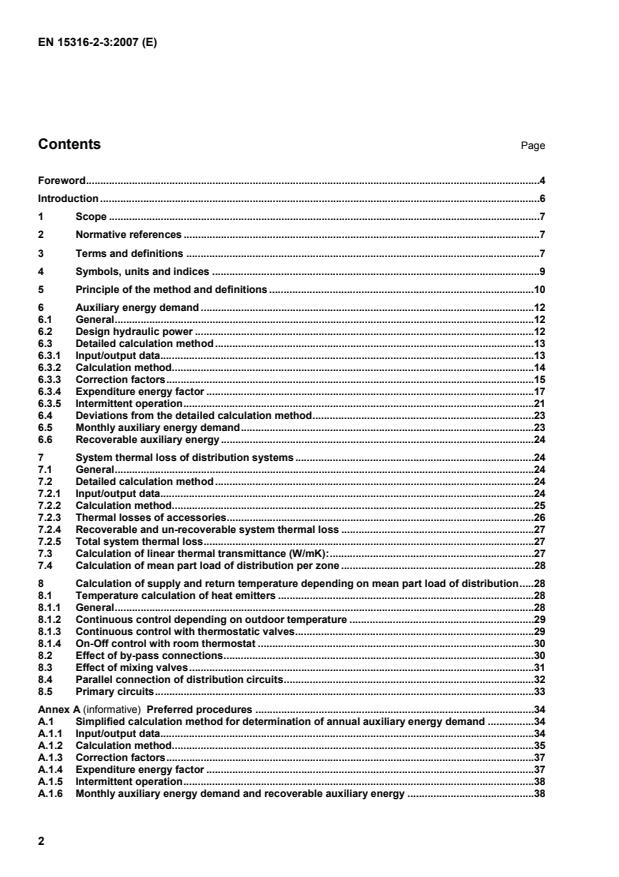
Preferred procedures.34 A.1 Simplified calculation method for determination of annual auxiliary energy demand.34 A.1.1 Input/output data.34 A.1.2 Calculation method.35 A.1.3 Correction factors.37 A.1.4 Expenditure energy factor.37 A.1.5 Intermittent operation.38 A.1.6 Monthly auxiliary energy demand and recoverable auxiliary energy.38
The guidelines describe ways to meet the requirements, but other ways to fulfil the functional requirements might be used if fulfilment can be proved. Heating systems differ among the member countries due to climate, traditions and national regulations. In some cases requirements are given as classes so national or individual needs may be accommodated. In cases where the standards contradict with national regulations, the latter should be followed. EN 15316 Heating systems in buildings — Method for calculation of system energy requirements and system efficiencies consists of the following parts: Part 1: General
[m²] c Specific heat capacity
[J/kg K] dise Expenditure energy factor for operation of circulation pump [-] Sf Correction factor for supply flow temperature control
[-] NETf Correction factor for hydraulic networks (layout)
[-] desSf, Correction factor for heating surface design
[-] HBf Correction factor for hydraulic balance
[-] PMGf, Correction factor for generators with integrated pump management
[-] PLf Correction factor for partial load characteristics
[-] Cf Correction factor for control of the pump
[-] PSPf Correction factor for selection of design point [-] ϑf Correction factor for differential temperature dimensioning
[-] qf& Correction factor for surface related heating load [-] ηf Correction factor for efficiency
[-] levh Floor height
[m] LL Building length
[m] maxL Maximum length of pipe
[m] WL Building width
[m] byk
Ratio of flow over the heat emitter to flow in the ring
[-] n Exponent of the heat emission system
[-] levN Number of floors
[-] desp∆ Differential pressure at design point
[kPa] HSp∆ Differential pressure of heating surfaces
[kPa] CVp∆ Differential pressure of control valves for heating surfaces
[kPa] ZVp∆ Differential pressure of zone valves
[kPa] Gp∆ Differential pressure of heat supply [kPa] FHp∆ Differential pressure of floor heating systems [kPa] ADDp∆ Differential pressure of additional resistances
[kPa] deshydrP, Hydraulic power at design point
[W] pmpelP, Actual power input
[W] refpmpelP,, Reference power input
[W] HΦ Design heating load
[kW] rblauxdisHQ,,, Recoverable auxiliary energy for space heating
[kWh/time step] rvdauxdisHQ,,, Recovered auxiliary energy in the distribution system
[kWh/time step]
[kWh/year] anrbllsdisHQ,,,, Recoverable system thermal losses for space heating [kWh/year] annrbllsdisHQ,,,, Unrecoverable system thermal losses
[kWh/year] R Pressure loss in pipes [kPa/m] anopt, Heating hours per year [h/year] Ψ Linear thermal transmittance [W/mK] desV& Flow at design point
[m³/h]
minV& Minimum volume flow
[m³/h] anauxdisHW,,, Annual auxiliary energy demand [kWh/year] mauxdisHW,,, Monthly auxiliary energy demand
[kWh/month] anhydrdisHW,,, Annual hydraulic energy demand [kWh/year] compf Resistance ratio of components
[-] k Time factor
[-] bk
Boost mode time factor
[-] rk
Regular mode time factor
[-] setbk
Set back mode time factor
[-] desdis,ϑ∆ Design heating system temperature difference [K] Pη Efficiency of pump at design point
[-] disβ Mean part load of the distribution [-] ρ Specific density
[kg/m³] iθ
Surrounding temperature
[°C] mθ
Mean medium temperature
[°C] uθ
Temperature in unheated space
[°C] sθ
Supply temperature
[°C] rθ
Return temperature
[°C] dess,θ
Design supply temperature
[°C] desr,θ
Design return temperature
[°C] 5 Principle of the method and definitions The method allows the calculation of the system thermal loss and the auxiliary energy demand of water based distribution systems for heating circuits (primary and secondary), as well as the recoverable system thermal losses and the recoverable auxiliary energy. As shown in Figure 1, a heating system can be divided in three parts – emission and control, distribution and generation. A simple heating system has no buffer-storage, no distributor/collector, and only one pump is applied. Larger heating systems comprise more than one secondary heating circuit with different emitters. Often, such larger heating systems comprise also more than one heat generator with either one common primary heating circuit or individual primary heating circuits (in Figure 1, only one primary heating circuit is shown). The subdivision of the heating system into primary and secondary circuits is given by any hydraulic separator, which can be a buffer-storage with a large volume or a hydraulic separator with a small volume. Anyhow, the
Key 1 next heating circuit 2 pump 3 room 4 emission 5 buffer-storage 6 pump 7 generator 8 generation 9 distribution 10 primary heating circuits 11 secondary heating circuits Figure 1 — Scheme distribution and definitions of heating circuits
desdesdeshydrVpP&⋅∆⋅=2778,0,
[W] (1) where desV& is the flow at design point [m³/h]; desp∆ is the differential pressure at design point [kPa]. The flow is calculated from the heat load outemH,,Φ of the zone (the design heat load shall be according to
EN 12831) and the design temperature difference desdis,ϑ∆ of the heating system:
desdisoutemHdescV,.,3600ϑρ∆⋅⋅Φ⋅=& [m³/h] (2) where c
is the specific heat capacity [kJ/kg K]; ρ
is the density [kg/m³];
()ADDGZVCVHScompdespppppLRfp∆+∆+∆+∆+∆+⋅⋅+=∆max1 [kPa] (3) where compf is the resistance ratio of components [-]; R is the pressure loss per m [kPa/m]; maxL is the maximum pipe length of the heating circuit [m]; HSp∆ is the differential pressure of heating surface [kPa]; CVp∆ is the differential pressure of control valve for heating surface [kPa]; ZVp∆ is the differential pressure of zone valves [kPa]; Gp∆ is the differential pressure of heat supply [kPa]; ADDp∆ is the differential pressure of additional resistances [kPa]. 6.3 Detailed calculation method 6.3.1 Input/output data The input data for the detailed calculation method are listed below. These are all part of the detailed project data. deshydrP, hydraulic power at the design point for the zone [in W]
- by calculation according to Equations (1) and (2) outemH,,Φ design heat load of the zone according to EN 12831; desdis,ϑ∆ design temperature difference for the distribution system in the zone [K]; maxL maximum pipe length of the heating circuit in the zone [m]; p∆ differential pressure of the circuit in the zone [kPa]; disβ mean part load of the distribution [-]; anopt, heating hours per year [h/year];
Type of pump control
Design temperature level Heat emitter type Intermittent operation
The output data of the detailed calculation method are: anauxdisHW,,, annual auxiliary energy demand [kWh/year]; mauxdisHW,,, monthly auxiliary energy demand [kWh/month]; rvdauxdisHQ,,, recovered auxiliary energy in the distribution system [kWh/time step]; rblauxdisHQ,,, recoverable auxiliary energy for space heating [kWh/time step]. 6.3.2 Calculation method The annual auxiliary energy demand for circulation pumps for water based heating systems is calculated by:
disanhydrdisHanauxdisHeWW⋅=,,,,,,
[kWh/year] (4) where anauxdisHW,,, is the annual auxiliary energy demand [kWh/year];
PMGHBSDNETSanopdisdeshydranhydrdisHffffftPW,,,,,,1000⋅⋅⋅⋅⋅⋅⋅=β [kWh/year]
(5) where deshydrP, is the hydraulic power at design point [W]; disβ is the mean part load of the distribution [-]; anopt, are the heating hours per year [h/year]; Sf is the correction factor for supply flow temperature control [-]; NETf is the correction factor for hydraulic networks [-]; SDf is the correction factor for heating surface dimensioning [-]; HBf is the correction factor for hydraulic balance [-]; PMGf, is the correction factor for generators with integrated pump management [-]. The correction factors, Sf, NETf and SDf include the most important parameters related to dimensioning of the heating system. The factor HBf takes into account the hydraulic balance of the distribution system. The correction factor PMGf, for generators with integrated pump management, takes into account the reduction of operation time in relation to the heating time. 6.3.3 Correction factors 6.3.3.1 General The correction factors are based on a wide range of simulations of different networks. Some of the correction factors can not be changed without changing the method. Correction factors, which are based on assumptions, may be changed on a national level in a national annex (see A.1.3). 6.3.3.2 Correction factor for supply flow temperature control
Sf 1=Sf
for systems with outdoor temperature compensation;
see Figure 2, for systems without outdoor temperature compensation (i.e. constant flow temperature) or very much higher flow temperature than necessary.
Key 1 correction factor Sf [-] 2 ground plan AN [m²] 3 flow temperature characteristics Figure 2 — Correction factor Sf for constant flow temperature and very much higher flow temperature 6.3.3.3 Correction factor for hydraulic networks NETf 1=NETf
for a two-pipe ring line horizontal layout (on each floor); NETf
see Table 2 for other types of layout.
Table 2 — Correction factor NETf for hydraulic network Network design One family house Dwellings 2 – pipe system
Ring line 1,0 1,0 Ascending – pipe 0,93 0,92 Star-shaped 0,98 0,98
7,06,8+⋅=byNETkf [-] (6) where byk is the ratio of flow over the heat emitter to flow in the ring [-]. 6.3.3.4 Correction factor for heating surface dimensioning SDf 1=SDf
for dimensioning according to design heat load; 96,0=SDf in case of additional over-sizing of the heating surfaces. 6.3.3.5 Correction factor for hydraulic balance HBf See A.1.3. 6.3.3.6 Correction factor for generators with integrated pump management PMGf, See A.1.3. 6.3.4 Expenditure energy factor 6.3.4.1 General For assessment of partial load conditions and control performance of the circulation pump, the expenditure energy factor is determined by:
CPSPPLdisffffe⋅⋅⋅=η [-] (7) where ηf
is the correction factor for efficiency [-]; PLf
is the correction factor for part load [-]; PSPf is the correction factor for design point selection [-]; Cf
is the correction factor for control [-]. With these four correction factors, the expenditure energy factor take into account the most important influences on the energy demand, representing the design, the efficiency of the pump, the part load and the control. The physical relations are shown in Figure 3.
Key 1 pressure head H [m] 2 power P1 [W] 3 flow rate [m³/h] 4 H0,max 5 Hpmp 6 Hdes 7 HPL 8 Phydr,des 9 PPL 10 Pel,pmp 11 Pel,pmp,max 12 PPL,C 13 Pel,pmp,ref
14 PLV&
15 V& 16 PLCPLPLPPf,= 17 refpumpelpumpelPSPPPf,,,= 18 deshydrrefpumpelPPf,,,=η 19 pumpeldisPLPLPPf,⋅=β Figure 3 — Expenditure energy factor - physical interpretation of the correction factors
[-] (8) The reference power input is calculated by means of the hydraulic characteristics of the pump:
+⋅=5,0,,,,20025,1deshydrdeshydrrefpmpelPPP [W] (9) 6.3.4.3 Correction factor for part load PLf The correction factor for part load takes into account the reduction of pump efficiency by partial load. It also takes into account the hydraulic characteristics of non-controlled pumps. The impact of the partial load on the pipe system, and thus on the hydraulic energy demand, is taken into account by the mean part load of the distributiondisβ, according to 6.3.2. Figure 4 shows the correction factor for part load of the pump, depending on the mean part load of the distribution.
Key 1 correction factor fPL [-] 2 mean part load of distribution ßdis
3 mean part load ratio (PLR) Figure 4 — Correction factor for part load of the pump
refpmpelpmpelPSPPPf,,,= [-] (10) where pmpelP,
is the actual power input of pump at design point [W]; refpmpelP,, is the reference power input of pump at design point [W]. 6.3.4.5 Correction factor for control of the pump Cf 1=Cf
for non-controlled pumps; Cf
see Figure 5 for controlled pumps.
Key 1 correction factor for control of the pump fC [-] 2 Pel,pmp,max / Pel,pmp
3 constp∆ - control 4 ipvar∆ - control 5 pump control Figure 5 — Correction factor for control of the pump
Key 1 room temperature 2 time 3 set back 4 boost 5 regular mode 6 set back Figure 6 — Intermittent operation, phases
boostanauxdisHsetbanauxdisHreganauxdisHimanauxdisHWWWW,,,,,,,,,,,,,,,,++= [kWh/year]
(11) For the regular mode operation, the auxiliary energy demand is determined from Equation (4) in 6.3.2 and by multiplication with a time factor for the proportional time of regular mode operation, rk:
disanhydrdisHrreganauxdisHeWkW⋅⋅=,,,,,,, [kWh/year]
(12) For the set back operation, it is necessary to distinguish between: turn off mode, for which the auxiliary energy demand of the pump is zero - 0,,,,=setbanauxdisHW; set back of supply temperature and minimum speed of the pump. When the pump is operated at minimum speed, the power is assumed to be constant as follows:
max,,,,3,0pmpelsetbpmpelPP⋅= [W]
(13) and the auxiliary energy demand is determined by multiplication with a time factor for the proportional time of set back operation, setbk:
anopsetbpmpelsetbsetbanauxdisHtPkW,,,,,,,1000⋅⋅= [kWh/year]
(14) set back of supply temperature. If thermostatic valves in this mode are not set back, the flow compensates the lower supply temperature and the auxiliary energy demand is not reduced. For this type of set back operation, the auxiliary energy demand is calculated as for the regular mode operation. The correction factor for control to be applied is 1=Cf in case of room temperature control with constant value (no changes between regular mode and set back mode). In case of room temperature control with set back, Cf depends on the type of pump control (see Figure 5). For the boost mode operation, the power boostpmpelP,, is equal to the power despmpelP,, at the design point. The auxiliary energy demand for the boost mode operation is determined by multiplication with a time factor for the proportional time of boost mode operation, bk:
anopboostpmpelbboostanauxdisHtPkW,,,,,,,1000⋅⋅= [kWh/year]
(15) The time factors can be calculated according to ratios of time periods. The regular mode time factor, rk, expresses the number of hours of regular mode operation ropt, per total number of hours per time period Pt (period could be day, week, month or year):
Proprttk,= [-]
(16)
Pboostopbttk,= [-] (17) The set back mode time factor, setbk, expresses the number of hours of set back mode operation per total number of hours per time period Pt and is determined from rk and bk:
brsetbkkk−−=1 [-] (18) 6.4 Deviations from the detailed calculation method For some applications, deviations from the detailed calculation method are taken into account: One-pipe heating systems The total flow in the heating circuit and in the pump is constant. The pump is always working at the design point. The mean part load of distribution is 1=disβ Overflow valves Overflow valves are used to ensure a minimum flow at the heat generator or a maximum differential pressure at the heat emitter. The function of the overflow valve is given by the interaction between the pressure loss of the system, the characteristics of the pump and the set point of the overflow valve. The influence on hydraulic energy demand can be estimated by applying a corrected mean part load of distribution, disβ′:
()desdisdisdisVV&&min1⋅−+=′βββ [-] (19) where disβ is the mean part load of distribution; desV&
is the design volume flow [m³/h]; minV& is the minimum volume flow [m³/h]. The minimum volume flow takes into account the requirements of the heat generator or the maximum pressure loss of the heat emitter. 6.5 Monthly auxiliary energy demand In the detailed calcula
...