

prEN ISO 11137-3
(Main)Sterilization of medical devices - Microbiological methods - Part 3: Guidance on the evaluation and interpretation of bioburden data
General Information
- Abstract
Migrated from Progress Sheet (TC Comment) (2000-07-10): WIs 030-033 are the result of the splitting of WI 026 (CC/000327) ++ Please contact T Vyze x 850 when progressing this project though any stage
- Status
- Not Published
- Publication Date
- 08-Aug-2005
- Technical Committee
- CEN/TC 204 - Sterilization of medical devices
- Drafting Committee
- CEN/TC 204 - Sterilization of medical devices
- Current Stage
- 3097 - Decision to split/merge - Consensus building
- Start Date
- 31-Mar-2003
- Completion Date
- 31-Mar-2003


Overview
The draft European Standard prEN ISO 11137-3:2004, developed by ISO/TC 198 and CEN/TC 204, provides comprehensive guidance on dosimetric aspects related to the sterilization of medical devices using radiation. This document complements parts 1 and 2 of ISO 11137 and focuses on the measurement, calibration, and evaluation of radiation dose (dosimetry) essential in the safe and effective sterilization process of health care products.
The standard applies to gamma irradiators using radionuclides (Cobalt-60 and Cesium-137), as well as electron beam and X-ray irradiators. It establishes the requirements for dosimetry systems, emphasizing traceability, accuracy, and precision in dose measurement. Compliance with this guidance supports regulatory requirements and ensures that sterilization processes meet validated quality and safety standards.
Key Topics
Dosimetry System Selection and Calibration
- Emphasizes the need for selecting dosimetry systems capable of accurate dose measurement across the required dose range.
- Calibration must be traceable to national or international standards with known uncertainty, performed under conditions mimicking actual sterilization environments (temperature, humidity, dose rate).
- Use of accredited laboratories for calibration to ensure traceability and reliability.
Measurement of Absorbed Dose
- Dose is measured in terms of absorbed dose in water, providing a consistent metric for radiation exposure across devices and processes.
- Dosimetry involves interrelated elements including dosimeters, instruments, and procedures to determine the absorbed dose.
Establishing Maximum Acceptable and Sterilization Doses
- Defines procedures to set dose limits ensuring effective sterilization without compromising device integrity.
- Supports the validation of sterilization cycles and routine control.
Qualification and Routine Monitoring
- Covers installation, operational, and performance qualification of irradiation equipment.
- Details routine monitoring requirements including frequency of dose measurements to maintain process control and consistency.
Mathematical Modeling and Practical Applications
- Introduces modeling techniques such as Point Kernel and Monte Carlo methods to optimize irradiator design and operation.
- Modeling assists in dose distribution analyses, enhancing process reliability.
Applications
Health Care Product Sterilization
- Provides essential guidelines for manufacturers and sterilization facilities using radiation to sterilize medical devices.
- Ensures sterilization processes meet the requirements of regulatory bodies including compliance with EU Directives.
Radiation Facility Operation and Validation
- Assists technical personnel in selecting dosimetry systems and calibrating equipment specifically tailored to their facility’s radiation source.
- Supports validation and routine control operations for gamma, electron beam, and X-ray irradiation processes.
Quality Assurance and Regulatory Compliance
- Facilitates traceability of dose measurements, supporting quality assurance systems aligned with ISO 11137 parts 1 and 2.
- Enhances product safety and reliability by ensuring accurate dose delivery within prescribed sterilization limits.
Related Standards
- ISO 11137-1 - Requirements for development, validation, and routine control of a sterilization process for medical devices using radiation.
- ISO 11137-2 - Establishing the sterilization dose to achieve validated sterility assurance.
- ISO/ASTM Guide 51261 - Guidance on selection and use of dosimetry systems.
- ISO/ASTM 51707 - Estimation and reporting of measurement uncertainty in dosimetry.
- ISO 17025 - General requirements for the competence of testing and calibration laboratories, critical for calibration traceability.
Summary
prEN ISO 11137-3:2004 is an authoritative resource offering essential guidance on dosimetric measurement, calibration, and interpretation in radiation sterilization of medical devices. It ensures dosimetry processes are reliable and compliant with international and European standards, supporting manufacturers and sterilization service providers in delivering safe, effective, and validated health care products. Adhering to these guidelines promotes consistent product quality, regulatory compliance, and patient safety in the sterilization industry.
Relations
- Effective Date
- 08-Mar-2023
- Effective Date
- 22-Dec-2008
Frequently Asked Questions
prEN ISO 11137-3 is a draft published by the European Committee for Standardization (CEN). Its full title is "Sterilization of medical devices - Microbiological methods - Part 3: Guidance on the evaluation and interpretation of bioburden data". This standard covers: Migrated from Progress Sheet (TC Comment) (2000-07-10): WIs 030-033 are the result of the splitting of WI 026 (CC/000327) ++ Please contact T Vyze x 850 when progressing this project though any stage
Migrated from Progress Sheet (TC Comment) (2000-07-10): WIs 030-033 are the result of the splitting of WI 026 (CC/000327) ++ Please contact T Vyze x 850 when progressing this project though any stage
prEN ISO 11137-3 has the following relationships with other standards: It is inter standard links to EN ISO 11137-2:2006; is excused to EN ISO 11137-2:2006. Understanding these relationships helps ensure you are using the most current and applicable version of the standard.
prEN ISO 11137-3 is associated with the following European legislation: EU Directives/Regulations: 90/385/EEC, 93/42/EEC; Standardization Mandates: M/BC/CEN/89/9. When a standard is cited in the Official Journal of the European Union, products manufactured in conformity with it benefit from a presumption of conformity with the essential requirements of the corresponding EU directive or regulation.
prEN ISO 11137-3 is available in PDF format for immediate download after purchase. The document can be added to your cart and obtained through the secure checkout process. Digital delivery ensures instant access to the complete standard document.
Standards Content (Sample)
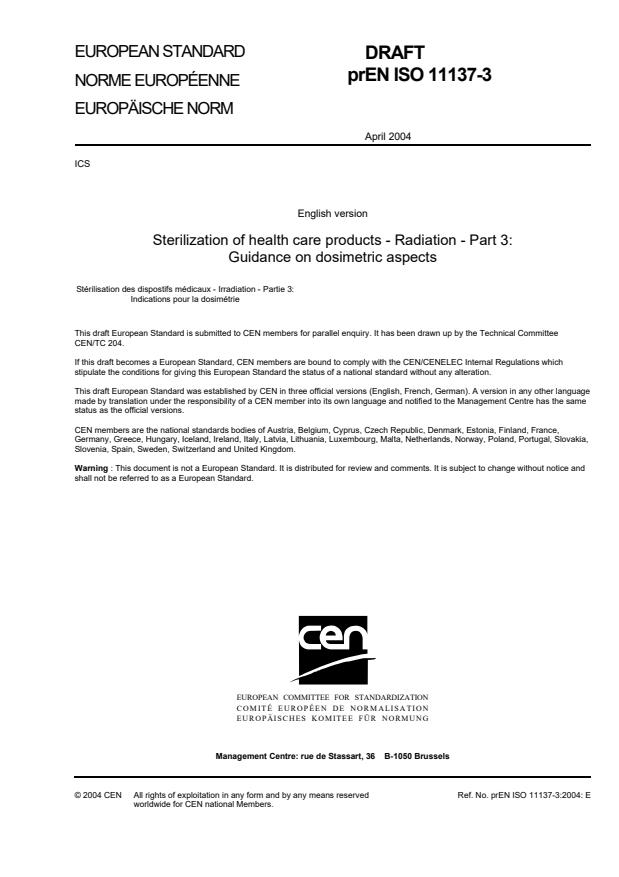
EUROPEAN STANDARD
DRAFT
NORME EUROPÉENNE
EUROPÄISCHE NORM
April 2004
ICS
English version
Sterilization of health care products - Radiation - Part 3:
Guidance on dosimetric aspects
Stérilisation des dispostifs médicaux - Irradiation - Partie 3:
Indications pour la dosimétrie
This draft European Standard is submitted to CEN members for parallel enquiry. It has been drawn up by the Technical Committee
CEN/TC 204.
If this draft becomes a European Standard, CEN members are bound to comply with the CEN/CENELEC Internal Regulations which
stipulate the conditions for giving this European Standard the status of a national standard without any alteration.
This draft European Standard was established by CEN in three official versions (English, French, German). A version in any other language
made by translation under the responsibility of a CEN member into its own language and notified to the Management Centre has the same
status as the official versions.
CEN members are the national standards bodies of Austria, Belgium, Cyprus, Czech Republic, Denmark, Estonia, Finland, France,
Germany, Greece, Hungary, Iceland, Ireland, Italy, Latvia, Lithuania, Luxembourg, Malta, Netherlands, Norway, Poland, Portugal, Slovakia,
Slovenia, Spain, Sweden, Switzerland and United Kingdom.
Warning : This document is not a European Standard. It is distributed for review and comments. It is subject to change without notice and
shall not be referred to as a European Standard.
EUROPEAN COMMITTEE FOR STANDARDIZATION
COMITÉ EUROPÉEN DE NORMALISATION
EUROPÄISCHES KOMITEE FÜR NORMUNG
Management Centre: rue de Stassart, 36 B-1050 Brussels
© 2004 CEN All rights of exploitation in any form and by any means reserved Ref. No. prEN ISO 11137-3:2004: E
worldwide for CEN national Members.
Foreword
This document (prEN ISO 11137-3:2004) has been prepared by Technical Committee ISO/TC
198 "Sterilization of health care products" in collaboration with Technical Committee CEN/TC 204
"Sterilization of medical devices", the secretariat of which is held by BSI.
This document is currently submitted to the parallel Enquiry.
This document has been prepared under a mandate given to CEN by the European Commission
and the European Free Trade Association, and supports essential requirements of EU
Directive(s).
Endorsement notice
The text of ISO/DIS 11137-3:2004 has been approved by CEN as prEN ISO 11137-3:2004
without any modifications.
DRAFT INTERNATIONAL STANDARD ISO/DIS 11137-3
ISO/TC 198 Secretariat: ANSI
Voting begins on: Voting terminates on:
2004-04-29 2004-09-29
INTERNATIONAL ORGANIZATION FOR STANDARDIZATION • МЕЖДУНАРОДНАЯ ОРГАНИЗАЦИЯ ПО СТАНДАРТИЗАЦИИ • ORGANISATION INTERNATIONALE DE NORMALISATION
Sterilization of health care products — Radiation —
Part 3:
Guidance on dosimetric aspects
Stérilisation des produits de santé — Irradiation —
Partie 3: Guide sur les aspects dosimétriques
ICS 11.080.01
ISO/CEN PARALLEL ENQUIRY
The CEN Secretary-General has advised the ISO Secretary-General that this ISO/DIS covers a subject
of interest to European standardization. In accordance with the ISO-lead mode of collaboration as
defined in the Vienna Agreement, consultation on this ISO/DIS has the same effect for CEN
members as would a CEN enquiry on a draft European Standard. Should this draft be accepted, a
final draft, established on the basis of comments received, will be submitted to a parallel two-month FDIS
vote in ISO and formal vote in CEN.
To expedite distribution, this document is circulated as received from the committee secretariat.
ISO Central Secretariat work of editing and text composition will be undertaken at publication
stage.
Pour accélérer la distribution, le présent document est distribué tel qu'il est parvenu du
secrétariat du comité. Le travail de rédaction et de composition de texte sera effectué au
Secrétariat central de l'ISO au stade de publication.
THIS DOCUMENT IS A DRAFT CIRCULATED FOR COMMENT AND APPROVAL. IT IS THEREFORE SUBJECT TO CHANGE AND MAY NOT BE
REFERRED TO AS AN INTERNATIONAL STANDARD UNTIL PUBLISHED AS SUCH.
IN ADDITION TO THEIR EVALUATION AS BEING ACCEPTABLE FOR INDUSTRIAL, TECHNOLOGICAL, COMMERCIAL AND USER PURPOSES, DRAFT
INTERNATIONAL STANDARDS MAY ON OCCASION HAVE TO BE CONSIDERED IN THE LIGHT OF THEIR POTENTIAL TO BECOME STANDARDS TO
WHICH REFERENCE MAY BE MADE IN NATIONAL REGULATIONS.
© International Organization for Standardization, 2004
ISO/DIS 11137-3
PDF disclaimer
This PDF file may contain embedded typefaces. In accordance with Adobe's licensing policy, this file may be printed or viewed but shall
not be edited unless the typefaces which are embedded are licensed to and installed on the computer performing the editing. In
downloading this file, parties accept therein the responsibility of not infringing Adobe's licensing policy. The ISO Central Secretariat
accepts no liability in this area.
Adobe is a trademark of Adobe Systems Incorporated.
Details of the software products used to create this PDF file can be found in the General Info relative to the file; the PDF-creation
parameters were optimized for printing. Every care has been taken to ensure that the file is suitable for use by ISO member bodies. In the
unlikely event that a problem relating to it is found, please inform the Central Secretariat at the address given below.
Copyright notice
This ISO document is a Draft International Standard and is copyright-protected by ISO. Except as permitted
under the applicable laws of the user's country, neither this ISO draft nor any extract from it may be
reproduced, stored in a retrieval system or transmitted in any form or by any means, electronic, photocopying,
recording or otherwise, without prior written permission being secured.
Requests for permission to reproduce should be addressed to either ISO at the address below or ISO's
member body in the country of the requester.
ISO copyright office
Case postale 56 CH-1211 Geneva 20
Tel. + 41 22 749 01 11
Fax + 41 22 749 09 47
E-mail copyright@iso.org
Web www.iso.org
Reproduction may be subject to royalty payments or a licensing agreement.
Violators may be prosecuted.
©
ii ISO 2004 – All rights reserved
ISO/DIS 11137-3
Contents
Foreword.iv
Introduction.5
1 Scope .1
2 Normative references.1
3 Terms and definitions .1
4 Measurement of dose.1
5 Selection and calibration of dosimetry systems.2
5.1 General .2
5.2 Selection of dosimetry systems.2
5.3 Calibration of dosimetry system.2
6 Establishing the maximum acceptable dose.2
7 Establishing the sterilization dose .3
8 Installation qualification.4
9 Operational qualification.4
9.1 General .4
9.2 Gamma irradiators.4
9.3 Electron beam irradiators .6
9.4 X-ray irradiators.7
10 Performance qualification .8
11 Routine monitoring and control.9
11.1 General .9
11.2 Frequency of dose measurements .10
Annex A Mathematical modeling .11
A.1 General .11
A.2 Types of models .11
A.2.1 Point Kernel.11
A.2.2 Monte Carlo .11
A.3 Use of models .12
A.3.1 Design of irradiators.12
A.3.2 Operation of gamma and x-ray Irradiators.12
A.3.3 Operation of electron beam irradiators.12
Bibliography.13
ISO/DIS 11137-3
Foreword
ISO (the International Organization for Standardization) is a worldwide federation of national standards bodies (ISO
member bodies). The work of preparing International Standards is normally carried out through ISO technical
committees. Each member body interested in a subject for which a technical committee has been established has
the right to be represented on that committee. International organizations, governmental and non-governmental, in
liaison with ISO, also take part in the work. ISO collaborates closely with the International Electrotechnical
Commission (IEC) on all matters of electrotechnical standardization.
International Standards are drafted in accordance with the rules given in the ISO/IEC Directives, Part 2.
The main task of technical committees is to prepare International Standards. Draft International Standards adopted
by the technical committees are circulated to the member bodies for voting. Publication as an International
Standard requires approval by at least 75 % of the member bodies casting a vote.
Attention is drawn to the possibility that some of the elements of this document may be the subject of patent rights.
ISO shall not be held responsible for identifying any or all such patent rights.
ISO 11137-3 was prepared by Technical Committee ISO/TC 198, Sterilization of health care products.
ISO 11137 consists of the following parts, under the general title Sterilization of health care products — Radiation:
⎯ Part 1: Requirements for development, validation and routine control of a sterilization process for medical
devices
⎯ Part 2: Establishing the sterilization dose
⎯ Part 3: Guidance on dosimetric aspects
iv © ISO 2004 – All rights reserved
ISO/DIS 11137-3
Introduction
An integral part of radiation sterilization is the ability to measure dose. The dose is measured during all
stages of development, validation and routine monitoring of the sterilization process. It has to be
demonstrated that dose measurement is traceable to a national or international standard, that the
uncertainty of measurement is known, and that the influence of temperature, humidity and other
environmental factors on dosimeter response is known and taken into account.
Requirements in regard to dosimetry and dose measurement are given in ISO 11137-1 and ISO 11137-2.
This part of ISO 11137 gives guidance to these requirements.
ISO/DIS 11137-3
Sterilization of health care products — Radiation — Part 3:
Guidance on dosimetric aspects
1 Scope
This International Standard gives guidance on the requirements relating to dosimetry and dose measurement in
60 137
ISO 11137 parts 1 and 2. It applies to gamma irradiators using the radionuclides Co and Cs, and to irradiators
using a beam from an electron or x-ray generator.
2 Normative references
The following standards contain provisions, which through reference in this text, constitute provisions of this
International Standard. For dated references, subsequent amendments to, or revisions of, any of these
publications do not apply. However, parties to agreements based on this International Standard are encouraged to
investigate the possibility of applying the most recent editions of the normative documents indicated below. For
undated references, the latest edition of the normative document referred to applies. Members of ISO and IEC
maintain registers of currently valid International Standards.
ISO 11137-1 Sterilization of health care products – Radiation – Part 1: Requirements for the development,
validation and routine control of a sterilization process for medical devices
ISO 11137-2 Sterilization of health care products – Radiation – Part 2: Establishing the sterilization dose
3 Terms and definitions
For the purposes of this International Standard, the terms and definitions in ISO 11137-1 and ISO 11137-2,
together with the following, apply.
3.1
dosimetry system
interrelated elements used for determining absorbed dose, including dosimeters, instruments, associated reference
standards and procedures for their use
3.2
uncertainty
parameter, associated with the result of a measurement, that characterises the dispersion of values that could
reasonably be attributed to the measurand
4 Measurement of dose
Measurement of absorbed dose in connection with the radiation sterilization of medical devices is expressed in
terms of the absorbed dose in water. Dosimetry systems should be calibrated in terms of dose in water. In this
International Standard, absorbed dose is referred to as dose.
ISO/DIS 11137-3
5 Selection and calibration of dosimetry systems
5.1 General
The dosimetry system(s) used to monitor the irradiation of product has to be capable of providing accurate and
precise results over the entire dose range of interest. This range will depend on the range of doses delivered to
product and on the dose received at the position(s) used for routine monitoring.
5.2 Selection of dosimetry systems
5.2.1 Dosimetric measurements are required in sterilization dose establishment, validation and routine control of
radiation sterilization; different dosimetry systems might be needed for these different tasks. In dose
establishment, for example, the range of doses required for a verification or incremental dose experiment might be
outside the recommended (and calibrated) operating range of the dosimetry system used for measurement of
sterilization dose and, therefore, an alternative system will have to be employed.
5.2.2 Guidance on the selection of appropriate dosimetry systems used in radiation sterilization can be found in
ISO/ASTM Guide 51261. The properties of individual dosimetry systems and procedures for their use are given in
the ISO/ASTM Practices listed in the bibliography.
5.3 Calibration of dosimetry system
5.3.1 It is a requirement in ISO 11137-1 that dose measurements are traceable to an appropriate national or
international standard and that their level of uncertainty is known. Consequently, all significant sources of
measurement uncertainty should be identified and their magnitudes assessed.
5.3.2 Calibration of dosimetry systems for use in radiation sterilization is a significant activity. The response of
most systems is influenced by the conditions of irradiation and measurement, for example, temperature, humidity,
dose rate and interval of time between termination of irradiation and measurement. In addition, the effects of these
conditions are often interrelated and they can vary from batch to batch of dosimeters. Therefore, calibration should
be carried out under conditions that match as closely as possible the actual conditions of use. This means that
calibration is needed for each radiation facility and it is not acceptable to use an outcome of a calibration supplied
by the dosimeter manufacturer without additional experimental verification of its validity.
5.3.3 A recognised national metrology institute or other calibration laboratory accredited to ISO 17025, or its
equivalent, should be used in order to ensure traceability to a national or international standard. A calibration
certificate provided by a laboratory not having formal recognition or accreditation will not necessarily be proof of
traceability to a national or international standard and additional documentary evidence will be required.
5.3.4 The ability to make accurate dose measurements depends on the calibration and consistency of
performance of the entire dosimetry system. This means that all equipment associated with the measurement
procedure, not just the dosimeters themselves, has to be adequately controlled and its performance verified.
5.3.5 Detailed calibration procedures are given in ISO/ASTM 51261. Information on estimating and reporting
uncertainty of measurement can be found in ISO/ASTM 51707. Additional guidance is given in Sharpe and Miller
(1999).
6 Establishing the maximum acceptable dose
6.1 Testing to establish the maximum acceptable dose has to be carried out using product or samples of
materials that have been irradiated to doses greater than those anticipated during actual processing. The value of
the maximum dose received during sterilization will be influenced by the characteristics of the irradiator and the
loading pattern of the product. Thus transfer of the process to another irradiator, or a change to the loading pattern,
might result in a change to the maximum dose to product.
6.2 Irradiation geometries for testing of product or samples of materials should be chosen to ensure that the
dose is determined accurately and is as uniform as practicable. Irradiation in containers used for routine
2 © ISO 2004 – All rights reserved
ISO/DIS 11137-3
sterilization processing will usually produce too wide a range of doses to the product to be meaningful for testing
purposes. If routine irradiator containers are used, the location of the product test samples should be such that the
range of doses each product receives is minimized.
6.3 The doses required in product or materials testing might be outside the operating range of available
dosimeter systems. In such cases it may suffice to deliver the dose in increments, with monitoring of each
increment of dose. The total dose is equal to the sum of the incremental doses.
7 Establishing the sterilization dose
7.1 The methods of establishing the sterilization dose (ISO 11137-2) require product, or portions thereof
(Sample Item Portion, SIP), to be irradiated at doses within specified tolerance levels. The dosimetry system used
to monitor such doses has to be capable of providing accurate and precise measurements over the entire dose
range of interest. In order to avoid compromising the outcome of the dose setting or dose substantiation methods,
the dosimetry system employed has to be sufficiently accurate to ensure measurement within the tolerances
specified in the method.
7.2 The dose tolerances specified in the dose setting and substantiation methods refer to the maximum, and in
some cases minimum, doses that can be delivered to any point on/in a given product item or SIP. Implicit in this
requirement is the fact that the distribution of dose applied to product is known; this can require detailed dose
mapping of individual product items, particularly in the case of electron beam irradiation. Such dose mapping is
similar to that required for Performance Qualification (see 10.).
7.3 The configuration of the product during irradiation should be chosen to achieve the minimum practical
variation in dose, both for individual items and between items. This can necessitate the irradiation of product items
individually. In exceptional cases, it might be necessary to dismantle and repackage the product in order to achieve
an acceptable range of doses applied to the item. In this context see also ISO 11137-2, 5.4.1 Note 2.
7.4 To determine the range of doses applied to product, or portions thereof, dose mapping exercises are
performed. These dose mapping exercises do not have to be carried out at the same dose as used for dose setting
irradiations. The use of higher doses can enable the dosimetry system to be used in a more accurate part of its
operating range, thereby improving the overall accuracy of the dose mapping.
7.5 Replicate dose mapping exercises can be performed to reduce measurement uncertainty.
7.6 Irradiation for dose setting or substantiation purposes using gamma-rays is normally carried out employing
either a special facility that is designed for irradiation with doses lower than the sterilization dose or a defined
location outside the normal product path in a sterilization facility, such as on a turntable or research carrier.
7.7 Irradiation for dose setting or substantiation purposes using electrons or x-rays can normally be carried out
at the facility used for sterilization, as low doses can be achieved by reducing irradiator output power and/or
increasing conveyor speed.
7.8 Irradiation using electrons can be carried out with the product surrounded by material to scatter the
electrons and produce a more uniform dose distribution.
7.9 In the performance of a verification dose experiment, it is required that the highest dose to product does
not exceed the verification dose by more than 10%. The highest dose is either measured directly during the
irradiation or calculated from dose mapping data. If dose mapping data are used, account should be taken of the
statistical variability of the data. One approach to achieving this is given in Panel on Gamma & Electron Irradiation,
(1996).
7.10 A repeat of the verification dose experiment is allowed if the arithmetic mean of the highest and lowest
doses to product is less than 90% of the intended verification dose. The highest and the lowest doses can either be
measured directly during the irradiation or calculated from dose mapping data.
7.11 Methods 2A and 2B (see ISO 11137-2) each require performance of an incremental dose experiment in
which product is irradiated at a series of nominal doses, with the additional requirement that the dose for each
increment is delivered and measured independently. The highest dose within each dose increment is required to be
within a specified dose range and is either measured directly during the irradiation or calculated from dose mapping
ISO/DIS 11137-3
data. If dose mapping data are used, account should be taken of the statistical variability of the data. One approach
to achieving this is given in Panel on Gamma & Electron Irradiation, (1996).
7.12 Methods 2A and 2B allow a repeat of an incremental dose irradiation using a further set of product, or
SIPs, if the arithmetic mean of the highest and lowest doses at that increment is less than the lower limit of the
specified range. The highest and the lowest doses are either measured directly during the irradiation or calculated
from dose mapping data.
8 Installation qualification
8.1 The purpose of Installation Qualification is to demonstrate that the irradiator has been supplied and
installed in accordance with its specifications. There is a requirement to determine the characteristics of the beam
for an electron or an x-ray irradiator. These characteristics include electron or x-ray energy, average beam current,
scan width and scan uniformity. The details of characterization depend on the design and construction of the
irradiator. Some examples are given in 8.2 and 8.3, but these should not be considered exhaustive.
8.2 For x-ray irradiators, it is required to measure either the electron beam energy or x-ray beam energy during
Installation Qualification. Where the design of the x-ray irradiator permits, it is usual to measure the electron beam
energy.
8.3 For electron accelerators, consideration should be given to the relationship between the scan frequency,
the scan width, pulse repetition rate (for pulse accelerators) and the conveyor speed relative to the cross-sectional
distribution of the electron beam at the product surface in order to ensure that there is sufficient overlap to provide
the required degree of dose uniformity.
8.4 Characterization of scan uniformity involves in many cases measurement of the uniformity both in the
direction of the scan and in the direction of the product travel.
8.5 Most methods of determining the electron beam characteristics involve dosimetry, although in many cases
only relative measurements are required, for example, measurement of scan width. In instances where relative
measurements are made, measurement traceability might not be required.
8.6 Details of the methods for electron beam characterization can be found in ISO/ASTM 51649, and those for
x-ray characterization in ISO/ASTM 51608.
9 Operational qualification
9.1 General
The purpose of Operational Qualification (OQ) is to demonstrate that the irradiator as installed is capable of
operating and delivering appropriate doses within defined acceptance criteria. This is achieved by determining dose
distributions through dose mapping exercises and relating these distributions to process parameters.
9.2 Gamma irradiators
9.2.1 Dose mapping for OQ is carried out to characterize the irradiator with respect to the distribution and
reproducibility of dose and to establish the effect of process interruption on dose. Dose mapping should be
performed by placing dosimeters in an irradiation container filled to its design limits with material of homogeneous
density. This density should be within the density range for which the irradiator is to be used. At least two dose
mapping exercises should be carried out, one with material close to the lower limit of the density range for which
the irradiator is intended to be used and another with material close to the upper limit of this range.
9.2.2 A sufficient number of irradiation containers (at least three) should be dose mapped at each chosen density
to allow determination of variability of dose and dose distribution between containers. The detail and number of
replicate dose mapping exercises required will be influenced by the amount of knowledge gained from previous OQ
dose mapping exercises on the same or similar irradiators. This means that a greater number of replicate exercises
4 © ISO 2004 – All rights reserved
ISO/DIS 11137-3
might be required for a new installation than for qualification dose mapping exercises after replenishment of
sources.
9.2.3 During dose mapping for OQ, the irradiator should have in place a sufficient number of containers to mimic
effectively an irradiator filled with containers holding material of the same density as that being dose mapped. The
number of containers required to achieve this depends on irradiator design.
9.2.4 Individual dosimeters, dosimeter strips or dosimeter sheets should be placed in a three dimensional array
sufficient to determine and resolve the dose distribution throughout the entire volume of the irradiation container.
The number of dosimeters will depend upon the size of the irradiation container and the design of the irradiation
facility. For example, for a container of size 1,0 m x 1,0 m x 0,5 m dosimeters might be placed in a 20 cm grid (i.e.
at 20 cm intervals) throughout the container. For requalification dose mapping, data from previous exercises can be
used to optimise the positioning of the dosimeters. Mathematical modelling techniques, such as Monte Carlo or
Point Kernel calculations, can also be useful in optimizing the positioning of dosimeters. See Annex A.
9.2.5 Data from dose mapping exercises can be used to establish the relationships between timer setting and
the magnitude of dose at a defined location within the irradiation container for product of different densities.
Approximate values for these relationships might be supplied by the irradiator manufacturer or obtained from
calculations using mathematical models. Dose mapping data can then be used to refine these approximate
relationships for the particular irradiator. See Annex A.
9.2.6 A separate dose mapping exercise should be carried out or a calculation of transit dose should be
performed in order to assess the effect of process interruption. This exercise can be done through irradiating a
container having dosimeters or dosimeter strips located as described above and interrupting the process when the
container is close to the source where dose is expected to be most influenced by source transit. The effect of
process interruption is evaluated by comparing the results with those of dose mapping exercises carried out under
normal process conditions. It might be necessary to interrupt the process multiple times in order to evaluate
accurately the effect.
In addition, the response of some dosimeters is known to be influenced by the period of time that lapses between
irradiation and measurement; the magnitude of this effect can depend on temperature during this period. These
factors should be taken into account when interpreting measurements from dosimeters that have been subjected to
process interruption.
9.2.7 Dose mapping should be carried out to determine the effects on dose and dose distribution that may occur
in irradiation containers as a result of changing to product of different density. The acceptable range of densities
that can be processed together can be determined based on these measurements. The effect of density changes
on dose and dose distribution can be determined by sequentially processing two products with different densities
and dose mapping the last container of the first product density and the first container of the second product
density. The data for these containers should be compared to the homogeneous dose mapping data for these
product to determine the additional dose variation when the two product densities are irradiated sequentially.
9.2.8 A separate dose mapping exercise should be performed for special conveyor systems (research loops) or
fixed locations in the irradiation cell (turntables) designated for manual placement of products. Consideration
should be given to dosimetry and the conditions associated with these processing methods. For example, dose
rate or temperature, which might affect the performance of some dosimetry systems.
9.2.9 Additional do
...