

EN 15794:2009
(Main)Determination of explosion points of flammable liquids
- Abstract
This European Standard specifies a test method to determine the explosion points of flammable liquids in air. This European Standard applies to flammable liquids at atmospheric pressure and at temperatures in the range from 50 °C to 300 °C.
This European standard must not be applied to explosives or materials which, under the test conditions, are thermally unstable liquids (e.g. polymerizing/oxidizing materials).
- Status
- Published
- Publication Date
- 20-Oct-2009
- Current Stage
- 9060 - Closure of 2 Year Review Enquiry - Review Enquiry
- Start Date
- 04-Jun-2026
- Completion Date
- 04-Jun-2026
- Directive
- 2014/34/EU - Directive 2014/34/EU Of The European Parliament And Of The Council of 26 February 2014 on the harmonisation of the laws of the Member States relating to equipment and protective systems intended for use in potentially explosive atmospheres (recast)OJ Ref: C, C 126, HARMONIZIRAN OJ Date: 08-Apr-2016
94/9/EC - Equipment and protective systems intended for use in potentially explosive atmospheres (ATEX)OJ Ref: C, C 97 OJ Date: 16-Apr-2010



Overview - EN 15794:2009 (CEN)
EN 15794:2009 is a CEN European Standard that defines a standardized test method to determine the explosion points of flammable liquids in air. It applies to flammable liquids at atmospheric pressure and temperatures from -50 °C to 300 °C. The standard explicitly excludes explosives and liquids that are thermally unstable under test conditions (for example polymerizing or strongly oxidizing materials). EN 15794 helps ensure comparable, repeatable explosion‑point data for use in hazard assessment, process safety and regulatory compliance.
Key topics and technical requirements
- Scope & purpose: Measurement of explosion points (lower and upper explosion points) of flammable liquids in air; relationship to flashpoint (explosion point is normally lower than flashpoint; up to ~10 K difference for pure substances and up to ~25 K for mixtures).
- Sample requirements: Pure liquids or defined mixtures should have purity ≥ 99.8 % mol. Process samples of unknown composition must be identified and characterised; guidance on sampling and storage references EN ISO 3170 / 3171 / 15528.
- Test vessel and setup:
- Cylindrical, pressure‑resistant glass vessel (inner diameter 80–100 mm, height 300–500 mm) with tightly fitting lid and vapour purge valves.
- Thermocouples for gas‑phase and liquid measurements (placement and accuracy specified).
- Heating/cooling chamber with air circulation, volume ≥ 10× test volume (>15 L) and air exchange rate ≥ 10 air changes/hour; temperature steps of 1 ± 0.2 K and internal uniformity ≤ 1 K.
- Ignition and detection:
- Spark ignition between pointed electrodes (tip distance 5.0 ± 0.1 mm, tip angle 60° ± 3°).
- High voltage transformer open‑circuit voltage 13–16 kV, short‑circuit current 20–30 mA; spark discharge typically 0.2 s (up to 0.5 s if needed).
- Stirring via magnetic drive; barometer accuracy 0.1 kPa.
- Procedure & safety: Stepwise heating/cooling, observation of flame detachment or temperature rise, verification of apparatus, and Annex A safety guidance. Annex B provides estimation approaches; Annex D covers verification criteria.
Practical applications and users
- Safety engineers and process safety teams assessing explosion hazards and designing ventilation/inerting systems.
- Test and calibration laboratories performing flammability testing for chemicals, fuels and industrial liquids.
- Chemical and petrochemical manufacturers, transport and storage operators, and regulatory bodies evaluating compliance with explosive‑atmosphere directives (e.g., ATEX/94/9/EC references in Annex ZA).
- Product stewardship, classification and labeling (hazard communication), and risk assessments for handling and storage.
Related standards
- EN 13237:2003 (terms and definitions for equipment in potentially explosive atmospheres)
- Sampling standards referenced: EN ISO 3170, EN ISO 3171, EN ISO 15528
Keywords: EN 15794:2009, explosion point, flammable liquids, test method, LEP, UEP, flashpoint, CEN, explosion protection.
Relations
- Effective Date
- 28-Jan-2026
- Effective Date
- 28-Jan-2026
Get Certified
Connect with accredited certification bodies for this standard

Element Materials Technology
Materials testing and product certification.

ABS Group Brazil
ABS Group certification services in Brazil.

ABS Quality Evaluations Inc.
American Bureau of Shipping quality certification.
Sponsored listings
Frequently Asked Questions
EN 15794:2009 is a standard published by the European Committee for Standardization (CEN). Its full title is "Determination of explosion points of flammable liquids". This standard covers: This European Standard specifies a test method to determine the explosion points of flammable liquids in air. This European Standard applies to flammable liquids at atmospheric pressure and at temperatures in the range from 50 °C to 300 °C. This European standard must not be applied to explosives or materials which, under the test conditions, are thermally unstable liquids (e.g. polymerizing/oxidizing materials).
This European Standard specifies a test method to determine the explosion points of flammable liquids in air. This European Standard applies to flammable liquids at atmospheric pressure and at temperatures in the range from 50 °C to 300 °C. This European standard must not be applied to explosives or materials which, under the test conditions, are thermally unstable liquids (e.g. polymerizing/oxidizing materials).
EN 15794:2009 is classified under the following ICS (International Classification for Standards) categories: 75.160.20 - Liquid fuels. The ICS classification helps identify the subject area and facilitates finding related standards.
EN 15794:2009 has the following relationships with other standards: It is inter standard links to EN 13237:2003, EN 1127-1:2011. Understanding these relationships helps ensure you are using the most current and applicable version of the standard.
EN 15794:2009 is associated with the following European legislation: EU Directives/Regulations: 2014/34/EU, 94/9/EC; Standardization Mandates: M/BC/CEN/92/46. When a standard is cited in the Official Journal of the European Union, products manufactured in conformity with it benefit from a presumption of conformity with the essential requirements of the corresponding EU directive or regulation.
EN 15794:2009 is available in PDF format for immediate download after purchase. The document can be added to your cart and obtained through the secure checkout process. Digital delivery ensures instant access to the complete standard document.
Standards Content (Sample)
2003-01.Slovenski inštitut za standardizacijo. Razmnoževanje celote ali delov tega standarda ni dovoljeno.Bestimmung von Explosionspunkten brennbarer FlüssigkeitenDétermination des points d'explosion des liquides inflammablesDetermination of explosion points of flammable liquids13.230Varstvo pred eksplozijoExplosion protectionICS:Ta slovenski standard je istoveten z:EN 15794:2009SIST EN 15794:2010en,fr,de01-februar-2010SIST EN 15794:2010SLOVENSKI
STANDARD
EUROPEAN STANDARD NORME EUROPÉENNE EUROPÄISCHE NORM
EN 15794
October 2009 ICS 75.160.20 English Version
Determination of explosion points of flammable liquids
Détermination des points d'explosion des liquides inflammables
Bestimmung von Explosionspunkten brennbarer Flüssigkeiten This European Standard was approved by CEN on 22 September 2009.
CEN members are bound to comply with the CEN/CENELEC Internal Regulations which stipulate the conditions for giving this European Standard the status of a national standard without any alteration. Up-to-date lists and bibliographical references concerning such national standards may be obtained on application to the CEN Management Centre or to any CEN member.
This European Standard exists in three official versions (English, French, German). A version in any other language made by translation under the responsibility of a CEN member into its own language and notified to the CEN Management Centre has the same status as the official versions.
CEN members are the national standards bodies of Austria, Belgium, Bulgaria, Cyprus, Czech Republic, Denmark, Estonia, Finland, France, Germany, Greece, Hungary, Iceland, Ireland, Italy, Latvia, Lithuania, Luxembourg, Malta, Netherlands, Norway, Poland, Portugal, Romania, Slovakia, Slovenia, Spain, Sweden, Switzerland and United Kingdom.
EUROPEAN COMMITTEE FOR STANDARDIZATION
COMITÉ EUROPÉEN DE NORMALISATION EUROPÄISCHES KOMITEE FÜR NORMUNG
Management Centre:
Avenue Marnix 17,
B-1000 Brussels © 2009 CEN All rights of exploitation in any form and by any means reserved worldwide for CEN national Members. Ref. No. EN 15794:2009: ESIST EN 15794:2010
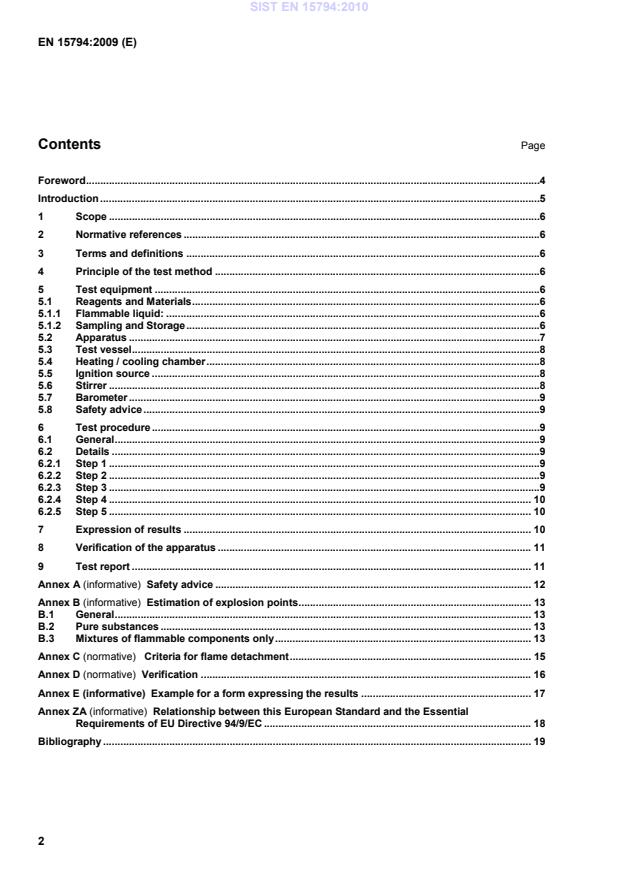
Safety advice . 12Annex B (informative)
Estimation of explosion points . 13B.1General . 13B.2Pure substances . 13B.3Mixtures of flammable components only . 13Annex C (normative)
Criteria for flame detachment . 15Annex D (normative)
Verification . 16Annex E (informative)
Example for a form expressing the results . 17Annex ZA (informative)
Relationship between this European Standard and the Essential Requirements of EU Directive 94/9/EC . 18Bibliography . 19
Figures Figure 1 — Explosion point apparatus; schematic . 7Figure C.1 — Flame detachment . 15Figure C.2 — Halo (UNDETACHED FLAME) . 15 Tables Table D.1 — Data for verification of the apparatus . 16Table ZA.1 — Correspondence between this European Standard and Directive (Add the reference and title of the Directive) . 18 SIST EN 15794:2010
The flammable liquid may be: a single liquid or a defined mixture of liquids; a process sample (of known or unknown composition). When a pure liquid or a mixture of defined composition is used, the purity of each liquid shall be 99,8 % mol. or better. In the case of a mixture or a process sample of undefined composition the sample should be characterised so that the origin as well as the related process conditions can be identified. 5.1.2 Sampling and Storage Sampling should be carried out if possible according to the procedures given in EN ISO 3170, EN ISO 3171, EN ISO 15528 or an equivalent National Standard. SIST EN 15794:2010
Sample containers are to be kept closed before and after sampling to avoid alterations of the sample (e.g. evaporation of volatile constituents/impurities). 5.2 Apparatus Apparatus see Figure 1 Dimensions in millimetres
Key 1 Heating chamber with air circulation and temperature regulator6 Thermocouple determining the explosion point and checking the equilibrium2 Test vessel
7 Thermocouple for ignition detection and checking equilibrium3 Ignition source (spark)8 Tightly fitting lid allowing for pressure relief4 Electrodes 9 Inlet valve5 Stirrer 10 Outlet valveFigure 1 — Explosion point apparatus; schematic SIST EN 15794:2010
...