

EN 13566-2:2005
(Main)Plastics piping systems for renovation of underground non-pressure drainage and sewerage networks - Part 2: Lining with continuous pipes
- Abstract
This Part 2 of EN 13566, read in conjunction with Part 1, specifies requirements and test methods for pipes and fittings which are part of plastics piping systems installed as continuous pipes in the renovation of non-pressure drainage and sewerage networks. It covers;
- homogeneous-wall (HW) pipes made of polyethylene (PE) or polypropylene (PP),
- structured-wall (SW) pipes of the corrugated double-wall type of construction as defined in Annex B, whose structural layer(s) is (are) made of PE or PP,
- jointing of pipe lengths by means of butt fusion (HW) ) or electrofusion (SW),
- fabricated and injection-moulded fittings made of PE, PP and poly(vinyl chloride) (PVC-U).
NOTE The grouting procedure is outside the scope of this standard.
- Status
- Withdrawn
- Publication Date
- 22-Nov-2005
- Withdrawal Date
- 06-Oct-2026
- Technical Committee
- CEN/TC 155 - Plastics piping systems and ducting systems
- Current Stage
- 9960 - Withdrawal effective - Withdrawal
- Start Date
- 14-Feb-2018
- Completion Date
- 07-Oct-2026

Relations
- Effective Date
- 21-Feb-2018
- Effective Date
- 27-May-2026
- Effective Date
- 09-Feb-2026
- Effective Date
- 28-Jan-2026
- Effective Date
- 28-Jan-2026
- Effective Date
- 28-Jan-2026
- Effective Date
- 28-Jan-2026
- Effective Date
- 28-Jan-2026
- Effective Date
- 28-Jan-2026
- Effective Date
- 28-Jan-2026
- Effective Date
- 28-Jan-2026
- Effective Date
- 28-Jan-2026
- Effective Date
- 28-Jan-2026
- Effective Date
- 28-Jan-2026
- Effective Date
- 28-Jan-2026
Get Certified
Connect with accredited certification bodies for this standard

Zavod za gradbeništvo Slovenije (ZAG) - Inšpekcija
ZAG inspection body for construction products, structures, and materials.
Sponsored listings
Frequently Asked Questions
EN 13566-2:2005 is a standard published by the European Committee for Standardization (CEN). Its full title is "Plastics piping systems for renovation of underground non-pressure drainage and sewerage networks - Part 2: Lining with continuous pipes". This standard covers: This Part 2 of EN 13566, read in conjunction with Part 1, specifies requirements and test methods for pipes and fittings which are part of plastics piping systems installed as continuous pipes in the renovation of non-pressure drainage and sewerage networks. It covers; - homogeneous-wall (HW) pipes made of polyethylene (PE) or polypropylene (PP), - structured-wall (SW) pipes of the corrugated double-wall type of construction as defined in Annex B, whose structural layer(s) is (are) made of PE or PP, - jointing of pipe lengths by means of butt fusion (HW) ) or electrofusion (SW), - fabricated and injection-moulded fittings made of PE, PP and poly(vinyl chloride) (PVC-U). NOTE The grouting procedure is outside the scope of this standard.
This Part 2 of EN 13566, read in conjunction with Part 1, specifies requirements and test methods for pipes and fittings which are part of plastics piping systems installed as continuous pipes in the renovation of non-pressure drainage and sewerage networks. It covers; - homogeneous-wall (HW) pipes made of polyethylene (PE) or polypropylene (PP), - structured-wall (SW) pipes of the corrugated double-wall type of construction as defined in Annex B, whose structural layer(s) is (are) made of PE or PP, - jointing of pipe lengths by means of butt fusion (HW) ) or electrofusion (SW), - fabricated and injection-moulded fittings made of PE, PP and poly(vinyl chloride) (PVC-U). NOTE The grouting procedure is outside the scope of this standard.
EN 13566-2:2005 is classified under the following ICS (International Classification for Standards) categories: 93.030 - External sewage systems. The ICS classification helps identify the subject area and facilitates finding related standards.
EN 13566-2:2005 has the following relationships with other standards: It is inter standard links to EN ISO 11296-2:2018, EN 12666-1:2026, ISO 6259-3:1997, EN ISO 6259-1:2015, EN ISO 1133:1999, EN ISO 13968:2008, EN ISO 3127:2017, EN ISO 1183-1:2025, EN ISO 11357-6:2025, EN 13566-1:2002, EN 1401-1:2019+A1:2023, EN 12666-1:2005+A1:2011, EN 1852-1:2018+A1:2022, EN ISO 9967:2016, EN ISO 9969:2016. Understanding these relationships helps ensure you are using the most current and applicable version of the standard.
EN 13566-2:2005 is associated with the following European legislation: EU Directives/Regulations: 305/2011, 89/106/EEC. When a standard is cited in the Official Journal of the European Union, products manufactured in conformity with it benefit from a presumption of conformity with the essential requirements of the corresponding EU directive or regulation.
EN 13566-2:2005 is available in PDF format for immediate download after purchase. The document can be added to your cart and obtained through the secure checkout process. Digital delivery ensures instant access to the complete standard document.
Standards Content (Sample)
SLOVENSKI STANDARD
01-april-2006
Plastics piping systems for renovation of underground non-pressure drainage and
sewerage networks - Part 2: Lining with continuous pipes
Plastics piping systems for renovation of underground non-pressure drainage and
sewerage networks - Part 2: Lining with continuous pipes
Kunststoff-Rohrleitungssysteme für die Renovierung von erdverlegten drucklosen
Entwässerungsnetzen (Freispiegelleitungen) - Teil 2: Rohrstrang-Lining
Systemes de canalisations plastiques pour la rénovation des réseaux d'assainissement
enterrés sans pression - Partie 2 : Tubage par tuyau continu avec espace annulaire
Ta slovenski standard je istoveten z: EN 13566-2:2005
ICS:
23.040.20 Cevi iz polimernih materialov Plastics pipes
93.030 Zunanji sistemi za odpadno External sewage systems
vodo
2003-01.Slovenski inštitut za standardizacijo. Razmnoževanje celote ali delov tega standarda ni dovoljeno.
EUROPEAN STANDARD
EN 13566-2
NORME EUROPÉENNE
EUROPÄISCHE NORM
November 2005
ICS 93.030
English Version
Plastics piping systems for renovation of underground non-
pressure drainage and sewerage networks - Part 2: Lining with
continuous pipes
Systèmes de canalisations plastiques pour la rénovation Kunststoff-Rohrleitungssysteme für die Renovierung von
des réseaux d'assainissement enterrés sans pression - erdverlegten drucklosen Entwässerungsnetzen
Partie 2 : Tubage par tuyau continu avec espace annulaire (Freispiegelleitungen) - Teil 2: Rohrstrang-Lining
This European Standard was approved by CEN on 29 July 2004.
CEN members are bound to comply with the CEN/CENELEC Internal Regulations which stipulate the conditions for giving this European
Standard the status of a national standard without any alteration. Up-to-date lists and bibliographical references concerning such national
standards may be obtained on application to the Central Secretariat or to any CEN member.
This European Standard exists in three official versions (English, French, German). A version in any other language made by translation
under the responsibility of a CEN member into its own language and notified to the Central Secretariat has the same status as the official
versions.
CEN members are the national standards bodies of Austria, Belgium, Cyprus, Czech Republic, Denmark, Estonia, Finland, France,
Germany, Greece, Hungary, Iceland, Ireland, Italy, Latvia, Lithuania, Luxembourg, Malta, Netherlands, Norway, Poland, Portugal, Slovakia,
Slovenia, Spain, Sweden, Switzerland and United Kingdom.
EUROPEAN COMMITTEE FOR STANDARDIZATION
COMITÉ EUROPÉEN DE NORMALISATION
EUROPÄISCHES KOMITEE FÜR NORMUNG
Management Centre: rue de Stassart, 36 B-1050 Brussels
© 2005 CEN All rights of exploitation in any form and by any means reserved Ref. No. EN 13566-2:2005: E
worldwide for CEN national Members.
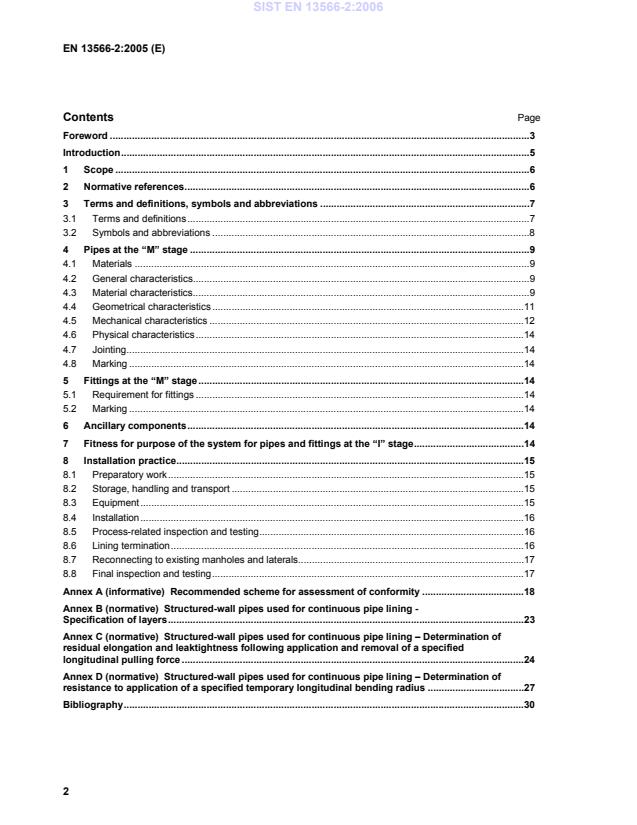
Contents Page
Foreword .3
Introduction.5
1 Scope .6
2 Normative references.6
3 Terms and definitions, symbols and abbreviations .7
3.1 Terms and definitions.7
3.2 Symbols and abbreviations .8
4 Pipes at the “M” stage .9
4.1 Materials .9
4.2 General characteristics.9
4.3 Material characteristics.9
4.4 Geometrical characteristics .11
4.5 Mechanical characteristics .12
4.6 Physical characteristics.14
4.7 Jointing.14
4.8 Marking .14
5 Fittings at the “M” stage.14
5.1 Requirement for fittings .14
5.2 Marking .14
6 Ancillary components.14
7 Fitness for purpose of the system for pipes and fittings at the “I” stage.14
8 Installation practice.15
8.1 Preparatory work.15
8.2 Storage, handling and transport .15
8.3 Equipment.15
8.4 Installation.16
8.5 Process-related inspection and testing.16
8.6 Lining termination.16
8.7 Reconnecting to existing manholes and laterals.17
8.8 Final inspection and testing.17
Annex A (informative) Recommended scheme for assessment of conformity .18
Annex B (normative) Structured-wall pipes used for continuous pipe lining -
Specification of layers.23
Annex C (normative) Structured-wall pipes used for continuous pipe lining – Determination of
residual elongation and leaktightness following application and removal of a specified
longitudinal pulling force .24
Annex D (normative) Structured-wall pipes used for continuous pipe lining – Determination of
resistance to application of a specified temporary longitudinal bending radius .27
Bibliography.30
Foreword
This document (EN 13566-2:2005) has been prepared by Technical Committee CEN/TC 155 "Plastics piping
systems and ducting systems", the secretariat of which is held by NEN.
This European Standard shall be given the status of a national standard, either by publication of an identical
text or by endorsement, at the latest by May 2006, and conflicting national standards shall be withdrawn at the
latest by November 2007.
This standard is a Part of a System Standard for plastics piping systems of various materials used for
renovation of existing pipelines in a specified application area. System Standards for renovation dealing with
the following applications are either available or in preparation:
Plastics piping systems for renovation of underground non-pressure drainage and sewerage networks
(this application);
Plastics piping systems for renovation of underground water supply networks;
Plastics piping systems for renovation of underground gas supply networks;
Plastics piping systems for renovation of underground pressure drainage and sewerage networks;
Plastics piping systems for renovation of industrial pipe systems.
These system standards are distinguished from system standards for conventionally installed plastics piping
systems by the requirement to verify certain characteristics in the “as installed” condition, after site processing.
This is in addition to verification of characteristics of plastics piping systems “as manufactured”.
System standard EN 13566 comprises six parts, as follows:
Part 1: General
Part 2: Lining with continuous pipes (this standard)
Part 3: Lining with close-fit pipes
Part 4: Lining with cured-in-place pipes
Part 5: Lining with discrete pipes
Part 7: Lining with spirally wound pipes
A consistent structure of clause headings has been adopted for all parts to facilitate direct comparisons across
renovation technique families.
Figure 1 shows the common Part and clause structure and the relationship between EN 13566 and system
standards for other applications.
Annex A of this document is informative. Annexes B, C and D are normative.
This document includes a bibliography.
According to the CEN/CENELEC Internal Regulations, the national standards organizations of the following
countries are bound to implement this European Standard: Austria, Belgium, Cyprus, Czech Republic,
Denmark, Estonia, Finland, France, Germany, Greece, Hungary, Iceland, Ireland, Italy, Latvia, Lithuania,
Luxembourg, Malta, Netherlands, Norway, Poland, Portugal, Slovakia, Slovenia, Spain, Sweden, Switzerland
and United Kingdom.
Figure 1 — Format of the renovation system standards.
Introduction
The requirements for any given renovation technique family are covered by Part 1: General, used in
conjunction with the relevant other Part. For example, for the requirements relating to Lining with continuous
pipes, it is necessary to refer to both Parts 1 and 2. Complementary information is contained in
[1] [2]
ISO/TR 11295 and a supporting standard, EN 13689 , listed in the bibliography.
1 Scope
This Part 2 of EN 13566, read in conjunction with Part 1, specifies requirements and test methods for pipes
and fittings which are part of plastics piping systems installed as continuous pipes in the renovation of non-
pressure drainage and sewerage networks. It covers;
homogeneous-wall (HW) pipes made of polyethylene (PE) or polypropylene (PP),
structured-wall (SW) pipes of the corrugated double-wall type of construction as defined in Annex B,,
whose structural layer(s) is (are) made of PE or PP,
jointing of pipe lengths by means of butt fusion (HW) ) or electrofusion (SW),
fabricated and injection-moulded fittings made of PE, PP and poly(vinyl chloride) (PVC-U).
NOTE The grouting procedure is outside the scope of this standard.
2 Normative references
This Standard incorporates by dated or undated reference, provisions from other publications. These
normative references are cited at the appropriate places in the text and the publications are cited hereafter.
For dated references, subsequent amendments to, or revisions of, any of these publications apply to this
standard only when incorporated in it by amendment or revision. For undated references, the latest version of
the publication referred to applies (including amendments).
EN 728, Plastics piping and ducting systems — Polyolefin pipes and fittings — Determination of oxidation
induction time.
EN 744, Plastics piping and ducting systems — Thermoplastics pipes — Test method for resistance to
external blows by the round-the-clock method.
EN 921:1994, Plastics piping systems — Thermoplastics pipes — Determination of resistance to internal
pressure at constant temperature (with Corrigendum EN/AC 921:1995).
EN 1277:1996, Plastics piping systems — Thermoplastics piping systems for buried non-pressure
applications — Test methods for leaktightness of elastomeric sealing ring type joints.
EN 1401-1, Plastics piping systems for non-pressure underground drainage and sewerage — Unplasticized
poly(vinyl chloride) (PVC-U) — Part 1: Specifications for pipes, fittings and the system.
EN 1446, Plastics piping and ducting systems — Thermoplastics pipes — Determination of ring flexibility.
EN 1852-1, Plastic piping systems for non-pressure underground drainage and sewerage — Polypropylene
(PP) — Part 1: Specifications for pipes, fittings and the system.
EN 12666-1, Plastics piping systems for non-pressure underground drainage and sewerage — Polyethylene
(PE) — Part 1: Specifications for pipes, fittings and the system.
prEN 13476-1, Thermoplastics piping systems for non-pressure underground drainage and sewerage —
Structured-wall piping systems of unplasticized poly(vinyl chloride) (PVC-U), polypropylene (PP) and
polyethylene (PE) — Part 1: Specifications for pipes, fittings and the system.
) Continuous pipes are extruded in single lengths, or are assembled by fusing individual pipe lengths at the site of
installation.
EN 13566-1:2002, Plastics piping systems for renovation of underground non-pressure drainage and
sewerage networks — Part 1: General.
EN ISO 527-2, Plastics — Determination of tensile properties — Part 2: Test conditions for moulding and
extrusion plastics (ISO 527-2:1993 including Corr 1:1994).
EN ISO 1133:1999, Plastics — Determination of the melt mass-flow rate (MFR) and the melt volume-flow rate
(MVR) of thermoplastics (ISO 1133:1997).
EN ISO 3126, Plastics piping systems — Plastics components — Determination of dimensions
(ISO 3126:2005).
EN ISO 6259-1, Thermoplastics pipes — Determination of tensile properties — Part 1: General test method
(ISO 6259-1:1997).
EN ISO 9967, Thermoplastics pipes — Determination of creep ratio (ISO 9967:1994).
EN ISO 9969, Thermoplastics pipes — Determination of ring stiffness (ISO 9969:1994).
EN ISO 1183-1, Plastics — Methods for determining the density of non-cellular plastics — Part 1: Immersion
method, liquid pyknometer method and titration method (ISO 1183-1:2004).
ISO 6259-3, Thermoplastics pipes — Determination of tensile properties — Part 3: Polyolefin pipes.
3 Terms and definitions, symbols and abbreviations
3.1 Terms and definitions
For the purposes of this European Standard the terms and definitions given in EN 13566-1:2002 and the
following apply.
3.1.1
assembly
section of continuous pipe including any joints and/or fittings
3.1.2
maximum system diameter
diameter of the circle just circumscribing the system cross-section at its widest point
3.1.3
melt mass-flow rate
value relating to the viscosity of the molten material at a specified temperature and rate of shear
3.1.4
minimum bending radius
minimum bending radius at any point throughout the length of the pipe, measured to the longitudinal axis of
the pipe
3.1.5
non-structural layer
material layer of structured-wall (SW) pipe where the contribution of the layer to the ring stiffness is not
essential to satisfy the relevant class requirement (see Annex B)
3.1.6
structural layer
material layer of SW pipe which is not defined as non-structural
3.1.7
structured-wall
type of design of thermoplastic pipe or fitting which does not have a homogeneous wall of uniform thickness
3.1.8
out-of-roundness
the difference between the measured maximum and the measured minimum outside diameter in the same
cross-sectional plane of the pipe.
3.2 Symbols and abbreviations
3.2.1 Symbols
For the purposes of this standard the following symbols apply:
F maximum allowed pulling force
a
e total wall thickness of structured-wall pipe
c
e inner wall thickness of structured-wall pipes, see Annex B
r minimum bending radius
min.
ε strain in the pipe wall due to longitudinal bending along its outer curvature
e
σ longitudinal tensile strength
y
3.2.2 Abbreviations
For the purposes of this standard the following abbreviations apply:
EPDM Ethylene-propylene-dimonomer
EVA Ethylene-vinyl-acetate
HW Homogeneous-wall
MFR Melt mass-flow rate
SEBS Styrene-ethylene-butadiene
SN ring stiffness
SW Structured-wall
TIR True impact rate
4 Pipes at the “M” stage
4.1 Materials
4.1.1 HW pipes
Pipes shall be of PE or PP conforming to the requirements of EN 12666-1 or EN 1852-1.
4.1.2 SW pipes
4.1.2.1 General
The material for the structural layer(s) shall be PE or PP, to which may be added only those additives needed
to facilitate the manufacture of pipes conforming to this standard.
The material for a non-structural inner layer shall be PE, or compounds of PE with EPDM, EVA or SEBS.
4.1.2.2 Virgin material
The use of virgin material, as defined in EN 13566-1:2002, is permitted without limitation.
4.1.2.3 Reprocessable material
The use of own reprocessable material, as defined in EN 13566-1:2002, is permitted without limitation.
The use of external reprocessable PE material, as defined in EN 13566-1:2002, in non-structural layers not in
contact with the transported fluid shall be permitted without limitation.
External reprocessable material compounds of PE with EPDM, EVA or SEBS shall not be used.
External reprocessable material shall not be used in structural layers, or in non-structural layers in contact with
the transported fluid.
4.1.2.4 Recyclable material
The use of recyclable PE and PP material, as defined in EN 13566-1:2002, in non-structural layers not in
contact with the transported fluid shall be permitted without limitation. Recyclable material compounds of PE
with EPDM, EVA or SEBS shall not be used. Recyclable material shall not be used in structural layers, or in
non-structural layers in contact with the transported fluid.
4.2 General characteristics
When viewed without magnification the internal and external surfaces of pipes shall be smooth, clean and free
from grooving, blistering, impurities and pores and any other surface irregularity likely to prevent their
conformity to this standard. The pipe ends shall be cut square to the axis of the pipe.
4.3 Material characteristics
4.3.1 HW pipes
Material characteristics shall conform to the requirements of EN 12666-1:2005 or EN 1852-1.
4.3.2 SW pipes
PE and PP materials from which structural layers are made shall conform to the requirements given in Table 1
and Table 2. Materials from which the non-structural layers are made shall conform to the requirements given
in Table 3.
Table 1 — Material characteristics for PE in structural layers of SW pipes
Characteristics Requirements Test parameters Test method
Characteristic Value
Reference density ≥ 930 kg/m Temperature (23 ± 2) °C ISO 1183-1
Melt mass-flow rate Temperature 190 °C EN ISO
≤ 1,6 g/10 min
Loading mass 5 kg 1133:1999
Condition T
Resistance to internal No failure during the End caps Type a or b EN 921:1994
pressure (solid wall test period Orientation Free
test piece) Number of test pieces 3
Temperature 80 °C
Circumferential stress 3,9 MPa
Conditioning period Shall conform
to EN 921:1994
Type of test Water-in-water
Test period 165 h
Resistance to internal No failure during the End caps Type a or b EN 921:1994
pressure (solid wall test period Orientation Free
specimen) Number of test pieces 3
Temperature 80 °C
Circumferential stress 2,8 MPa
Conditioning period Shall conform
to EN 921:1994
Type of test Water-in-water
Test period 1000 h
Thermal stability, OIT Temperature 200 °C EN 728
≥ 20 min
Table 2 — Material characteristics for PP in structural layers of SW pipes
Test parameters
Characteristics Requirements Test method
Characteristic Value
Melt mass-flow rate Temperature 230 °C EN ISO 1133:1999
≤ 1,5 g/10 min
Loading mass 2,16 kg Condition M
Resistance to internal No failure during the End caps Type a or b EN 921:1994
pressure (solid wall test period Orientation Free
specimen) Number of test pieces 3
Temperature 80 °C
Circumferential stress 4,2 MPa
Conditioning period Shall conform to in
EN 921:1994
Type of test Water-in-water
Test period 140 h
Resistance to internal No failure during the End caps Type a or b EN 921:1994
pressure (solid wall test period Orientation Free
specimen) Number of test pieces 3
Temperature 95 °C
Circumferential stress 2,5 MPa
Conditioning period Shall conform to in
EN 921:1994
Type of test Water-in-water
Test period 1000 h
Thermal stability, OIT ≥ 8 min Temperature 200 °C EN 728
Table 3 — Material characteristics for non-structural layers of SW pipes
Characteristic Requirement Test parameters Test method
Base material To be declared in accordance with 4.1.2.1
Elongation at break > 200 %, Number of test pieces 5 EN ISO 6259-1
Temperature
80 °C
ISO 6259-3
but reduction < 50 %
Aging time
2000 h
Longitudinal tensile strength ≥ 4 MPa Speed 10 mm/min EN ISO 6259-1
Number of test pieces 5
ISO 6259-3
Longitudinal tensile E-modulus ≥ 20 MPa Number of test pieces 5 EN ISO 527-2
Elongation 5%
Speed 10 mm/min
4.4 Geometrical characteristics
4.4.1 HW pipes
Geometrical characteristics of HW-pipes shall conform to the requirements of EN 12666-1 or EN 1852-1
except that any nominal diameter shall be permitted.
4.4.2 SW pipes
All SW pipes shall be assigned nominal outside diameters d by the manufacturer. Nominal outside diameters
n
DN need not conform to standardised nominal sizes DN/OD or DN/ID. The geometrical characteristics of SW
pipes shall conform to the requirements of Annex B and Table 4.
Table 4 — Geometrical characteristics of SW pipes.
Dimensions in millimetres
Dimension Requirement Test method
d ≥ d EN ISO 3126
em,min n
d ≤ 1,02d
em,max n
a
Out-of-roundness ≤ 0,035d
n
b
e 1,0
5,min
c
e
5,min
for d < 200 1,0
n
200 ≤ d < 250 1,1
n
250 ≤ d < 315 1,4
n
315 ≤ d < 355 1,6
n
355 ≤ d < 400 1,8
n
a
This requirement only applies to non-coiled pipes before storage. For coiled pipes
the out-of-roundness shall not exceed any value agreed between the
manufacturer and the customer.
b
This requirement applies, when inner layer is non-structural (refer to Annex B)
c
This requirement applies, when inner layer is structural (refer to Annex B)
4.5 Mechanical characteristics
4.5.1 HW pipes
The mechanical characteristics of HW pipes shall conform to the requirements of EN 12666-1 or EN 1852-1.
4.5.2 SW pipes
The mechanical characteristics of SW pipes shall conform to the requirements specified in Table 5.
Table 5 — Mechanical characteristics of SW pipes.
Characteristic Requirement Test parameters Test method
Ring stiffness (SN) Shall conform to EN ISO 9969 EN ISO 9969
≥ declared value,
chosen from either
4 kN/m , 8 kN/m or
16 kN/m
Creep ratio ≤ 4,0 at 2 years Shall conform to EN ISO 9967 EN ISO 9967
extrapolation
a
Ring flexibility D
...