

EN 13476-2:2025
(Main)Plastics piping systems for non-pressure underground drains and sewers - Structured-wall piping systems of unplasticized poly(vinyl chloride) (PVC-U), polypropylene (PP) and polyethylene (PE) - Part 2: Specifications for pipes and fittings with smooth internal and external surface and the system, Type A
- Abstract
This document, together with EN 13476-1, specifies the definitions and requirements for pipes, fittings and the system based on unplasticized poly(vinyl chloride) (PVC-U), polypropylene (PP) and polyethylene (PE) structured-wall piping systems that are intended for use in non-pressure underground drains and sewers for foul wastewater.
NOTE 1 Products complying with this document can also be used in non-pressure underground drains and sewers for surface water.
This document is applicable to pipes and fittings with smooth internal and external surfaces, designated as Type A.
This document also specifies test methods and test parameters.
This document is applicable to:
a) structured-wall pipes and fittings, which are intended to be used buried underground outside the building structure; reflected in the marking of products by “U”;
b) structured-wall pipes and fittings, which are intended to be used buried underground both outside (application area code “U”) and within the building structure, reflected in the marking of products by “UD”.
This document is applicable to structured-wall pipes and fittings with or without an integral socket with elastomeric ring seal joints as well as welded and fused joints.
This document is applicable to a range of pipe and fitting sizes, materials, pipe constructions, stiffness classes, application areas, tolerance classes and gives recommendations concerning colours.
NOTE 2 It is the responsibility of the purchaser or specifier to make the appropriate selections from these aspects, taking into account their particular requirements and any relevant national regulations and installation practices or codes.
- Status
- Published
- Publication Date
- 07-Oct-2025
- Technical Committee
- CEN/TC 155 - Plastics piping systems and ducting systems
- Current Stage
- 6060 - Definitive text made available (DAV) - Publishing
- Start Date
- 08-Oct-2025
- Due Date
- 07-Oct-2025
- Completion Date
- 08-Oct-2025

Overview
EN 13476-2:2025 specifies requirements for structured-wall piping systems (Type A) made of unplasticized poly(vinyl chloride) (PVC‑U), polypropylene (PP) and polyethylene (PE) for non-pressure underground drains and sewers. Together with EN 13476-1, it defines materials, geometry, mechanical and physical properties, test methods and marking for pipes and fittings with smooth internal and external surfaces intended primarily for foul wastewater (and also suitable for surface water).
Key topics and technical requirements
- Scope and application: buried structured‑wall pipes and fittings for outside building use (marked “U”) and for combined outside/inside use (“UD”) - Type A systems only.
- Materials: formulation and compound characteristics for PVC‑U, PP, PE; provisions for use of recyclates (annexes).
- Wall constructions: Type A subtypes (e.g., multilayer/hollow‑wall constructions, axial/spiral hollow sections) and examples of jointing methods (A1, A2).
- Joint types: elastomeric ring seal sockets, welded and fused joints; design and jointing dimensions specified.
- Geometrical and dimensional requirements: diameters, lengths, wall thicknesses, stiffness classes and tolerance classes.
- Physical & mechanical properties: ring flexibility, tensile strength (including seams), impact performance (including tests at 23 °C and −10 °C), and other performance criteria.
- Testing: normative test methods and parameters (impact tests, ring flexibility, large diameter structured‑wall impact tests, etc.).
- Marking & appearance: minimum marking requirements and recommendations on colours for product identification and traceability.
- Annexes: detailed material formulations, recyclate specifications and test procedures.
Applications and who uses this standard
EN 13476-2:2025 is intended for:
- Manufacturers of structured‑wall PVC‑U, PP and PE pipes and fittings to demonstrate compliance with European product requirements.
- Design engineers and specifiers selecting piping systems for gravity drainage and sewer systems.
- Contractors and installers implementing jointing methods (socket seals, welding/fusing).
- Asset owners, local authorities and regulators requiring standardized products for underground foul and surface water drainage.
Practical uses include buried gravity sewer mains, branch connections, surface water drainage systems and situations requiring corrosion‑resistant plastic piping.
Related standards
- EN 13476-1 - companion part covering general requirements, definitions and system aspects.
- Other parts of the EN 13476 series and applicable national regulations and installation codes (specifiers must verify national requirements).
Keywords: EN 13476-2:2025, structured-wall piping systems, PVC‑U, PP, PE, non-pressure underground drains, sewers, Type A, elastomeric ring seal, pipe stiffness, impact test.
Relations
- Effective Date
- 05-Jul-2023
- Effective Date
- 27-May-2026
- Effective Date
- 29-Apr-2026
- Effective Date
- 29-Apr-2026
- Effective Date
- 08-Apr-2026
- Effective Date
- 09-Feb-2026
- Effective Date
- 09-Feb-2026
- Effective Date
- 28-Jan-2026
- Effective Date
- 28-Jan-2026
- Effective Date
- 28-Jan-2026
- Effective Date
- 28-Jan-2026
- Effective Date
- 28-Jan-2026
- Effective Date
- 28-Jan-2026
- Effective Date
- 28-Jan-2026
- Effective Date
- 28-Jan-2026
Get Certified
Connect with accredited certification bodies for this standard

Institut za varilstvo d.o.o. (Welding Institute)
Slovenia's leading welding institute since 1952. ISO 3834, EN 1090, pressure equipment certification, NDT personnel, welder qualification. Only IIW Au
Zavod za gradbeništvo Slovenije (ZAG) - Inšpekcija
ZAG inspection body for construction products, structures, and materials.
Sponsored listings
Frequently Asked Questions
EN 13476-2:2025 is a standard published by the European Committee for Standardization (CEN). Its full title is "Plastics piping systems for non-pressure underground drains and sewers - Structured-wall piping systems of unplasticized poly(vinyl chloride) (PVC-U), polypropylene (PP) and polyethylene (PE) - Part 2: Specifications for pipes and fittings with smooth internal and external surface and the system, Type A". This standard covers: This document, together with EN 13476-1, specifies the definitions and requirements for pipes, fittings and the system based on unplasticized poly(vinyl chloride) (PVC-U), polypropylene (PP) and polyethylene (PE) structured-wall piping systems that are intended for use in non-pressure underground drains and sewers for foul wastewater. NOTE 1 Products complying with this document can also be used in non-pressure underground drains and sewers for surface water. This document is applicable to pipes and fittings with smooth internal and external surfaces, designated as Type A. This document also specifies test methods and test parameters. This document is applicable to: a) structured-wall pipes and fittings, which are intended to be used buried underground outside the building structure; reflected in the marking of products by “U”; b) structured-wall pipes and fittings, which are intended to be used buried underground both outside (application area code “U”) and within the building structure, reflected in the marking of products by “UD”. This document is applicable to structured-wall pipes and fittings with or without an integral socket with elastomeric ring seal joints as well as welded and fused joints. This document is applicable to a range of pipe and fitting sizes, materials, pipe constructions, stiffness classes, application areas, tolerance classes and gives recommendations concerning colours. NOTE 2 It is the responsibility of the purchaser or specifier to make the appropriate selections from these aspects, taking into account their particular requirements and any relevant national regulations and installation practices or codes.
This document, together with EN 13476-1, specifies the definitions and requirements for pipes, fittings and the system based on unplasticized poly(vinyl chloride) (PVC-U), polypropylene (PP) and polyethylene (PE) structured-wall piping systems that are intended for use in non-pressure underground drains and sewers for foul wastewater. NOTE 1 Products complying with this document can also be used in non-pressure underground drains and sewers for surface water. This document is applicable to pipes and fittings with smooth internal and external surfaces, designated as Type A. This document also specifies test methods and test parameters. This document is applicable to: a) structured-wall pipes and fittings, which are intended to be used buried underground outside the building structure; reflected in the marking of products by “U”; b) structured-wall pipes and fittings, which are intended to be used buried underground both outside (application area code “U”) and within the building structure, reflected in the marking of products by “UD”. This document is applicable to structured-wall pipes and fittings with or without an integral socket with elastomeric ring seal joints as well as welded and fused joints. This document is applicable to a range of pipe and fitting sizes, materials, pipe constructions, stiffness classes, application areas, tolerance classes and gives recommendations concerning colours. NOTE 2 It is the responsibility of the purchaser or specifier to make the appropriate selections from these aspects, taking into account their particular requirements and any relevant national regulations and installation practices or codes.
EN 13476-2:2025 is classified under the following ICS (International Classification for Standards) categories: 23.040.01 - Pipeline components and pipelines in general; 93.030 - External sewage systems. The ICS classification helps identify the subject area and facilitates finding related standards.
EN 13476-2:2025 has the following relationships with other standards: It is inter standard links to EN 13476-2:2018+A1:2020, EN 12666-1:2026, ISO 6259-2:2020, ISO 13259:2020, EN ISO 1183-2:2026, EN ISO 2507:2026, ISO 18373-1:2007, EN 14758-1:2023, EN ISO 3126:2005, EN ISO 580:2005, EN ISO 1167-1:2006, EN ISO 13263:2017, EN 681-4:2000, EN ISO 6259-1:2015, EN ISO 9969:2016. Understanding these relationships helps ensure you are using the most current and applicable version of the standard.
EN 13476-2:2025 is available in PDF format for immediate download after purchase. The document can be added to your cart and obtained through the secure checkout process. Digital delivery ensures instant access to the complete standard document.
Standards Content (Sample)
SLOVENSKI STANDARD
01-december-2025
Cevni sistemi iz polimernih materialov za odvodnjavanje in kanalizacijo, ki delujejo
po težnostnem principu in so položeni v zemljo - Cevni sistemi s strukturirano
steno iz nemehčanega polivinilklorida (PVC-U), polipropilena (PP) in polietilena
(PE) - 2. del: Specifikacije za cevi in fitinge z gladko notranjo in zunanjo površino
in sistem, tip A
Plastics piping systems for non-pressure underground drainage and sewerage -
Structured-wall piping systems of unplasticized poly(vinyl chloride) (PVC-U),
polypropylene (PP) and polyethylene (PE) - Part 2: Specifications for pipes and fittings
with smooth internal and external surface and the system, Type A
Kunststoff-Rohrleitungssysteme für erdverlegte drucklose Abwasserkanäle und -
leitungen - Rohrleitungssysteme mit profilierter Wandung aus weichmacherfreiem
Polyvinylchlorid (PVC-U), Polypropylen (PP) und Polyethylen (PE) - Teil 2:
Anforderungen an Rohre und Formstücke mit glatter Innen- und Außenfläche und an das
Rohrleitungssystem, Typ A
Systèmes de canalisations en plastique pour les branchements et les collecteurs
d'assainissement sans pression enterrés - Systèmes de canalisations à parois
structurées en poly(chlorure de vinyle) non plastifié (PVC-U), polypropylène (PP) et
polyéthylène (PE) - Partie 2 : Spécifications pour les tubes et raccords avec une surface
interne et externe lisses et le système, de Type A
Ta slovenski standard je istoveten z: EN 13476-2:2025
ICS:
23.040.01 Deli cevovodov in cevovodi Pipeline components and
na splošno pipelines in general
2003-01.Slovenski inštitut za standardizacijo. Razmnoževanje celote ali delov tega standarda ni dovoljeno.
EN 13476-2
EUROPEAN STANDARD
NORME EUROPÉENNE
October 2025
EUROPÄISCHE NORM
ICS 23.040.01; 93.030 Supersedes EN 13476-2:2018+A1:2020
English Version
Plastics piping systems for non-pressure underground
drains and sewers - Structured-wall piping systems of
unplasticized poly(vinyl chloride) (PVC-U), polypropylene
(PP) and polyethylene (PE) - Part 2: Specifications for
pipes and fittings with smooth internal and external
surface and the system, Type A
Systèmes de canalisations en plastique pour les Kunststoff-Rohrleitungssysteme für erdverlegte
branchements et les collecteurs d'assainissement sans drucklose Abwasserkanäle und -leitungen -
pression enterrés - Systèmes de canalisations à parois Rohrleitungssysteme mit profilierter Wandung aus
structurées en poly(chlorure de vinyle) non plastifié weichmacherfreiem Polyvinylchlorid (PVC-U),
(PVC-U), polypropylène (PP) et polyéthylène (PE) - Polypropylen (PP) und Polyethylen (PE) - Teil 2:
Partie 2 : Spécifications pour les tubes et raccords avec Anforderungen an Rohre und Formstücke mit glatter
une surface interne et externe lisses et le système, de Innen- und Außenfläche und an das
Type A Rohrleitungssystem, Typ A
This European Standard was approved by CEN on 23 June 2025.
CEN members are bound to comply with the CEN/CENELEC Internal Regulations which stipulate the conditions for giving this
European Standard the status of a national standard without any alteration. Up-to-date lists and bibliographical references
concerning such national standards may be obtained on application to the CEN-CENELEC Management Centre or to any CEN
member.
This European Standard exists in three official versions (English, French, German). A version in any other language made by
translation under the responsibility of a CEN member into its own language and notified to the CEN-CENELEC Management
Centre has the same status as the official versions.
CEN members are the national standards bodies of Austria, Belgium, Bulgaria, Croatia, Cyprus, Czech Republic, Denmark, Estonia,
Finland, France, Germany, Greece, Hungary, Iceland, Ireland, Italy, Latvia, Lithuania, Luxembourg, Malta, Netherlands, Norway,
Poland, Portugal, Republic of North Macedonia, Romania, Serbia, Slovakia, Slovenia, Spain, Sweden, Switzerland, Türkiye and
United Kingdom.
EUROPEAN COMMITTEE FOR STANDARDIZATION
COMITÉ EUROPÉEN DE NORMALISATION
EUROPÄISCHES KOMITEE FÜR NORMUNG
CEN-CENELEC Management Centre: Rue de la Science 23, B-1040 Brussels
© 2025 CEN All rights of exploitation in any form and by any means reserved Ref. No. EN 13476-2:2025 E
worldwide for CEN national Members.
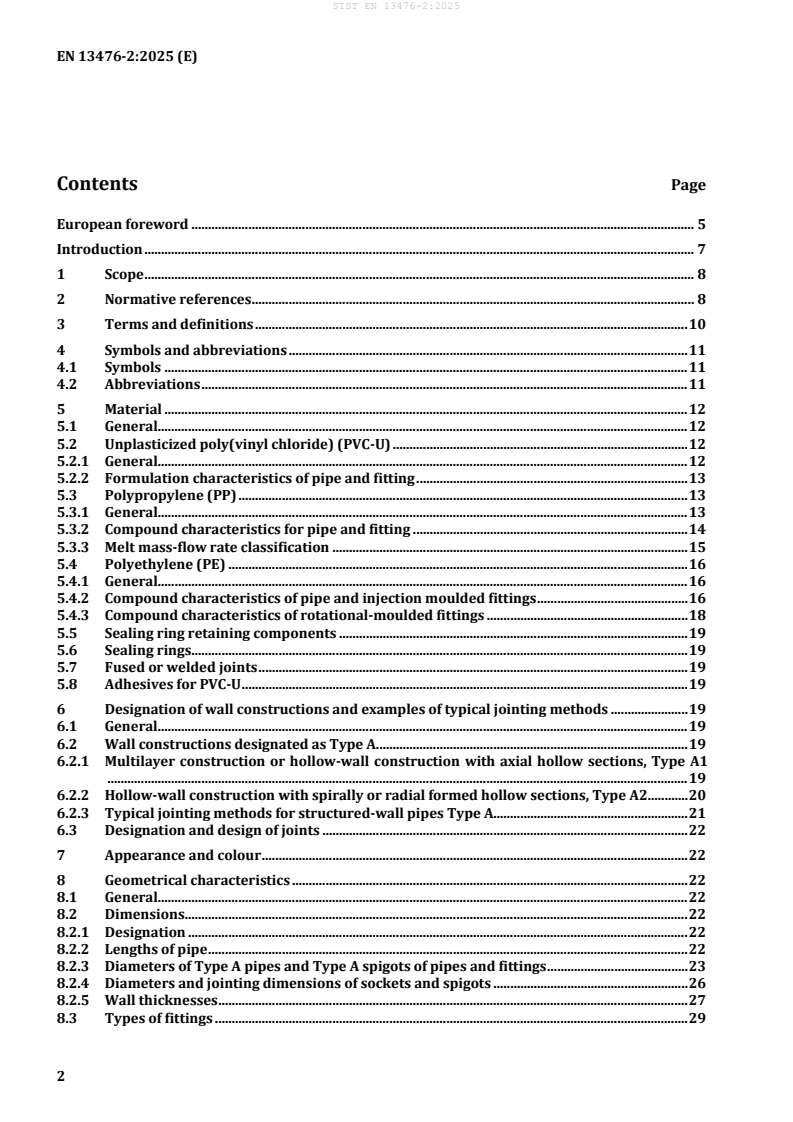
Contents Page
European foreword . 5
Introduction . 7
1 Scope . 8
2 Normative references . 8
3 Terms and definitions . 10
4 Symbols and abbreviations . 11
4.1 Symbols . 11
4.2 Abbreviations . 11
5 Material . 12
5.1 General. 12
5.2 Unplasticized poly(vinyl chloride) (PVC-U) . 12
5.2.1 General. 12
5.2.2 Formulation characteristics of pipe and fitting . 13
5.3 Polypropylene (PP) . 13
5.3.1 General. 13
5.3.2 Compound characteristics for pipe and fitting . 14
5.3.3 Melt mass-flow rate classification . 15
5.4 Polyethylene (PE) . 16
5.4.1 General. 16
5.4.2 Compound characteristics of pipe and injection moulded fittings . 16
5.4.3 Compound characteristics of rotational-moulded fittings . 18
5.5 Sealing ring retaining components . 19
5.6 Sealing rings . 19
5.7 Fused or welded joints . 19
5.8 Adhesives for PVC-U . 19
6 Designation of wall constructions and examples of typical jointing methods . 19
6.1 General. 19
6.2 Wall constructions designated as Type A. 19
6.2.1 Multilayer construction or hollow-wall construction with axial hollow sections, Type A1
............................................................................................................................................................................. 19
6.2.2 Hollow-wall construction with spirally or radial formed hollow sections, Type A2 . 20
6.2.3 Typical jointing methods for structured-wall pipes Type A. 21
6.3 Designation and design of joints . 22
7 Appearance and colour . 22
8 Geometrical characteristics . 22
8.1 General. 22
8.2 Dimensions. 22
8.2.1 Designation . 22
8.2.2 Lengths of pipe . 22
8.2.3 Diameters of Type A pipes and Type A spigots of pipes and fittings . 23
8.2.4 Diameters and jointing dimensions of sockets and spigots . 26
8.2.5 Wall thicknesses . 27
8.3 Types of fittings . 29
8.4 Design length of fittings . 29
9 Physical characteristics . 29
9.1 Unplasticized poly(vinyl chloride) (PVC-U) . 29
9.1.1 Physical characteristics of PVC-U pipes . 29
9.1.2 Physical characteristics of PVC-U fittings . 30
9.2 Polypropylene (PP) . 31
9.2.1 Physical characteristics of PP pipes . 31
9.2.2 Physical characteristics of PP fittings . 32
9.3 Polyethylene (PE) . 32
9.3.1 Physical characteristics of PE pipes . 32
9.3.2 Physical characteristics of PE fittings . 32
10 Mechanical characteristics . 33
10.1 Mechanical characteristics of pipes . 33
10.1.1 General requirements . 33
10.1.2 Ring flexibility . 35
10.1.3 Tensile strength of seams (Type A.2) . 35
10.2 Mechanical characteristics of fittings . 35
11 Performance requirements . 37
12 Marking . 39
12.1 General . 39
12.2 Minimum required marking . 39
12.2.1 Pipes . 39
12.2.2 Fittings . 40
12.3 Additional marking . 41
12.3.1 General . 41
Annex A (normative) Formulation PVC-U material . 42
Annex B (normative) Utilization of PVC-U recyclates . 43
B.1 General . 43
B.2 Agreed specification . 43
B.3 Additional specifications for recyclate and agreed specifications . 44
Annex C (normative) Compound PP material . 46
Annex D (normative) Utilization of PP recyclate . 47
D.1 General . 47
D.2 Agreed specification . 47
D.3 Additional specifications for recyclate and agreed specification . 48
Annex E (normative) Compound PE material . 49
Annex F (normative) Utilization of PE recyclate . 51
F.1 General . 51
F.2 Agreed specification . 51
F.3 Additional specifications for recyclate and agreed specification . 52
Annex G (normative) Impact test at 23 °C . 54
Annex H (normative) Impact test at −10 °C . 55
Annex I (normative) Ring flexibility test at 20 % diametric deflection . 56
Annex J (normative) Impact test for large diameter pipes with structured wall . 57
J.1 Principle . 57
J.2 Apparatus . 57
J.3 Test samples . 58
J.3.1 Preparation . 58
J.3.2 Number of test pieces . 58
J.4 Conditioning . 58
J.5 Procedure . 58
J.6 Test result . 60
Bibliography . 61
European foreword
This document (EN 13476-2:2025) has been prepared by Technical Committee CEN/TC 155 “Plastics
piping systems and ducting systems”, the secretariat of which is held by NEN.
This European Standard shall be given the status of a national standard, either by publication of an
identical text or by endorsement, at the latest by April 2026, and conflicting national standards shall be
withdrawn at the latest by April 2026.
Attention is drawn to the possibility that some of the elements of this document may be the subject of
patent rights. CEN shall not be held responsible for identifying any or all such patent rights.
This document supersedes EN 13476-2:2018+A1:2020.
The main changes with respect to EN 13476-2:2018+A1:2020 are listed below:
a) updating of the ”terms” and “definitions” in line with EN 14541-1;
b) “drainage and sewerage” changed into “drains and sewers” through the document;
c) NOTE 1 introduced in Scope;
d) Clause 5 complete updated;
e) Clause 9 Table 8 updated;
f) figures updated;
g) ring stiffness classes (SN) better described;
h) all material Annexes A, B, C, D, E and F updated;
i) Annex J figures updated;
j) editorial updates through the document.
This document is a part of a System Standard for plastics piping systems of particular materials for a
specified application. There are a number of such System Standards.
System Standards are based on the results of the work being undertaken in ISO/TC 138 “Plastics pipes,
fittings and valves for the transport of fluids”, which is a Technical Committee of the International
Organization for Standardization (ISO).
They are supported by separate standards on test methods to which references are made throughout the
System Standard.
The System Standards are consistent with general standards on functional requirements and on
recommended practice for installation.
EN 13476:2025 consists of the following parts under the general title “Plastics piping systems for non-
pressure underground drains and sewers — Structured-wall piping systems of unplasticized poly(vinyl
chloride) (PVC-U), polypropylene (PP) and polyethylene (PE)”:
— Part 1: General requirements and performance characteristics;
— Part 2: Specifications for pipes and fittings with smooth internal and external surface and the system,
Type A (this document);
— Part 3: Specifications for pipes and fittings with a smooth internal surface and profiled external surface
and the system, Type B;
— Part 4: Assessment of conformity (CEN/TS). (CEN/TS 13476-4:2025)
·
For guidance for installation, see CEN/TS 1046.
Any feedback and questions on this document should be directed to the users’ national standards body.
A complete listing of these bodies can be found on the CEN website.
According to the CEN-CENELEC Internal Regulations, the national standards organisations of the
following countries are bound to implement this European Standard: Austria, Belgium, Bulgaria, Croatia,
Cyprus, Czech Republic, Denmark, Estonia, Finland, France, Germany, Greece, Hungary, Iceland, Ireland,
Italy, Latvia, Lithuania, Luxembourg, Malta, Netherlands, Norway, Poland, Portugal, Republic of North
Macedonia, Romania, Serbia, Slovakia, Slovenia, Spain, Sweden, Switzerland, Türkiye and the United
Kingdom.
Introduction
This document provides optional choices for impact resistance (see Annex G, Annex H and Annex J) and
ring flexibility, see Annex I.
As appropriate, the individual countries may select between those options in their national forewords.
1 Scope
This document, together with EN 13476-1, specifies the definitions and requirements for pipes, fittings
and the system based on unplasticized poly(vinyl chloride) (PVC-U), polypropylene (PP) and
polyethylene (PE) structured-wall piping systems that are intended for use in non-pressure underground
drains and sewers for foul wastewater.
NOTE 1 Products complying with this document can also be used in non-pressure underground drains and
sewers for surface water.
This document is applicable to pipes and fittings with smooth internal and external surfaces, designated
as Type A.
This document also specifies test methods and test parameters.
This document is applicable to:
a) structured-wall pipes and fittings, which are intended to be used buried underground outside the
building structure; reflected in the marking of products by “U”;
b) structured-wall pipes and fittings, which are intended to be used buried underground both outside
(application area code “U”) and within the building structure, reflected in the marking of products by
“UD”.
This document is applicable to structured-wall pipes and fittings with or without an integral socket with
elastomeric ring seal joints as well as welded and fused joints.
This document is applicable to a range of pipe and fitting sizes, materials, pipe constructions, stiffness
classes, application areas, tolerance classes and gives recommendations concerning colours.
NOTE 2 It is the responsibility of the purchaser or specifier to make the appropriate selections from these
aspects, taking into account their particular requirements and any relevant national regulations and installation
practices or codes.
2 Normative references
The following documents are referred to in the text in such a way that some or all of their content
constitutes requirements of this document. For dated references, only the edition cited applies. For
undated references, the latest edition of the referenced document (including any amendments) applies.
EN 476, General requirements for components used in drains and sewers
EN 681-1, Elastomeric seals — Materials requirements for pipe joint seals used in water and drainage
applications — Part 1: Vulcanized rubber
EN 681-2, Elastomeric seals — Materials requirements for pipe joint seals used in water and drainage
applications — Part 2: Thermoplastic elastomers
EN 681-4, Elastomeric seals — Materials requirements for pipe joint seals used in water and drainage
applications — Part 4: Cast polyurethane sealing elements
EN 1401-1, Plastics piping systems for non-pressure underground drainage and sewerage — Unplasticized
poly(vinyl chloride) (PVC-U) — Part 1: Specifications for pipes, fittings and the system
EN 1852-1, Plastics piping systems for non-pressure underground drainage and sewerage — Polypropylene
(PP) — Part 1: Specifications for pipes, fittings and the system
EN 12666-1, Plastics piping systems for non-pressure underground drainage and sewerage — Polyethylene
(PE) — Part 1: Specifications for pipes, fittings and the system
EN 13476-1:2025, Plastics piping systems for non-pressure underground drains and sewers — Structured-
wall piping systems of unplasticized poly(vinyl chloride) (PVC-U), polypropylene (PP) and polyethylene (PE)
— Part 1: General requirements and performance characteristics
EN 13476-3:2025, Plastics piping systems for non-pressure underground drains and sewers — Structured-
wall piping systems of unplasticized poly(vinyl chloride) (PVC-U), polypropylene (PP) and polyethylene (PE)
— Part 3: Specifications for pipes and fittings with smooth internal and profiled external surface and the
system, Type B
EN 14680, Adhesives for non-pressure thermoplastics piping systems — Specifications
EN 14758-1, Plastics piping systems for non-pressure underground drainage and sewerage —
Polypropylene with mineral modifiers (PP-MD) — Part 1: Specifications for pipes, fittings and the system
EN ISO 580, Plastics piping and ducting systems — Injection-moulded thermoplastics fittings — Methods
for visually assessing the effects of heating (ISO 580)
EN ISO 1133-1, Plastics — Determination of the melt mass-flow rate (MFR) and melt volume-flow rate
(MVR) of thermoplastics — Part 1: Standard method (ISO 1133-1)
EN ISO 1167-1, Thermoplastics pipes, fittings and assemblies for the conveyance of fluids — Determination
of the resistance to internal pressure — Part 1: General method (ISO 1167-1)
EN ISO 1167-2, Thermoplastics pipes, fittings and assemblies for the conveyance of fluids — Determination
of the resistance to internal pressure — Part 2: Preparation of pipe test pieces (ISO 1167-2)
EN ISO 1183-1, Plastics — Methods for determining the density of non-cellular plastics — Part 1: Immersion
method, liquid pyknometer method and titration method (ISO 1183-1)
EN ISO 1183-2, Plastics — Methods for determining the density of non-cellular plastics — Part 2: Density
gradient column method (ISO 1183-2)
EN ISO 2505, Thermoplastics pipes — Longitudinal reversion — Test method and parameters (ISO 2505)
EN ISO 2507-1, Thermoplastics pipes and fittings — Vicat softening temperature — Part 1: General test
method (ISO 2507-1)
EN ISO 3126, Plastics piping systems — Plastics components — Determination of dimensions (ISO 3126)
EN ISO 3127, Thermoplastics pipes — Determination of resistance to external blows — Round-the-clock
method (ISO 3127)
EN ISO 3451-5, Plastics — Determination of ash - Poly(vinyl chloride) (ISO 3451-5)
EN ISO 6259-1, Thermoplastics pipes — Determination of tensile properties — Part 1: General test method
(ISO 6259-1)
EN ISO 9852, Unplasticized poly(vinyl chloride) (PVC-U) pipes — Dichloromethane resistance at specified
temperature (DCMT) — Test method (ISO 9852)
EN ISO 9967, Thermoplastics pipes — Determination of creep ratio (ISO 9967)
EN ISO 9969, Thermoplastics pipes — Determination of ring stiffness (ISO 9969)
EN ISO 10147, Pipes and fittings made of crosslinked polyethylene (PE-X) — Estimation of the degree of
crosslinking by determination of the gel content (ISO 10147)
EN ISO 11173, Thermoplastics pipes — Determination of resistance to external blows — Staircase method
(ISO 11173)
EN ISO 11357-6, Plastics — Differential scanning calorimetry (DSC) — Part 6: Determination of oxidation
induction time (isothermal OIT) and oxidation induction temperature (dynamic OIT) (ISO 11357-6)
EN ISO 13254, Thermoplastics piping systems for non-pressure applications — Test method for
watertightness (ISO 13254)
EN ISO 13257:2018, Thermoplastics piping systems for non-pressure applications — Test method for
resistance to elevated temperature cycling (ISO 13257:2018)
EN ISO 13260, Thermoplastics piping systems for non-pressure underground drainage and sewerage —
Test method for resistance to combined temperature cycling and external loading (ISO 13260)
EN ISO 13262, Thermoplastics piping systems for non-pressure underground drainage and sewerage —
Thermoplastics spirally-formed structured-wall pipes — Determination of the tensile strength of a seam
(ISO 13262)
EN ISO 13263, Thermoplastics piping systems for non-pressure underground drainage and sewerage —
Thermoplastics fittings — Test method for impact strength (ISO 13263)
EN ISO 13264, Thermoplastics piping systems for non-pressure underground drainage and sewerage —
Thermoplastics fittings — Test method for mechanical strength or flexibility of fabricated fittings
(ISO 13264)
EN ISO 13967, Thermoplastics fittings — Determination of ring stiffness (ISO 13967)
EN ISO 13968, Plastics piping and ducting systems — Thermoplastics pipes — Determination of ring
flexibility (ISO 13968)
ISO 6259-2, Thermoplastics pipes — Determination of tensile properties — Part 2: Pipes made of
unplasticized poly(vinyl chloride) (PVC-U), oriented unplasticized poly(vinyl chloride) (PVC-O), chlorinated
poly(vinyl chloride) (PVC-C) and high-impact poly(vinyl chloride) (PVC-HI)
ISO 13259, Thermoplastics piping systems for underground non-pressure applications — Test method for
leak tightness of elastomeric sealing ring type joints
ISO 18373-1, Rigid PVC pipes — Differential scanning calorimetry (DSC) method — Part 1: Measurement
of the processing temperature
3 Terms and definitions
For the purposes of this document, the terms and definitions given in EN 13476-1:2025 apply.
ISO and IEC maintain terminology databases for use in standardization at the following addresses:
— ISO Online browsing platform: available at https://www.iso.org/obp/
— IEC Electropedia: available at https://www.electropedia.org/
4 Symbols and abbreviations
4.1 Symbols
For the purposes of this document, the following symbols apply.
A length of engagement, or maximum pull-out whilst maintaining tightness
C length of the sealing zone
d outside diameter
e
d mean outside diameter
em
d inside diameter
i
d mean inside diameter
im
d nominal diameter
n
d inside diameter of socket
s
d minimum mean inside diameter of socket
sm,min
e wall thickness (at any point)
e construction height
c
e minimum wall thickness of pipe or spigot
min
e wall thickness at any point of the cylindrical part of a socket
e wall thickness at any point of a sealing ring groove of a socket
e wall thickness of the inside layer (waterway wall thickness)
e wall thickness of the inside layer under a hollow section
L effective length of a pipe
L minimum length of a spigot
1,min
IMP 23C impact resistance determined at +23 °C
impact resistance determined at −10 °C
❄
4.2 Abbreviations
For the purposes of this document, the following abbreviations apply.
CaCO calcium carbonate
CT close tolerance
DN nominal size
DN/ID nominal size related to inside diameter
DN/OD nominal size related to outside diameter
H50 value for impact resistance of a pipe
MgCO magnesium carbonate
Mg Si O (OH) magnesium silicate, talcum
3 4 10 2
MFR melt mass-flow rate
OIT oxidation induction time
PE polyethylene
PE-X cross-linked polyethylene
PP polypropylene
PP-MD mineral modified PP
PVC-U unplasticized poly(vinyl chloride)
RF ring flexibility performance
S pipe series S
SDR standard dimension ratio
SN ring stiffness class
TIR true impact rate
VST vicat softening temperature
5 Material
5.1 General
The material shall be one of the following: unplasticized poly(vinyl chloride) (PVC-U), polypropylene (PP)
or polyethylene (PE).
5.2 Unplasticized poly(vinyl chloride) (PVC-U)
5.2.1 General
The formulation for production of pipes and fittings shall be PVC material to which additives are added
to enable conformity with the requirements of this document. (See also Annex A.)
PVC material may be virgin material, reworked material or recyclates (pre- or post-consumer).
Recyclates may be used if they comply with Annex B.
The formulation (including virgin material, reworked material, recyclates or a mixture, if applicable) shall
comply with the requirements given in 5.2.2.
NOTE 1 Layers can have different formulations.
Test results with 100 % virgin material (internal and external layers) and test results with the maximum
specified amount of recyclates with the same agreed specification (in the internal and external layers)
shall be taken as proving conformity of products containing a lower amount of recyclates.
NOTE 2 Attention is drawn to changing of European and/or national regulations regarding e.g. heavy metals.
5.2.2 Formulation characteristics of pipe and fitting
When tested in accordance with the test method as specified in Table 1 using the indicated parameters,
the formulation shall have characteristics conforming to the requirements given in Table 1.
Table 1 — Characteristics of PVC-U formulation for pipes and injection-moulded fittings
Characteristic Requirements Test parameters Test method
Resistance to No failure End caps Type A or type B EN ISO 1167-1
internal pressure during the test and
Orientation Free
a b c period EN ISO 1167-2
Number of test 3
pieces
Test temperature 60 °C
Circumferential 10 MPa
stress for pipe
compound /
formulation
Circumferential 6,3 MPa
stress for fitting
compound /
formulation
Conditioning Shall conform to
period EN ISO 1167-1
Type of test Water-in-water
Test period 1 000 h
a
This requirement does not apply to the specified intermediate layer of a Type A1 pipe.
b
For the extrusion formulation for the internal and external layers of a multilayer pipe A1 as well as for the
formulation of A2 pipes (as defined in 6.2), this test shall be carried out in the form of an injection-moulded
or extruded sample of a solid wall pipe made from the relevant formulation.
c
For injection-moulding formulation, this test shall be carried out in the form of an injection-moulded or
extruded sample in solid wall pipe form made from the relevant formulation.
5.3 Polypropylene (PP)
5.3.1 General
The compound for production of pipes and fittings shall be PP-base material to which additives can be
added to enable conformity with the requirements of this document. (See also Annex C.)
PP material may be virgin material, reworked material or recyclates (pre- or post-consumer).
Recyclates are permitted if they comply with Annex D.
The compound (including virgin material, reworked material, recyclates or a mixture, if applicable) shall
comply with the requirements given in 5.3.2 and 5.3.3.
NOTE 1 Layers can have different compounds.
Test results with 100 % virgin material (internal and external layers) and test results with the maximum
specified amount of recyclates with the same agreed specification (in the internal and external layers)
shall be taken as proving conformity of products containing a lower amount of recyclates.
NOTE 2 Attention is drawn to changing of European and/or national regulations.
5.3.2 Compound characteristics for pipe and fitting
When tested in accordance with the test methods as specified in Table 2 using the indicated parameters,
the compound shall have characteristics conforming to the requirements given in Table 2.
Table 2 — Characteristics of PP compound for pipes and injection-moulded fittings
Characteristic Requirements Test parameters Test method
Resistance to No failure End caps Type A or Type B EN ISO 1167-1 and
internal during the test EN ISO 1167-2
Test temperature 80 °C
pressure, 140 h period
a b c Orientation Free
Number of test pieces 3
Circumferential stress 4,2 MPa
Conditioning period Shall conform to
EN ISO 1167-1
Type of test Water-in-water
Test period 140 h
Resistance to No failure End caps Type A or Type B EN ISO 1167-1 and
internal during the test EN ISO 1167-2
Test temperature 95 °C
pressure, period
a b c Orientation Free
1 000 h
Number of test pieces 3
Circumferential stress 2,5 MPa
Conditioning period Shall conform to
EN ISO 1167-1
Type of test Water-in-water
Test period 1 000 h
Melt mass-flow ≤ 1,5 g/10 min Temperature 230 °C EN ISO 1133-1
d
rate Loading mass 2,16 kg
Thermal ≥ 8 min Temperature 200 °C EN ISO 11357-6
stability, OIT
Test atmosphere Oxygen
a
This requirement does not apply to the specified intermediate layer of a type A1 pipe.
b
For the extrusion compound for the internal and external layers of a multilayer pipe A1 as well as for the
compound of A2 pipes, this test shall be carried out in the form of an injection-moulded or extruded sample of
a solid wall pipe made from the relevant compound.
c
For injection-moulding compound, this test shall be carried out in the form of an injection-moulded or
extruded sample in solid wall pipe form made from the relevant compound.
d
This requirement only applies to pipes and fittings intended for welding.
5.3.3 Melt mass-flow rate classification
Materials for pipes and fittings intended for jointing by fusion or welding, shall be designated by the
following MFR classes:
— Class A: MFR ≤ 0,3 g/10 min;
— Class B: 0,3 g/10 min < MFR ≤ 0,6 g/10 min;
— Class C: 0,6 g/10 min < MFR ≤ 0,9 g/10 min;
— Class D: 0,9 g/10 min < MFR ≤ 1,5 g/10 min.
In the case where a compound, because of its MFR tolerance arbitrarily falls in one of two adjacent classes,
the manufacturer of the components may mark the MFR class on the product as follows:
— MFR value across the border between A and B, it is permitted to classify as class A;
— MFR value across the border between B and C, it is permitted to classify as class C;
— MFR value across the border between C and D, it is permitted to classify as class D.
NOTE Pipes and fittings type A1 are not intended for field jointing by fusion or welding.
5.4 Polyethylene (PE)
5.4.1 General
The compound for production of pipes and fittings shall be PE-base material to which additives can be
added to enable conformity with the requirements of this document. (See also Annex E.)
PE material may be virgin material, reworked material or recyclates (pre- or post-consumer).
Recyclates are permitted if they comply with Annex F.
The compound (including virgin material, reworked material, recyclates or a mixture, if applicable) shall
comply with the requirements given in 5.4.2 and 5.4.3.
NOTE 1 Layers can have different compounds.
Test results with 100 % virgin material (internal and external layers) and test results with the maximum
specified amount of recyclates with the same agreed specification (in the internal and external layers)
shall be taken as proving conformity of products containing a lower amount of recyclates.
NOTE 2 Attention is drawn to changing of European and/or national regulations.
5.4.2 Compound characteristics of pipe and injection moulded fittings
When tested in accordance with the test method as specified in Table 3 using the indicated parameters,
the compound shall have characteristics conforming to the requirements given in Table 3.
Table 3 — Characteristics of PE compound for pipes and injection-moulded fittings
Characteristic Requirements Test parameters Test method
Resistance to No failure during End caps Type A or Type B EN ISO 1167-1
internal pressure the test period and
Test temperature 80 °C
a b c EN ISO 1167-2
165 h
Orientation Free
Number of test 3
pieces
Circumferential 4,0 MPa
stress
Conditioning Shall conform to
period EN ISO 1167-1
Type of test Water-in-water
Test period 165 h
Resistance to No failure End caps Type A or Type B EN ISO 1167-1
internal pressure and
during the test
Test temperature 80 °C
a b c EN ISO 1167-2
1 000 h
period
Orientation Free
Number of test 3
pieces
Circumferential 2,8 MPa
stress
Conditioning Shall conform to
period EN ISO 1167-1
Type of test Water-in-water
Test period 1 000 h
Melt mass-flow ≤ 1,6 g/10 min Temperature 190 °C EN ISO 1133-1
d
rate Loading mass 5 kg
Thermal stability, ≥ 20 min Temperature 200 °C EN ISO 11357-6
OIT
Test atmosphere Oxygen
Reference density 3 Shall conform to EN ISO 1183-1 EN ISO 1183-1
≥ 930 kg/m
EN ISO 1183-2
a
This requirement does not apply to the specified intermediate layer of a Type A1 pipe.
b
For the extrusion compound for the internal and external layers of a multilayer pipe A1 as well as for the
compound of A2 pipes, this test shall be carried out in the form of an injection-moulded or extruded sample of a
solid wall pipe made from the relevant compound.
c
For injection-moulding compound, this test shall be carried out in the form of an injection-moulded or extruded
sample in solid wall pipe form made from the relevant compound.
d
This requirement only applies to pipes and fittings intended for welding.
5.4.3 Compound characteristics of rotational-moulded fittings
When tested in accordance with the test methods as specified in Table 4 using the indicated parameters,
the compound shall have characteristics conforming to the requirements given in Table 4.
Table 4 — Characteristics of PE compound for rotational-moulded fittings
Characteristic Requirements Test parameters Test method
Resistance to No failure during End caps Type A or Type B EN ISO 1167-1 and
internal pressure th
...