

EN 1852-1:2018+A1:2022
(Main + Amendment)Plastics piping systems for non-pressure underground drainage and sewerage - Polypropylene (PP) - Part 1: Specifications for pipes, fittings and the system
- Abstract
This part of EN 1852 specifies the requirements for solid wall pipes with smooth internal and external surfaces extruded from the same compound/formulation throughout the wall, fittings and the system of polypropylene (PP) piping systems intended for use for:
- non-pressure underground drainage and sewerage outside the building structure (application area code "U"), and
- non-pressure underground drainage and sewerage for both buried in ground within the building structure (application area code "D") and outside the building structure.
This is reflected in the marking of products by "U" and "UD".
This standard covers PP materials without mineral modifiers.
It also specifies the test parameters for the test methods referred to in this standard.
NOTE 1 Solid wall multilayer pipes with different formulation throughout the wall and foamed core pipes are covered by EN 13476-2 [1] (see also CEN ISO/TR 27165 [2]).
This standard covers a range of nominal sizes, and pipe series and gives recommendations concerning colours.
NOTE 2 It is the responsibility of the purchaser or specifier to make the appropriate selection from these aspects, taking into account their particular requirements and any relevant national regulations and installation practices or codes.
In conjunction with CEN/TS 1852-2, it is applicable to PP pipes and fittings, their joints and to joints with components of other plastics and non-plastics materials intended to be used for buried piping systems for non-pressure underground drainage and sewerage.
The fittings can be manufactured by injection-moulding or be fabricated from pipes and/or mouldings.
NOTE 3 Pipes, fittings and other components conforming to any of the plastics product standards listed in Annex C can be connected to pipes and fittings conforming to this standard, when they conform to the requirements for joint dimensions given in Clause 6 and to the requirements of Table 14.
- Status
- Published
- Publication Date
- 04-Oct-2022
- Technical Committee
- CEN/TC 155 - Plastics piping systems and ducting systems
- Current Stage
- 6060 - Definitive text made available (DAV) - Publishing
- Start Date
- 05-Oct-2022
- Due Date
- 09-Oct-2023
- Completion Date
- 05-Oct-2022



Overview
EN 1852-1:2018+A1:2022 is a CEN (European) standard that defines specifications for polypropylene (PP) piping systems used in non‑pressure underground drainage and sewerage applications. It applies to solid‑wall PP pipes and fittings extruded from a single PP compound (smooth internal and external surfaces) and covers the system requirements, product marking and the test parameters for referenced methods. Products are marked for application area code “U” (outside the building) or “UD” (suitable for both buried in‑ground within and outside the building). The standard covers PP without mineral modifiers.
Key topics and technical requirements
- Material requirements
- Final PP compound specifications, melt mass‑flow characteristics and restrictions on mineral modifiers (PP‑MD is covered by EN 14758‑1).
- Rules for utilization of non‑virgin (reprocessed/recycled) PP (Annex A).
- Geometrical and mechanical characteristics
- Nominal sizes, pipe series, wall thicknesses, socket/spigot dimensions and joint dimension requirements.
- Requirements for fittings (injection‑moulded or fabricated) and sealing ring retaining means.
- Performance and physical testing
- Test parameters for referenced test methods (mechanical, physical and hydraulic performance).
- Requirements for ring stiffness, abrasion resistance, hydraulic roughness and diametric deflection (general guidance in Annex B).
- Marking and traceability
- Minimum marking content for pipes and fittings including application code (“U” / “UD”), material and manufacturer identification.
- Interoperability
- Conditions under which components from other plastics standards may be connected (joint dimension compliance, see Annex C and Clause 6).
- Referenced standards
- Includes cross‑references to CEN/TS 1852‑2, EN 681‑1/2 (elastomeric seals), EN ISO test standards and others.
Applications and users
Who benefits:
- Manufacturers of PP pipes and fittings - to design, produce and mark compliant products.
- Specifiers and engineers - for selecting appropriate systems for buried, non‑pressure drainage and sewer networks.
- Contractors and installers - to ensure correct jointing, sealing and installation practice.
- Public authorities and asset owners - for procurement, conformity assessment and lifecycle planning.
Typical applications:
- Buried gravity drainage mains, branch connections and sewer runs outside buildings (U) and buried systems within and outside building footprints (UD).
Related standards
- CEN/TS 1852‑2 (conformity assessment guidance)
- EN 14758‑1 (PP with mineral modifiers)
- EN 681‑1 / EN 681‑2 (elastomeric seals)
- Relevant EN/ISO test methods referenced in the standard
EN 1852‑1:2018+A1:2022 is essential when specifying or manufacturing PP piping systems for safe, interoperable and verifiable non‑pressure underground drainage and sewerage installations across Europe.
Relations
- Effective Date
- 19-Jan-2023
- Effective Date
- 18-Jan-2023
- Effective Date
- 25-Aug-2026
- Refers
EN ISO 3451-1:2026 - Plastics - Determination of ash - Part 1: General methods (ISO 3451-1:2026) - Effective Date
- 10-Jun-2026
- Effective Date
- 08-Apr-2026
- Effective Date
- 28-Jan-2026
- Effective Date
- 28-Jan-2026
- Effective Date
- 28-Jan-2026
- Effective Date
- 28-Jan-2026
- Effective Date
- 28-Jan-2026
- Effective Date
- 28-Jan-2026
- Effective Date
- 28-Jan-2026
- Effective Date
- 28-Jan-2026
- Effective Date
- 28-Jan-2026
- Effective Date
- 28-Jan-2026
Get Certified
Connect with accredited certification bodies for this standard

Institut za varilstvo d.o.o. (Welding Institute)
Slovenia's leading welding institute since 1952. ISO 3834, EN 1090, pressure equipment certification, NDT personnel, welder qualification. Only IIW Au
Sponsored listings
Frequently Asked Questions
EN 1852-1:2018+A1:2022 is a standard published by the European Committee for Standardization (CEN). Its full title is "Plastics piping systems for non-pressure underground drainage and sewerage - Polypropylene (PP) - Part 1: Specifications for pipes, fittings and the system". This standard covers: This part of EN 1852 specifies the requirements for solid wall pipes with smooth internal and external surfaces extruded from the same compound/formulation throughout the wall, fittings and the system of polypropylene (PP) piping systems intended for use for: - non-pressure underground drainage and sewerage outside the building structure (application area code "U"), and - non-pressure underground drainage and sewerage for both buried in ground within the building structure (application area code "D") and outside the building structure. This is reflected in the marking of products by "U" and "UD". This standard covers PP materials without mineral modifiers. It also specifies the test parameters for the test methods referred to in this standard. NOTE 1 Solid wall multilayer pipes with different formulation throughout the wall and foamed core pipes are covered by EN 13476-2 [1] (see also CEN ISO/TR 27165 [2]). This standard covers a range of nominal sizes, and pipe series and gives recommendations concerning colours. NOTE 2 It is the responsibility of the purchaser or specifier to make the appropriate selection from these aspects, taking into account their particular requirements and any relevant national regulations and installation practices or codes. In conjunction with CEN/TS 1852-2, it is applicable to PP pipes and fittings, their joints and to joints with components of other plastics and non-plastics materials intended to be used for buried piping systems for non-pressure underground drainage and sewerage. The fittings can be manufactured by injection-moulding or be fabricated from pipes and/or mouldings. NOTE 3 Pipes, fittings and other components conforming to any of the plastics product standards listed in Annex C can be connected to pipes and fittings conforming to this standard, when they conform to the requirements for joint dimensions given in Clause 6 and to the requirements of Table 14.
This part of EN 1852 specifies the requirements for solid wall pipes with smooth internal and external surfaces extruded from the same compound/formulation throughout the wall, fittings and the system of polypropylene (PP) piping systems intended for use for: - non-pressure underground drainage and sewerage outside the building structure (application area code "U"), and - non-pressure underground drainage and sewerage for both buried in ground within the building structure (application area code "D") and outside the building structure. This is reflected in the marking of products by "U" and "UD". This standard covers PP materials without mineral modifiers. It also specifies the test parameters for the test methods referred to in this standard. NOTE 1 Solid wall multilayer pipes with different formulation throughout the wall and foamed core pipes are covered by EN 13476-2 [1] (see also CEN ISO/TR 27165 [2]). This standard covers a range of nominal sizes, and pipe series and gives recommendations concerning colours. NOTE 2 It is the responsibility of the purchaser or specifier to make the appropriate selection from these aspects, taking into account their particular requirements and any relevant national regulations and installation practices or codes. In conjunction with CEN/TS 1852-2, it is applicable to PP pipes and fittings, their joints and to joints with components of other plastics and non-plastics materials intended to be used for buried piping systems for non-pressure underground drainage and sewerage. The fittings can be manufactured by injection-moulding or be fabricated from pipes and/or mouldings. NOTE 3 Pipes, fittings and other components conforming to any of the plastics product standards listed in Annex C can be connected to pipes and fittings conforming to this standard, when they conform to the requirements for joint dimensions given in Clause 6 and to the requirements of Table 14.
EN 1852-1:2018+A1:2022 is classified under the following ICS (International Classification for Standards) categories: 23.040.05 - Pipeline and its parts for external sewage systems. The ICS classification helps identify the subject area and facilitates finding related standards.
EN 1852-1:2018+A1:2022 has the following relationships with other standards: It is inter standard links to EN 1852-1:2018/prA1, EN 1852-1:2018, ISO 4065:1996, EN ISO 3451-1:2026, EN ISO 1183-2:2026, EN ISO 3127:2017, EN ISO 11357-6:2025, EN ISO 2505:2023, EN ISO 13263:2017, EN ISO 3126:2005, EN ISO 580:2005, EN ISO 8494:2004, EN ISO 1167-1:2006, EN ISO 9969:2016, EN ISO 11173:2017. Understanding these relationships helps ensure you are using the most current and applicable version of the standard.
EN 1852-1:2018+A1:2022 is available in PDF format for immediate download after purchase. The document can be added to your cart and obtained through the secure checkout process. Digital delivery ensures instant access to the complete standard document.
Standards Content (Sample)
SLOVENSKI STANDARD
01-december-2022
Cevni sistemi iz polimernih materialov za odpadno vodo in kanalizacijo, ki delujejo
po težnostnem principu in so položeni v zemljo - Polipropilen (PP) - 1. del:
Specifikacije za cevi, fitinge in sistem (vključno z dopolnilom A1)
Plastics piping systems for non-pressure underground drainage and sewerage -
Polypropylene (PP) - Part 1: Specifications for pipes, fittings and the system
Kunststoff-Rohrleitungssysteme für erdverlegte drucklose Abwasserkanäle und -
leitungen - Polypropylen (PP) - Teil 1: Anforderungen an Rohre, Formstücke und das
Rohrleitungssystem
Systèmes de canalisations en plastique pour les branchements et les collecteurs
d'assainissement enterrés sans pression - Polypropylène (PP) - Partie 1: Spécifications
pour tubes, raccords et le système
Ta slovenski standard je istoveten z: EN 1852-1:2018+A1:2022
ICS:
23.040.05 Cevovodi za zunanje Pipeline and its parts for
sisteme za odpadno vodo in external sewage systems
njihovi deli
93.030 Zunanji sistemi za odpadno External sewage systems
vodo
2003-01.Slovenski inštitut za standardizacijo. Razmnoževanje celote ali delov tega standarda ni dovoljeno.
EN 1852-1:2018+A1
EUROPEAN STANDARD
NORME EUROPÉENNE
October 2022
EUROPÄISCHE NORM
ICS 23.040.05 Supersedes EN 1852-1:2018
English Version
Plastics piping systems for non-pressure underground
drainage and sewerage - Polypropylene (PP) - Part 1:
Specifications for pipes, fittings and the system
Systèmes de canalisations en plastique pour les Kunststoff-Rohrleitungssysteme für erdverlegte
branchements et les collecteurs d'assainissement drucklose Abwasserkanäle und -leitungen -
enterrés sans pression - Polypropylène (PP) - Partie 1: Polypropylen (PP) - Teil 1: Anforderungen an Rohre,
Spécifications pour tubes, raccords et le système Formstücke und das Rohrleitungssystem
This European Standard was approved by CEN on 20 November 2017 and includes Amendment 1 approved by CEN on 28 June
2022.
CEN members are bound to comply with the CEN/CENELEC Internal Regulations which stipulate the conditions for giving this
European Standard the status of a national standard without any alteration. Up-to-date lists and bibliographical references
concerning such national standards may be obtained on application to the CEN-CENELEC Management Centre or to any CEN
member.
This European Standard exists in three official versions (English, French, German). A version in any other language made by
translation under the responsibility of a CEN member into its own language and notified to the CEN-CENELEC Management
Centre has the same status as the official versions.
CEN members are the national standards bodies of Austria, Belgium, Bulgaria, Croatia, Cyprus, Czech Republic, Denmark, Estonia,
Finland, France, Germany, Greece, Hungary, Iceland, Ireland, Italy, Latvia, Lithuania, Luxembourg, Malta, Netherlands, Norway,
Poland, Portugal, Republic of North Macedonia, Romania, Serbia, Slovakia, Slovenia, Spain, Sweden, Switzerland, Türkiye and
United Kingdom.
EUROPEAN COMMITTEE FOR STANDARDIZATION
COMITÉ EUROPÉEN DE NORMALISATION
EUROPÄISCHES KOMITEE FÜR NORMUNG
CEN-CENELEC Management Centre: Rue de la Science 23, B-1040 Brussels
© 2022 CEN All rights of exploitation in any form and by any means reserved Ref. No. EN 1852-1:2018+A1:2022 E
worldwide for CEN national Members.
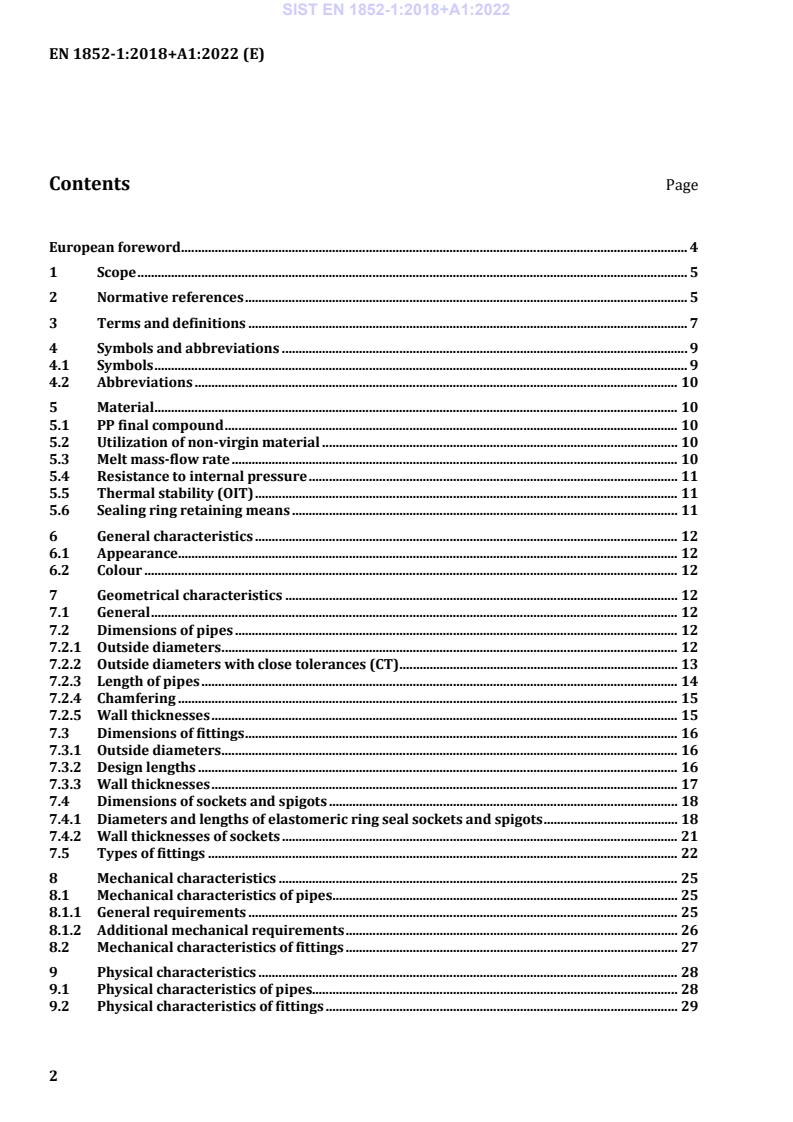
Contents Page
European foreword . 4
1 Scope . 5
2 Normative references . 5
3 Terms and definitions . 7
4 Symbols and abbreviations . 9
4.1 Symbols . 9
4.2 Abbreviations . 10
5 Material . 10
5.1 PP final compound . 10
5.2 Utilization of non-virgin material . 10
5.3 Melt mass-flow rate . 10
5.4 Resistance to internal pressure . 11
5.5 Thermal stability (OIT) . 11
5.6 Sealing ring retaining means . 11
6 General characteristics . 12
6.1 Appearance . 12
6.2 Colour . 12
7 Geometrical characteristics . 12
7.1 General . 12
7.2 Dimensions of pipes . 12
7.2.1 Outside diameters . 12
7.2.2 Outside diameters with close tolerances (CT) . 13
7.2.3 Length of pipes . 14
7.2.4 Chamfering . 15
7.2.5 Wall thicknesses . 15
7.3 Dimensions of fittings . 16
7.3.1 Outside diameters . 16
7.3.2 Design lengths . 16
7.3.3 Wall thicknesses . 17
7.4 Dimensions of sockets and spigots . 18
7.4.1 Diameters and lengths of elastomeric ring seal sockets and spigots . 18
7.4.2 Wall thicknesses of sockets . 21
7.5 Types of fittings . 22
8 Mechanical characteristics . 25
8.1 Mechanical characteristics of pipes. 25
8.1.1 General requirements . 25
8.1.2 Additional mechanical requirements . 26
8.2 Mechanical characteristics of fittings . 27
9 Physical characteristics . 28
9.1 Physical characteristics of pipes. 28
9.2 Physical characteristics of fittings . 29
10 Performance requirements . 30
11 Sealing rings . 31
12 Marking . 31
12.1 General . 31
12.2 Minimum required marking of pipes . 31
12.3 Minimum required marking of fittings . 32
12.4 Additional marking . 33
Annex A (normative) Utilization of non-virgin PP material . 34
A.1 Own reprocessed material from pipes and fittings . 34
A.2 External reprocessed and recycled materials with an agreed specification . 34
A.2.1 Material from PP pipes and fittings . 34
A.2.2 Material from PP products other than pipes and fittings . 35
Annex B (informative) General characteristics of PP pipes and fittings . 36
B.1 General . 36
B.2 Material characteristics . 36
B.3 Ring stiffness . 36
B.4 Chemical resistance . 37
B.5 Abrasion resistance . 37
B.6 Hydraulic roughness . 37
B.7 Diametric deflection . 37
Annex C (informative) Product standards of components that can be connected to
components conforming to this standard . 38
Bibliography . 39
European foreword
This document (EN 1852-1:2018+A1:2022) has been prepared by Technical Committee CEN/TC 155
“Plastics piping systems and ducting systems”, the secretariat of which is held by NEN.
This European Standard shall be given the status of a national standard, either by publication of an
identical text or by endorsement, at the latest by April 2023, and conflicting national standards shall be
withdrawn at the latest by April 2023.
Attention is drawn to the possibility that some of the elements of this document may be the subject of
patent rights. CEN not be held responsible for identifying any or all such patent rights.
This document includes Amendment 1 approved by CEN on 28 June 2022.
The start and finish of text introduced or altered by amendment is indicated in the text by tags ! ".
!This document supersedes EN 1852-1:2018."
The System Standards are based on the results of the work undertaken in ISO/TC 138 “Plastics pipes,
fittings and valves for the transport of fluids”, which is a Technical Committee of the International
Organization for Standardization (ISO).
The System Standards are supported by separate standards on test methods to which references are
made throughout the System Standard.
The System Standards are consistent with general standards on functional requirements and on
recommended practice for installation.
EN 1852 consists of the following parts, under the general title Plastics piping systems for non-pressure
underground drainage and sewerage − Polypropylene (PP):
— Part 1: Specifications for pipes, fittings and the system (the present standard)
— Part 2: Guidance for the assessment of conformity (CEN Technical Specification)
This part of EN 1852 includes Annex A (normative) “Utilization of non-virgin PP materials”, Annex B
(informative), “General characteristics of PP pipes and fittings” and Annex C (informative), “Product
standards of components that can be connected to components conforming to this standard”.
Plastics piping systems made of PP with mineral modifiers (PP-MD) are covered by EN 14758-1 [1].
Any feedback and questions on this document should be directed to the users’ national standards body.
A complete listing of these bodies can be found on the CEN website.
According to the CEN-CENELEC Internal Regulations, the national standards organisations of the
following countries are bound to implement this European Standard: Austria, Belgium, Bulgaria,
Croatia, Cyprus, Czech Republic, Denmark, Estonia, Finland, France, Germany, Greece, Hungary, Iceland,
Ireland, Italy, Latvia, Lithuania, Luxembourg, Malta, Netherlands, Norway, Poland, Portugal, Republic of
North Macedonia, Romania, Serbia, Slovakia, Slovenia, Spain, Sweden, Switzerland, Türkiye and the
United Kingdom.
1 Scope
This part of EN 1852 specifies the requirements for solid wall pipes with smooth internal and external
surfaces extruded from the same compound/formulation throughout the wall, fittings and the system of
polypropylene (PP) piping systems intended for use for:
— non-pressure underground drainage and sewerage outside the building structure (application area
code “U”), and
— non-pressure underground drainage and sewerage for both buried in ground within the building
structure (application area code “D”) and outside the building structure.
This is reflected in the marking of products by “U” and “UD”.
This standard covers PP materials without mineral modifiers.
It also specifies the test parameters for the test methods referred to in this standard.
NOTE 1 Solid wall multilayer pipes with different formulation throughout the wall and foamed core pipes are
covered by EN 13476-2 [1] (see also CEN ISO/TR 27165 [2]).
This standard covers a range of nominal sizes, and pipe series and gives recommendations concerning
colours.
NOTE 2 It is the responsibility of the purchaser or specifier to make the appropriate selection from these
aspects, taking into account their particular requirements and any relevant national regulations and installation
practices or codes.
In conjunction with CEN/TS 1852-2, it is applicable to PP pipes and fittings, their joints and to joints
with components of other plastics and non-plastics materials intended to be used for buried piping
systems for non-pressure underground drainage and sewerage.
The fittings can be manufactured by injection-moulding or be fabricated from pipes and/or mouldings.
NOTE 3 Pipes, fittings and other components conforming to any of the plastics product standards listed in
Annex C can be connected to pipes and fittings conforming to this standard, when they conform to the
requirements for joint dimensions given in Clause 6 and to the requirements of Table 14.
2 Normative references
The following documents are referred to in the text in such a way that some or all of their content
constitutes requirements of this document. For dated references, only the edition cited applies. For
undated references, the latest edition of the referenced document (including any amendments) applies.
EN 681-1, Elastomeric seals — Materials requirements for pipe joint seals used in water and drainage
applications — Part 1: Vulcanized rubber
EN 681-2, Elastomeric Seals — Materials requirements for pipe joint seals used in water and drainage
applications — Part 2: Thermoplastic elastomers
EN 12099, Plastics piping systems — Polyethylene piping materials and components — Determination of
volatile content
EN ISO 472, Plastics — Vocabulary (ISO 472)
EN ISO 580, Plastics piping and ducting systems — Injection-moulded thermoplastics fittings — Methods
for visually assessing the effects of heating (ISO 580)
EN ISO 1043-1, Plastics — Symbols and abbreviated terms — Part 1: Basic polymers and their special
characteristics (ISO 1043-1)
EN ISO 1133-1, Plastics — Determination of the melt mass-flow rate (MFR) and melt volume-flow rate
(MVR) of thermoplastics — Part 1: Standard method (ISO 1133-1)
EN ISO 1167-1, Thermoplastics pipes, fittings and assemblies for the conveyance of fluids —
Determination of the resistance to internal pressure — Part 1: General method (ISO 1167-1)
EN ISO 1167-2, Thermoplastics pipes, fittings and assemblies for the conveyance of fluids —
Determination of the resistance to internal pressure — Part 2: Preparation of pipe test pieces (ISO 1167-2)
EN ISO 1183-2, Plastics — Methods for determining the density of non-cellular plastics — Part 2: Density
gradient column method (ISO 1183-2)
EN ISO 2505, Thermoplastics pipes — Longitudinal reversion — Test method and parameters (ISO 2505)
EN ISO 3126, Plastics piping systems — Plastics components — Determination of dimensions (ISO 3126)
EN ISO 3451-1, Plastics — Determination of ash — Part 1: General methods (ISO 3451-1)
EN ISO 9969:2016, Thermoplastics pipes — Determination of ring stiffness (ISO 9969:2016)
EN ISO 11357-6, Plastics — Differential scanning calorimetry (DSC) — Part 6: Determination of oxidation
induction time (isothermal OIT) and oxidation induction temperature (dynamic OIT) (ISO 11357-6)
EN ISO 3127, Thermoplastics pipes — Determination of resistance to external blows — Round-the-clock
method (ISO 3127)
EN ISO 11173, Thermoplastics pipes — Determination of resistance to external blows — Staircase method
(ISO 11173)
EN ISO 13254, Thermoplastics piping systems for non-pressure applications — Test method for
watertightness (ISO 13254)
EN ISO 13257:2017, Thermoplastics piping systems for non-pressure applications — Test method for
resistance to elevated temperature cycling (ISO 13257:2010)
prEN ISO 13259, Thermoplastics piping systems for underground non-pressure applications — Test
method for leaktightness of elastomeric sealing ring type joints (ISO/DIS 13259)
EN ISO 13263, Thermoplastics piping systems for non-pressure underground drainage and sewerage —
Thermoplastics fittings — Test method for impact strength (ISO 13263)
EN ISO 13264, Thermoplastics piping systems for non-pressure underground drainage and sewerage —
Thermoplastics fittings — Test method for mechanical strength or flexibility of fabricated fittings
(ISO 13264)
ISO 4065:1996, Thermoplastics pipes — Universal wall thickness table
3 Terms and definitions
For the purposes of this document, the terms and definitions given in EN-ISO 472, EN-ISO 1043-1 and
the following apply.
3.1
application area code
code used in the marking of pipes and fittings to indicate the application area for which they are
intended, as follows:
U: application area code for the area more than 1 m from the building to which the buried piping system
is connected;
D: application area code for the area under and within 1 m from the building where the pipes and the
fittings are buried in ground and are connected to the soil and waste discharge system of the building
Note 1 to entry: In code D application areas, the existence of hot water discharge in addition to the external
forces from the surroundings is usual.
3.2
nominal size
DN/OD
numerical designation of the size of a component, which is a convenient round number approximately
equal to the manufacturing dimension of the outside diameter, in millimetres
3.3
nominal outside diameter
d
n
specified outside diameter, in millimetres, assigned to a nominal size DN/OD
3.4
outside diameter
d
e
value of the measurement of the outside diameter through its cross section at any point of a pipe or
spigot end of a fitting, rounded up to the next greater 0,1 mm
3.5
mean outside diameter
d
em
value of the measurement of the outer circumference of a pipe or spigot end of a fitting in any cross
section, divided by π (≈ 3,142), rounded to the next greater 0,1 mm
3.6
mean inside diameter of a socket
d
sm
arithmetical mean of a number of measurements of the inside diameter of a socket in the same cross
section
3.7
wall thickness
e
value of the measurement of the wall thickness at any point around the circumference of a component
3.8
mean wall thickness
e
m
arithmetical mean of a number of measurements of the wall thickness, regularly spaced around the
circumference and in the same cross section of a component, including the measured minimum and the
measured maximum values of the wall thickness in that cross section
3.9
pipes series
S
number for pipe designation (see ISO 4065:1996, 3.6)
3.10
standard dimension ratio
SDR
numerical designation of a pipe series, which is a convenient round number approximately equal to the
ratio of the nominal outside diameter, d , and the minimum wall thickness, e
n min
3.11
nominal ring stiffness
SN
numerical designation of the ring stiffness of a pipe or fitting, which is a convenient round number,
relative to the determined stiffness in kilonewtons per square metre (kN/m ), indicating the minimum
ring stiffness of a pipe or fitting
3.12
solid wall pipe
pipe with smooth internal and external surface with same compound/formulation throughout the wall
3.13
virgin material
material in a form such as granules or powder that has not been subjected to use or processing other
than that required for its manufacture and to which no reprocessed or recycled material has been
added
3.14
own reprocessed material
material prepared from rejected unused pipes or fittings, including trimmings from the production of
pipes or fittings, that will be reprocessed in a manufacturer’s plant after having been previously
processed by the same manufacturer by a process such as moulding or extrusion, and for which the
complete formulation is known
3.15
external reprocessed material
material comprising either one of the following forms:
a) material from rejected unused pipes or fittings or trimmings there from, that will be reprocessed
and that were originally processed by another manufacturer;
b) material from the production of unused PP products other than pipes and fittings, regardless of
where they are manufactured
3.16
recycled material
material comprising either one of the following forms:
a) material from used pipes or fittings which have been cleaned and crushed or ground;
b) material from used PP products other than pipes or fittings which have been cleaned and crushed
or ground
3.17
mineral modified material (PP-MD)
material to which has been added minerals during specific processing operation(s) which during such
processing is well distributed in the material
4 Symbols and abbreviations
4.1 Symbols
A length of engagement
C depth of sealing zone
d outside diameter
e
d mean outside diameter
em
d nominal outside diameter
n
d mean inside diameter of a socket
sm
e wall thickness
e mean wall thickness
m
e wall thickness of a socket
e wall thickness in the groove area
l effective length of a pipe
L length of spigot
M length of spigot of a plug
R radius of swept fittings
Z design length of (a part of) a fitting
α nominal angle of a fitting
4.2 Abbreviations
CT close tolerance
DN nominal size
DN/OD nominal size, outside diameter related
MFR melt mass-flow rate
OIT oxidation induction time
PP polypropylene
S pipes series
SDR standard dimension ratio
SN nominal ring stiffness
TIR true impact rate
5 Material
5.1 PP final compound
The final compound for pipes and fittings shall be PP base material without added mineral modifiers, to
which is added those additives that are needed to facilitate the manufacture of components, and with
added non-virgin material (if applicable) conforming to the requirements of this standard.
NOTE PP-based materials with added mineral modifiers (PP-MD) are covered in EN 14758-1 [3].
Due to the use of additives and non-virgin material, which both can contain minerals, the maximum
content of minerals in the final compound shall be ≤ 3,0 % by mass.
The content of the minerals (Ash residue) shall be tested in accordance with EN ISO 3451-1.
5.2 Utilization of non-virgin material
For the utilization of non-virgin PP materials, conditions and requirements are given in Annex A.
5.3 Melt mass-flow rate
Pipes and fittings shall be made from materials with an MFR as follows:
MFR (230/2,16) ≤ 1,5 g/10 min.
The MFR of the base material shall be tested in accordance with EN ISO 1133-1, using the test
parameters: temperature 230 °C and loading mass 2,16 kg.
Materials for pipes and fittings for butt fusion joints shall be designated by the following classes with
regard to the MFR:
Class A: MFR ≤ 0,3 g/10 min;
Class B: 0,3 g/10 min < MFR ≤ 0,6 g/10 min;
Class C: 0,6 g/10 min < MFR ≤ 0,9 g/10 min;
Class D: 0,9 g/10 min < MFR ≤ 1,5 g/10 min.
Only pipes and fittings made from materials of the same or an adjacent MFR class may be fused
together.
5.4 Resistance to internal pressure
When tested in accordance with the test method as specified in Table 1, using the indicated parameters,
the material shall have characteristics conforming to the requirements given in Table 1.
The material shall be tested in the form of a pipe.
Table 1 — Material characteristics (long-term behaviour)
Characteristic Requirements Test parameters Test method
Resistance to No failure End caps Type A or type B EN ISO 1167–1
internal during the test
EN ISO 1167-2
Test temperature 80 °C
pressure period
Orientation free
Number of test 3
pieces
Circumferential 4,2 MPa
(hoop) stress
Conditioning period 1 h
Type of test Water-in-water
Test period 140 h
End caps Types A or B
Test temperature 95 °C
Orientation free
Number of test 3
pieces
Circumferential 2,5 MPa
(hoop) stress
Conditioning period 1 h
Type of test Water-in-water
Test period 1 000 h
5.5 Thermal stability (OIT)
The test shall be carried out in accordance with EN ISO 11357-6 using a test temperature of 200 °C. The
oxidation induction time of the material shall not be less than 8 min.
5.6 Sealing ring retaining means
Sealing rings may be retained using means made from polymers other than PP.
6 General characteristics
6.1 Appearance
When viewed without magnification, the following requirements apply.
The internal and external surfaces of pipes and fittings shall be smooth, clean and free from grooving,
blistering, impurities and pores and any other surface irregularity likely to prevent their conformity to
this standard.
Pipe ends shall be cleanly cut and the ends of pipes and fittings shall be square to their axis.
6.2 Colour
The pipes and fittings shall be coloured through the wall.
1)
The colour should preferably be black, orange-brown (approximately RAL 8023 or dusty grey
1)
(approximately RAL 7037 ). Other colours may be used.
7 Geometrical characteristics
7.1 General
Dimensions shall be measured in accordance with EN ISO 3126.
NOTE The figures are schematic sketches only, to indicate the relevant dimensions. They do not necessarily
represent the manufactured components.
7.2 Dimensions of pipes
7.2.1 Outside diameters
The mean outside diameter, d , shall conform to Table 2 or Table 3, as applicable.
em
1) See colour register RAL 840-HR [4].
Table 2 — Mean outside diameters
Dimensions in millimetres
Nominal outside a
Mean outside diameter
Nominal size
diameter
DN/OD
d d d
n em,min em,max
110 110 110,0 110,4
125 125 125,0 125,4
160 160 160,0 160,5
200 200 200,0 200,6
250 250 250,0 250,8
315 315 315,0 316,0
355 355 355,0 358,2
400 400 400,0 403,6
450 450 450,0 454,1
500 500 500,0 504,5
560 560 560,0 565,0
630 630 630,0 635,7
710 710 710,0 716,4
800 800 800,0 807,2
1 000 1 000 1 000,0 1 009,0
1 200 1 200 1 200,0 1 210,0
1 400 1 400 1 400,0 1 410,0
1 600 1 600 1 600,0 1 610,0
a
The tolerances for mean outside diameters up to and including 315 mm conform to
ISO 11922–1:1997 [5], grade C.
The tolerances for mean outside diameters greater than 315 mm conform to ISO 11922–
1:1997 [5], grade A.
7.2.2 Outside diameters with close tolerances (CT)
For the purposes of this standard in addition to the dimensions and tolerances given in Table 2 for
spigot ends of pipes and fittings, tolerances which are in accordance with EN 1401-1 [6] may be used.
If these tolerances, classified as close tolerance (CT), are required, the mean outside diameter, d , and
em
the tolerances shall conform to Table 3.
Table 3 — Mean outside diameters with close tolerances type CT
Dimensions in millimetres
Nominal outside Mean outside diameter
Nominal size
diameter
DN/OD
d d d
n em,min em,max
200 200 200,0 200,5
250 250 250,0 250,5
315 315 315,0 315,6
355 355 355,0 355,7
400 400 400,0 400,7
450 450 450,0 450,8
500 500 500,0 500,9
560 560 560,0 561,0
630 630 630,0 631,1
710 710 710,0 711,2
800 800 800,0 801,3
1000 1000 1 000,0 1 001,6
NOTE Spigot ends of pipes and fittings with maximum mean outside diameters conforming to
Table 3 can be used with pipes and fittings conforming to EN 1401–1 [6] provided that the socket(s)
for these pipes and fittings are intended to be used for elastomeric ring seal joints.
7.2.3 Length of pipes
The effective length of a pipe, l, shall be not less than that declared by the manufacturer when measured
as shown in Figure 1.
Figure 1 — Effective length of pipes
7.2.4 Chamfering
If a chamfer is applied, the angle of chamfering shall be between 15° and 45° to the axis of the pipe.
The remaining wall thickness of the end of the pipe shall be at least 1∕3 of e .
min
7.2.5 Wall thicknesses
The wall thickness, e, shall conform to Table 4, where the maximum wall thickness at any point of 1,25
e is permitted provided that the mean wall thickness, e , is less than or equal to the specified
min m
e .
m,max
Table 4 — Wall thicknesses
Dimensions in millimetres
!
a,b
Wall thickness
SN 2 SN4 SN8 SN 16
Nominal
Nominal
outside
c S11,2
S 16 S14 S 12,5 S10,5
size
S 20
diameter
DN/OD
d
n
SDR 41 SDR 33 SDR 29 SDR 26 SDR23,4 SDR22
e e e e e e e e e e e e
min m,max min m,max min m,max min m,max min m,max min m,max
110 110 − − 3,4 4,0 3,8 4,4 4,2 4,9 4,7 5,4 5,0 5,7
125 125 − − 3,9 4,5 4,3 5,0 4,8 5,5 5,4 6,2 5,7 6,5
160 160 − − 4,9 5,6 5,5 6,3 6,2 7,1 6,9 7,8 7,3 8,3
200 200 − − 6,2 7,1 6,9 7,8 7,7 8,7 8,6 9,7 9,1 10,3
250 250 6,2 7,1 7,7 8,7 8,6 9,7 9,6 10,8 10,7 12,0 11,4 12,8
315 315 7,7 8,7 9,7 10,9 10,8 12,1 12,1 13,6 13,5 15,1 14,4 16,1
355 355 8,7 9,8 10,9 12,2 12,2 13,7 13,6 15,2 15,2 17,0 16,2 18,1
400 400 9,8 11,0 12,3 13,8 13,7 15,3 15,3 17,1 17,1 19,1 18,2 20,3
450 450 11,0 12,3 13,8 15,4 15,4 17,2 17,2 19,2 19,2 21,4 20,5 22,8
500 500 12,3 13,8 15,3 17,1 17,1 19,1 19,1 21,3 21,4 23,6 22,8 25,3
560 560 13,7 15,3 17,2 18,2 19,2 21,4 21,4 23,8 23,9 26,5 25,5 28,3
630 630 15,4 17,2 19,3 21,5 21,6 24,0 24,1 26,8 26,9 29,8 28,7 31,8
710 710 17,4 19,4 21,8 24,2 24,3 27,0 27,2 30,2 30,3 33,6 32,3 35,8
800 800 19,6 21,8 24,5 27,2 27,4 30,4 30,6 33,9 34,2 37,9 36,4 40,3
1 000 1 000 24,5 27,2 30,6 33,9 34,2 37,9 38,2 42,3 42,7 47,2 45,5 50,3
1 200 1 200 29,4 32,6 36,7 40,6 41,1 45,5 45,9 50,7 51,2 56,5 54,6 60,3
1 400 1 400 34,3 38,0 42,9 47,4 47,9 52,9 53,5 59,1 59,8 66,0 63,7 70,3
1 600 1 600 39,2 43,4 49,0 54,1 54,7 60,4 61,2 67,5 68,3 75,3 72,7 80,2
a
The e values are accordance with ISO 4065.
min
b
The tolerances for wall thickness conform to ISO 11922–1 [5], Grade W.
c
S 20 is applicable for application area code “U” only.
"
7.3 Dimensions of fittings
7.3.1 Outside diameters
The mean outside diameter, d , of the spigot shall conform to Table 2 or Table 3 as applicable.
em
7.3.2 Design lengths
The design lengths shall be declared by the manufacturer.
NOTE The design lengths (see the dimensions Z in Figures 7 to 11 and Figures 14 to 19) are intended to assist
in the design of moulds and are not intended to be used for quality control purposes. ISO 265-1:1988 [5] can be
used as a guideline.
7.3.3 Wall thicknesses
The minimum wall thickness e of the body or the spigot of a fitting shall conform to Table 5, except
min
that a reduction of 5 % resulting from core shifting is permitted. In such a case, the average of two
opposite wall thicknesses shall be equal to or exceed the values given in Table 5.
Where a fitting or adaptor provides for a transition between two nominal sizes, the wall thickness of
each connecting part shall conform to the requirements for the applicable nominal size. In such a case,
the wall thickness of the fitting body is permitted to change gradually from the one wall thickness to the
other.
The wall thickness of fabricated fittings, except for spigot and socket, may be changed locally by the
fabrication process, providing that the minimum wall thickness of the body conforms to e , as given
min
in Table 4 or Table 5 as appropriate for the pipe series concerned.
Table 5 — Wall thicknesses
Dimensions in millimetres
Nominal size Nominal a
Minimum wall thickness, e
min
DN/OD outside
diameter, d SN 2 SN 8
n SN 4
b c
S 20 S 16,0 S 13,3
SDR 41 SDR 33 SDR 27,6
110 110 ― 3,4 4,0
125 125 ― 3,9 4,6
160 160 ― 4,9 5,8
200 200 ― 6,2 7,3
250 250 6,2 7,7 9,1
315 315 7,7 9,7 11,4
355 355 8,7 10,9 12,9
400 400 9,8 12,3 14,5
450 450 11,0 13,8 16,3
500 500 12,3 15,3 18,1
560 560 13,7 17,2 20,3
630 630 15,4 19,3 22,8
710 710 17,4 21,8 25,7
800 800 19,6 24,5 29,0
1 000 1000 24,5 30,6 36,2
1 200 1200 29,4 36,7 43,4
1 400 1400 34,3 42,9 50,6
1 600 1600 39,2 49,0 57,9
a
The e values are in accordance with ISO 4065 .
min
b
S 20 is applicable for application area code “U” only.
c
S 13,3 is only an injection moulded fitting series.
7.4 Dimensions of sockets and spigots
7.4.1 Diameters and lengths of elastomeric ring seal sockets and spigots
The diameters and lengths of elastomeric ring seal sockets and lengths of spigots shall conform to
Table 6 (see Figures 2, 3, 4 or 5, as applicable).
Where sealing rings are firmly retained, the dimensions for the minimum value for A and the maximum
value for C shall be measured to the effective sealing point (see Figure 5) as specified by the
manufacturer.
This point shall give a full sealing action.
Different designs of elastomeric ring seal sockets and spigots are permitted, provided the joints
conform to the requirements given in Table 14.
Table 6 —Socket diameters and lengths of sockets and spigot
Dimensions in millimetres
Nominal size Nominal outside Minimum mean inside a Spigot
Socket
DN/OD diameter diameter of the socket
d b A C L
n d min max 1,min
sm,min
110 110 110,4 40 22 62
125 125 125,4 43 26 68
160 160 160,5 50 32 82
200 200 200,6 58 40 98
250 250 250,9 68 c 118
315 315 316,1 81 c 144
355 355 358,3 89 c 160
400 400 403,7 98 c 178
450 450 454,2 108 c 198
500 500 504,6 118 c 218
560 560 565,7 130 c 242
630 630 635,8 144 c 270
a
The socket is designed for an effective length of pipe of 6 m.
b
For nominal sizes DN/OD ≤ 200, d conforms to EN 1401–1 [6].
sm,min
c
Higher values for C are allowed for dimensions ≥ DN/OD 250. In that case the manufacturer shall state
in his documentation the actual required L according to the equation L = A + C.
1,min 1,min min
For sockets which have a nominal outside diameter greater than 630 mm, the values of d , A
sm,min min
and C shall be calculated using the following formulae:
max
d = 1,009 2 d ; (1)
sm,min n
A = (0,2 d + 18) mm; (2)
min n
C = 0,2 d (3)
max n.
For pipe lengths longer than 6 m the length of engagement A in the socket shall be calculated from the
equation: A = (0,2 d + 3 l) mm, where l is the pipe length in metres.
n
Figure 2 — Spigot length
Figure 3 — General dimensions of sockets and spigot ends with elastomeric sealing joints
Figure 4 — Typical groove designs for elastomeric ring seal sockets
Figure 5 — Example for measuring the effective sealing point
7.4.2 Wall thicknesses of sockets
The wall thicknesses of sockets, e and e (see Figure 3), excluding the socket mouth, shall conform to
2 3
Table 7, as applicable, except that a reduction of 5 % of e and e resulting from core shifting is
2 3
permitted. In such a case the average of two opposite wall thicknesses shall be equal to or exceed the
values in Table 7.
Where a sealing ring is located by means of a retaining cap or ring (see Figure 6) the wall thickness in
this area shall be calculated by addition of the wall thickness of the socket and the wall thickness of the
retaining cap or ring at the corresponding places in the same cross section.
Figure 6 — Example for calculation of the wall thickness of sockets with retaining cap
Table 7 — Wall thicknesses of sockets
Dimensions in millimetres
Nominal Nominal Wall thickness
size outside
SN 2 SN 4 SN 8 SN 16
DN/OD diameter
a b
S 16 S 14 S 12,5 S 10,5
S 20 S 13,3
d
n
e e e e e e e e e e e
2,m 3, 2,mi 3,mi 2,mi 3,mi 2,mi 3,mi 2,,m 3,mi 2,mi
e
3,min
in min n n n n n n in n n
110 110 − − 3,1 2,6 3,5 2,9 3,6 3,0 3,8 3,2 4,5 3,8
125 125 − − 3,6 3,0 3,9 3,3 4,2 3,5 4,4 3,6 5,2 4,3
160 160 − − 4,5 3,7 5,0 4,2 5,3 4,4 5,6 4,7 6,6 5,5
200 200 − − 5,6 4,7 6,3 5,2 6,6 5,5 7,0 5,8 8,2 6,9
250 250 5,6 4,7 7,0 5,8 7,8 6,5 8,2 6,9 8,7 7,2 10,3 8,6
315 315 7,0 5,8 8,8 7,3 9,7 8,1 10,3 8,6 10,9 9,1 13,0 10,8
355 355 7,9 6,6 9,9 8,2 11,0 9,2 11,7 9,7 12,3 10,2 14,6 12,2
c
≥ 400 8,9 7,4 11,1 9,3 12,4 10,3 13,1 10,9 13,8 11,5 16,4 13,7
≥ 400
a
S 20 is applicable for application area code “U” only.
b
S 13,3 is only an injection moulded fitting series
c
At the next revision values for e and e for DN/OD > 400 should be added into this table.
2,min 3,min
7.5 Types of fittings
This standard is applicable for the following types of fittings. Other designs of fittings are permitted.
a) Bends (see Figures 7, 8, 9, 10 and 11):
1) unswept and swept angle (see ISO 265-1:1988 [7]);
2) spigot/socket and socket/socket;
3) butt fused from segments;
NOTE 1 Preferred nominal angles α: 15°; 30°; 45°; 87,5° to 90°.
b) Couplers and slip couplers (see Figures 12 and 13);
c) Reducers (see Figure 14);
d) Branches and reducing branches (see Figures 15, 16, 17 and 18):
1) unswept and swept angle;
2) spigot/socket and socket/socket.
NOTE 2 Preferred nominal angles α: 45°; 87,5° to 90°.
e) Branches with flange and collar (see Figure 19);
f) Plugs (see Figure 20): minimum length of spigot, M = (C + 10) mm (see Table 6);
min max
g) Push-fit sockets for butt fusion for pipe end (see Figure 21).
Figure 7 ― Bend with single Figure 8 ― Bend with all Figure 9 ― Bend with all
socket (unswept) sockets (unswept) sockets (swept)
Figure 10 ― Bend, butt fused Figure 11 ― Bend with socket Figure 12 ― Coupler
fr
...