

EN 14664:2004
(Main)Chemicals used for treatment of water intended for human consumption - Iron (III) sulfate, solid
- Abstract
This document is applicable to iron (III) sulfate solid used for treatment of water intended for human consumption. It describes the characteristics of iron (III) sulfate solid and specifies the requirements and the corresponding analytical methods for iron (III) sulfate solid (analytical methods are given in Annex C) and gives information on its use in water treatment. It also determines the rules relating to safe handling and use of iron (III) sulfate solid (see Annex B).
- Status
- Withdrawn
- Publication Date
- 16-Nov-2004
- Withdrawal Date
- 06-Oct-2026
- Technical Committee
- CEN/TC 164 - Water supply
- Drafting Committee
- CEN/TC 164/WG 9 - Drinking water treatment
- Current Stage
- 9960 - Withdrawal effective - Withdrawal
- Start Date
- 28-Jun-2023
- Completion Date
- 07-Oct-2026

Relations
- Effective Date
- 20-Feb-2019
- Effective Date
- 25-Aug-2026
- Effective Date
- 25-Aug-2026
- Effective Date
- 25-Aug-2026
- Effective Date
- 09-Feb-2026
- Effective Date
- 09-Feb-2026
- Effective Date
- 28-Jan-2026
- Effective Date
- 28-Jan-2026
- Effective Date
- 28-Jan-2026
- Referred By
EN ISO 80000-11:2013 - Quantities and units - Part 11: Characteristic numbers (ISO 80000-11:2008) - Effective Date
- 28-Jan-2026
- Effective Date
- 28-Jan-2026
- Effective Date
- 28-Jan-2026
- Effective Date
- 28-Jan-2026
- Effective Date
- 28-Jan-2026
- Referred By
EN ISO 80000-12:2013 - Quantities and units - Part 12: Solid state physics (ISO 80000-12:2009) - Effective Date
- 28-Jan-2026
Get Certified
Connect with accredited certification bodies for this standard

ECOCERT
Organic and sustainability certification.

Eurofins Food Testing Global
Global leader in food, environment, and pharmaceutical product testing.

Intertek Bangladesh
Intertek certification and testing services in Bangladesh.
Sponsored listings
Frequently Asked Questions
EN 14664:2004 is a standard published by the European Committee for Standardization (CEN). Its full title is "Chemicals used for treatment of water intended for human consumption - Iron (III) sulfate, solid". This standard covers: This document is applicable to iron (III) sulfate solid used for treatment of water intended for human consumption. It describes the characteristics of iron (III) sulfate solid and specifies the requirements and the corresponding analytical methods for iron (III) sulfate solid (analytical methods are given in Annex C) and gives information on its use in water treatment. It also determines the rules relating to safe handling and use of iron (III) sulfate solid (see Annex B).
This document is applicable to iron (III) sulfate solid used for treatment of water intended for human consumption. It describes the characteristics of iron (III) sulfate solid and specifies the requirements and the corresponding analytical methods for iron (III) sulfate solid (analytical methods are given in Annex C) and gives information on its use in water treatment. It also determines the rules relating to safe handling and use of iron (III) sulfate solid (see Annex B).
EN 14664:2004 is classified under the following ICS (International Classification for Standards) categories: 71.100.80 - Chemicals for purification of water. The ICS classification helps identify the subject area and facilitates finding related standards.
EN 14664:2004 has the following relationships with other standards: It is inter standard links to EN 14664:2023, ISO 6206:1979, ISO 5790:1979, ISO 3165:1976, ISO 8213:1986, ISO 3696:1987, EN 1998-6:2005, EN ISO 8751:1997, EN ISO 1133:1999, EN ISO 80000-11:2013, EN ISO 80000-10:2013, EN 1789:2007+A1:2010, EN 13718-1:2014, EN 1789:2007+A2:2014, EN ISO 80000-12:2013. Understanding these relationships helps ensure you are using the most current and applicable version of the standard.
EN 14664:2004 is available in PDF format for immediate download after purchase. The document can be added to your cart and obtained through the secure checkout process. Digital delivery ensures instant access to the complete standard document.
Standards Content (Sample)
2003-01.Slovenski inštitut za standardizacijo. Razmnoževanje celote ali delov tega standarda ni dovoljeno.Kemikalije, ki se uporabljajo za pripravo pitne vode – Železov (III) sulfat, v trdnem stanjuProdukte zur Aufbereitung von Wasser für den meschlichen Gebrauch - Eisen(III)sulfat, festProduits chimiques utilisés pour le traitement de l'eau destinée a la consommation humaine - Sulfate de fer (III) solideChemicals used for treatment of water intended for human consumption - Iron (III) sulfate, solid71.100.80Chemicals for purification of water13.060.20Pitna vodaDrinking waterICS:Ta slovenski standard je istoveten z:EN 14664:2004SIST EN 14664:2005en01-marec-2005SIST EN 14664:2005SLOVENSKI
STANDARD
EUROPEAN STANDARDNORME EUROPÉENNEEUROPÄISCHE NORMEN 14664November 2004ICSEnglish versionChemicals used for treatment of water intended for humanconsumption - Iron (III) sulfate, solidProduits chimiques utilisés pour le traitment de l'eaudestinée à la consommation humaine - Sulfate de fer (III)solideProdukte zur Aufbereitung von Wasser für den meschlichenGebrauch - Eisen(III)sulfat, festThis European Standard was approved by CEN on 30 September 2004.CEN members are bound to comply with the CEN/CENELEC Internal Regulations which stipulate the conditions for giving this EuropeanStandard the status of a national standard without any alteration. Up-to-date lists and bibliographical references concerning such nationalstandards may be obtained on application to the Central Secretariat or to any CEN member.This European Standard exists in three official versions (English, French, German). A version in any other language made by translationunder the responsibility of a CEN member into its own language and notified to the Central Secretariat has the same status as the officialversions.CEN members are the national standards bodies of Austria, Belgium, Cyprus, Czech Republic, Denmark, Estonia, Finland, France,Germany, Greece, Hungary, Iceland, Ireland, Italy, Latvia, Lithuania, Luxembourg, Malta, Netherlands, Norway, Poland, Portugal, Slovakia,Slovenia, Spain, Sweden, Switzerland and United Kingdom.EUROPEAN COMMITTEE FOR STANDARDIZATIONCOMITÉ EUROPÉEN DE NORMALISATIONEUROPÄISCHES KOMITEE FÜR NORMUNGManagement Centre: rue de Stassart, 36
B-1050 Brussels© 2004 CENAll rights of exploitation in any form and by any means reservedworldwide for CEN national Members.Ref. No. EN 14664:2004: ESIST EN 14664:2005
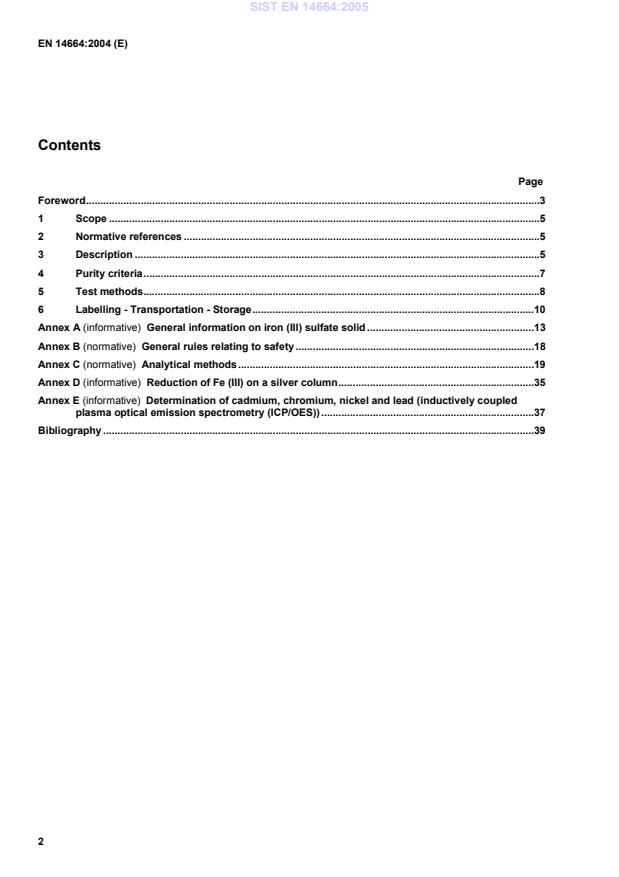
General information on iron (III) sulfate solid.13 Annex B (normative)
General rules relating to safety.18 Annex C (normative)
Analytical methods.19 Annex D (informative)
Reduction of Fe (III) on a silver column.35 Annex E (informative)
Determination of cadmium, chromium, nickel and lead (inductively coupled plasma optical emission spectrometry (ICP/OES)).37 Bibliography.39
1) Chemical Abstract Service Registry Number. 2) European Inventory of Existing Commercial Chemical Substances. 3) 100 kPa = 1 bar. SIST EN 14664:2005
Limit
Mass fraction in %
of Fe (III) content
Grade 1 Grade 2 Grade 3 Manganese max. 0,5 1 2 Iron(II) a max. 3,5 3,5 3,5 H2SO4 free max. 8 8 8 Insoluble mattersb
max. 10 10 10 a Fe (II) has a lower coagulant efficiency compared to Fe (III). Also hydrolysis of Fe (II) starts at pH value 8, and therefore Fe (II) can remain into the water at lower pH values b An excess of insoluble matters indicates the presence of foreign matter. Iron is a component of the product will usually be removed in the treatment process.
4.4 Chemical parameters The product shall conform to the requirements specified in Table 2. The concentration limits are specified in milligrams per kilogram of Fe (III). Table 2 – Chemical parameters Limit in mg/kg of Fe (III) Parameter Type 1 Type 2 Type 3 Arsenic (As) max. 1 20 50 Cadmium (Cd) max. 1 25 50 Chromium (Cr) max. 100 350 500 Mercury (Hg) max. 2,5 5 10 Nickel (Ni) max. 300 350 500 Lead (Pb) max. 2,5 100 400 Antimony (Sb) max. 10 20 60 Selenium (Se) max. 5 20 60 NOTE Cyanide (CN-) is usually not relevant because of the acidity of the product. Pesticides and polycyclic aromatic hydrocarbons are not relevant since the raw materials used in the manufacturing process are free of them. For maximum impact of iron (III) sulfate on trace metal content in drinking water see A.2. 5 Test methods 5.1 Sampling Observe the general recommendations in ISO 3165 and take into account ISO 6206. Prepare the laboratory sample required by the relevant procedure described in ISO 8213. SIST EN 14664:2005
trade name, grade and
type; net mass; name and the address of the supplier and/or manufacturer; statement "this product conforms to EN 14664". 6.5 Storage 6.5.1 General Iron (III) sulfate solid is not corrosive.
4) See [2]. 5) United Nations Number. SIST EN 14664:2005
General information on iron (III) sulfate solid A.1 Origin A.1.1 Raw materials The product is manufactured from sulfuric acid, iron (II) sulfate and oxygen. A.1.2 Manufacturing process Iron (III) sulfate solid is produced by dissolving iron (II) sulfate in sulfuric acid with oxygen as oxidant at elevated temperature followed by granulation or as powder produced by atomized drier of liquid iron (III) sulfate. A.2 Quality of commercial product The three types of iron (III) sulfate solid specified in Table 2 reflect the quality of commercially available products. Figures A.1 to A.3 show the maximum concentrations of trace metals that would be added to the raw water by the addition of products corresponding to the purity levels specified in Table 2. It can be seen that the concentrations of metal added are well below the Parametric Values given in the EU Directive 98/83/EC (see [1]) at typical product doses. Furthermore, the figures overstate the concentration of metals that would be present in the treated water since a substantial proportion of the trace metals will be incorporated in the sludge. Users of this product should select an appropriate grade an Type to enable them to achieve treated water quality targets taking into account raw water characteristics, required dosage, process plant conditions and other relevant factors. SIST EN 14664:2005
Element Drinking water limit ug/l As 10 Cd 5 Cr 50 Hg 1 Ni 20 Pb 10 Sb 5 Se 10 Key 1 Maximum addition to water
µg/l metal 2 Product dosage mg/l Fe – Typical dose Figure A.1 – Maximum impact of iron (III) sulfate solid, Type 1, on trace metal content of water SIST EN 14664:2005
Element Drinking water limit ug/l As 10 Cd 5 Cr 50 Hg 1 Ni 20 Pb 10 Sb 5 Se 10 Key 1 Maximum addition to water
µg/l metal 2 Product dosage mg/l Fe – Typical dose Figure A.2 – Maximum impact of iron (III) sulfate solid, Type 2, on trace metal content of water SIST EN 14664:2005
Element Drinking water limit ug/l As 10 Cd 5 Cr 50 Hg 1 Ni 20 Pb 10 Sb 5 Se 10 Key 1 Maximum addition to water
µg/l metal 2 Product dosage mg/l Fe – Typical dose Figure A.3 – Maximum impact of iron (III) sulfate solid, Type 3, on trace metal content of water SIST EN 14664:2005
General rules relating to safety B.1 Rules for safe handling and use The supplier shall provide current safety instructions. B.2 Emergency procedures B.2.1 First aid In case of contact with skin, wash with plenty of water. In case of contact with eyes, rinse immediately with plenty of water and seek medical advice. If swallowed, provided patient is conscious, wash out the mouth with water and mass fraction of 5 % sodium bicarbonate solution and give a demulcent such as milk. Seek medical advice immediately
B.2.2 Spillage Small spillage: wash away with large quantities of water. Large spillage: neutralize with lime or soda ash, then dispose of according to local regulations. Water can be used if washings can go to drain. Immediately inform police and local authorities if product has entered public drains or waterways. B.2.3 Fire Product is not combustible. However, in contact with metals, iron (III) sulfate can liberate the flammable gas hydrogen.
Analytical methods C.1 Determination of iron (III) sulfate C.1.1 Total iron C.1.1.1 General This method applies to products with iron contents greater than a mass fraction of 0,4 %. C.1.1.2 Principle Iron is reduced by tin (II) chloride and is subsequently titrated with potassium dichromate solution. C.1.1.3 Reagents All reagents shall be of a recognized analytical grade and the water used shall conform to the grade 3 specified in EN ISO 3696. C.1.1.3.1 Hydrochloric acid, HCl concentrated, density ρ = 1,19 g/ml. C.1.1.3.2 Tin (II) chloride solution, c(SnCl2.2H2O) = 0,5 mol/l. Dissolve 22,6 g of SnCl2 .2H2O with 20 ml of hydrochloric acid (C.1.1.3.1) and dilute with water to 200 ml. Keep this solution in the dark. C.1.1.3.3 Mercury (II) chloride, saturated solution c(HgCl2) = 0,27 mol/l. C.1.1.3.4 Sulfuric acid, H2SO4 concentrated, density ρ = 1,84 g/ml. C.1.1.3.5 Phosphoric acid, H3PO4 concentrated, density ρ = 1,71 g/ml. C.1.1.3.6 Barium diphenylamine sulfonate solution, c(Ba(C6H5-NH-C6H4SO3)2) = 8 mmol/l. C.1.1.3.7 Potassium dichromate solution, c(K2Cr2O7) = 0,0166 mol/l. C.1.1.4 Apparatus Ordinary laboratory apparatus and glassware. C.1.1.5 Procedure C.1.1.5.1 Test solution Weigh about, to the nearest 0,1 mg, 7 g of the laboratory sample and dissolve in 150 ml water. Remove insoluble matters by filtering. Wash the filter cake with hot water. Transfer filtrate and wash water to a 200 ml volumetric flask, dilute to the mark with water.
%, is given by the following equation : mVC113,1×=(II) where V is the volume, in millilitres, of potassium dichromate required for the titration; m is the mass, in grams, of the sample used for the test solution. C.1.3 Determination of iron (III) ( Fe (III)) The iron (III) content, C(III) expressed in mass fraction in %, is given by the following equation: (II)(III)CCCtot−= where Ctot is the total iron content (C.1.1.5.3), expressed as mass fraction; C(II) is the iron (II) content (C.1.2.5.3), expressed as mass fraction. C.2 Determination of manganese C.2.1 General This method is applicable to iron salts or iron solutions with manganese content greater than mass fraction of 0,05 %. SIST EN 14664:2005
...