

EN 1407:2023
(Main)Chemicals used for treatment of water intended for human consumption - Anionic and non-ionic polyacrylamides
- Abstract
This document is applicable to anionic and non-ionic polyacrylamides used for treatment of water intended for human consumption. It describes the characteristics of anionic and non-ionic polyacrylamides and specifies the requirements and the corresponding test methods for anionic and non-ionic polyacrylamides. It gives information on their use in water treatment.
- Status
- Published
- Publication Date
- 10-Oct-2023
- Technical Committee
- CEN/TC 164 - Water supply
- Drafting Committee
- CEN/TC 164/WG 9 - Drinking water treatment
- Current Stage
- 6060 - Definitive text made available (DAV) - Publishing
- Start Date
- 11-Oct-2023
- Due Date
- 22-Nov-2023
- Completion Date
- 11-Oct-2023

Overview
EN 1407:2023 is the CEN standard for anionic and non‑ionic polyacrylamides used in the treatment of water intended for human consumption. It updates and supersedes EN 1407:2008 and sets out identification, required characteristics, test methods and information on safe use, labelling, transport and storage. The standard is intended for manufacturers, suppliers, water utilities, testing laboratories and regulators working with polyacrylamide flocculants for drinking water treatment.
Key Topics
- Scope and identification
- Chemical names (copolymers of acrylamide and acrylic acid salt or homopolymers of acrylamide), synonyms and typical CAS numbers are listed.
- Typical relative molecular mass: about 1 million to 20 million Daltons.
- Physical and chemical properties
- Appearance, bulk density, solubility, viscosity and other physical parameters are addressed.
- Chemical composition, purity criteria and specification of impurities and by‑products are described.
- Critical analytical and test methods
- Requirements for sampling and analyses of the main product.
- Specific attention to residual acrylamide monomer as an impurity and its test methods.
- Normative references to laboratory water quality and sampling ISO/EN methods.
- Labelling, transport and storage
- Labelling in line with EU legislation, transport regulations and marking requirements (including accompanying documents).
- Storage guidance covering long‑term stability and incompatibilities.
- Guidance annex
- Informative Annex A provides practical information on origin, manufacturing, function, form of use, dosing considerations, application methods, handling, emergency procedures and safe removal of excess product.
Applications
EN 1407:2023 is used where quality, safety and traceability of polyacrylamide flocculants are critical:
- Drinking water treatment plants (coagulation/flocculation, sludge dewatering)
- Suppliers and manufacturers specifying product composition, purity and test methods
- Testing laboratories performing conformity and impurity analyses (including residual acrylamide)
- Procurement and compliance officers ensuring supplied chemicals meet CEN specifications and EU labelling/transport rules
- Regulators and health & safety personnel assessing potential impacts on water intended for human consumption
Note: conformity with EN 1407:2023 does not by itself guarantee national regulatory approval in all EU/EFTA states; national rules remain applicable.
Related standards
Normative references in EN 1407:2023 include:
- EN ISO 3696 (water for analytical laboratory use)
- ISO 3165, ISO 6206, ISO 8213 (sampling of chemical products)
Keywords: EN 1407:2023, anionic polyacrylamide, non‑ionic polyacrylamide, drinking water treatment, water treatment chemicals, residual acrylamide, CEN standard, test methods, labelling, transport, storage.
Relations
- Effective Date
- 19-Jan-2023
- Effective Date
- 25-Aug-2026
- Effective Date
- 25-Aug-2026
- Effective Date
- 09-Feb-2026
- Effective Date
- 28-Jan-2026
- Effective Date
- 28-Jan-2026
- Effective Date
- 28-Jan-2026
Get Certified
Connect with accredited certification bodies for this standard

ECOCERT
Organic and sustainability certification.

Eurofins Food Testing Global
Global leader in food, environment, and pharmaceutical product testing.

Intertek Bangladesh
Intertek certification and testing services in Bangladesh.
Sponsored listings
Frequently Asked Questions
EN 1407:2023 is a standard published by the European Committee for Standardization (CEN). Its full title is "Chemicals used for treatment of water intended for human consumption - Anionic and non-ionic polyacrylamides". This standard covers: This document is applicable to anionic and non-ionic polyacrylamides used for treatment of water intended for human consumption. It describes the characteristics of anionic and non-ionic polyacrylamides and specifies the requirements and the corresponding test methods for anionic and non-ionic polyacrylamides. It gives information on their use in water treatment.
This document is applicable to anionic and non-ionic polyacrylamides used for treatment of water intended for human consumption. It describes the characteristics of anionic and non-ionic polyacrylamides and specifies the requirements and the corresponding test methods for anionic and non-ionic polyacrylamides. It gives information on their use in water treatment.
EN 1407:2023 is classified under the following ICS (International Classification for Standards) categories: 71.100.80 - Chemicals for purification of water. The ICS classification helps identify the subject area and facilitates finding related standards.
EN 1407:2023 has the following relationships with other standards: It is inter standard links to EN 1407:2008, ISO 3165:1976, ISO 6206:1979, ISO 8213:1986, EN ISO 8751:1997, EN 1998-6:2005, EN ISO 3696:1995. Understanding these relationships helps ensure you are using the most current and applicable version of the standard.
EN 1407:2023 is available in PDF format for immediate download after purchase. The document can be added to your cart and obtained through the secure checkout process. Digital delivery ensures instant access to the complete standard document.
Standards Content (Sample)
SLOVENSKI STANDARD
01-december-2023
Nadomešča:
SIST EN 1407:2008
Kemikalije, ki se uporabljajo za pripravo pitne vode - Anionski in neionski
poliakrilamidi
Chemicals used for treatment of water intended for human consumption - Anionic and
non-ionic polyacrylamides
Produkte zur Aufbereitung von Wasser für den menschlichen Gebrauch - Anionische und
nicht-ionische Polyacrylamide
Produits chimiques utilisés pour le traitement de l'eau destinée à la consommation
humaine - Polyacrylamides anioniques et non-ioniques
Ta slovenski standard je istoveten z: EN 1407:2023
ICS:
13.060.20 Pitna voda Drinking water
71.100.80 Kemikalije za čiščenje vode Chemicals for purification of
water
2003-01.Slovenski inštitut za standardizacijo. Razmnoževanje celote ali delov tega standarda ni dovoljeno.
EN 1407
EUROPEAN STANDARD
NORME EUROPÉENNE
October 2023
EUROPÄISCHE NORM
ICS 71.100.80 Supersedes EN 1407:2008
English Version
Chemicals used for treatment of water intended for human
consumption - Anionic and non-ionic polyacrylamides
Produits chimiques utilisés pour le traitement de l'eau Produkte zur Aufbereitung von Wasser für den
destinée à la consommation humaine - menschlichen Gebrauch - Anionische und nicht-
Polyacrylamides anioniques et non-ioniques ionische Polyacrylamide
This European Standard was approved by CEN on 14 August 2023.
CEN members are bound to comply with the CEN/CENELEC Internal Regulations which stipulate the conditions for giving this
European Standard the status of a national standard without any alteration. Up-to-date lists and bibliographical references
concerning such national standards may be obtained on application to the CEN-CENELEC Management Centre or to any CEN
member.
This European Standard exists in three official versions (English, French, German). A version in any other language made by
translation under the responsibility of a CEN member into its own language and notified to the CEN-CENELEC Management
Centre has the same status as the official versions.
CEN members are the national standards bodies of Austria, Belgium, Bulgaria, Croatia, Cyprus, Czech Republic, Denmark, Estonia,
Finland, France, Germany, Greece, Hungary, Iceland, Ireland, Italy, Latvia, Lithuania, Luxembourg, Malta, Netherlands, Norway,
Poland, Portugal, Republic of North Macedonia, Romania, Serbia, Slovakia, Slovenia, Spain, Sweden, Switzerland, Türkiye and
United Kingdom.
EUROPEAN COMMITTEE FOR STANDARDIZATION
COMITÉ EUROPÉEN DE NORMALISATION
EUROPÄISCHES KOMITEE FÜR NORMUNG
CEN-CENELEC Management Centre: Rue de la Science 23, B-1040 Brussels
© 2023 CEN All rights of exploitation in any form and by any means reserved Ref. No. EN 1407:2023 E
worldwide for CEN national Members.
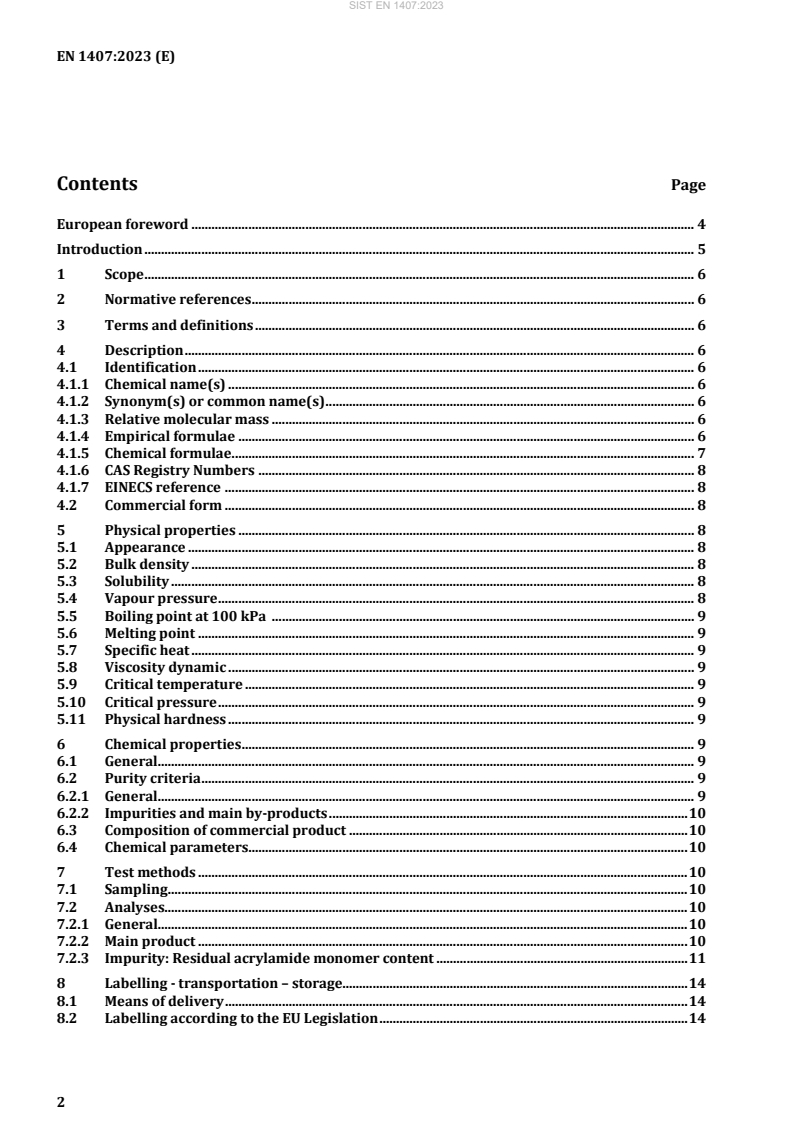
Contents Page
European foreword . 4
Introduction . 5
1 Scope . 6
2 Normative references . 6
3 Terms and definitions . 6
4 Description . 6
4.1 Identification . 6
4.1.1 Chemical name(s) . 6
4.1.2 Synonym(s) or common name(s) . 6
4.1.3 Relative molecular mass . 6
4.1.4 Empirical formulae . 6
4.1.5 Chemical formulae. 7
4.1.6 CAS Registry Numbers . 8
4.1.7 EINECS reference . 8
4.2 Commercial form . 8
5 Physical properties . 8
5.1 Appearance . 8
5.2 Bulk density . 8
5.3 Solubility . 8
5.4 Vapour pressure . 8
5.5 Boiling point at 100 kPa . 9
5.6 Melting point . 9
5.7 Specific heat . 9
5.8 Viscosity dynamic . 9
5.9 Critical temperature . 9
5.10 Critical pressure . 9
5.11 Physical hardness . 9
6 Chemical properties . 9
6.1 General. 9
6.2 Purity criteria . 9
6.2.1 General. 9
6.2.2 Impurities and main by-products . 10
6.3 Composition of commercial product . 10
6.4 Chemical parameters. 10
7 Test methods . 10
7.1 Sampling . 10
7.2 Analyses. 10
7.2.1 General. 10
7.2.2 Main product . 10
7.2.3 Impurity: Residual acrylamide monomer content . 11
8 Labelling - transportation – storage. 14
8.1 Means of delivery . 14
8.2 Labelling according to the EU Legislation . 14
8.3 Transportation regulations and labelling . 15
8.4 Marking . 15
8.5 Storage . 15
8.5.1 Long term stability . 15
8.5.2 Storage incompatibilities . 15
Annex A (informative) General information on anionic and non-ionic polyacrylamides . 16
A.1 Origin . 16
A.1.1 Raw materials . 16
A.1.2 Manufacturing process . 16
A.2 Use . 16
A.2.1 Function . 16
A.2.2 Form in which it is used . 16
A.2.3 Treatment dose . 17
A.2.4 Means of application. 17
A.2.5 Secondary effects . 17
A.2.6 Removal of excess product . 17
A.3 Rules for safe handling and use . 17
A.4 Emergency procedures . 18
A.4.1 First aid . 18
A.4.2 Spillage . 18
A.4.3 Fire . 18
Bibliography . 19
European foreword
This document (EN 1407:2023) has been prepared by Technical Committee CEN/TC 164 “Water supply”,
the secretariat of which is held by AFNOR.
This European Standard shall be given the status of a national standard, either by publication of an
identical text or by endorsement, at the latest by April 2024, and conflicting national standards shall be
withdrawn at the latest by April 2024.
Attention is drawn to the possibility that some of the elements of this document may be the subject of
patent rights. CEN shall not be held responsible for identifying any or all such patent rights.
This document supersedes EN 1407:2008.
In comparison with the previous edition EN 1407:2008, the following technical modifications have been
made:
a) updating in line with current legislation;
b) modification of 8.3 on transportation regulations and labelling, adding the sentence “The user must
be aware of the incompatibilities between transported products.”;
c) modification of 8.4 on marking. The requirements of marking are also applied to the accompanying
documents.
Annex A is informative and gives information on origin, use and handling of anionic and non-ionic
polyacrylamides.
Any feedback and questions on this document should be directed to the users’ national standards body.
A complete listing of these bodies can be found on the CEN website.
According to the CEN-CENELEC Internal Regulations, the national standards organisations of the
following countries are bound to implement this European Standard: Austria, Belgium, Bulgaria, Croatia,
Cyprus, Czech Republic, Denmark, Estonia, Finland, France, Germany, Greece, Hungary, Iceland, Ireland,
Italy, Latvia, Lithuania, Luxembourg, Malta, Netherlands, Norway, Poland, Portugal, Republic of North
Macedonia, Romania, Serbia, Slovakia, Slovenia, Spain, Sweden, Switzerland, Türkiye and the United
Kingdom.
Introduction
In respect of potential adverse effects on the quality of water intended for human consumption, caused
by the product covered by this document:
1) this document provides no information as to whether the product may be used without restriction
in any of the Member States of the EU or EFTA;
2) it should be noted that, while awaiting the adoption of verifiable European criteria, existing national
regulations concerning the use and/or the characteristics of this product remain in force.
NOTE Conformity with this document does not confer or imply acceptance or approval of the product in any of
the Member States of the EU or EFTA. The use of the product covered by this document is subject to regulation or
control by national authorities.
1 Scope
This document is applicable to anionic and non-ionic polyacrylamides used for treatment of water
intended for human consumption. It describes the characteristics of anionic and non-ionic
polyacrylamides and specifies the requirements and the corresponding test methods for anionic and non-
ionic polyacrylamides. It gives information on their use in water treatment.
2 Normative references
The following documents are referred to in the text in such a way that some or all of their content
constitutes requirements of this document. For dated references, only the edition cited applies. For
undated references, the latest edition of the referenced document (including any amendments) applies.
EN ISO 3696:1995, Water for analytical laboratory use — Specification and test methods (ISO 3696:1987)
ISO 3165:1976, Sampling of chemical products for industrial use — Safety in sampling
ISO 6206:1979, Chemical products for industrial use — Sampling — Vocabulary
ISO 8213:1986, Chemical products for industrial use — Sampling techniques — Solid chemical products in
the form of particles varying from powders to coarse lumps
3 Terms and definitions
No terms and definitions are listed in this document.
ISO and IEC maintain terminology databases for use in standardization at the following addresses:
— ISO Online browsing platform: available at https://www.iso.org/obp/
— IEC Electropedia: available at https://www.electropedia.org/
4 Description
4.1 Identification
4.1.1 Chemical name(s)
Copolymer of acrylamide and acrylic acid salt, or homopolymer of acrylamide.
4.1.2 Synonym(s) or common name(s)
Anionic polyacrylamide or non-ionic polyacrylamide.
NOTE The more general terms: “anionic (or non-ionic) polymer”, “anionic polyelectrolyte” and “anionic (or
non-ionic) flocculant” are used but can also cover other chemicals referred to in other European standards.
4.1.3 Relative molecular mass
Typically, in the range of 1 million to 20 million Daltons.
4.1.4 Empirical formulae
Non-ionic polyacrylamide:
— - (C H NO) -
3 5
x
Anionic polyacrylamide:
— - (C H NO) - (C H O A) -
3 5 x 3 3 2 y
where
A is a positive ion;
x is variable depending on the product;
y is variable depending on the product.
4.1.5 Chemical formulae
The following formula illustrates typical structures of:
— non-ionic polyacrylamide (Figure 1):
Figure 1 — Non-ionic polyacrylamide
— anionic polyacrylamide (Figure 2):
Figure 2 — Anionic polyacrylamide
where
m is variable depending on the product;
n is variable depending on the product.
1)
4.1.6 CAS Registry Numbers
The following is an exemplary list of CAS Registry Numbers for typical anionic or non-ionic
polyacrylamides:
— 25987-30-8
— 55554-55-7
— 25085-02-3
— 26100-47-0
— 9003-05-8
— 9003-04-7
— 9003-03-6
2)
4.1.7 EINECS reference
The conformity of polymers to EINECS is assessed on the basis of the monomers of which they are
composed. Thus, EINECS reference numbers do not exist for polymers.
Polymers are exempt from registration according to EU Regulation 1907/2006/EC (see [3]), REACH.
Monomer substance(s) and any other substance(s) in the form of monomeric units and chemically bound
substance(s) may have to be REACH registered according to Article 6 of EU Regulation 1907/2006/EC.
4.2 Commercial form
Anionic or non-ionic polyacrylamides as specified in this standard are available as solids containing a
small amount of residual moisture.
5 Physical properties
5.1 Appearance
The product is a white or off-white solid in the form of granule, flake or powder.
5.2 Bulk density
3 3
The bulk density of the product is typically in the range 0,5 g/cm to 0,9 g/cm .
5.3 Solubility
The product is soluble in cold water. Its solubility is limited only by viscosity, with a gel being formed at
concentrations of approximately 20 g/l and above.
5.4 Vapour pressure
Not applicable.
1)
Chemical Abstracts Service Registry Number.
2)
European Inventory of Existing Commercial Chemical Substances.
3)
5.5 Boiling point at 100 kPa
Not applicable.
5.6 Melting point
The product will decompose typically at temperature above 200 °C.
5.7 Specific heat
Not applicable.
5.8 Viscosity dynamic
Not applicable.
5.9 Critical temperature
Not applicable.
5.10 Critical pressure
Not applicable.
5.11 Physical hardness
Not applicable.
6 Chemical properties
6.1 General
Anionic and non-ionic polyacrylamides are non-hazardous materials and not intrinsically reactive.
However, in common with many other organic compounds, a strong exothermic reaction will occur if
they are brought into contact in the dry state with a strong acid or strong oxidizing agent.
NOTE In dilute solution there can be a reaction with, or destruction by, some of the disinfection and oxidizing
agents used in water treatment.
6.2 Purity criteria
6.2.1 General
This document specifies the minimum purity requirements for anionic and non-ionic polyacrylamides
used for the treatment of water intended for human consumption. Limits are given for impurities
commonly present in the product. Depending on the raw material and the manufacturing process other
impurities may be present and, if so, this shall be notified to the user and when necessary to relevant
authorities.
Limits have been given for impurities and chemical parameters where these are likely to be present in
significant quantities from the current production process and raw materials. If the production process
or raw materials lead to signifi
...