


EN 15316-4-8:2011
(Main)Heating systems in buildings - Method for calculation of system energy requirements and system efficiencies - Part 4-8: Space heating generation systems, air heating and overhead radiant heating systems
General Information
- Abstract
This European Standard is part of a series of standards on the method for calculation of system energy requirements and system efficiencies.
The scope of this specific part is to standardise the:
- required inputs;
- calculation method;
- resulting outputs
for space heating generation by:
a) air heating systems, including control, and
b) overhead radiant heating systems for non-domestic use , including control.
This European Standard does not apply to air heating systems that utilise water as a heat transfer medium.
- Status
- Withdrawn
- Publication Date
- 22-Feb-2011
- Withdrawal Date
- 08-Sep-2026
- Technical Committee
- CEN/TC 228 - Heating systems in buildings
- Current Stage
- 9960 - Withdrawal effective - Withdrawal
- Start Date
- 26-Apr-2017
- Completion Date
- 09-Sep-2026

Relations
- Effective Date
- 08-Jun-2022
- Effective Date
- 28-Jan-2026
- Effective Date
- 28-Jan-2026
- Effective Date
- 28-Jan-2026
- Effective Date
- 28-Jan-2026
- Effective Date
- 28-Jan-2026
- Effective Date
- 28-Jan-2026
- Effective Date
- 28-Jan-2026
- Effective Date
- 28-Jan-2026
- Effective Date
- 28-Jan-2026
- Effective Date
- 28-Jan-2026
- Effective Date
- 28-Jan-2026
Get Certified
Connect with accredited certification bodies for this standard

ICC Evaluation Service
Building products evaluation and certification.

QAI Laboratories
Building and construction product testing and certification.

Aboma Certification B.V.
Specialized in construction, metal, and transport sectors.
Sponsored listings
Frequently Asked Questions
EN 15316-4-8:2011 is a standard published by the European Committee for Standardization (CEN). Its full title is "Heating systems in buildings - Method for calculation of system energy requirements and system efficiencies - Part 4-8: Space heating generation systems, air heating and overhead radiant heating systems". This standard covers: This European Standard is part of a series of standards on the method for calculation of system energy requirements and system efficiencies. The scope of this specific part is to standardise the: - required inputs; - calculation method; - resulting outputs for space heating generation by: a) air heating systems, including control, and b) overhead radiant heating systems for non-domestic use , including control. This European Standard does not apply to air heating systems that utilise water as a heat transfer medium.
This European Standard is part of a series of standards on the method for calculation of system energy requirements and system efficiencies. The scope of this specific part is to standardise the: - required inputs; - calculation method; - resulting outputs for space heating generation by: a) air heating systems, including control, and b) overhead radiant heating systems for non-domestic use , including control. This European Standard does not apply to air heating systems that utilise water as a heat transfer medium.
EN 15316-4-8:2011 is classified under the following ICS (International Classification for Standards) categories: 91.140.10 - Central heating systems. The ICS classification helps identify the subject area and facilitates finding related standards.
EN 15316-4-8:2011 has the following relationships with other standards: It is inter standard links to EN 15316-4-8:2017, EN 15316-4-1:2008, EN 419:2019, EN ISO 7345:1995, EN 15316-3:2017, EN 17082:2019, EN 416:2019, EN 15316-2:2017, EN ISO 52016-1:2017, EN 17175:2019, EN 13410:2001, EN 15603:2008. Understanding these relationships helps ensure you are using the most current and applicable version of the standard.
EN 15316-4-8:2011 is available in PDF format for immediate download after purchase. The document can be added to your cart and obtained through the secure checkout process. Digital delivery ensures instant access to the complete standard document.
Standards Content (Sample)
2003-01.Slovenski inštitut za standardizacijo. Razmnoževanje celote ali delov tega standarda ni dovoljeno.Heizungsanlagen in Gebäuden - Verfahren zur Berechnung des Endenergiebedarfs und des Nutzungsgrades von Anlagen - Teil 4-8: Wärmeerzeugung von Warmluft- und StrahlungsheizsystemenÉlément introductif - Élément central - Partie 4-8 : Titre de la partieHeating systems in buildings - Method for calculation of system energy requirements and system efficiencies - Part 4-8: Space heating generation systems, air heating and overhead radiant heating systems91.140.10Sistemi centralnega ogrevanjaCentral heating systemsICS:Ta slovenski standard je istoveten z:EN 15316-4-8:2011SIST EN 15316-4-8:2011en,fr,de01-september-2011SIST EN 15316-4-8:2011SLOVENSKI
STANDARD
EUROPEAN STANDARD NORME EUROPÉENNE EUROPÄISCHE NORM
EN 15316-4-8
February 2011 ICS 91.140.10 English Version
Heating systems in buildings - Method for calculation of system energy requirements and system efficiencies - Part 4-8: Space heating generation systems, air heating and overhead radiant heating systems
Systèmes de chauffage dans les bâtiments - Méthode de calcul des besoins énergétiques et des rendements des systèmes - Partie 4-8: Systèmes de génération de chauffage des locaux, systèmes de chauffage par air chaud et par rayonnement
Heizungsanlagen in Gebäuden - Verfahren zur Berechnung des Endenergiebedarfs und des Nutzungsgrades von Anlagen - Teil 4-8: Wärmeerzeugung von Warmluft- und Strahlungsheizsystemen This European Standard was approved by CEN on 9 January 2011.
CEN members are bound to comply with the CEN/CENELEC Internal Regulations which stipulate the conditions for giving this European Standard the status of a national standard without any alteration. Up-to-date lists and bibliographical references concerning such national standards may be obtained on application to the CEN-CENELEC Management Centre or to any CEN member.
This European Standard exists in three official versions (English, French, German). A version in any other language made by translation under the responsibility of a CEN member into its own language and notified to the CEN-CENELEC Management Centre has the same status as the official versions.
CEN members are the national standards bodies of Austria, Belgium, Bulgaria, Croatia, Cyprus, Czech Republic, Denmark, Estonia, Finland, France, Germany, Greece, Hungary, Iceland, Ireland, Italy, Latvia, Lithuania, Luxembourg, Malta, Netherlands, Norway, Poland, Portugal, Romania, Slovakia, Slovenia, Spain, Sweden, Switzerland and United Kingdom.
EUROPEAN COMMITTEE FOR STANDARDIZATION
COMITÉ EUROPÉEN DE NORMALISATION EUROPÄISCHES KOMITEE FÜR NORMUNG
Management Centre:
Avenue Marnix 17,
B-1000 Brussels © 2011 CEN All rights of exploitation in any form and by any means reserved worldwide for CEN national Members. Ref. No. EN 15316-4-8:2011: ESIST EN 15316-4-8:2011
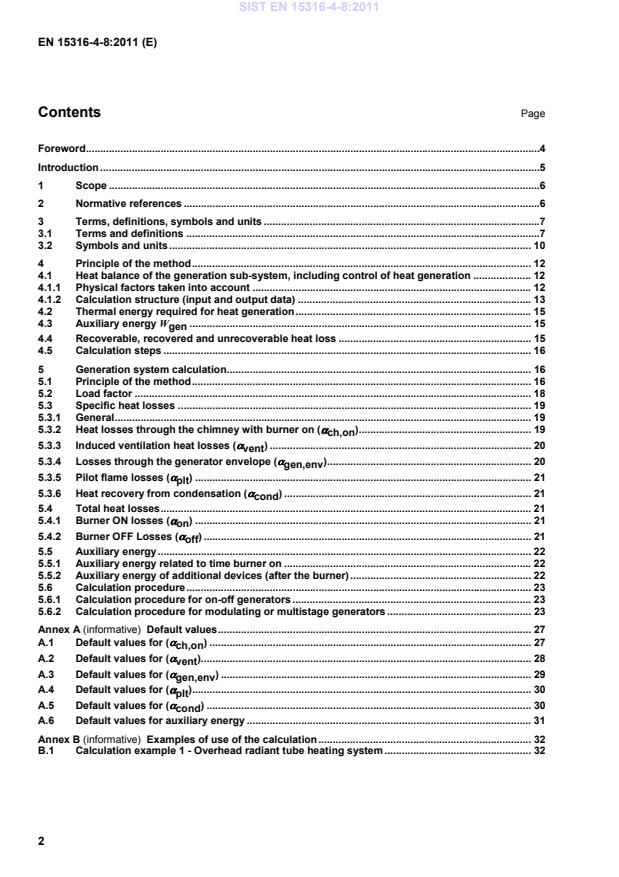
Default values . 27A.1 Default values for (ααααch,on) . 27A.2 Default values for (ααααvent) . 28A.3 Default values for (ααααgen,env) . 29A.4 Default values for (ααααplt) . 30A.5 Default values for (ααααcond) . 30A.6 Default values for auxiliary energy . 31Annex B (informative)
Examples of use of the calculation . 32B.1 Calculation example 1 - Overhead radiant tube heating system . 32SIST EN 15316-4-8:2011
Attention is drawn to the possibility that some of the elements of this document may be the subject of patent rights. CEN [and/or CENELEC] shall not be held responsible for identifying any or all such patent rights. According to the CEN/CENELEC Internal Regulations, the national standards organizations of the following countries are bound to implement this European Standard: Austria, Belgium, Bulgaria, Croatia, Cyprus, Czech Republic, Denmark, Estonia, Finland, France, Germany, Greece, Hungary, Iceland, Ireland, Italy, Latvia, Lithuania, Luxembourg, Malta, Netherlands, Norway, Poland, Portugal, Romania, Slovakia, Slovenia, Spain, Sweden, Switzerland and the United Kingdom.
This European Standard does not apply to air heating systems that utilise water as a heat transfer medium. 2 Normative references The following referenced documents are indispensable for the application of this document. For dated references, only the edition cited applies. For undated references, the latest edition of the referenced document (including any amendments) applies. EN 416-1, Single burner gas-fired overhead radiant tube heaters for non-domestic use — Part 1: Safety EN 419-1, Non-domestic gas-fired overhead luminous radiant heaters — Part 1:Safety EN 621, Non-domestic gas-fired forced convection air heaters for space heating not exceeding a net heat input of 300 kW, without a fan to assist transportation of combustion air and/or combustion products EN 777-1, Multi-burner gas-fired overhead radiant tube heater systems for non-domestic use — Part 1: System D - Safety EN 777-2, Multi-burner gas-fired overhead radiant tube heater systems for non-domestic use — Part 2: System E - Safety EN 777-3, Multi-burner gas-fired overhead radiant tube heater systems for non domestic use — Part 3: System F - Safety EN 777-4, Multi-burner gas-fired overhead radiant tube heater systems for non-domestic use — Part 4: System H - Safety EN 778, Domestic gas-fired forced convection air heaters for space heating not exceeding a net heat input of 70 kW, without a fan to assist transportation of combustion air and/or combustion products EN 1020, Non-domestic forced convection gas-fired air heaters for space heating not exceeding a net heat input of 300 kW, incorporating a fan to assist transportation of combustion air or combustion products EN 1196, Domestic and non-domestic gas-fired air heaters — Supplementary requirements for condensing air heaters EN 1319, Domestic gas-fired forced convection air heaters for space heating, with fan-assisted burners not exceeding a net heat input of 70 kW SIST EN 15316-4-8:2011
EN 15316-2-1, Heating systems in buildings — Method for calculation of system energy requirements and system efficiencies — Part 2-1: Space heating emission systems EN 15316-2-3, Heating systems in buildings — Method for calculation of system energy requirements and system efficiencies — Part 2-3: Space heating distribution systems EN 15316-4-1:2008, Heating systems in buildings — Method for calculation of system energy requirements and system efficiencies — Part 4-1: Space heating generation systems, combustion systems (boilers) EN ISO 7345:1995, Thermal insulation — Physical quantities and definitions (ISO 7345:1987) EN ISO 13790, Energy performance of buildings — Calculation of energy use for space heating and cooling (ISO 13790:2008) 3 Terms, definitions, symbols and units 3.1 Terms and definitions For the purposes of this document, the terms and definitions given in EN ISO 7345:1995 and the following apply. 3.1.1 air heating system heating system composed of one or more individual forced convection air heating appliances 3.1.2 auxiliary energy electrical energy used by technical building systems for heating, cooling, ventilation and /or domestic water to support energy transformation to satisfy energy needs NOTE 1 This includes energy for fans, pumps, electronics, etc.
NOTE 2 Adapted from EN 15316-1:2007. 3.1.3 calculation period time period over which the calculation is performed NOTE The calculation period can be divided into a number of calculation steps.
[EN 15316-1:2007] 3.1.4 combustion power product of the fuel flow rate and the net caloric value of the fuel 3.1.5 condensing air heater air heater designed to make use of the latent heat released by condensation of water vapour in the combustion flue products NOTE The heater will allow the condensate to leave the heat exchanger in liquid form by way of a condensate drain. 3.1.6 energy need for heating or cooling energy to be delivered to or extracted from a conditioned space to maintain the intended temperature conditions during a given period of time SIST EN 15316-4-8:2011
blw blower H heating r return br burner in input to system rad radiant ctr control int internal ref reference ch chimney j indices rvd recovered cmb combustion ls loss rbl recoverable cond condensation
corr corrected mass mass, specific weight sto storage
max maximum
dis distribution min minimal t total DHW domestic hot water mod modulating test test conditions
nom nominal th thermal e external nrbl non recoverable w heating system water el electrical nrvd non recovered
env envelope off off x indices em emission on on z indices exh exiting the building out output from system
4 Principle of the method 4.1 Heat balance of the generation sub-system, including control of heat generation 4.1.1 Physical factors taken into account The calculation method of the heat generation sub-system takes into account: heat demand of the heat distribution sub-system or heat emission sub-system; NOTE Heating systems with radiant luminous and radiant tube heaters as well as warm air heaters located inside the heated space include sub-system heat generation and heat emission in one appliance; in this case, a separate heat distribution sub-system does not exist, distribution losses are zero. and the heat losses and/or recovery due to the following physical factors: heat losses to the chimney (or flue gas exhaust) during total time of generator operation (running and stand-by); heat losses through the generator(s) envelope during total time of generator operation (running and stand-by); SIST EN 15316-4-8:2011
type of heat generator(s); location of heat generator(s); part load ratio; operation conditions (temperature, control, etc.); control strategy (on/off, high-low, modulating, etc.). 4.1.2 Calculation structure (input and output data) The calculation method of this standard requires input data from other parts of the EN 15316 standards series: heat demand of the heat distribution sub-system(s) ΣQH,dis,in, calculated according to EN 15316-2-3
or alternatively: heat demand of the heat emission and control sub-system(s) ΣQH,em,in, calculated according to EN 15316-2-1. The performance of the generation sub-system may be characterised by additional input data to take into account: type and characteristics of the generation sub-system; generator settings; type of the generation control system; location of the generator; operating conditions; heat requirement. Based on these data, the following output data are calculated by this standard: fuel heat requirement, EH,gen,in; total generation heat losses, QH,gen,ls; recoverable generation heat losses, QH,gen,ls,rbl; generation auxiliary energy consumption, WH,gen,aux. SIST EN 15316-4-8:2011
Key SUB Generation subsystem balance boundary HF Heating fluid balance boundary (see Equation (1)) QH,gen,out Generation subsystem heat output (input to distribution subsystem(s)) EH,gen,in Generation subsystem fuel input (energyware) WH,gen,aux Generation subsystem total auxiliary energy QH,gen,aux,rvd Generation subsystem recovered auxiliary energy QH,gen,ls Generation subsystem total thermal heat losses QH,gen,ls,rbl Generation subsystem recoverable heat QH,gen,rbl,th Generation subsystem recoverable thermal losses QH,gen,rbl,aux Generation subsystem recoverable auxiliary energy QH,gen,nrbl,th Generation subsystem non recoverable thermal losses QH,gen,nrbl,aux Generation subsystem non recoverable auxiliary energy
NOTE Figures shown are sample percentages. Figure 1 — Generation sub-system inputs, outputs and energy balance SIST EN 15316-4-8:2011
tgen = ton + toff.
where tgen is the total time of generator operation (available to supply heat as demanded by the control); ton is the time with the burner on (fuel valve open, pre- and post-ventilation are not considered); toff is the time with the burner off. Heat losses are taken into account separately for these two periods of time. Where applicable, the following heat losses are taken into account during burner on operation only: heat of flue gas with burner on: Qch,on; heat losses due to ventilation finalised to exhaust flue gases Qvent,on (type A appliances); heat losses through the generator envelope: Qgen,env,on. Where applicable, the following heat losses are taken into account during burner off time only:
heat of air flow to the chimney Qch,off; heat losses by a permanent pilot burner operation Qplt,off. SIST EN 15316-4-8:2011
...