

EN 13819-3:2019
(Main)Hearing protectors - Testing - Part 3: Supplementary acoustic test methods
- Abstract
This document specifies supplementary acoustic test methods for hearing protectors with additional electronic functions. The purpose of these tests is to enable assessment of the hearing protector performance as specified in the appropriate product standards.
- Status
- Withdrawn
- Publication Date
- 26-Nov-2019
- Withdrawal Date
- 20-Oct-2026
- Technical Committee
- CEN/TC 159 - Hearing protectors
- Drafting Committee
- CEN/TC 159/WG 2 - Amplitude sensitive hearing protectors
- Current Stage
- 9960 - Withdrawal effective - Withdrawal
- Start Date
- 03-Apr-2024
- Completion Date
- 21-Oct-2026
Buy Documents

EN 13819-3:2020 - POZOR !! Dodatek k standardu sta 2 Excel datoteki (Aneks C2 in D)
Relations
- Merged Into
EN 13819-3:2019+A1:2024 - Hearing protectors - Testing - Part 3: Supplementary acoustic test methods - Effective Date
- 22-Mar-2023
- Effective Date
- 09-Feb-2026
- Effective Date
- 28-Jan-2026
- Effective Date
- 28-Jan-2026
- Refers
EN 352-8:2020 - Hearing protectors - Safety requirements - Part 8: Entertainment audio earmuffs - Effective Date
- 28-Jan-2026
- Effective Date
- 28-Jan-2026
- Effective Date
- 28-Jan-2026
- Effective Date
- 28-Jan-2026
- Referred By
EN 352-5:2020 - Hearing protectors - Safety requirements - Part 5: Active noise reduction earmuffs - Effective Date
- 28-Jan-2026
- Referred By
EN 352-7:2020 - Hearing protectors - Safety requirements - Part 7: Level-dependent earplugs - Effective Date
- 28-Jan-2026
- Effective Date
- 28-Jan-2026
- Effective Date
- 28-Jan-2026
- Referred By
EN 352-10:2020 - Hearing protectors - Safety requirements - Part 10: Entertainment audio earplugs - Effective Date
- 28-Jan-2026
- Referred By
EN 352-4:2020 - Hearing protectors - Safety requirements - Part 4: Level-dependent earmuffs - Effective Date
- 28-Jan-2026
- Amended By
EN 13819-3:2019/FprA1 - Hearing protectors - Testing - Part 3: Supplementary acoustic test methods - Effective Date
- 26-May-2021
Buy Documents
EN 13819-3:2020 - POZOR !! Dodatek k standardu sta 2 Excel datoteki (Aneks C2 in D)
Get Certified
Connect with accredited certification bodies for this standard

CIS Institut d.o.o.
Personal Protective Equipment (PPE) certification body. Notified Body NB-2890 for EU Regulation 2016/425 PPE.

Kiwa BDA Testing
Building and construction product certification.
Kmetijski inštitut Slovenije
Agricultural Institute of Slovenia. Soil testing, plant health, agricultural product analysis.
Sponsored listings
Frequently Asked Questions
EN 13819-3:2019 is a standard published by the European Committee for Standardization (CEN). Its full title is "Hearing protectors - Testing - Part 3: Supplementary acoustic test methods". This standard covers: This document specifies supplementary acoustic test methods for hearing protectors with additional electronic functions. The purpose of these tests is to enable assessment of the hearing protector performance as specified in the appropriate product standards.
This document specifies supplementary acoustic test methods for hearing protectors with additional electronic functions. The purpose of these tests is to enable assessment of the hearing protector performance as specified in the appropriate product standards.
EN 13819-3:2019 is classified under the following ICS (International Classification for Standards) categories: 13.340.20 - Head protective equipment. The ICS classification helps identify the subject area and facilitates finding related standards.
EN 13819-3:2019 has the following relationships with other standards: It is inter standard links to EN 13819-3:2019+A1:2024, EN 60318-4:2010, EN ISO 11904-2:2004, EN ISO 4869-2:2018, EN 352-8:2020, EN ISO 4869-1:2018, EN 352-2:2002, EN ISO 11904-1:2002, EN 352-5:2020, EN 352-7:2020, EN 352-6:2020, EN 352-9:2020, EN 352-10:2020, EN 352-4:2020, EN 13819-3:2019/FprA1. Understanding these relationships helps ensure you are using the most current and applicable version of the standard.
EN 13819-3:2019 is associated with the following European legislation: EU Directives/Regulations: 2016/425, 89/686/EEC; Standardization Mandates: M/031. When a standard is cited in the Official Journal of the European Union, products manufactured in conformity with it benefit from a presumption of conformity with the essential requirements of the corresponding EU directive or regulation.
EN 13819-3:2019 is available in PDF format for immediate download after purchase. The document can be added to your cart and obtained through the secure checkout process. Digital delivery ensures instant access to the complete standard document.
Standards Content (Sample)
SLOVENSKI STANDARD
01-januar-2020
Varovala sluha - Preskušanje - 3. del: Dodatna akustična preskusna metoda
Hearing protectors - Testing - Part 3: Supplementary acoustic test method
Gehörschützer - Prüfung - Teil 3: Zusätzliche akustische Prüfverfahren
Protecteurs individuels contre le bruit - Essais - Partie 3 : Méthodes d'essais
acoustiques supplémentaires
Ta slovenski standard je istoveten z: EN 13819-3:2019
ICS:
13.340.20 Varovalna oprema za glavo Head protective equipment
2003-01.Slovenski inštitut za standardizacijo. Razmnoževanje celote ali delov tega standarda ni dovoljeno.
EN 13819-3
EUROPEAN STANDARD
NORME EUROPÉENNE
November 2019
EUROPÄISCHE NORM
ICS 13.340.20
English Version
Hearing protectors - Testing - Part 3: Supplementary
acoustic test methods
Protecteurs individuels contre le bruit - Essais - Partie Gehörschützer - Prüfung - Teil 3: Zusätzliche
3 : Méthodes d'essais acoustiques supplémentaires akustische Prüfverfahren
This European Standard was approved by CEN on 13 December 2018.
CEN members are bound to comply with the CEN/CENELEC Internal Regulations which stipulate the conditions for giving this
European Standard the status of a national standard without any alteration. Up-to-date lists and bibliographical references
concerning such national standards may be obtained on application to the CEN-CENELEC Management Centre or to any CEN
member.
This European Standard exists in three official versions (English, French, German). A version in any other language made by
translation under the responsibility of a CEN member into its own language and notified to the CEN-CENELEC Management
Centre has the same status as the official versions.
CEN members are the national standards bodies of Austria, Belgium, Bulgaria, Croatia, Cyprus, Czech Republic, Denmark, Estonia,
Finland, France, Germany, Greece, Hungary, Iceland, Ireland, Italy, Latvia, Lithuania, Luxembourg, Malta, Netherlands, Norway,
Poland, Portugal, Republic of North Macedonia, Romania, Serbia, Slovakia, Slovenia, Spain, Sweden, Switzerland, Turkey and
United Kingdom.
EUROPEAN COMMITTEE FOR STANDARDIZATION
COMITÉ EUROPÉEN DE NORMALISATION
EUROPÄISCHES KOMITEE FÜR NORMUNG
CEN-CENELEC Management Centre: Rue de la Science 23, B-1040 Brussels
© 2019 CEN All rights of exploitation in any form and by any means reserved Ref. No. EN 13819-3:2019 E
worldwide for CEN national Members.
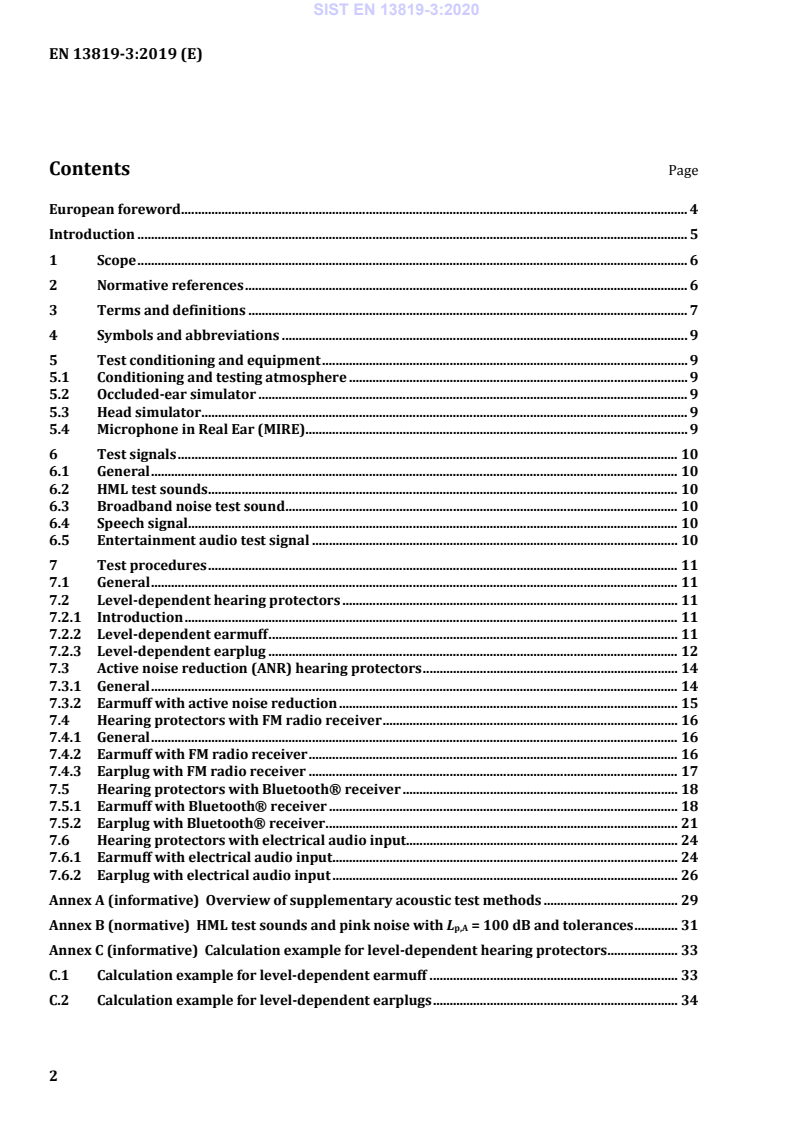
Contents Page
European foreword . 4
Introduction . 5
1 Scope . 6
2 Normative references . 6
3 Terms and definitions . 7
4 Symbols and abbreviations . 9
5 Test conditioning and equipment . 9
5.1 Conditioning and testing atmosphere . 9
5.2 Occluded-ear simulator . 9
5.3 Head simulator . 9
5.4 Microphone in Real Ear (MIRE) . 9
6 Test signals . 10
6.1 General . 10
6.2 HML test sounds . 10
6.3 Broadband noise test sound . 10
6.4 Speech signal . 10
6.5 Entertainment audio test signal . 10
7 Test procedures . 11
7.1 General . 11
7.2 Level-dependent hearing protectors . 11
7.2.1 Introduction . 11
7.2.2 Level-dependent earmuff . 11
7.2.3 Level-dependent earplug . 12
7.3 Active noise reduction (ANR) hearing protectors . 14
7.3.1 General . 14
7.3.2 Earmuff with active noise reduction . 15
7.4 Hearing protectors with FM radio receiver . 16
7.4.1 General . 16
7.4.2 Earmuff with FM radio receiver . 16
7.4.3 Earplug with FM radio receiver . 17
7.5 Hearing protectors with Bluetooth® receiver . 18
7.5.1 Earmuff with Bluetooth® receiver . 18
7.5.2 Earplug with Bluetooth® receiver . 21
7.6 Hearing protectors with electrical audio input. 24
7.6.1 Earmuff with electrical audio input. 24
7.6.2 Earplug with electrical audio input . 26
Annex A (informative) Overview of supplementary acoustic test methods . 29
Annex B (normative) HML test sounds and pink noise with L = 100 dB and tolerances . 31
p,A
Annex C (informative) Calculation example for level-dependent hearing protectors . 33
C.1 Calculation example for level-dependent earmuff . 33
C.2 Calculation example for level-dependent earplugs . 34
Annex D (informative) Calculation example for ANR . 35
Annex E (informative) Uncertainty of measurement and interpretation of test results . 36
Bibliography . 38
European foreword
This document (EN 13819-3:2019) has been prepared by Technical Committee CEN/TC 159 “Hearing
protectors”, the secretariat of which is held by DIN.
This European Standard shall be given the status of a national standard, either by publication of an
identical text or by endorsement, at the latest by May 2020, and conflicting national standards shall be
withdrawn at the latest by May 2020.
Attention is drawn to the possibility that some of the elements of this document may be the subject of
patent rights. CEN shall not be held responsible for identifying any or all such patent rights.
This document has been prepared under a standardization request given to CEN by the European
Commission and the European Free Trade Association.
According to the CEN-CENELEC Internal Regulations, the national standards organisations of the
following countries are bound to implement this European Standard: Austria, Belgium, Bulgaria,
Croatia, Cyprus, Czech Republic, Denmark, Estonia, Finland, France, Germany, Greece, Hungary, Iceland,
Ireland, Italy, Latvia, Lithuania, Luxembourg, Malta, Netherlands, Norway, Poland, Portugal, Republic of
North Macedonia, Romania, Serbia, Slovakia, Slovenia, Spain, Sweden, Switzerland, Turkey and the
United Kingdom.
Introduction
This standard is part of a set of standards for personal hearing protectors.
The EN 13819 series consists of three parts and deals with testing plans of hearing protectors.
— EN 13819-1, Hearing protectors — Testing — Part 1: Physical test methods
— EN 13819-2, Hearing protectors — Testing — Part 2: Acoustic test methods
— EN 13819-3, Hearing protectors — Testing — Part 3: Supplementary acoustic test methods
The product requirements are described in a family of standards:
— EN 352-1, Hearing protectors — General requirements — Part 1: Earmuffs
— EN 352-2, Hearing protectors — General requirements — Part 2: Earplugs
— EN 352-3, Hearing protectors — General requirements — Part 3: Earmuffs attached to head
protection and/or face protection devices
— EN 352-4, Hearing protectors — Safety requirements — Part 4: Level-dependent earmuffs
— EN 352-5, Hearing protectors — Safety requirements — Part 5: Active noise reduction earmuffs
— EN352-6, Hearing protectors — Safety requirements — Part 6: Earmuffs with safety-related audio
input
— EN 352-7, Hearing protectors — Safety requirements — Part 7: Level-dependent earplugs
— EN 352-8, Hearing protectors —Safety requirements — Part 8: Entertainment audio earmuffs
— EN 352-9, Hearing protectors — Safety requirements — Part 9: Earplugs with safety-related audio
input
— EN 352-10, Hearing protectors — Safety requirements — Part 10: Entertainment audio earplugs
This standard also provides informative spreadsheets with
— calculation examples for level-dependent earplugs
— calculation examples for ANR
to allow the user to make own calculations.
CEN is not responsible for errors that may arise or occur with the use of these spreadsheets.
An associated standard, EN 458, covers selection, use, care and maintenance of hearing protectors.
1 Scope
This document specifies supplementary acoustic test methods for hearing protectors with additional
electronic functions. The purpose of these tests is to enable assessment of the hearing protector
performance as specified in the appropriate product standards.
2 Normative references
The following documents are referred to in the text in such a way that some or all of their content
constitutes requirements of this document. For dated references, only the edition cited applies. For
undated references, the latest edition of the referenced document (including any amendments) applies.
EN 352-2:2002, Hearing protectors — General requirements — Part 2: Earplugs
EN 352-8:- , Hearing protectors — Safety requirements — Part 8: Entertainment audio earmuffs
EN 352-10:- , Hearing protectors — Safety requirements — Part 10: Entertainment audio earplugs
EN 60318-4:2010, Electroacoustics - Simulators of human head and ear - Part 4: Occluded-ear simulator
for the measurement of earphones coupled to the ear by means of ear inserts (IEC 60318-4:2018)
EN ISO 4869-1:2018, Acoustics — Hearing protectors — Part 1: Subjective method for the measurement
of sound attenuation (ISO 4869-1:2018)
EN ISO 4869-2:2018, Acoustics — Hearing protectors — Part 2: Estimation of effective A-weighted sound
pressure levels when hearing protectors are worn (ISO 4869-2:2018)
EN ISO 11904-1:2002, Acoustics - Determination of sound immission from sound sources placed close to
the ear - Part 1: Technique using a microphone in a real ear (MIRE technique) (ISO 11904-1:2002)
EN ISO 11904-2:2004, Acoustics - Determination of sound immission from sound sources placed close to
the ear - Part 2: Technique using a manikin (ISO 11904-2:2004)
IEC 60268-1:1985, Sound system equipment - Part 1: General
ITU-T P.50:1999, SERIES P: TELEPHONE TRANSMISSION QUALITY, TELEPHONE INSTALLATIONS, LOCAL
LINE NETWORKS, Objective measuring apparatus, Artificial voices. Appendix I: Test signals
Under preparation: Stage at time of publication: FprEN 352-8:2018.
Under preparation: Stage at time of publication: FprEN 352-10:2018.
3 Terms and definitions
For the purposes of this document, the following terms and definitions apply.
ISO and IEC maintain terminological databases for use in standardization at the following addresses:
• IEC Electropedia: available at http://www.electropedia.org/
• ISO Online browsing platform: available at http://www.iso.org/obp
3.1
hearing protector
device, that can be an earmuff or an earplug, worn by a person to prevent harmful effects from noise
and other loud acoustic stimuli
3.2
ear simulator
device for measuring the acoustic output of sound sources where the sound pressure is measured by a
calibrated microphone coupled to the source so that the overall acoustic impedance of the device
approximates that of the normal human ear at a given location and in a given frequency band
[SOURCE: EN 60318-4:2010, 3.4]
Note 1 to entry: The standard EN 60318-4:2010 has replaced HD 443 S1:1983.
3.3
occluded-ear simulator
ear simulator which approximates the acoustic transfer impedance of the inner part of the ear canal,
from the tip of an ear insert to the eardrum
[SOURCE: EN 60318-4:2010, 3.5]
Note 1 to entry: The standard EN 60318-4:2010 has replaced HD 443 S1:1983.
3.4
insertion loss
algebraic difference in decibels between the one-third-octave band sound pressure level, measured by
the microphone of the acoustic test fixture with the hearing protector absent, and the sound pressure
level with the hearing protector present
[SOURCE: EN ISO 4869-3:2007, 3.5]
3.5
sound attenuation
difference, in decibels, between the threshold of hearing with and without the hearing protector in
place for a test subject, for a given test signal
[SOURCE: EN ISO 4869-1:2018, 3.8, modified - “, in decibels,” added after “difference” and “,” added
after “test subject”]
3.6
reference point
fixed spatial location within the test chamber at which the midpoint of a line connecting the test
subject’s or ATF’s ear canal openings is located for MIRE or ATF measurements, and likewise the point
to which all objective measurements of the sound field characteristics are referenced
3.7
acoustic test fixture
ATF
device that approximates certain dimensions of an average adult human head
[SOURCE: EN ISO 4869-3:2007, 3.4]
3.8
head simulator
acoustic test fixture with an occluded ear-simulator
3.9
level-dependent hearing protector
hearing protector fitted with an electronic circuit intended to reproduce lower level external sounds in
the ear canal, while usually restricting reproduction of higher level sounds by means of a level-
dependent gain function
3.10
active noise reduction hearing protector
hearing protector designed to provide additional attenuation of external sounds by means of a noise
cancellation circuit
3.11
hearing protector with electrical audio input
hearing protector designed to provide speech information and warning signals, while providing
attenuation of sounds in excess of limit levels
3.12
entertainment audio hearing protector
hearing protector additionally providing reproduced sound for entertainment purposes
3.13
crest factor
peak amplitude of the signal divided by its rms value in linear scale
3.14
decibel full scale
decibel with respect to digital full scale
Note 1 to entry: The full scale value (0 dB FS) is the rms value of a sine wave whose positive peak just reaches
positive full scale.
4 Symbols and abbreviations
ANR Active Noise Reduction
ATF Acoustic Test Fixture
APV Assumed Protection Value
DUT Device Under Test
MIRE Microphone In Real Ear
rms root mean square
SNR Single Number Rating
SPL Sound Pressure Level
dB FS decibel Full Scale
5 Test conditioning and equipment
5.1 Conditioning and testing atmosphere
All specimens shall be conditioned for 4 h and tested in an environment having a temperature of
(22 ± 5) °C and a relative humidity of not more than 85 %.
5.2 Occluded-ear simulator
The occluded-ear simulator shall be used together with an ear canal extension and a pinna simulator,
when necessary. Different ear canal extensions and pinna simulators may be used. When earplugs are
tested the earplug end shall be positioned at the reference plane according to EN 60318-4:2010,
Figure 1 and the diffuse-field frequency response of EN ISO 11904-2:2004, Table 1 shall be used as
diffuse-field related transfer function.
5.3 Head simulator
The head simulator composed of an occluded-ear simulator built into an acoustic test fixture (ATF) shall
be used to achieve sufficient acoustic attenuation of the test fixture. Different ear canal extensions and
pinna simulators may be used. When earplugs with electronic level-dependent feature are tested (7.2.3)
the individual diffuse-field related transfer function for the specific equipment shall be determined and
used. When other earplugs are tested the earplug end shall be positioned at the reference plane
according to EN 60318-4:2010, Figure 1 and the diffuse-field frequency response of
EN ISO 11904-2:2004, Table 1 shall be used as diffuse-field related transfer function.
5.4 Microphone in Real Ear (MIRE)
The MIRE-technique as described in EN ISO 11904-1:2002 shall be used with the following
modification: in the area of the concha the microphone, including supporting elements and electrical
leads, shall occupy an area not exceeding 25 mm in the plane perpendicular to the centre axis of the ear
canal. The microphone position, as shown in EN ISO 11904-1:2002, Figure 1 a) shall be used, i.e. with an
open ear canal and the microphone membrane showing towards the ear drum and positioned in
between the ear canal entrance and the ear drum, preferably at a distance of a few mm from the ear
canal entrance.
Test subject noise exposure shall be monitored. The microphone, its mounting and electrical leads shall
not introduce leakage, e.g. between the hearing protector and the head.
Alternatively, for safety reason, the occluded ear canal can be used as specified in EN ISO 11904-1:2002,
Figure 1 c).
The measurement and calculation of the diffuse-field correction shall be carried out according to
EN ISO 11904-1:2002 for each test subject.
6 Test signals
6.1 General
Test signals can be realized acoustically as sound or transmitted by other means, for example
electrically. The signal to noise ratio shall be 10 dB across the range of tested frequencies.
6.2 HML test sounds
The test sound at the reference point of the sound field shall be a broadband random noise with
three different spectra in the frequency range 100 Hz to 10 kHz and a defined L – L value:
p,C p,A
— H-oriented noise (Ho) +01,
L – L = −12, dB
p,C p,A
−0,2
— M-noise (M) +0,2
L – L = 2,0 dB
p,C p,A
−0,2
— L-oriented noise (Lo) +04,
L – L = 60, dB
p,C p,A
−0,2
The spectra shall fulfil the spectral shape and tolerances given in Annex B.
NOTE 1 The spectrum of the H-oriented noise has a rising output (+3 dB/octave) between 100 Hz and 10 kHz.
The spectrum of the M-noise has a flat output up to 2 kHz and a falling characteristic above. The spectrum of the L-
oriented noise has a falling output (–3 dB/octave) from 100 Hz to 10 kHz.
The crest factor shall be 5 ± 1.
NOTE 2 In EN ISO 4869-2:2018, H-noise is defined as having an L – L value of –2 dB and L-noise is defined
p,C p,A
as having an L – L value of 10 dB. It has been found that the generation of H and L test noises is complicated
p,C p,A
and for the purposes of this standard, alternative noises of slightly different spectral shape are stated.
6.3 Broadband noise test sound
The test sound at the reference point of the sound field shall be a broadband random noise with the
crest factor 5 ± 1.
If pink noise is used as broadband noise the spectrum shall fulfil the spectral shape and tolerances given
in Annex B.
6.4 Speech signal
The speech test signal according to ITU-T P50_F:1999 (Female speech test signal) shall be used, starting
at time 0,15 s and ending at time 10,75 s. If a longer signal is needed repeat a part of the signal and
verify that the rms does not change by more than ± 0,2 dB.
NOTE The ITU-T P50_F signal includes silent parts at the beginning and at the end. The duration of the signal
is selected to avoid influence of these silent parts.
6.5 Entertainment audio test signal
The test signal shall be broadband random noise with overall spectral shape of long-term speech and
music as referenced in IEC 60268-1:1985. The crest factor shall be 5 ± 1.
7 Test procedures
7.1 General
An overview of the supplementary acoustic test procedures is reported in Annex A.
7.2 Level-dependent hearing protectors
7.2.1 Introduction
The A-weighted equivalent diffuse-field related SPL is measured with the level-dependent function
switched on and operating at full volume for three different external noise spectra. The measurements
are conducted in a range of sound level settings. The HML test sounds according to 6.2 shall be used.
This test procedure does not apply to hearing protectors specific for impulse noise.
7.2.2 Level-dependent earmuff
7.2.2.1 Test method
The SPL effective to the ear comprising the passively attenuated SPL and the sound output of the level-
dependent function shall be measured using the MIRE technique described in 5.4. The measured sound
levels shall be corrected for the diffuse-field frequency response of the test subject to give the A-
weighted equivalent diffuse-field related SPL as a function of the external SPL. If the DUT is fitted with a
volume control, it shall be set to maximum audio output.
Four earmuffs and eight test subjects shall be used. Each of the four earmuff samples shall be tested on
two subjects. Measurements shall be taken on both ears.
Determine the A-weighted equivalent diffuse-field related SPL as a function of the external SPL for each
ear and for each type of test sound specified in 6.2. The measurement shall start at an external SPL of
65 dB(A) and shall increase in steps of 5 dB, ensuring that data points for the A-weighted equivalent
diffuse field related SPL lower and higher than 85 dB(A) are encompassed.
The measurement shall start 10 s after the activation of the test sound or a period specified by the
manufacturer. The measurement time shall be at least 20 s.
If the DUT is battery powered specified fresh batteries shall be fitted. Systems with external power
source (e.g. hearing protector connected to a radio system) shall be operating as specified by the
manufacturer.
7.2.2.2 Calculation procedure
Calculate for each type of external noise spectrum (Ho, M, Lo) and for each of the sixteen ears tested the
external SPL for which the A-weighted equivalent diffuse-field related SPL equals 85 dB(A). Use linear
interpolation between adjacent test values of the external SPL on either side of the 85 dB(A) value.
Calculate for each test sound the mean value and the standard deviation of the interpolated values of
the external SPL for the sixteen ears tested.
Subtract one standard deviation from the mean value of external noise level to obtain the criterion level
for each type of external noise spectrum.
Obtain the criterion levels for H-noise with L – L = –2 dB and L-noise with L – L = 10 dB by
p,C p,A p,C p,A
extrapolation from the M-value to the H-oriented resp. the L-oriented values. Assume a linear relation
for the change in external SPL with (L – L )-value on either side of the M-value of L – L = 2 dB.
p,C p,A p,C p,A
An example of the calculation is given in C.1.
7.2.2.3 Report
The following information shall be reported:
a) the A-weighted equivalent diffuse-field related SPL as a function of the external A-weighted SPL, for
each of the sixteen ears and each of the three HML test sounds;
b) the interpolated A-weighted SPL corresponding to the A-weighted equivalent diffuse-field related
SPL of 85 dB, for each of the sixteen ears and each of the three HML test sounds;
c) the mean value and the standard deviation of the sixteen interpolated A-weighted external SPL for
the three HML test sounds;
d) the five criterion levels for the H-, M- and L-noises (oriented and not oriented), rounded to the
nearest integer.
7.2.3 Level-dependent earplug
7.2.3.1 Test method
The SPL effective to the ear comprising the passively attenuated SPL and the sound output of the level-
dependent function shall be measured using a head simulator as described in 5.3. The contributions of
the restored sound and the sound reaching the ear through the passive sound attenuation of the earplug
are combined (see calculation procedure in 7.2.3.2).
The measurement shall be performed on four pairs of earplugs with related electronic units. For each
single earplug and for each type of test sound specified in 6.2, the A-weighted equivalent diffuse-field
related SPL shall be determined, starting at an external SPL of 65 dB(A). If the DUTs are fitted with a
volume control, it shall be set to maximum audio output. The external SPL shall be increased in steps of
5 dB, until the A-weighted equivalent diffuse-field related SPL at the head simulator exceeds 85 dB(A).
In case the insertion loss from the head simulator measurement is much larger than the passive HML
values from EN 352-2:2002, the maximum external SPL can be limited to 85 dB(A) plus the HML values
(see 3.5) rounded up to the next 5 dB step.
The measurement shall start 10 s after the activation of the test sound or a period specified by the
manufacturer. The measurement time shall be at least 20 s.
If the DUT is battery powered specified fresh batteries shall be fitted. Systems with external power
source (e.g. hearing protector connected to a radio system) shall be operating as specified by the
manufacturer.
The insertion loss of each DUT in passive mode shall be determined in an additional measurement with
the level-dependent function of the earplugs switched off. The A-weighted equivalent diffuse-field
related SPL (L ; L ; L ) shall be determined for each test sound (H-oriented noise,
c-off-Ho-100 c-off-M-100 c-off-Lo-100
M noise, L-oriented noise) at an external SPL of 100 dB(A).
In addition the A-weighted equivalent diffuse-field related SPL without the hearing protector in place
; L ; L ).
shall be measured for each test sound (Lo-Ho-100 o-M-100 o-Lo-100
NOTE The subscripts have the following meaning: c = closed (ear simulator fitted with earplug), o = open
(unoccluded ear simulator), off = level dependent function switched off (passive mode), Ho = H-oriented noise,
M = M-noise, Lo = L-oriented noise, 100 = SPL of external noise in dB(A).
7.2.3.2 Calculation procedure
7.2.3.2.1 Introduction
The measured quantities for each type of test sound are A-weighted sum levels (diffuse-field related)
for different external levels.
These levels result from two contributions: the SPL created by the loudspeaker in the earplug and the
SPL due to the external sound attenuated by the earplug.
NOTE It is known especially for earplugs that the values of passive insertion loss, determined with an
occluded-ear simulator built into an acoustic test fixture according to 5.3, can differ significantly from the values
measured with test subjects according to EN ISO 4869-1:2018 and calculated according to EN ISO 4869-2:2018.
Therefore, it is necessary to correct this difference by calculation.
7.2.3.2.2 Calculation of the corrected SPL
From the A-weighted equivalent diffuse-field related SPL L ; L ; L measured with
c-off-Ho-100 c-off-M-100 c-off-Lo-100
the DUT in passive mode the attenuation values for H-oriented, M- and L-oriented noise (Ho, M, Lo) can
be calculated.
Ho = L – L
o-Ho-100 c-off-Ho-100
M = L – L
o-M-100 c-off-M-100
Lo = L – L
o-Lo-100 c-off-Lo-100
This calculation gives the ΔL values for each test sound (Ho, M, Lo) and each DUT.
ap
From the HML values obtained from the passive sound attenuation measured with test subjects
according to EN ISO 4869-1:2018 the sound attenuation values for the H-oriented noise with L − L =
p,C p,A
–1,2 dB and the L-oriented noise with L – L = 6 dB shall be interpolated. Assume a linear relation for
p,C p,A
the change in sound attenuation with (L – L )-value on either side of the M-value of L – L = 2 dB.
p,C p,A p,C p,A
This calculation gives the ΔL values for each test sound.
rp
The measured values from the head simulator shall be corrected by the procedure below. It shall be
performed for the Ho-M-Lo values only.
For each test sound, for each SPL step and for each of the eight measurements the following equation
shall be applied:
01,,L −∆L 01 L −∆L
01, L +σ
( ) ( )
( ) ext ap ext rp
a a
L 10log10−+10 10
ac
where
L is the SPL measured with the head simulator, corrected with the passive sound attenuation
ac
(A-weighted, equivalent diffuse-field related);
L is the uncorrected SPL measured with the head simulator (A-weighted, equivalent diffuse-
a
field related);
σ is the standard deviation of the L SPL values of the eight earplug samples measured with the
a a
head simulator at each external level;
L is the A-weighted external SPL;
ext
ΔL is the passive insertion loss for the head simulator (Ho-M-Lo values) for each DUT;
ap
ΔL is the passive sound attenuation measured with test subjects according to
rp
EN ISO 4869-1:2018 (Ho-M-Lo values).
=
7.2.3.2.3 Calculation of the criterion levels
Calculate for each type of external noise spectrum (Ho, M, Lo) and for each of the eight earplugs tested
the external SPL for which the A-weighted equivalent diffuse-field related SPL equals 85 dB(A). Use
linear interpolation between adjacent test values of the external SPL on either side of the 85 dB(A)
value.
Calculate for each test sound (Ho, M, Lo) the mean value and the standard deviation of the interpolated
values of the external noise SPL for the eight earplugs tested.
Subtract one standard deviation from the mean value of external noise level to obtain the criterion level
for each type of external noise spectrum (Ho, M, Lo). Obtain the criterion levels for H-noise with
L − L = –2 dB and L-noise with L – L = 10 dB by extrapolation. Assume a linear relation for the
p,C p,A p,C p,A
change in external SPL with (L – L )-value on either side of the M-value of L – L = 2 dB.
p,C p,A p,C p,A
An example of the calculation is given in C.2.
7.2.3.3 Report
The following information shall be reported:
a) the A-weighted equivalent diffuse-field related SPL as a function of the external A-weighted SPL, for
each of the eight earplugs and each of the three HML test sounds (L in 7.2.3.2.2);
a
b) the corrected A-weighted equivalent diffuse-field related SPL as a function of the external A-
weighted SPL, for each of the eight earplugs and each of the three HML test sounds (L in 7.2.3.2.2);
ac
c) the mean of the corrected A-weighted equivalent diffuse-field related SPL as a function of the
external A-weighted SPL, for each of the three HML test sounds
d) the interpolated A-weighted SPL corresponding to the A-weighted equivalent diffuse-field related
SPL of 85 dB, for each of the eight earplugs and each of the three HML test sounds
e) insertion loss results for all three test sounds and each DUT (ΔL in 7.2.3.2.2) and the HML values
ap
obtained from the passive sound attenuation measured with test subjects according to
EN ISO 4869-1:2018 and the related Ho and Lo values;
f) the mean value and the standard deviation of the eight interpolated A-weighted SPL for the three
HML test sounds;
g) the five criterion levels for the H-, M- and L-noises (oriented and not oriented), rounded to the
nearest integer.
7.3 Active noise reduction (ANR) hearing protectors
7.3.1 General
The total attenuation (TA) is determined by combining the passive sound attenuation from testing the
hearing protectors according to EN ISO 4869-1:2018 with the contribution from the active noise
reduction (active attenuation) according to the following procedure.
7.3.2 Earmuff with active noise reduction
7.3.2.1 Test method
7.3.2.1.1 Active attenuation
The active attenuation of the earmuff, which is the difference in equivalent diffuse-field related SPL at
the wearer's ear between the active mode and the passive mode, shall be measured using the MIRE
technique as defined in 5.4. The measured sound levels shall be corrected for the diffuse-field frequency
response of the subject's ear canal to give the equivalent diffuse-field related SPL.
Four earmuffs and 16 test subjects shall be used. Each of the four earmuff samples shall be tested on
four subjects. Measurements shall be taken on both ears. The timespan between the two measurements
shall be as short as possible and the test conditions shall be unaltered, especially the fitting of the
earmuff and the positions of the microphone in real ear. The measurements shall be performed with the
same test subjects as the measurements of the passive sound attenuation according to
EN ISO 4869-1:2018. A broadband noise shall be used (see 6.3) set at an external SPL in the range of
85 dB(A) to 95 dB(A).
Determine the active attenuation at one-third-octave band centre frequencies between 50 Hz and
10 kHz, for all the samples and test subjects.
Some devices may incorporate a threshold level only above which the active attenuation is working.
This option exists with some devices which combine level-dependence and active attenuation. For all
devices, the active attenuation may not function at levels as low as 85 dB(A) to 95 dB(A), even if
switched on. For these devices the measurements are to be carried out 5 dB above that threshold
(specified by the manufacturer), but not lower than 85 dB(A) or above 110 dB(A).
If any subject reports sustained oscillation or acoustic malfunction when the ANR system is switched
on, the subject shall be asked to switch the ANR system off, remove the earmuffs and refit them,
according to the manufacturer's instructions.
If the oscillation persists when the ANR system is switched on again, the specimen shall be passed on to
another test subject, to verify if the malfunction is due to some characteristics of the subject or if it is
due to a malfunction of the sample. If it is due to the subject, the subject shall be replaced. If the problem
occurs for a second subject the test shall be stopped. If the problems are due to the sample, this shall be
reported and the test stopped.
In any case the occurrence of sustained oscillation or acoustic malfunction shall be reported.
7.3.2.1.2 Maximum SPL for the linear operation in active mode
For each subject and each ear, the equivalent diffuse-field related SPL in the 125 Hz octave band
(calculated from the three one-third-octave bands 100 Hz, 125 Hz and 160 Hz) shall be measured,
starting at the external SPL set in 7.3.2.1.1. The external SPL shall be increased in steps of 5 dB and it
shall be verified that also the SPL at the ear increases by (5 ± 1) dB(A). If this linear relationship is still
maintained at an external SPL of 110 dB(A), stop the test.
7.3.2.2 Calculation procedure
The assumed protection value (APV) of the total (active plus passive) attenuation shall be derived in
octave bands. It shall be derived using the active attenuation measured according to 7.3.2.1.1 and the
passive sound attenuation determined according to EN ISO 4869-1:2018 combining these two data sets
for each test subject individually.
1) For each subject the passive sound attenuation data shall be linearly interpolated in one-third-
octave bands between 63 Hz and 8 kHz and extrapolated to 50 Hz and 10 kHz.
2) For each subject and in each one-third-octave band, only the ear with the lower value of the active
attenuation is chosen.
3) For each subject the results from step 1 and 2 shall be added in one-third-octave bands to gain the
total attenuation per subject.
4) To obtain the total attenuation in octave bands for each subject (TA ) the three one-third-octave
oct,sub
bands of total attenuation for one octave band (between 63 Hz and 8 kHz) shall be energetically
averaged using negative values.
−⋅01, TA −⋅01,,TA −⋅01 TA
f 1,sub f 23,,sub f sub
TA =−⋅10 log 10 + 10 + 10 / 3
oct,sub
5) The 16 data sets of total attenuation in octave bands are used to calculate mean and standard
deviation and the APV, HML values and SNR value according to EN ISO 4869-2:2018 with a
protection performance of 84 %.
An example of the calculation of total attenuation is given in Annex D.
7.3.2.3 Report
The test report shall contain the following items:
a) the highest external SPL for which the SPL at the ear remains linearly related, for all samples and
subjects tested. If the test was stopped at 110 dB(A), it shall be stated — “remained linearly related
up to 110 dB(A), the highest level tested”;
b) whether any subjects have identified oscillation or acoustic malfunction in the course of testing;
c) the active attenuation results for all 16 test subjects (left and right ear) in one-third-octave bands
including the external SPL at which the test was conducted;
d) the passive sound attenuation according to EN ISO 4869-1:2018 for all 16 test subjects;
e) the total attenuation for all 16 test subjects in one-third-octave bands and in octave bands;
f) the mean, the standard deviation and the calculated APV for each test frequency (63 Hz to 8 kHz)
for the total attenuation together with the derived HML and SNR values.
7.4 Hearing protectors with FM radio receiver
7.4.1 General
Scope of this test is to determine the maximum A-weighted equivalent diffuse-field related SPL
generated by hearing protectors with built-in broadcast receivers.
7.4.2 Earmuff with FM radio receiver
7.4.2.1 Test method
The A-weighted equivalent diffuse-field related SPL is measured using the entertainment audio test
signal (6.5), with the entertainment audio system on and operated at maximum settings.
An FM radio signal generator shall be used in mono mode without pre-emphasis. The input voltage rms
level of the signal shall result in the maximum possible frequency modulation.
The sound at the receiver's output (peak to peak) is directly proportional to the peak frequency
deviation of the radio frequency carrier. In order to comply with the definition of maximum peak
frequency deviation (determined with a sinusoidal modulating waveform), the test signal applied at the
input of the radio frequency generator shall be set at an rms value of –3 dB related to the rms of a
sinusoidal waveform at 250 Hz that produces a peak deviation of ± 75 kHz.
The sound output level of the earmuff shall be measured using the microphone in the real ear technique
(MIRE) described in 5.4.
Four earmuffs and eight test subjects shall be used. Each of the four earmuff samples shall be tested on
two subjects. Measurements shall be taken on both ears. The measured levels shall be corrected for the
diffuse-field frequency response of the subject's ear canal to give the A-weighted equivalent diffuse-
field related SPL produced by the restoration facility.
7.4.2.2 Calculation procedure
This calculation procedure shall be followed, using for each subject the same input signal to the radio
frequency generator and the same settings of the generation, transmitting and receiving equipment
under test.
The mean A-weighted equivalent diffuse-field related SPL and its standard deviation shall be calculated
for all cups and subjects tested. In cases where the manufacturer designed left and right cup in a
different way (especially in terms of SPL effective to the ear), the means and standard deviations of the
A-weighted equivalent diffuse-field related SPL shall be calculated separately for right and left cups.
The maximum A-weighted equivalent diffuse-field related SPL is the mean plus one standard deviation.
7.4.2.3 Report
The test report shall contain the following items:
a) the A-weighted equivalent diffuse-field related SPL for each cup and subject;
b) the mean and standard deviation of the A-weighted equivalent diffuse-field related SPL for all cups
and subjects tested;
c) the mean and standard deviation of left and right cups separately, in case where the manufacturer
designed left and right cup in a different way (especially in terms of SPL effective to the ear);
d) the maximum A-weighted equivalent diffuse-field related SPL.
7.4.3 Earplug with FM radio receiver
7.4.3.1 Test method
The A-weighted equivalent diffuse-field related SPL is measured using the entertainment audio test
signal (6.5), with the entertainment audio system operated at maximum settings and the restoration
functi
...