

EN 16123:2013
(Main)Characterization of waste - Guidance on selection and application of screening methods
- Abstract
This European Standard gives guidance on the selection and application of screening methods for waste characterisation. The aim of this document is to set up criteria as to when the different kinds of screening methods may be applied for the analysis of a certain parameter in waste and which steps are required to prove their suitability.
This document does not recommend any particular screening method, but confirms the principles of its selection and application.
- Status
- Withdrawn
- Publication Date
- 12-Feb-2013
- Withdrawal Date
- 06-Oct-2026
- Technical Committee
- CEN/TC 444 - Environmental characterization
- Drafting Committee
- CEN/TC 444/WG 6 - Cross cutting issues
- Current Stage
- 9960 - Withdrawal effective - Withdrawal
- Start Date
- 30-Jun-2021
- Completion Date
- 07-Oct-2026



Relations
- Effective Date
- 31-Mar-2021
- Effective Date
- 28-Jan-2026
Get Certified
Connect with accredited certification bodies for this standard

CIS Institut d.o.o.
Personal Protective Equipment (PPE) certification body. Notified Body NB-2890 for EU Regulation 2016/425 PPE.

Kiwa BDA Testing
Building and construction product certification.
Kmetijski inštitut Slovenije
Agricultural Institute of Slovenia. Soil testing, plant health, agricultural product analysis.
Sponsored listings
Frequently Asked Questions
EN 16123:2013 is a standard published by the European Committee for Standardization (CEN). Its full title is "Characterization of waste - Guidance on selection and application of screening methods". This standard covers: This European Standard gives guidance on the selection and application of screening methods for waste characterisation. The aim of this document is to set up criteria as to when the different kinds of screening methods may be applied for the analysis of a certain parameter in waste and which steps are required to prove their suitability. This document does not recommend any particular screening method, but confirms the principles of its selection and application.
This European Standard gives guidance on the selection and application of screening methods for waste characterisation. The aim of this document is to set up criteria as to when the different kinds of screening methods may be applied for the analysis of a certain parameter in waste and which steps are required to prove their suitability. This document does not recommend any particular screening method, but confirms the principles of its selection and application.
EN 16123:2013 is classified under the following ICS (International Classification for Standards) categories: 13.030.01 - Wastes in general. The ICS classification helps identify the subject area and facilitates finding related standards.
EN 16123:2013 has the following relationships with other standards: It is inter standard links to EN ISO 12404:2021, CEN/TR 16192:2020. Understanding these relationships helps ensure you are using the most current and applicable version of the standard.
EN 16123:2013 is available in PDF format for immediate download after purchase. The document can be added to your cart and obtained through the secure checkout process. Digital delivery ensures instant access to the complete standard document.
Standards Content (Sample)
2003-01.Slovenski inštitut za standardizacijo. Razmnoževanje celote ali delov tega standarda ni dovoljeno.Karakterizacija odpadkov - Navodilo za izbiro in uporabo rešetalnih metodCharakterisierung von Abfall - Leitfaden für Auswahl und Anwendung von Screening-VerfahrenCaractérisation des déchets - Lignes directrices relatives au choix et à l'application des méthodes de dépistageCharacterization of waste - Guidance on selection and application of screening methods13.030.01Odpadki na splošnoWastes in generalICS:Ta slovenski standard je istoveten z:EN 16123:2013SIST EN 16123:2013en,fr,de01-julij-2013SIST EN 16123:2013SLOVENSKI
STANDARD
EUROPEAN STANDARD NORME EUROPÉENNE EUROPÄISCHE NORM
EN 16123
February 2013 ICS 13.030.01 English Version
Characterization of waste - Guidance on selection and application of screening methods
Caractérisation des déchets - Lignes directrices relatives au choix et à l'application des méthodes de dépistage
Charakterisierung von Abfall - Anleitung für Auswahl und Anwendung von Screening-Verfahren This European Standard was approved by CEN on 7 December 2012.
CEN members are bound to comply with the CEN/CENELEC Internal Regulations which stipulate the conditions for giving this European Standard the status of a national standard without any alteration. Up-to-date lists and bibliographical references concerning such national standards may be obtained on application to the CEN-CENELEC Management Centre or to any CEN member.
This European Standard exists in three official versions (English, French, German). A version in any other language made by translation under the responsibility of a CEN member into its own language and notified to the CEN-CENELEC Management Centre has the same status as the official versions.
CEN members are the national standards bodies of Austria, Belgium, Bulgaria, Croatia, Cyprus, Czech Republic, Denmark, Estonia, Finland, Former Yugoslav Republic of Macedonia, France, Germany, Greece, Hungary, Iceland, Ireland, Italy, Latvia, Lithuania, Luxembourg, Malta, Netherlands, Norway, Poland, Portugal, Romania, Slovakia, Slovenia, Spain, Sweden, Switzerland, Turkey and United Kingdom.
EUROPEAN COMMITTEE FOR STANDARDIZATION
COMITÉ EUROPÉEN DE NORMALISATION EUROPÄISCHES KOMITEE FÜR NORMUNG
Management Centre:
Avenue Marnix 17,
B-1000 Brussels © 2013 CEN All rights of exploitation in any form and by any means reserved worldwide for CEN national Members. Ref. No. EN 16123:2013: ESIST EN 16123:2013
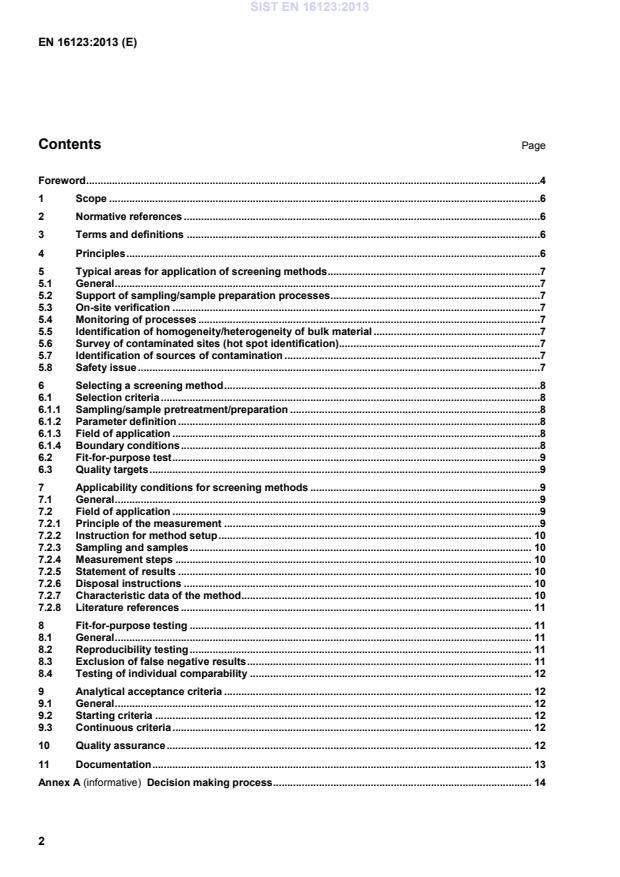
Decision making process . 14 SIST EN 16123:2013
Example of documentation aid/check list . 15 Annex C (informative)
Statistical tool for individual comparability – Equality of results from reference method and screening method: Mean value t-test for real samples . 18 C.1 General . 18 C.2 Test on outliers . 18 C.3 Homogeneity of variances . 18 C.4 Mean value t-test . 19 Bibliography . 21
Screening methods are of increasing interest in processes such as entrance control because, in addition to standardized methods, they allow fast verification of the documented waste characteristics. SIST EN 16123:2013
This document does not recommend any particular screening method, but confirms the principles of its selection and application. 2 Normative references The following documents, in whole or in part, are normatively referenced in this document and are indispensable for its application. For dated references, only the edition cited applies. For undated references, the latest edition of the referenced document (including any amendments) applies. EN 16192,
3 Terms and definitions For the purposes of this document, the following terms and definitions apply. 3.1 reference method method which is performed in accordance with national or international Standards and is not necessarily comparable with screening methods 3.2 on-site verification third level of inspection according to the Landfill Directive and the Landfill Decision to ensure that the waste accepted at a landfill is the same as described in the accompanying documents and that it is in accordance with the basic characterisation and/or compliance testing 3.3 screening application of any analytical semi-quantitative method for exploratory analysis 3.4 screening method method which is used (often on-site) to quickly explore a given area or test a set of samples and obtain data on sample characteristics [SOURCE: ISO 12404, modified] 4 Principles This standard defines the whole process from the selection of the screening method, applicability, fit-for-purpose testing, fulfilment of the acceptance criteria, quality control, and documentation of the measurement results. SIST EN 16123:2013
5.2 Support of sampling/sample preparation processes
Screening methods may be used for:
selection of the most suitable analytical method (concentration range, interferences); pre-selection of samples for analysis in the laboratory; provision of information about accompanying compounds relevant for sample preparation. 5.3 On-site verification Characteristics of sampled waste are verified, e.g. during transport or at the entrance of waste treatment plants and landfills. 5.4 Monitoring of processes
Screening methods can be used:
to monitor and control processes (e.g. success of treatment processes); to perform quality control on a treatment plant.
5.5 Identification of homogeneity/heterogeneity of bulk material Screening methods may be applied to measure “leading” parameters in huge charges of waste to identify whether the material is homogenous or not. 5.6 Survey of contaminated sites (hot spot identification) Screening methods are useful to identify contaminated areas in contamination-suspected sites. 5.7 Identification of sources of contamination Screening methods can be useful to identify the source of a contaminant or content in a material stream. 5.8 Safety issue Screening methods can be used to detect potentially toxic compounds (e.g. gases, radioactivity, explosives) which may be hazardous to the personnel taking and processing samples. SIST EN 16123:2013
Prerequisites are: one known parameter or a set of known parameters; aim of determination;
matrix (solid/liquid waste). 6.1.1 Sampling/sample pretreatment/preparation direct measurement (e.g. handheld XRF-systems); pretreatment/preparation (e.g. extractions, separation) particularly for solid waste. Most screening methods require the provision of the analyte in an extract/eluate, which therefore requires sample pretreatment. Pretreatment shall be carried out in accordance with EN 16192. If sample preparation is necessary, follow the principles of EN 15002 taking into account CEN/TR 16130. 6.1.2 Parameter definition individual species (e.g. total Fe, Fe2+, Fe3+); group parameters (e.g. total organic carbon (TOC), absorbable organically bound halogens (AOX)); in the case of on-site verification, the parameters are typically defined by declaration or based on the experience of the staff. 6.1.3 Field of application specified decision value (e.g. limit value, target value); concentr
...